THE SHORT ANSWER
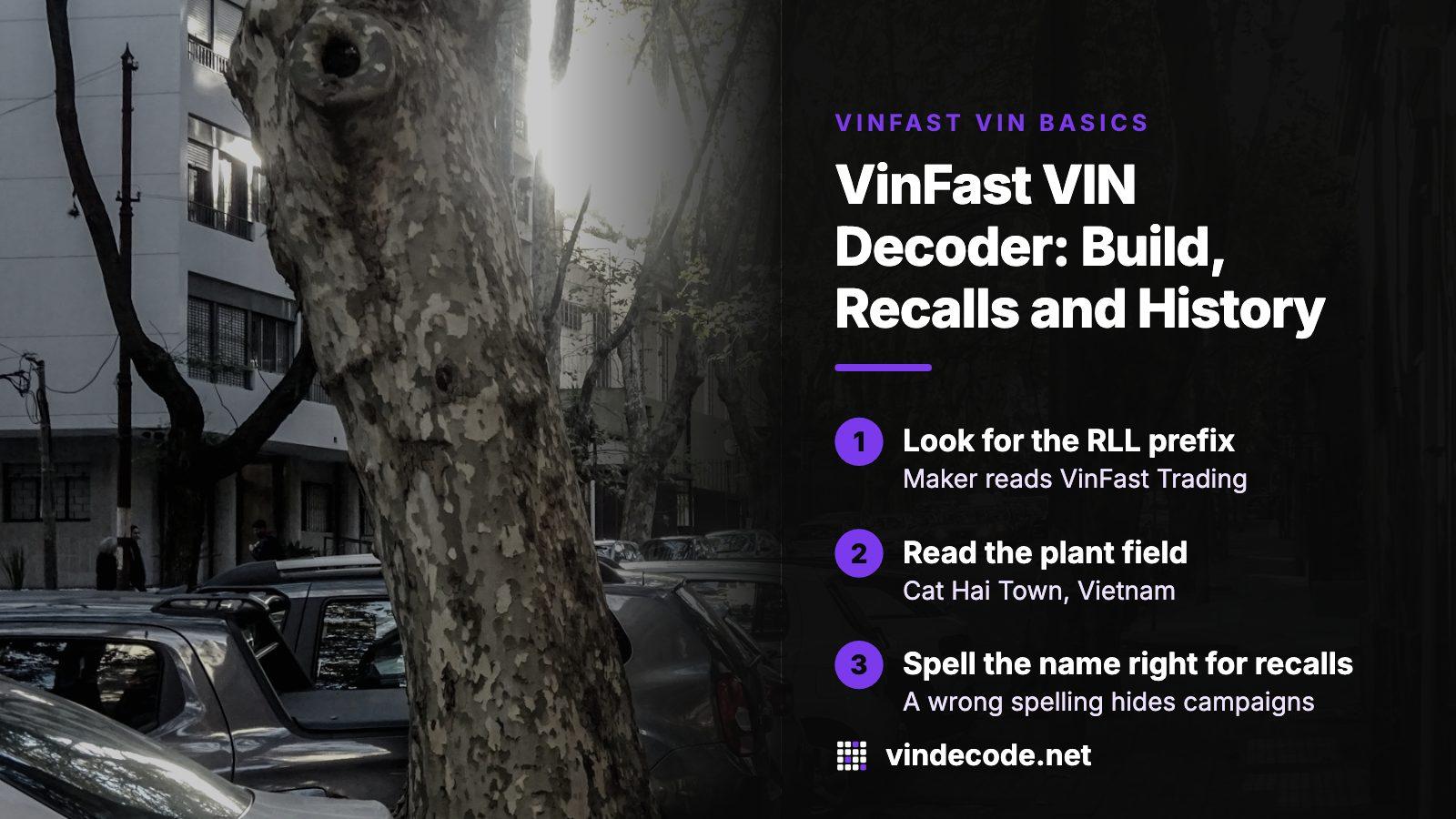
Put the whole VinFast VIN into the decoder above. A genuine one starts RLL, names VinFast Trading and Production as the maker, and shows Cat Hai Town, Vietnam as the plant. The tenth character sets the model year, so P means 2023 and R means 2024. Accidents and brands never surface here, so look at a history preview before you hand a seller any money.
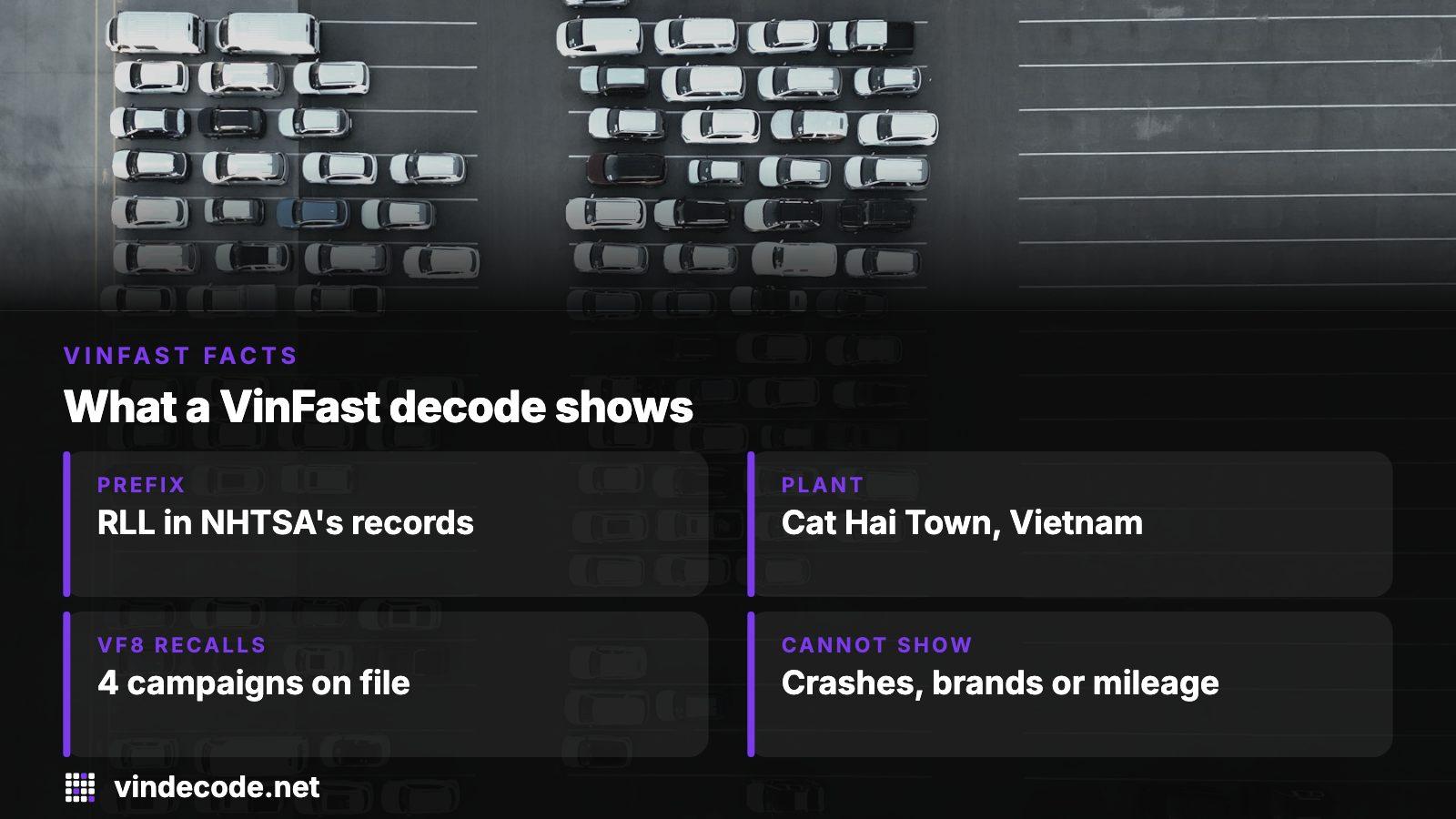
- Prefix in NHTSA's records
- RLL
- Plant returned on decodes
- Cat Hai Town, Vietnam
- VF8 recalls on file
- 4 campaigns
- A decode cannot show
- Crashes, brands or mileage
What a VinFast decode puts on screen
The decoder is NHTSA's vPIC tool, and it matches your VIN against patterns the maker filed with the government. You are reading VinFast's own description of the car, which makes it a fair test of a listing.
| Decoded field | Check it against |
|---|---|
| Make and manufacturer | VinFast, with VinFast Trading and Production as the company |
| Plant city and country | The assembly location in the ad, if one is given |
| Model year | The year on the title and registration |
| Electrification and drive | Battery electric, and the drive layout the seller claims |
On the patterns run for this page, the 2023 and 2024 codes returned battery electric and all-wheel drive. The 2022 code returned neither. NHTSA warns that a blank field means no data on file, not a missing feature, so a blank is a reason to ask, nothing more.
One prefix to look for
NHTSA's manufacturer record for VinFast carries a single world manufacturer code, RLL, filed in late 2021 and tied to the maker's Vietnamese company. That code covers the first three characters of every VinFast VIN you are likely to meet.
If a car sold as a VinFast starts with anything else, do not guess at an explanation. Photograph the number on the car, run it again, and ask the seller where the car was built and imported.
Which models the decoder knows
NHTSA lists four VinFast models: the VF 6, VF 7, VF 8 and VF 9, the same four for model years 2024 and 2025. Not every one has the same paper trail, though. Only the VF8 shows up in NHTSA's recall data for those years.
- VF8: four recall campaigns on file, covered in the next section.
- VF 9: no campaigns returned for 2023 through 2025 under either spelling of the name.
- VF 6 and VF 7: nothing returned for any year I tried.
- Model year 2026: no campaigns for any VinFast model on the day I looked.
An empty list on a newer model mostly reflects how little time those cars have had on the road, so do not read it as proof of anything.
The four VF8 recalls NHTSA lists
Each of these is a free repair under the recall, and the maker's remedy text gives customer service as 1-833-503-0600. A VF8 should have all that apply to its build either done or scheduled.
| Campaign | Vehicles | Problem | Fix |
|---|---|---|---|
| 23V355000 | 2023 VF8 | Center display can go blank | Software update |
| 24V369000 | 2022-2024 VF8 | Inactive igniters in air bags | Replace air bags |
| 24V933000 | 2023-2025 VF8 | Driver-seat center air bag may strike the driver's arm in a side impact | Replace center air bag |
| 25V559000 | 2023-2025 VF8 | Driver assistance can tug the wheel in wide turns, hard to override | Software update |
Two of the four involve air bags, which is why an open one on a used car deserves a firm answer from the seller.
The spelling trap in recall lookups
NHTSA's data stores this model two ways. Searching the model as VF8, without a space, returned three of the campaigns above. Searching VF 8, with a space, returned only the fourth, 25V559000, for the same years.
Complaints split the same way: 21 for the 2024 model year under the unspaced name, and 6 for 2025 under the spaced one. A buyer who searches by name and tries only one spelling can walk away believing a car has fewer problems than it does.
Look up by VIN, not by name
A recall search keyed to the full VIN sidesteps the spelling problem, because it asks about your exact car. Run it, then compare the answer with the four campaigns above.
Getting a clean decode
- Read the number off the car, take a photo of it, and set it beside the title.
- Type all 17 characters with no gaps, and recheck any that could be read two ways.
- Leave the model year box empty. If you type a year, NHTSA's tool ignores the year hidden in the VIN, and you lose a useful cross-check.
- Read the make, plant and year first, then the powertrain lines.
If a decode returns error codes 1, 5 or 14, the check digit failed, a few positions look wrong, or the maker gave no data for some characters. Retype before you suspect the car.
When the decode and the car disagree
| What you see | What to do |
|---|---|
| Prefix is not RLL | Get a written account of where the car was built and imported |
| Decoded year differs from the title | Ask which is correct, since recall scope follows the year |
| Door label, dash plate and title disagree | Pause the deal until the seller puts an explanation in writing |
| Air bag recall still open | Ask for a repair date from VinFast or an authorized shop |
| Decode comes back almost empty | Retype it, then look at the history preview |
From an NHTSA owner complaint
Owners of two VF8 cars told NHTSA both showed a drive train fault, jerked, lost all power and would shift only into neutral or park. The first car came back after a visit the owners say could not reproduce the fault. They also said the nearest service center was far from home, and the maker would not deliver the second car.
Treat it as one household's account, not a verdict on every VF8. Ask a seller about past software or drivetrain visits, and how far the nearest authorized service point is from you.
From an NHTSA owner complaint
Another VF8 owner described the car shutting off at an intersection while moving, then refusing to go into gear, with about two hours spent waiting for a tow. The dealer reportedly said it was holding that car and others with the latest update, and the owner said this was the second tow in roughly three months.
A decode cannot reveal repeat visits for software faults; only the seller can.
Gaps a decode cannot fill
The decode tells you how the car looked on the factory floor. Nothing in it covers the years afterward, which is where used buyers lose money.
- Whether the title ever carried a salvage, junk or flood label.
- Insurance total-loss declarations and auction sales with photos.
- Odometer readings over time, which expose rollbacks.
- Liens, impound events and theft records.
The federal title system covers five indicators and is meant to be concise. Its operators put coverage at 87 percent of vehicles, and warn that a search can come back looking clean when a reporting entity never sent its data. They also point buyers to the state's own title record.
Cost, and the sequence that saves money
Nothing is charged to preview a report. If you want the whole thing, you pay once for each car you check, and shoppers weighing several cars can take a pack of 3, 5 or 10. No subscription runs in the background; see the pricing page for amounts.
- Start with the decode and test each line against the ad.
- Check recalls by the full VIN, then compare with the four VF8 campaigns above.
- Look at the history preview next. Buy the full report only when build and recalls look right, and at pickup match both VIN labels to the title.

Where this information comes from
- NHTSA vPIC: VIN decoder — The federal decoder behind these results, including how a typed model year overrides the VIN and where the plant shows.
- NHTSA vPIC: VinFast manufacturer record — The single maker record and its country, behind the RLL prefix.
- NHTSA recalls data: VinFast VF8 — Campaign text, remedies and the model-name spelling difference.
- NMVTIS consumer information (Bureau of Justice Assistance) — What the federal title database shows and where it can miss.
- NHTSA owner complaint 11678395 — owner experience, paraphrased
- NHTSA owner complaint 11660720 — owner experience, paraphrased
Sources and photos: Facts checked against the sources above in November 2026. Photos by Nikolai Kolosov, Jakub Żerdzicki and Iain on Unsplash; diagrams by VINDecode.
Keep reading
- Tesla VIN Decoder: Plant Letter, Motor Line and What the VIN Won't ShowAnother electric maker, with its own prefixes and recall history to read.
- Rivian VIN Decoder: R1T and R1S Decodes, Recalls and Ownership TransferA newer EV brand decoded the same way, with different pitfalls.
- NHTSA VIN Decoder: What It Returns, Where It Stops, What Comes NextHow the federal tool behind these results works and where its data stops.
- Sample reportA finished history report, to see what it adds after the decode.
Frequently asked questions
How do I decode a VinFast VIN?
Put the full 17 characters in the box above. The tool matches them to patterns VinFast filed with NHTSA and shows maker, plant, year and powertrain. A blank or odd result is most often a mistyped character, so read your entry back against the car.
What does a VinFast VIN start with?
NHTSA's records list one world manufacturer code for VinFast, RLL, tied to the Vietnamese maker. A car sold as a VinFast that starts with anything else is a mismatch. Photograph the number, run it again, and ask the seller in writing where the car was built and imported.
Does a VIN decode show recalls?
No. The decode covers the build and nothing else. Recalls come from a separate NHTSA lookup, best run by the full VIN. For the VF8, NHTSA lists four campaigns, two of them about air bags, and a free repair is available through the maker's customer line for each.
Can a decoder tell me if a VinFast was in a crash?
It cannot. Crash, salvage and flood records live in title and insurance data, not in the factory filing. The history preview is the place to look, and it is free. Compare what it shows with the seller's story before you commit.
Why did one recall search miss campaigns?
NHTSA files this model under two spellings, with and without a space. Searching one returned three campaigns and the other returned the fourth. Search by the exact VIN, or try both spellings, so you do not mistake a gap in the lookup for a clean record.
Now check the car itself
The guide explains what to look for. The report shows what this VIN has on record.