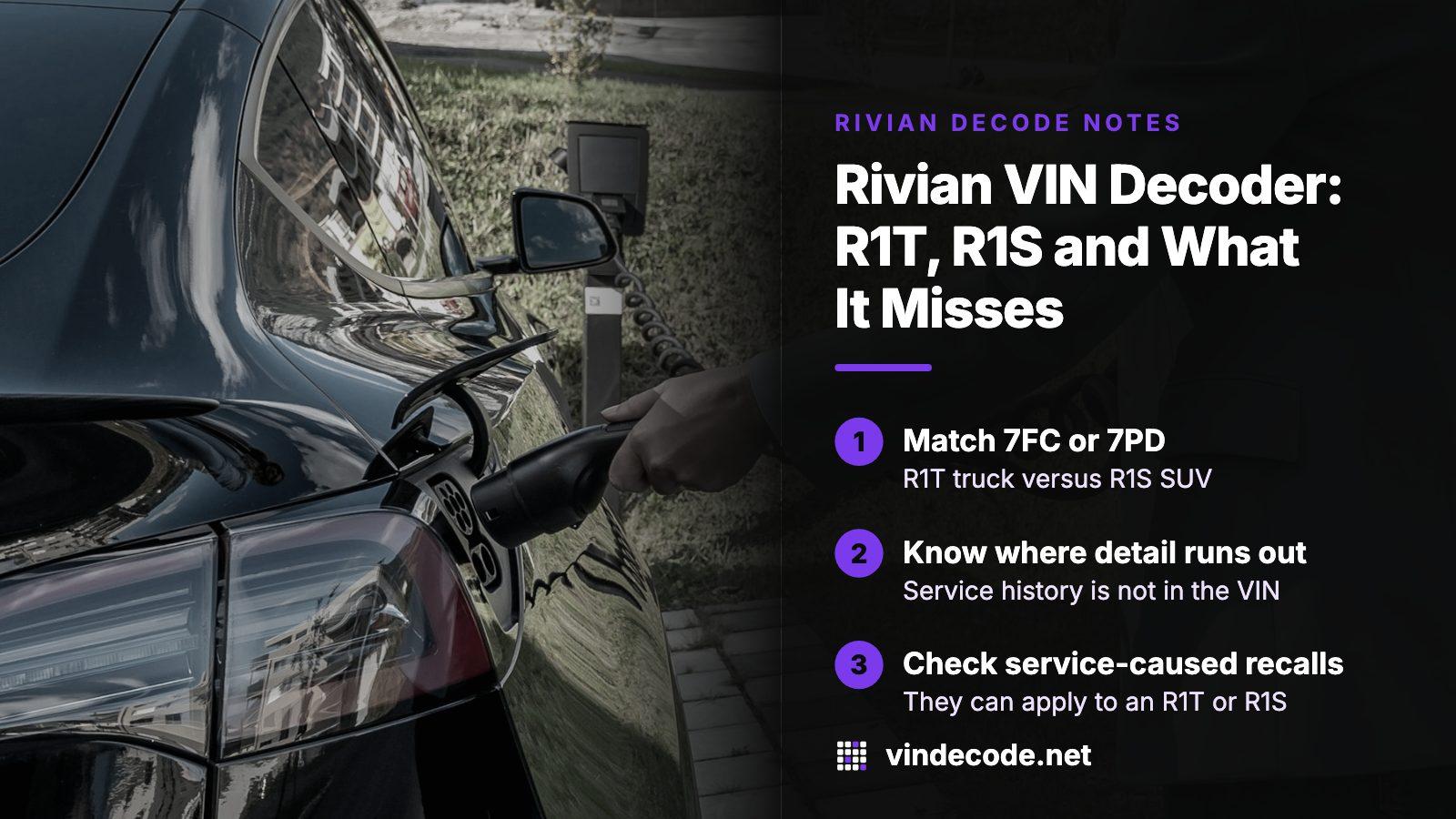
THE SHORT ANSWER
To decode a Rivian VIN, type all 17 characters into the decoder on this page. A VIN starting 7FC is an R1T pickup and one starting 7PD is an R1S SUV. The result names year, trim, all-wheel drive, electric fuel and the Normal, Illinois plant. It cannot show past service work, accident damage, a title brand or digital ownership. Run the free history preview for those.
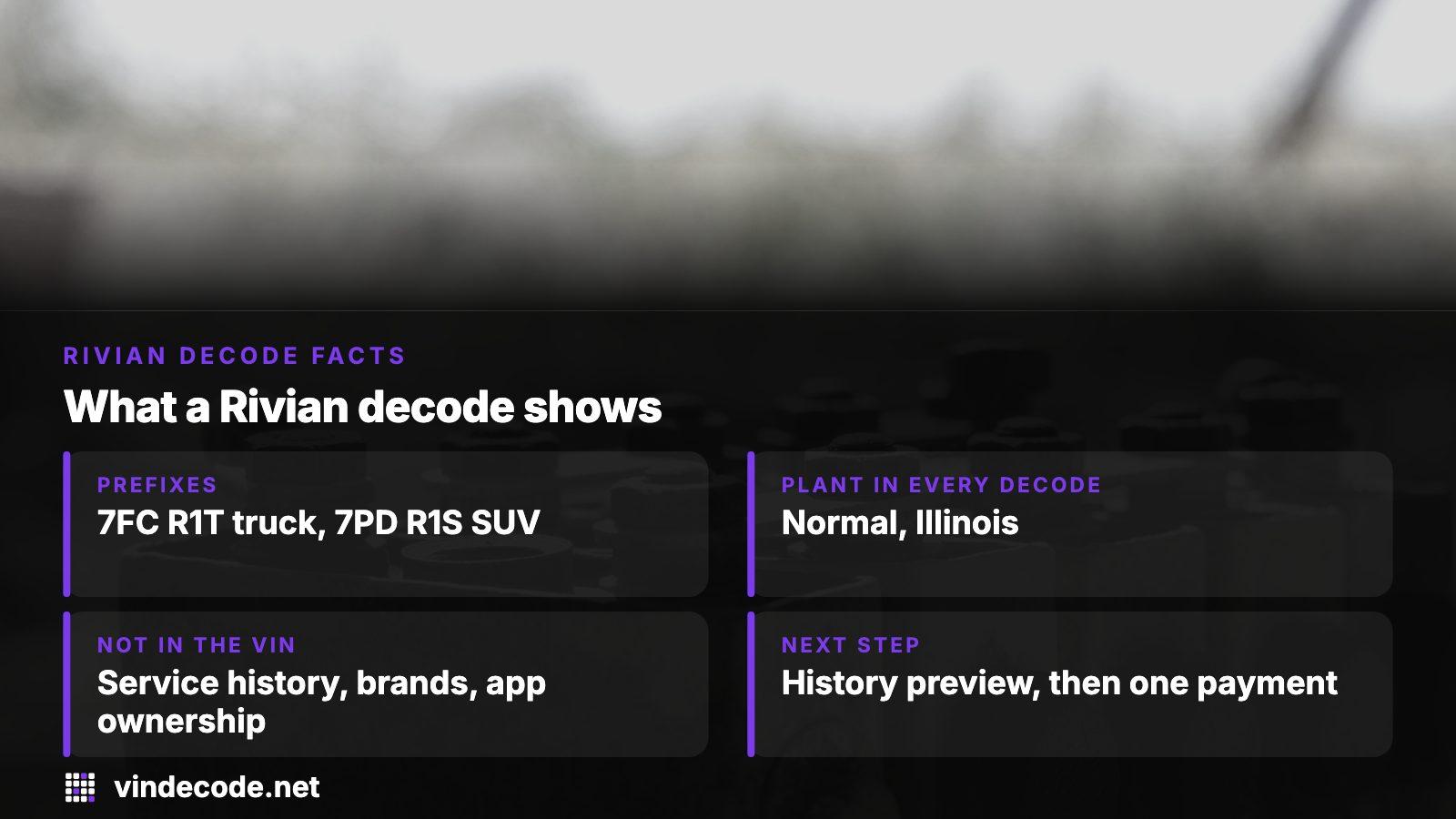
- Prefixes
- 7FC for the R1T truck, 7PD for the R1S SUV
- Plant in every decode
- Normal, Illinois
- Not in the VIN
- Service history, title brands, app ownership
- Next step
- Free history preview, then one payment for the report
What a Rivian decode puts on screen
The decoder reads your VIN against NHTSA's vPIC catalog, where Rivian files the patterns behind its numbers. The output describes the vehicle as it left the factory, which makes it the first thing to hold up against an advert. If the seller says Adventure trim and the decode says something else, ask why before you drive anywhere.
- Model year and model, such as R1T or R1S
- Body class: pickup for the truck, SUV for the larger SUV
- Trim name, such as Launch Edition, Adventure or Premium
- Drive type and fuel: all-wheel drive, electric
- Assembly plant, city and state
- Weight class, where the maker filed one
Copy the number from the vehicle or the signed title, never from the listing. One wrong character makes the tool flag an error or describe a different truck, so recopy before you blame the decoder.
7FC or 7PD, and eight real decodes
NHTSA lists two manufacturer codes for Rivian Automotive. The 7FC code is filed as a truck and 7PD as a multipurpose passenger vehicle, which is why the R1T and R1S start differently. The rows below decode the first eleven characters of VINs that owners entered in NHTSA complaints.
| Decoded vehicle | Starts with | Trim returned | Plant |
|---|---|---|---|
| 2022 R1S | 7PD | Launch Edition | Normal, Illinois |
| 2023 R1S | 7PD | Adventure | Normal, Illinois |
| 2024 R1S | 7PD | Adventure | Normal, Illinois |
| 2025 R1S | 7PD | Premium | Normal, Illinois |
| 2022 R1T | 7FC | Adventure | Normal, Illinois |
| 2023 R1T | 7FC | Adventure | Normal, Illinois |
| 2024 R1T | 7FC | Adventure | Normal, Illinois |
| 2025 R1T | 7FC | Adventure | Normal, Illinois |
Every one of the 119 distinct prefixes we pulled decoded to the same plant and to electric all-wheel drive, so the plant tells you little on a Rivian. The tenth character did the dating, running N, P, R, S across the four model years in the table.
Where the decode runs out of detail
Two quirks showed up. The series field came back empty and the trim field carried the name, so read the trim line rather than looking for a package in the series. And the 128.90 kWh battery figure appeared only on the 2022 rows. Later decodes left the battery blank, which is a gap in the filing and not a sign of a missing pack.
A decode also cannot say which options were fitted, how the battery has aged or which software version runs the screens. For those, ask for the build details in writing and check them in the vehicle's own settings during the test drive.
Partial VINs still decode
Given only eleven characters, the tool flags an error code yet still returns the pattern fields. Useful for sorting a list of listings, not for buying: always run the full 17.
Recalls on an R1T or R1S, including ones caused by service
Campaigns reach only some trucks, so a VIN search is the reliable way to see which apply to a given one. NHTSA's feed lists a dozen for the 2022 R1T alone. Rivian says its service team fixes recalls at no cost to the owner.
Two campaigns matter because the fault came from earlier repairs. One covers 2022 to 2025 trucks and SUVs whose rear toe link may have been put back together wrongly during service before March 2025, with a joint that could separate. NHTSA gives the potential count as 19,641 vehicles. The other covers pillar trim clips harmed during a repair visit, which can upset how the side curtain air bag opens.
From an NHTSA owner complaint
An owner of a 2022 R1S told NHTSA that third-row seat crossmember bolts had worked loose and the threaded inserts had come away from the body. They wrote that the service center confirmed it, while Rivian blamed the end user. They also said the problem seems to affect low-VIN trucks. Ask any seller of an early build whether that area has ever been opened up.
An open recall does not stop a sale. It does mean your first service visit may be spent on someone else's deferred repair.
Digital ownership transfers with the truck, but not by itself
A Rivian is tied to an owner's account in the Rivian app as well as to a title. Rivian's support pages say a private buyer must start an ownership transfer: make an account, open the inquiry form, choose the ownership transfer topic, and upload photos of a driver's license plus a signed bill of sale or signed title or registration card. Receipts and title applications are refused. Rivian says the move can take up to 7 business days once all papers arrive.
From an NHTSA owner complaint
Two weeks after buying a 2022 R1T from a private seller, an owner told NHTSA that Rivian would not move the truck into their account. They said a major recall could not be scheduled, and the previous owners could still disable the keys. They wanted it treated as a safety and privacy matter. The takeaway: sort the paperwork with the seller before money moves.
- Ask the seller to run Clear Settings on the center display
- Ask them to remove the vehicle from their app profile under vehicle ownership
- Photograph the signed bill of sale and title the day you pay
- Until Rivian completes the transfer, you can turn off the app's location access from the center display
What the history report covers after the decode
A decode starts with the factory. A history report picks up at the first sale and follows the VIN through registrations, auctions and insurers. For a used R1T or R1S the useful parts are the title record, any accident or damage entry, odometer readings over time, and whether the truck ever passed through a salvage auction.
A good paint finish proves nothing about a past write-off, which only the title record shows. That data comes from NMVTIS, the federal system the Department of Justice oversees to keep stolen and unsafe vehicles from being resold.
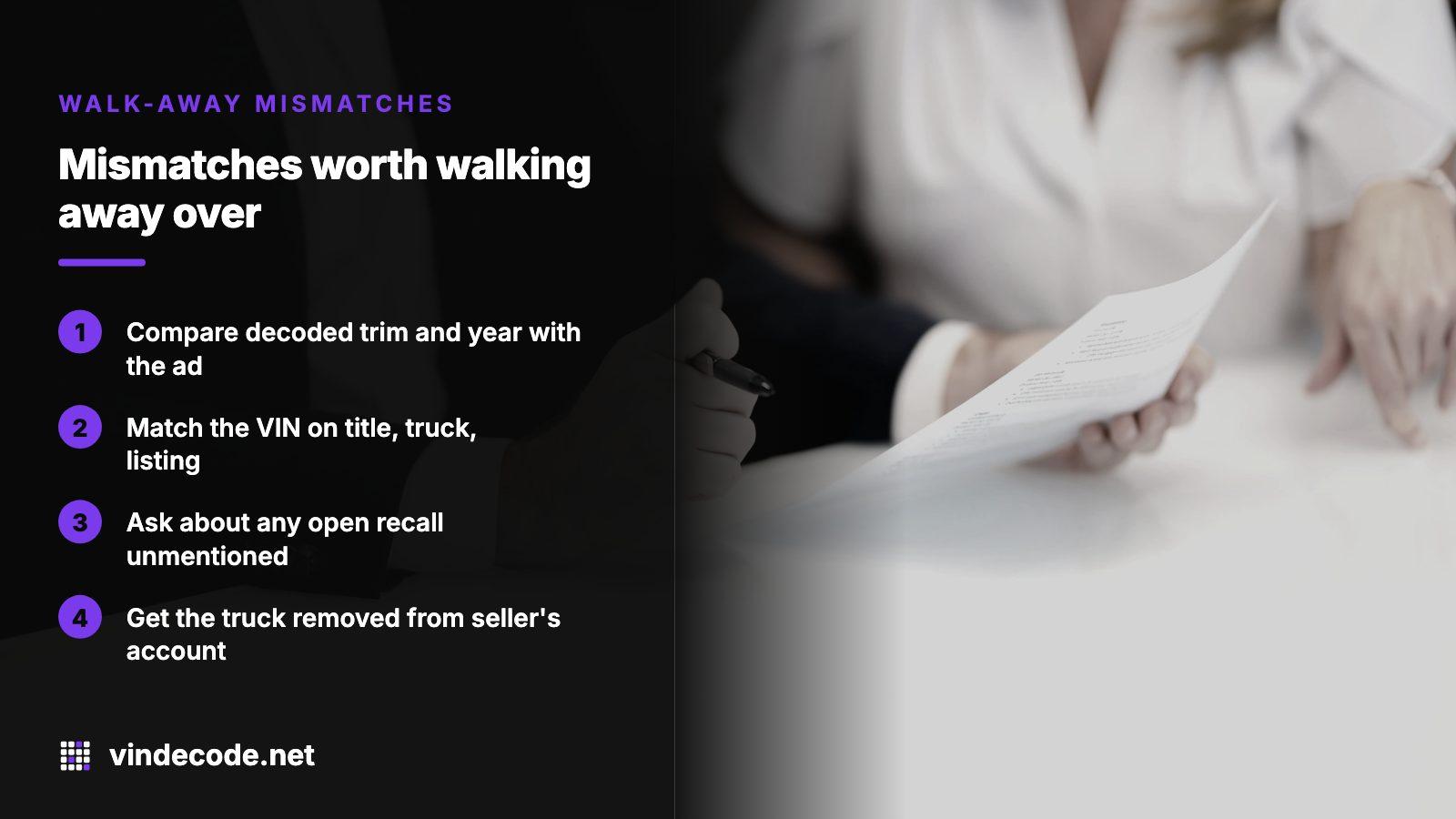
Mismatches worth walking away over
- The decoded trim or year disagrees with the advert and the seller cannot explain it
- The VIN on the title, the vehicle and the listing are not identical
- An open recall the seller never mentioned, especially one tied to earlier repairs
- The seller cannot or will not remove the truck from their Rivian account
- A title brand or salvage record in the history preview that the advert left out
One mismatch on this list is a question. Two is a reason to stop and ask for more records.
What to run next, and what it costs
Decode first, since it costs nothing and catches the easy mismatches. If the numbers line up, enter the same VIN for the history preview, which is free. The full report is a separate one-time payment, with no subscription, and the current prices are on the pricing page.
Before you hand over a deposit, also check the recall list for that VIN, ask Rivian Service to confirm the truck's account status, and have the seller's paperwork ready for the transfer.
Where this information comes from
- NHTSA: vPIC VIN decoder — The public catalog where Rivian's VIN patterns sit and where the decodes above were run.
- NHTSA: Rivian manufacturer codes — Lists the 7FC truck and 7PD passenger-vehicle codes filed for Rivian.
- NHTSA: recalls API for the 2022 R1T — Campaign summaries, remedies and the service-related recalls discussed above.
- Rivian Support: private party purchase — Documents and steps a private buyer needs for the ownership transfer.
- VehicleHistory.gov: NMVTIS — The federal title-record system behind vehicle history reports.
- NHTSA owner complaint 11526327 — owner experience, paraphrased
- NHTSA owner complaint 11646688 — owner experience, paraphrased
Sources and photos: Facts checked against the sources above in November 2026. Photos by smart-me AG, Carrie Allen www.carrieallen.com and Stephen Mabbs on Unsplash; diagrams by VINDecode.
Keep reading
- Tesla VIN Decoder: Plant Letter, Motor Line and What the VIN Won't ShowAnother electric brand, with plant letters and software limits.
- NHTSA VIN Decoder: What It Returns, Where It Stops, What Comes NextHow the federal database behind these decodes works.
- VIN Decoder: Decode a VIN Number Online, Then Check Its HistoryEvery VIN position explained, check digit included.
- PricingWhat the report costs: one payment, or a pack, no subscription.
Frequently asked questions
How do I decode a Rivian VIN?
Enter all 17 characters in the decoder on this page. The result gives model, year, trim, drive type and plant. If you get an error, check the characters against the vehicle or title, since a single wrong character changes or breaks the answer.
Does a Rivian VIN decoder show the battery pack?
Not reliably. In the decodes we ran, a 128.90 kWh figure appeared only on 2022 rows and later rows left the field blank. Treat pack size as something to confirm with the seller and the vehicle's own screens rather than the decoder.
Which characters tell an R1T from an R1S?
The first three. NHTSA files 7FC as a Rivian truck code and 7PD as a Rivian multipurpose passenger vehicle code, and the decodes we ran matched that split: pickups began 7FC and SUVs began 7PD.
Can a VIN decode show open recalls?
No, a decode describes the build. Recalls are searched by VIN on NHTSA's recall tool and on Rivian's recall page, and some campaigns only apply to trucks that had certain service work, so a model-level list can mislead.
What should I do if the seller will not release the Rivian account?
Pause the purchase. Rivian's process needs your license plus a signed bill of sale, title or registration card, and the seller's app link should be removed. Without that, a recall visit or key control can end up with the previous owner.
Now check the car itself
The guide explains what to look for. The report shows what this VIN has on record.