
THE SHORT ANSWER
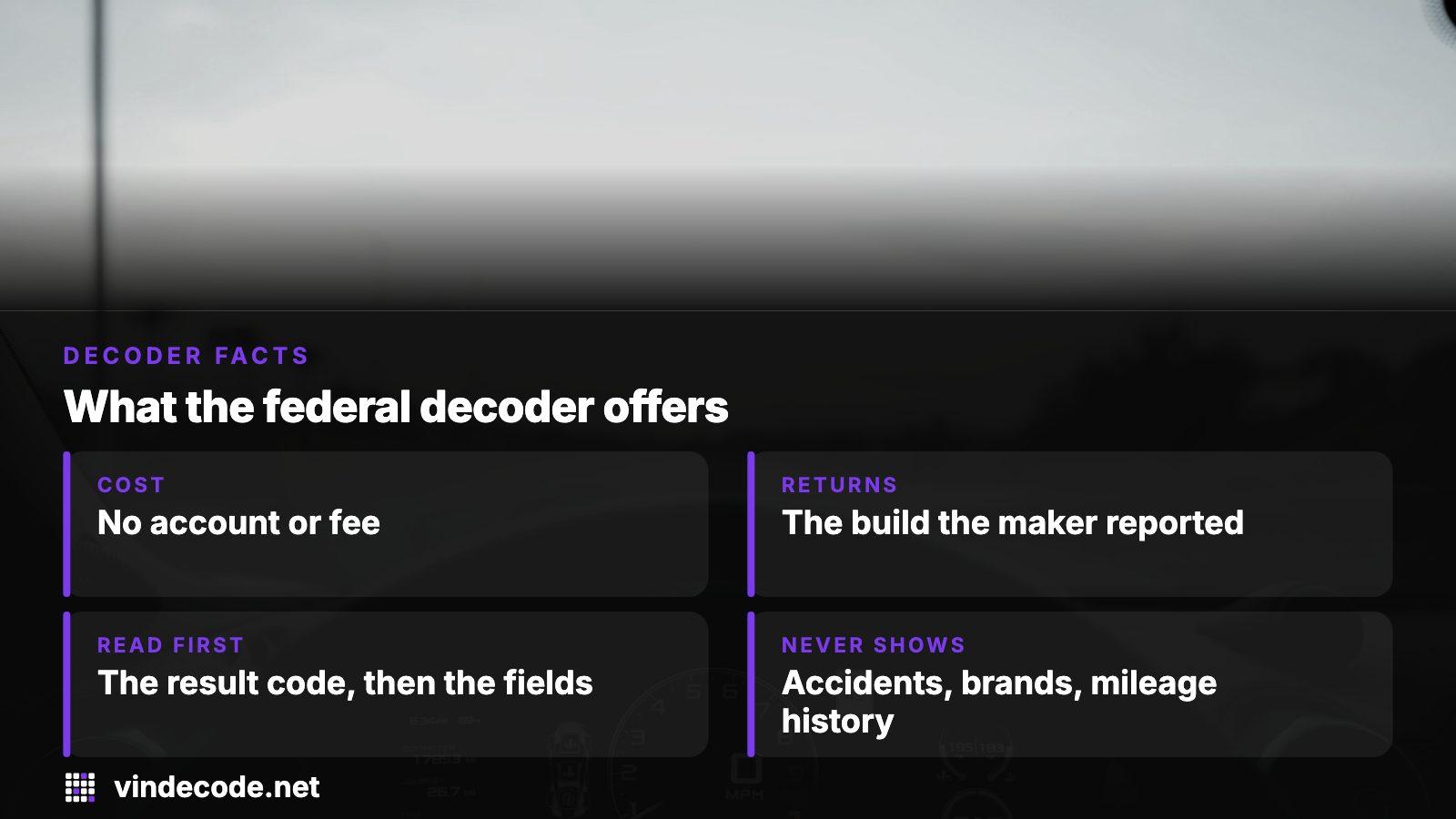
Enter the VIN at vpic.nhtsa.dot.gov/decoder and read the result code before anything else. Code 0 means a clean decode; any other code limits how far the fields can be trusted. The output is the build the manufacturer reported, so a blank field means no data, not missing equipment. No accident, title, odometer or theft records appear. A history report searches those by the same VIN, and its preview is free.
- Cost
- No account or fee for NHTSA's decoder
- Returns
- The build the maker reported
- Read first
- The result code, then the fields
- Never shows
- Accidents, title brands, mileage history
What a clean decode looks like on a real VIN
Start with 1G1ZD5ST4PF233170, a mid-size sedan. Run through NHTSA's decoder, roughly 70 of the 154 response entries carry a value. A buyer's essentials:
| Entry | Value returned |
|---|---|
| Make and model | Chevrolet Malibu |
| Model year | 2023 |
| Trim and body | LT (1LT), four-door sedan |
| Engine | 1.5 liter, four cylinders, gasoline |
| Filed by | General Motors LLC |
| Assembly plant | Kansas City, Kansas |
| Result code | 0, decoded clean |
Each line is the maker's report of the vehicle as built, which is why nothing in it reflects later wear or damage. NHTSA also attaches a note to every response: a blank value means the agency holds no data on that item, not that the vehicle lacks the feature.
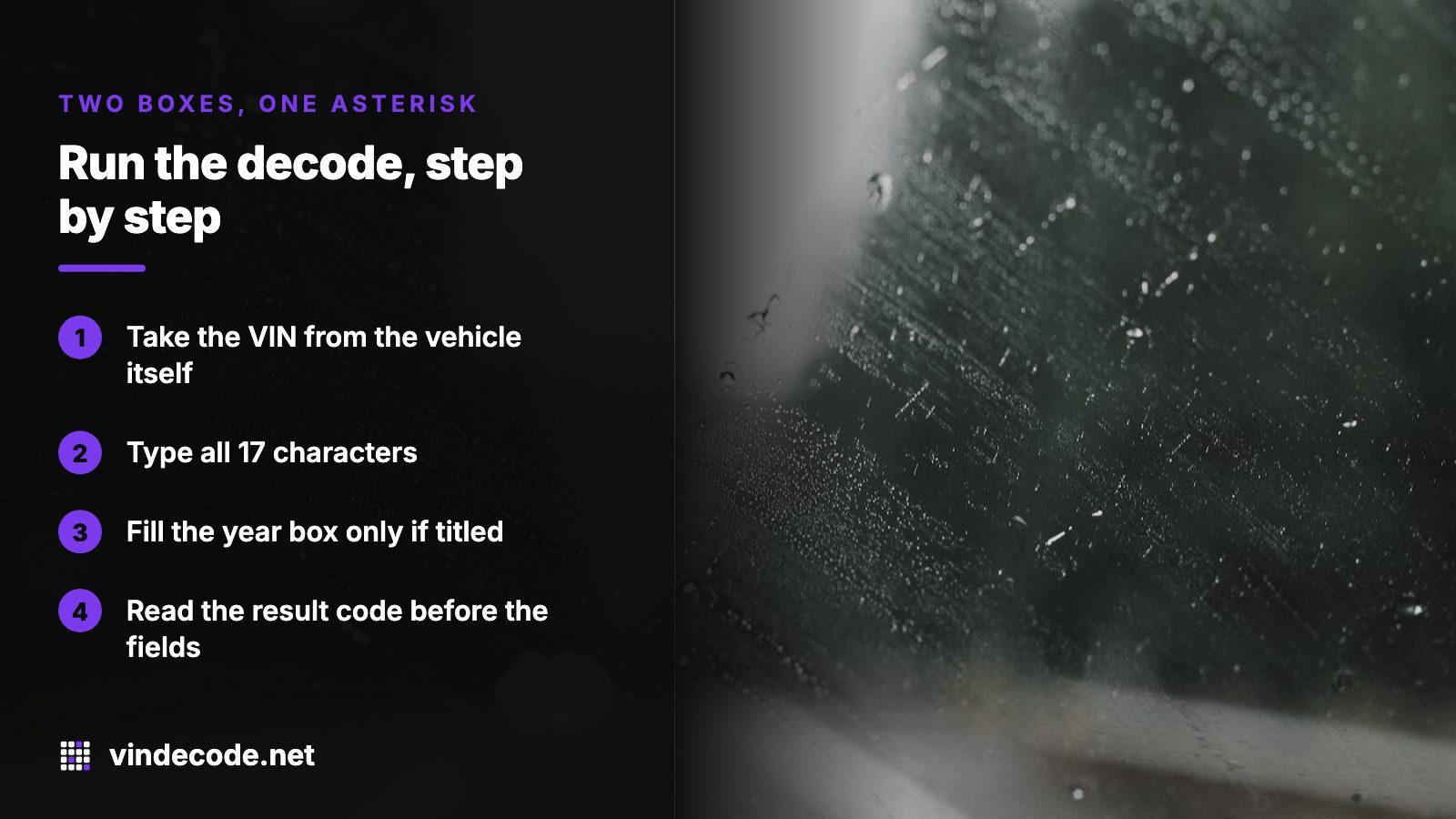
Running it: two boxes and one asterisk
- Take the VIN from the vehicle itself, not the listing. Crouch beside the driver's front corner of the dash and read the plate through the glass; the door-pillar label is a second copy. Match both to the title.
- Open vpic.nhtsa.dot.gov/decoder and type all 17 characters. For one you cannot read, type an asterisk in its place; partial numbers are accepted.
- Fill the model year box only when the title confirms the year. Whatever goes there replaces the year the VIN itself encodes, and a year before 1981 is rejected.
- Press decode and read the result code line before any field.
- Scroll to the bottom for the plant lines, which name the build plant and country.
Result codes worth stopping on
The code field can hold several codes at once, separated by commas. These are the ones a buyer meets most.
| Code | What NHTSA is saying | What to do |
|---|---|---|
| 0 | Decoded clean, check digit correct | Trust the fields as the maker's record |
| 1 | Check digit does not calculate | Reread the number from the car |
| 3 | One position was corrected | Compare the suggested VIN with the car |
| 6 | Incomplete VIN | Fine for a first look, not a verdict |
| 7 | Maker not registered for US sale | Ask how it was titled before paying |
| 9, 10 | Glider, or off-road product | Not a standard motor vehicle; ask how it registers |
| 11, 12 | Bad year character, or year mismatch | Check the year box and the title |
| 400 | Invalid character present | Look for I, O or Q |
Why I, O and Q fail
The rule in 49 CFR Part 565 sets position 9 aside for the check digit, and no VIN may contain an I, an O or a Q. A typed O is more likely a zero.
Four slips, tested on one VIN
To see how the decoder reacts, we changed one thing at a time in the Malibu number above and ran each version on November 5, 2026.
| What changed | Codes returned | What came back |
|---|---|---|
| Ninth character 4 swapped for 1 | 1 | Every vehicle field, filled as before |
| Last character typed as the letter O | 1 and 400 | Full fields, bad position marked |
| Eleventh character U instead of F | 1, 3 and 14 | Suggested fix equal to the original VIN; plant blank |
| 2020 typed in the year box | 0 and 12 | Model year shown as 2020, though the VIN reads 2023 |
The first row is the lesson: a failed check digit does not stop a confident-looking build, so reading fields without the code hides the warning. The last row is quieter: the box beat the VIN, and only code 12 said so.
Plant and engine: the details dealers dispute
Assembly plant and engine family are the two decoded details owners most often need when a dealer cites the limits of a recall. One Kia Sorento case shows how.
From an NHTSA owner complaint
Second owners of a 2013 Kia Sorento told NHTSA the engine died on a two-lane road at 55 mph. The dealer said an engine recall would not reach the car, since it fell outside a "certain plant" and "certain month" window, yet could not name either. The owners decoded their VIN and found a Georgia build and the Theta II engine.
For that VIN prefix NHTSA's decoder gives the same two answers: a Kia plant in Georgia and a 2.4 liter Theta II engine. They are starting facts only, since recall scope is checked by VIN, as the next section shows. The maker line can surprise too: a Hyundai Santa Fe Sport prefix decodes to Kia Georgia, because the legal builder need not share the badge. The brand guides here cover each maker's habits.
What a decode will never know
Everything after the factory sits in other records. The federal title system, NMVTIS, is one of them, and it is built around five indicators:
- Which state holds the title now, and when it last changed
- Brands: junk, salvage or flood labels that any state attached
- Odometer readings
- A total loss on record
- Any salvage record
By federal law, titling agencies, insurers, salvage and junk yards and auto recyclers all feed data into it. Its operator calls a short, clean report a good outcome, and says private providers add records NMVTIS leaves out, repair histories among them.
The recall search next door, and its gaps
NHTSA's recall page also takes a VIN, and it answers a different question: does this exact vehicle still need a recall repair. A clean result reads zero unrepaired recalls. Some things never appear there:
- A recall the owner already had fixed
- A fresh announcement not yet matched to every affected VIN
- Notices issued more than 15 years back, except where the maker kept a longer window
- Small builders, non-safety campaigns and vehicles made for other markets
From an NHTSA owner complaint
The owner of a 2014 GMC Acadia filed after the SUV lost power at 70 mph on a Chicago interstate. Typing the VIN into NHTSA's site showed no open recalls, yet searching by year and model without the VIN surfaced a recall for what looked like the same fault. A separate decoder put the build date inside that recall's production window, the owner says, and asks why the VIN search did not flag the car.
Read a zero as nothing listed yet. NHTSA says VINs are added continuously, so repeat the search before you buy and again after.
After the decode: the history report and its price
A decode proves identity. The history report searches the same VIN for what came after: accident and damage entries, any title brand, mileage readings over the years, salvage-auction photos and theft flags.
- Decode the VIN and compare year, engine and plant with the advert and the title.
- Enter the same VIN in the form above to see the preview, which is free and needs no card.
- If the preview fits the car, decide on the full report. Buying costs a single payment with nothing to cancel later: take one report or a bundle, and read today's amounts on the pricing page.
- Before paying the seller, put the number through NHTSA's recall search too, and hire a mechanic of your own choosing to look the car over.
Where this information comes from
- NHTSA: VIN decoder (vPIC) — The form itself: the VIN and model year boxes, partial numbers, the plant lines and the manufacturer-reported caveat.
- NHTSA: vPIC API documentation — How the data service works, where its data comes from, and the live result codes the tests on this page read.
- NHTSA: check for recalls — What a VIN recall search shows and the six kinds of recall it leaves out.
- BJA: understanding an NMVTIS vehicle history report — The five federal title indicators and who must report into the system.
- eCFR: 49 CFR Part 565, VIN requirements — The check digit position and the letters a VIN may never contain.
- NHTSA owner complaint 11003909 — owner experience, paraphrased
- NHTSA owner complaint 11428039 — owner experience, paraphrased
Sources and photos: Facts checked against the sources above in November 2026. Photos by Alejandro Escamilla, Cole Keister and Dennis Eusebio on Unsplash; diagrams by VINDecode.
Keep reading
- VIN Decoder: Decode a VIN Number Online, Then Check Its HistoryThe general decoder guide: what each of the 17 characters holds.
- VIN Decoder Explained: What Decoding a VIN Means and How It WorksReading the positions by hand, including the check digit.
- Classic Car VIN Decoder: Which Years It Reads and What Comes AfterOlder numbers that trigger code 7 and fall outside the 17-character format.
- Sample reportA finished history report, to see what comes after the decode.
Frequently asked questions
Is the NHTSA VIN decoder free to use?
Yes. The web decoder and the data service behind it need no account, and the figures come from filings that makers send the agency, which is why many other decoders read the same data. The limit is scope: it describes the build, never the car's history.
Does the NHTSA decoder show accidents, title brands or mileage?
No. It returns the build record the maker submitted, plus result codes about the number itself. Brands, total losses, salvage entries and odometer readings live in title and insurer records, which a history report searches. A clean code 0 says the number is consistent, not that the car is.
Why does the decoder show the wrong model year?
Check the year box first. Anything typed there replaces the year in the VIN, and the tool only warns with code 12. If the box was empty, reread the tenth character against the car and compare the result with the title. A misread character in the number is worth ruling out too.
What does "manufacturer not registered with NHTSA" mean?
That is code 7: the maker code is not on file for sale in the US. It turns up on very old numbers, on vehicles built for other markets and on numbers that are simply wrong. It is not proof of fraud, but ask the seller how the car was titled and registered before any money moves.
Can I decode a partial VIN?
Yes. Type an asterisk for each unreadable character and the tool returns what the known characters support, flagged with code 6. That is enough for a first look at make, model and engine. A history check works from the whole 17 characters, so get the full number from the car.
Now check the car itself
The guide explains what to look for. The report shows what this VIN has on record.