THE SHORT ANSWER
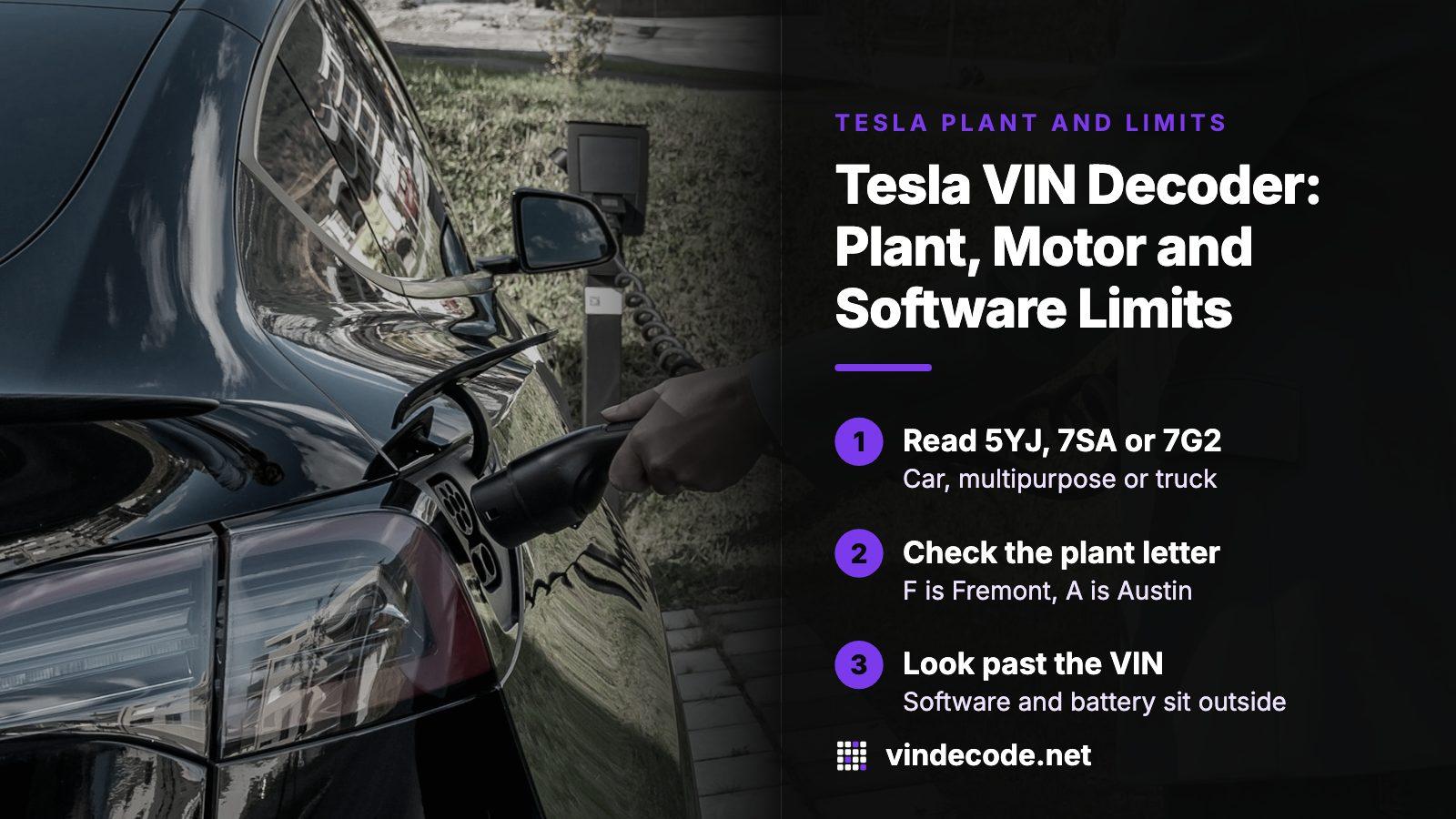
To decode a Tesla VIN, enter all 17 characters in the decoder on this page. Character ten carries the model year and character eleven the plant letter: F for Fremont and A for Austin in the decodes below. The result names model, body, motor line and plant. It cannot show Full Self-Driving, acceleration upgrades, battery chemistry, pack health or a title brand. Open the history preview for the title and damage side.
- Prefixes
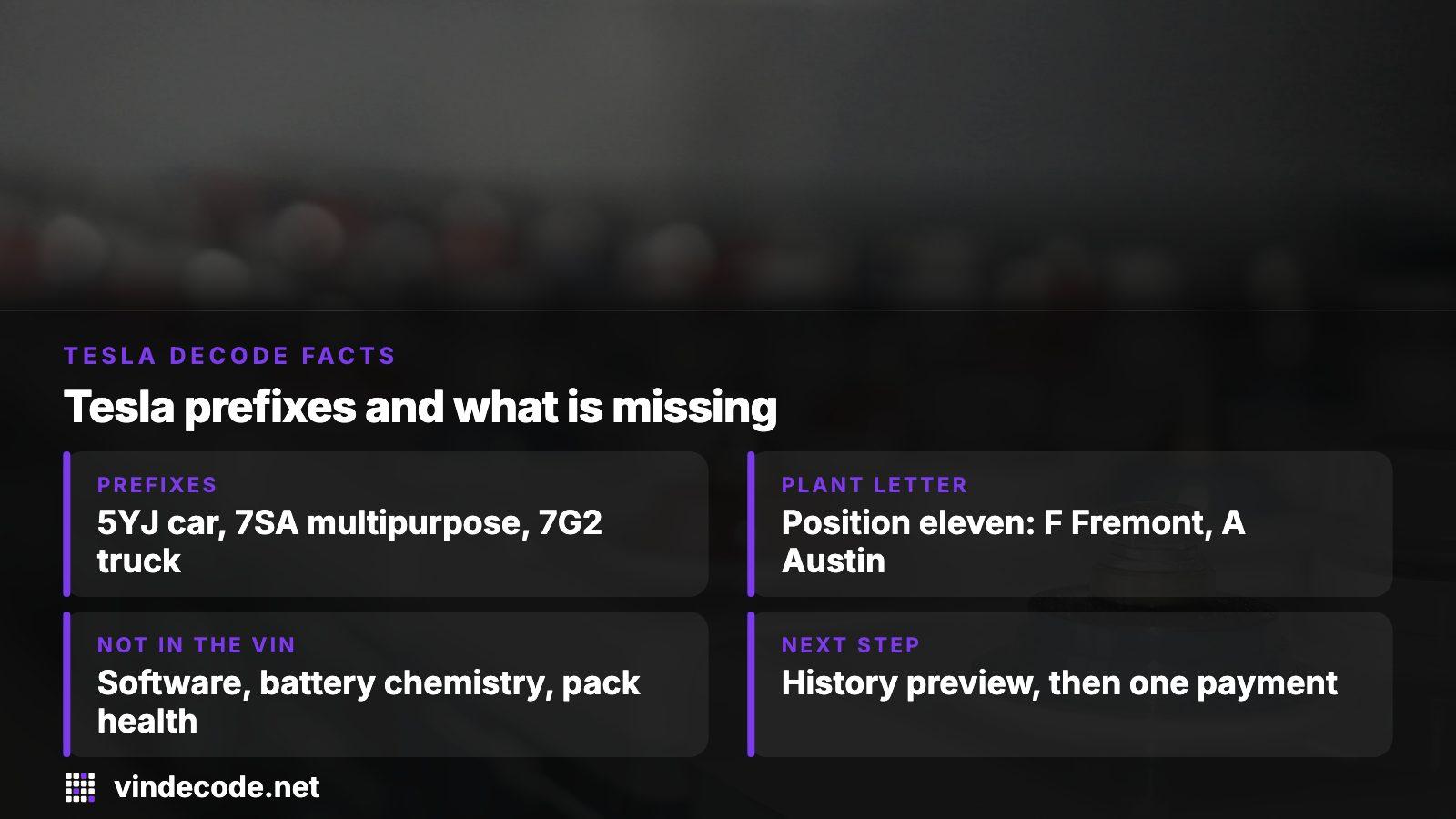
- 5YJ passenger car, 7SA multipurpose, 7G2 truck
- Plant letter
- Position eleven: F for Fremont, A for Austin in the decodes run
- Not in the VIN
- Software features, battery chemistry, pack health
- Next step
- Free history preview, then one payment if you want the report
What a Tesla decode puts on screen
The decoder checks your VIN against NHTSA's vPIC database, where Tesla files the pattern behind its numbers. The answer describes the car as built, so it is the first thing to hold against a listing. A seller who says dual motor over a decode that says single motor has just told you something.
- Model, model year and body style
- Motor line, such as single, dual or performance
- Battery-electric drivetrain flag
- Vehicle type, set by the three-character prefix
- Assembly plant, city and state
Copy the number off the car, not the advert. Read it through the windshield at the lower corner by the driver, or off the pillar label with the driver's door open, or from the software information screen. Character nine is a check digit, so a mistyped VIN usually returns an error. Recopy it before blaming the tool.
Seven real Tesla decodes, and how to read prefix and plant
NHTSA lists 5YJ as a Tesla passenger car code, 7SA as a multipurpose code and 7G2 as a truck code. The prefix names maker and vehicle type, while position eleven names the plant. These rows decode the first eleven characters of VINs filed in NHTSA owner complaints.
| Decoded car | Prefix | Position 11 and plant | Motor line |
|---|---|---|---|
| 2013 Model S | 5YJ | F, Fremont, California | Blank; drive type RWD |
| 2018 Model 3 | 5YJ | F, Fremont, California | Single Motor - Standard |
| 2018 Model 3 | 5YJ | F, Fremont, California | Dual Motor - Standard |
| 2020 Model Y | 5YJ | F, Fremont, California | Dual Motor - Standard |
| 2023 Model X | 7SA | F, Fremont, California | P2 Dual Motor |
| 2023 Model Y | 7SA | A, Austin, Texas | Dual Motor - Standard |
| 2024 Cybertruck | 7G2 | A, Austin, Texas | Motor: Standard |
Two quirks show up. The same 7SA prefix sits on a Fremont Model X and an Austin Model Y, so a prefix alone never names the factory. And the drive layout moves between fields: the Model S fills drive type, the newer cars fill the motor line. A blank field is not an error.
LRW and XP7: when NHTSA has no record
Shanghai-built Teslas carry LRW and Berlin-built ones carry XP7. NHTSA's code lookup returned no manufacturer record for either when we ran it. We also decoded an LRW number taken from a 2020 Model 3 that a media company in China had leased. It returned no model, year or plant, only a notice that the maker is not registered with NHTSA for use on U.S. roads.
So a U.S. listing with one of these prefixes raises an import question, not a decoding one. Ask how the car was imported and registered, and have the seller put it in writing first.
Software, battery and range sit outside the VIN
More of a Tesla lives in software than of most cars, and an account holds it rather than the number. Two cars with neighboring VINs can differ in features, cell chemistry and charging access. A decode fixes the hardware baseline and stops there.
- Full Self-Driving, acceleration upgrades and connectivity packages are licensed to the car through an account
- Cell chemistry has varied by plant, variant and date, and the decode narrows it without naming the pack
- Current range depends on this pack's age and charging habits, which no lookup can see
- Whether a bought feature stays with the car for a new owner is Tesla's answer to give, not the seller's
Have the seller show every claimed feature on the car's own screens, powered up, in front of you. A screenshot proves nothing. Charge the car well up, compare the indicated range with the official figure for that variant, and ask whether the pack or a drive unit was ever replaced, with paperwork.
Branded titles and the extra Tesla question
A decode cannot show a title brand, and on a Tesla that gap costs more than usual. Tesla has limited Supercharger network use for cars that carry salvage titles. Its position has shifted over time and varies by case, so the only safe answer is Tesla's own, given for that VIN, before you buy.
| You want to know | Decode | History report |
|---|---|---|
| Model, year, plant, motor line | Yes | Yes, as factory specs |
| Title brands and salvage history | No | Yes |
| Accident and damage records | No | Yes |
| Odometer readings over time | No | Yes |
| Open recalls | No | Yes |
A salvage Tesla that cannot use the fast-charging network is a different product from one that can, mainly for anyone driving beyond home-charging range. On a car priced low, read the title record first.
Recalls follow the VIN, and many arrive as software
NHTSA's recall lookup works from the VIN, and a Tesla campaign counts the same whether the remedy is a part or a software release. Many are fixed over the air, so a recall can read as remedied because an update was pushed. On a used car, confirm it is really running current software, especially after a long stretch parked or offline.
From an NHTSA owner complaint
A 2018 Model 3 owner told NHTSA a front lower suspension link came loose at low speed with no impact. The car sat outside recall 23V-235, the owner says Tesla's lookup listed every recall as done, and the car was later written off and sent to salvage.
A clean lookup shows which campaigns cover that VIN, not that every part is sound.
From an NHTSA owner complaint
A 2017 Model 3 owner reported that updates had failed for more than 26 months. The screen stayed dark for the first minutes of each drive, and Tesla asked for a paid visit to fix it. Ask when the car last took an update, and watch the screen start cold.
The order to check a used Tesla in
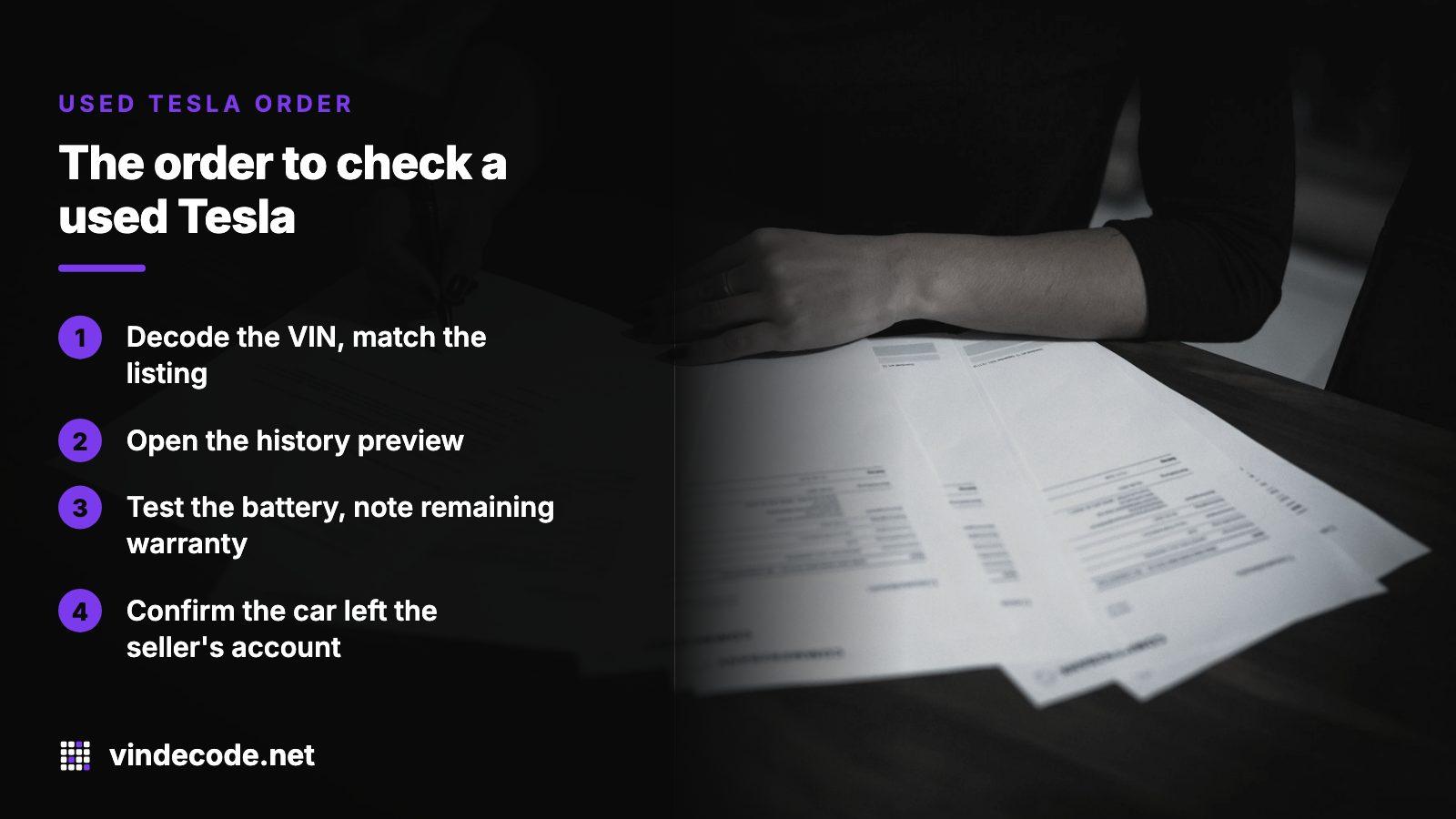
- Decode the VIN and match model, year, plant and motor line to the listing.
- Open the history preview for title brands, damage and odometer records.
- Ask Tesla about Supercharging if the title carries any brand.
- Watch the car's screens confirm each software feature claimed.
- Test the battery, and note what warranty remains on it and the drive unit.
- Run the recall lookup, then get an insurance quote using the real VIN.
- At handover, confirm the car has left the seller's account and their phone keys are gone.
From an NHTSA owner complaint
The owner of a 2018 Model 3, bought used in December 2022, told NHTSA the driver's belt would not catch on sudden stops. Tesla said it was not responsible for the part, and the owner adds they cannot know whether earlier owners noticed.
A decode matches that car perfectly and says nothing about faults earlier owners lived with. Ask for service records, and test belts and suspension on the drive.
Cost, and what to run next
The preview is free and needs no card. The full report is paid once: a single report or a set of three, five or ten, with no subscription after that. Amounts are listed on the pricing page. You decide after the preview whether the full report is worth buying.
Beyond the decode, the report brings title, damage, odometer, auction and theft records. Run the preview once the decode matches the listing, and read the full report before any money changes hands.
Where this information comes from
- NHTSA: vPIC VIN decoder — The public database where Tesla's VIN pattern sits, and where the decodes in the table were run.
- NHTSA: recalls lookup — Open-recall check by VIN, including campaigns whose remedy is a software update.
- EPA: fuel economy and range data — Official range and efficiency figures by model and variant, to compare with a test charge.
- NHTSA owner complaint 11765550 — owner experience, paraphrased
- NHTSA owner complaint 11726794 — owner experience, paraphrased
- NHTSA owner complaint 11518957 — owner experience, paraphrased
- NHTSA owner complaint 11406059 — Source of the LRW number decoded above; not an experience callout.
Sources and photos: Facts checked against the sources above in November 2026. Photos by smart-me AG, Dimitri Karastelev and Vanya Smythe on Unsplash; diagrams by VINDecode.
Keep reading
- VIN Decoder: Decode a VIN Number Online, Then Check Its HistoryEvery VIN position walked through, check digit included.
- NHTSA VIN Decoder: What It Returns, Where It Stops, What Comes NextHow the federal database behind these decodes works.
- Sample reportA finished report, to judge what history adds to a decode.
- PricingWhat the report costs: one payment, or a pack, with no subscription.
Frequently asked questions
How do I decode a Tesla VIN?
Enter all 17 characters in the decoder on this page, then read the model, year, body, motor line and plant it returns. Take the number from the car itself, since one wrong character gives an error or a different car.
What do 5YJ, 7SA and 7G2 mean on a Tesla VIN?
They are three-character maker codes that NHTSA lists for Tesla: 5YJ for passenger cars, 7SA for multipurpose vehicles and 7G2 for trucks. They do not name the factory. Position eleven does, and the decodes above show F for Fremont and A for Austin.
Can a Tesla VIN tell me if it has Full Self-Driving?
No. Software features are tied to the car's account and configuration, not to the number, so two similar cars can differ. Have the seller show the feature on the car's screen, then ask Tesla if a buyer keeps it after the sale.
Can I tell the battery type from a Tesla VIN?
Only in part. A decode narrows it by plant and model year without naming the pack, since chemistry has changed by plant, variant and date. The car's own screens or Tesla give the real answer.
Will a salvage-titled Tesla still use Superchargers?
Tesla has curbed Supercharger access for salvage-titled cars, and its position has changed over time. Ask Tesla about that exact VIN before buying, and check the title in the history preview first.
Now check the car itself
The guide explains what to look for. The report shows what this VIN has on record.