
THE SHORT ANSWER
NHTSA's vPIC service decodes a VIN through a plain GET request such as DecodeVinValues, with format=json and the model year added. Up to 50 VINs can go in one batch POST. Each response carries an error code that says how far to trust the fields. The data describes the build as filed, so accidents, title status and odometer history need a separate history check.
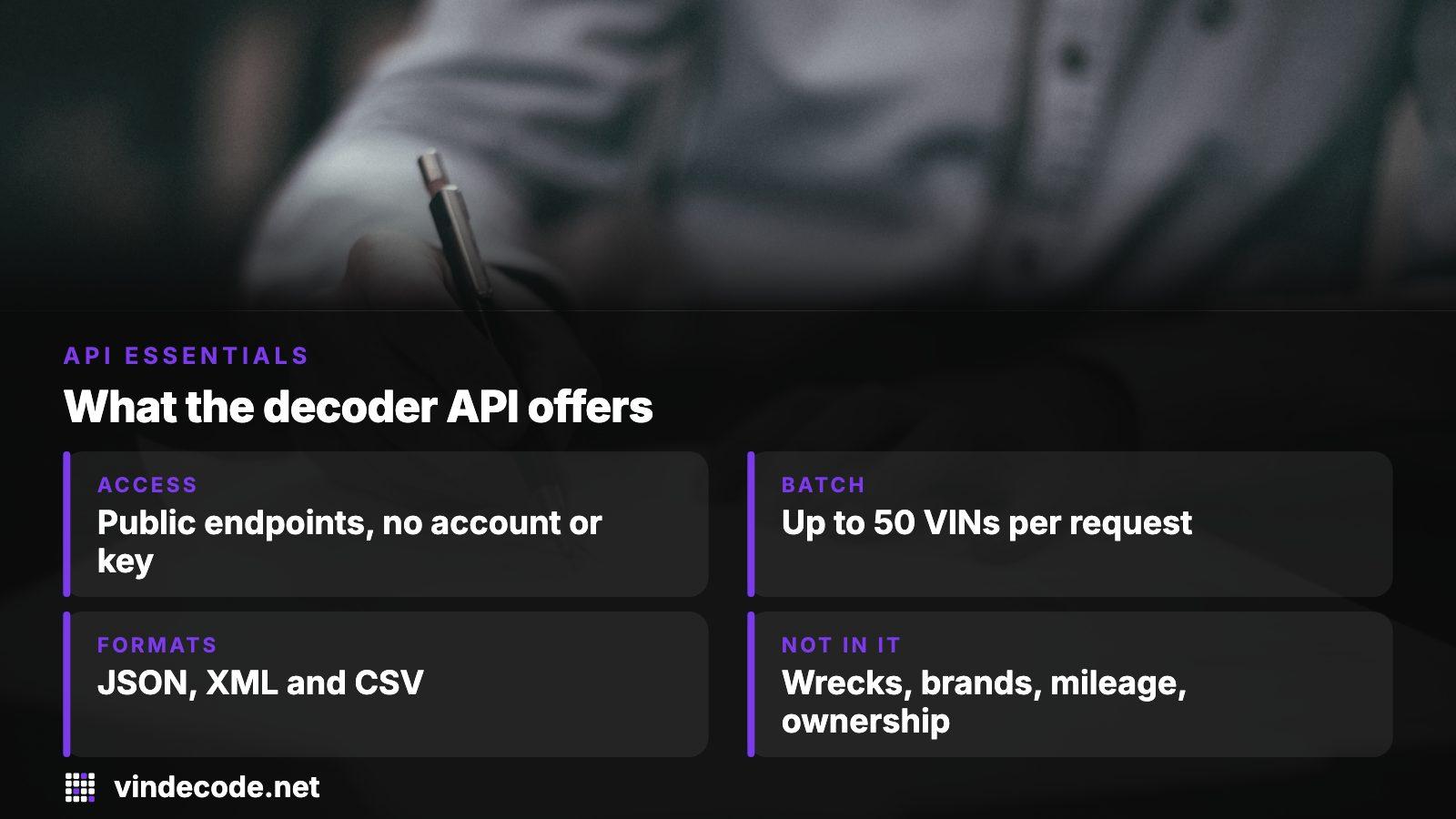
- Access
- Public endpoints, no account or key step documented
- Batch
- Up to 50 VINs per request
- Formats
- JSON, XML and CSV
- Not in it
- Wrecks, title brands, mileage, ownership
One request, one flat JSON object
The simplest call is a GET against the DecodeVinValues method on NHTSA's vPIC host, with the VIN in the path and format=json on the end. You get back a single results object, one field per variable, which is far easier to read in code than the key-value layout of the plain DecodeVin method. That older method returned 141 rows for the same VIN, each with a variable name, value and numeric IDs.
NHTSA recommends sending the model year too, as modelyear=, because it lets the decoder pick the right year range. If you send one that disagrees with the tenth character of the VIN, the call still answers, but the error field adds a warning. Treat the year you send as a claim you have verified against the title, not a default.
What a real VIN returned when I called it
I ran 1G1ZD5ST4PF233170 through the flat endpoint. The response held 154 fields, and 70 of them had a value. The ones a buyer would care about:
| What you read | What came back |
|---|---|
| Error field | 0 |
| Nameplate | Chevrolet Malibu, model year 2023 |
| Package | LT, listed as 1LT |
| Builder on file | GM, as General Motors LLC |
| Body class | Four-door passenger car |
| Powertrain | 1.5 liter gasoline four |
| Built at | Kansas City, USA |
Blank is the other half of that story. NHTSA attaches a notice to every response: an empty field means the agency has no data on that item, not that the car lacks the feature. Drive type came back empty for this sedan, which says nothing about whether it has one. Code defensively around nulls.
Batches, wildcards and the other endpoints
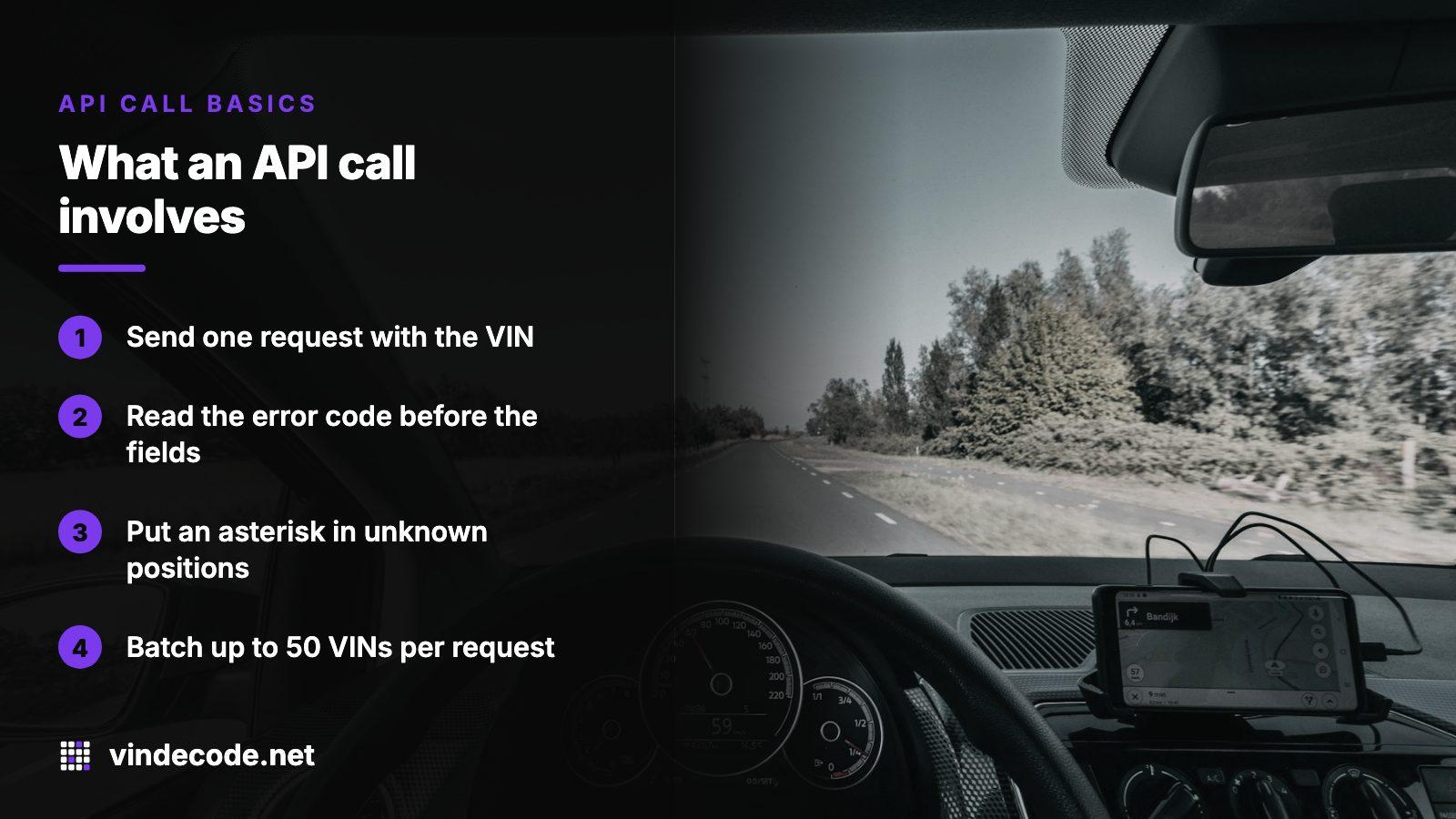
For a dealer lot or a spreadsheet, the batch method decodes up to 50 VINs per call. You POST a string with form fields named data and format, formatted as vin,year pairs separated by semicolons; the year is optional. A two-VIN test of mine came back as two rows, one clean and one flagged. Check codes row by row, never once per batch.
- Partial VINs: put an asterisk in each unknown position. The ninth character is not needed, and a truncated 15-character number still returned make, model and year in my test, along with code 6.
- DecodeWMI: feed it the first three characters and it names the manufacturer and vehicle type. The prefix 1FD answered Ford Motor Company, flagged as an incomplete vehicle.
- Extended variants: the same decode plus fields tied to other NHTSA programs.
- Catalog lookups: all makes, manufacturers and their details, paged in chunks of 100.
Reading the error code before the fields
The error field is a string, and it can hold several codes joined by commas. Parse it as a list. Three outcomes from my own calls show why:
| Input | Codes | Meaning for your code |
|---|---|---|
| Valid VIN | 0 | Clean decode, check digit correct |
| Valid VIN with a wrong year sent | 0, 12 | Fields fine, but your year argument disagrees with the VIN |
| Letter I in the last position | 1, 400 | Check digit fails and a character is illegal |
| Truncated to 15 characters | 6 | Incomplete VIN, partial fields only |
Gate on the code
Accept a record into your database only when the code list is exactly 0. Anything else deserves a flag for a human to look at, because a decode with a bad check digit can still return a confident-looking make and model.
Where the data comes from, and what that limits
Behind the catalog sit the filings makers send NHTSA under the federal VIN rule, 49 CFR Part 565. So it is authoritative about the build and silent about everything after the car left the factory. NHTSA also says requests pass through an automated rate control, and I found no published numeric cap. For a large job, batch the work, cache each result by VIN and retry after a pause.
NHTSA offers standalone vPIC databases for download as well, which suits anyone who would rather decode offline than depend on a public service staying quick.
Where a decoder API stops and a history check starts
Recalls come from a separate NHTSA service. Its endpoint takes make, model and year rather than a VIN, so a call for the 2023 Malibu returned the campaigns filed for that model year, not whether this one car had the fix. Title history sits in NMVTIS, a federal system aimed at fraud, unsafe cars and the resale of stolen ones.
That gap is why a spec sheet should never close a deal. Once a VIN decodes cleanly and the car is still in the running, search it with VINDecode. Start with the no-cost preview, then decide on the full report, one payment per vehicle, whose rates sit on the pricing page.
Build the handoff into your tool
If you wrap the decoder in your own app, show the decoded build and then link the same VIN to a history check as the next step, so users do not mistake the spec sheet for a clean record.
When a person, not a program, needs the answer
An API suits bulk jobs. A shopper with one VIN gets more from a page that explains the answer in brand terms, since each maker places its own meaning on the plant letter and the descriptor positions. VINDecode keeps decoder pages for individual brands, and the guides on reading a VIN by hand and on NHTSA's own web form cover the same data without any code.
Where this information comes from
- NHTSA: vPIC API documentation — Methods, formats, the batch limit, partial VIN rules and the rate-control notice.
- NHTSA: vPIC language examples — How the batch POST is built, with the data and format fields.
- NHTSA: sample JSON decode — The live response behind the table and error codes on this page.
- NHTSA: recalls by vehicle API — Shows that recall lookups key on make, model and year.
- VehicleHistory.gov: NMVTIS — What the federal title system is for and whom it serves.
Sources and photos: Facts checked against the sources above in November 2026. Photos by Jakub Żerdzicki, Sander Jeurissen and Scott Graham on Unsplash; diagrams by VINDecode.
Keep reading
- NHTSA VIN Decoder: What It Returns, Where It Stops, What Comes NextThe same federal data through the web form, with the result codes explained.
- VIN Decoder: Decode a VIN Number Online, Then Check Its HistoryWhat each of the 17 characters holds.
- VIN Decoder Explained: What Decoding a VIN Means and How It WorksReading a number by hand, no request needed.
- Sample reportA finished history report, to see what the API cannot supply.
Frequently asked questions
Is there a free VIN decoder API?
Yes. NHTSA runs the vPIC service and documents its endpoints publicly, with no account or key step mentioned on the page. Commercial decoders exist too, usually adding fields or support. Whichever you pick, a decoder reports build data only, so it will not replace a title and damage check on a used car.
How many VINs can I decode in one call?
The batch method accepts up to 50 VINs per request. Send them in one string as vin,year pairs divided by semicolons, with the year optional. Each VIN gets its own result row and its own error code, so loop over the rows and judge them one at a time.
Does the API return accident or title history?
No. The data comes from manufacturer filings about how the vehicle was built. Nothing in it records crashes, brands such as salvage or flood, odometer readings, liens or owners. Those live in title and insurance records, which a vehicle history report searches by VIN.
What does a blank field mean in the response?
It means NHTSA holds no data for that variable on that VIN. It does not mean the car lacks the feature. A sedan can come back with no drive type listed and still have one, so avoid writing code that treats null as no.
Can I decode a VIN with missing characters?
Yes. Replace each unknown position with an asterisk. The ninth character is not required. A shortened number decodes only as far as the characters allow and comes back with code 6, so use it to narrow candidates, not to confirm a vehicle.
Now check the car itself
The guide explains what to look for. The report shows what this VIN has on record.