THE SHORT ANSWER
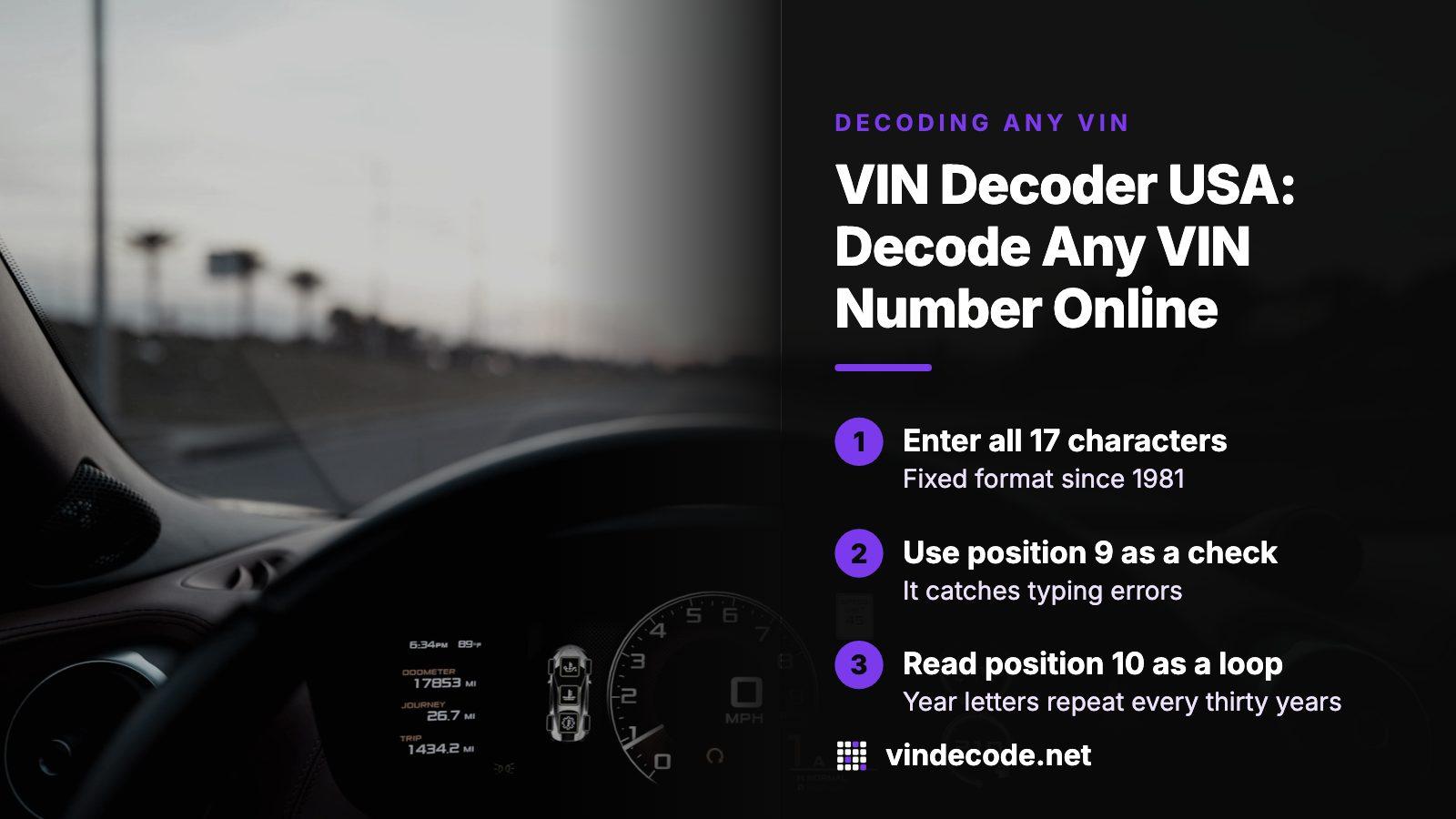
To decode a VIN number online, type all 17 characters into the form above and read back the factory build: who made the vehicle, which model, body and engine, the model year and the plant. The check digit in position 9 catches typos. A decode cannot show wrecks, branded titles or mileage fraud. Those live in separate records, which the history report searches by the same VIN.
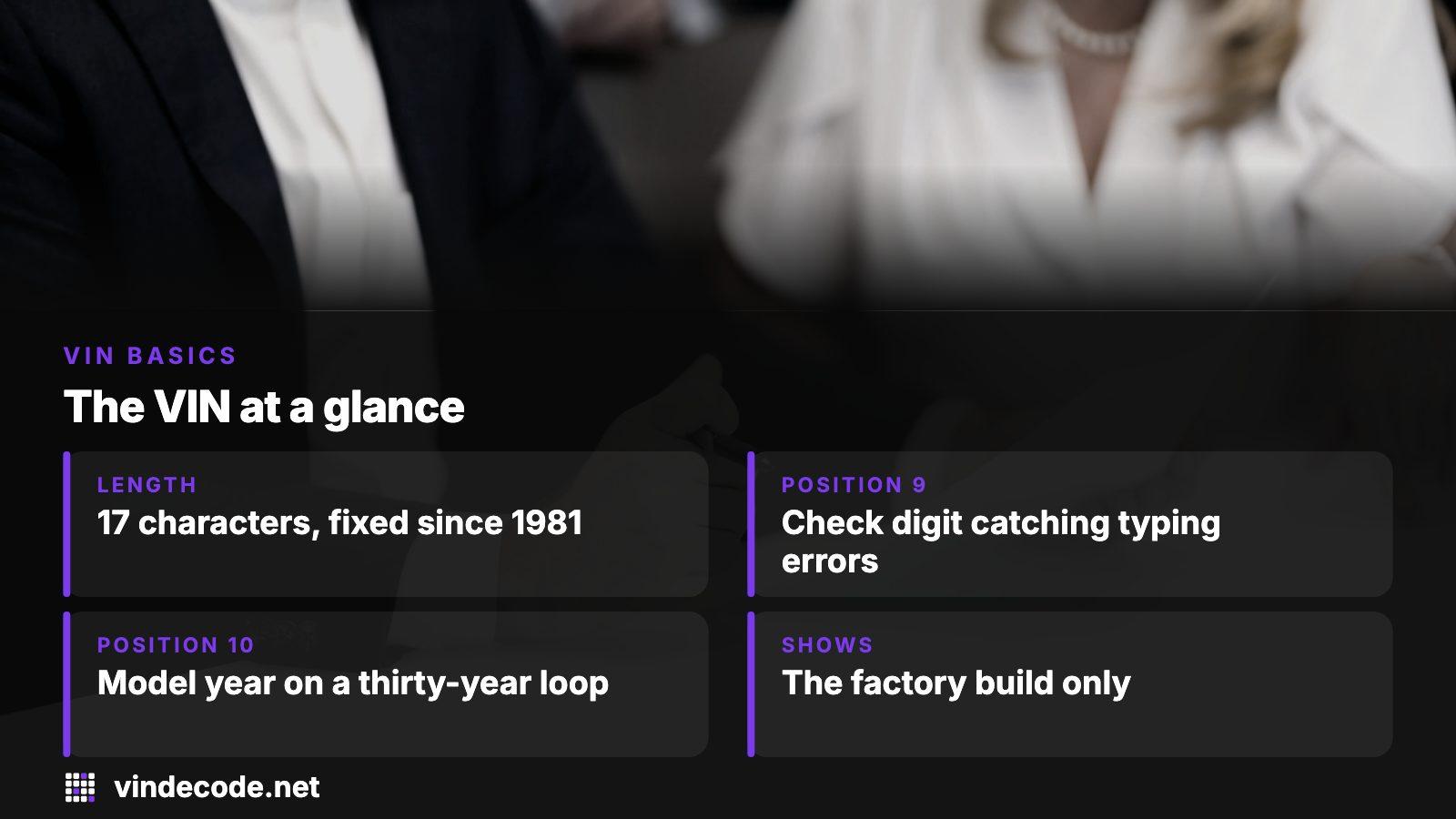
- Length
- 17 characters, a fixed format since 1981
- Position 9
- A check digit that catches typing errors
- Position 10
- Model year, on a thirty-year letter loop
- Shows
- The factory build, not the car's later life
What decoding a VIN returns, shown on a real number
To see a decode, take 1G1ZD5ST4PF233170 and run it through NHTSA's public decoder. It reads back a full factory description.
| Field | Result for 1G1ZD5ST4PF233170 |
|---|---|
| Model and year | Chevrolet Malibu, model year 2023 |
| Body | Sedan, 4 doors |
| Engine | 1.5-liter gasoline four-cylinder |
| Trim | LT |
| Builder | General Motors LLC, Kansas City, Kansas |
| Status line | Decoded clean, check digit correct |
Every field there came from the assembly line. Paint color, dealer add-ons and owner count are missing, because no character records them.
What each of the 17 characters tells you
Read left to right, the number narrows from country and maker to the model and then to the single car.
| Position | Block | What it holds |
|---|---|---|
| 1 to 3 | Maker | Country, builder and vehicle type |
| 4 to 8 | Descriptor | Model line, body style, engine family, restraints |
| 9 | Check digit | Arithmetic proof that the rest was typed right |
| 10 | Model year | One letter or digit |
| 11 | Plant | The factory that assembled the car |
| 12 to 17 | Serial | This vehicle's place in the production run |
The first character alone narrows the origin. Cars built in the US start with 1, 4 or 5, Canadian ones with 2, Mexican with 3, Japanese with J, Korean with K and German with W.
Position 10: a model-year letter on a thirty-year loop
Position 10 encodes the model year and skips I, O, Q, U and Z. Recently G means 2016, L 2020, P 2023 and T 2026. Letters covered 1980 to 2000, digits took the nine years after, and then the letters started over, so a letter alone is ambiguous until you know the car's rough age.
From an NHTSA owner complaint
An owner of a 2016 Hyundai Elantra told NHTSA that a web search of the VIN on two decoder sites returned a 1986 Elantra GLS, not the 2016 SE or Value Edition the owner believed it was. The complaint says no more than that.
The tenth character of that VIN is G, which reads as 2016 and, thirty years earlier, 1986. The complaint does not say why the sites chose 1986, but a letter read without context is an easy way to land on the wrong year. NHTSA's database reads the first characters of that VIN as a 2016 Elantra. Check the year against the title.
How the same decode reads on different brands
Each maker fills the same frame with its own prefixes and plant letters. This is how NHTSA's database files a few common ones.
| Badge | Prefixes | What they mark |
|---|---|---|
| Ford | 1FA, 1FM, 1FT | Car, multipurpose vehicle, truck |
| Chevrolet | 1G1, 1GC | Car and truck, both filed under General Motors |
| Honda | 1HG, 2HG | Car built in the US, car built in Canada |
| Toyota | JTD, 5TF | Car built in Japan, truck built in Texas |
| Volkswagen | WVW, 3VW | Built in Germany, built in Mexico |
| Chrysler, Dodge, Jeep, Ram | 1C4, 2C3 | 1C4 is shared by several badges; 2C3 marks Canadian-built cars |
A prefix names the legal builder and a vehicle class, so one code can cover several brands. A 9 in position 3 signals that the maker's identity continues at positions 12 to 14, which is how builders under 1,000 vehicles of a type a year are identified. The make-by-make guides here cover each brand's engine and plant letters.
When the decode and the car disagree
Trim, cab and engine are the fields owners dispute. Two took it to NHTSA.
From an NHTSA owner complaint
A Toyota Tundra owner, who bought a 2025 1794 CrewMax in late 2024, told NHTSA that the agency's own VIN decoder listed the truck as a Double Cab. Several cases opened with Toyota had produced no satisfactory answer, and the owner feared a hit to resale value.
Trim names are marketing as much as engineering. A trim that disagrees with the badge is something to ask the seller about.
From an NHTSA owner complaint
An owner of a 2022 Chrysler 300 filed a single-sentence complaint: a decoder reported eight cylinders for the VIN, but the car has the 3.6-liter V6. No decoder was named. Run through NHTSA's decoder for this page, that VIN reads as a six-cylinder 3.6-liter built in Brampton, Ontario, which fits the 2 at the front.
Two decoders can disagree on one number. Look under the hood, and keep the federal database's answer as your reference.
Getting the number right before you type it
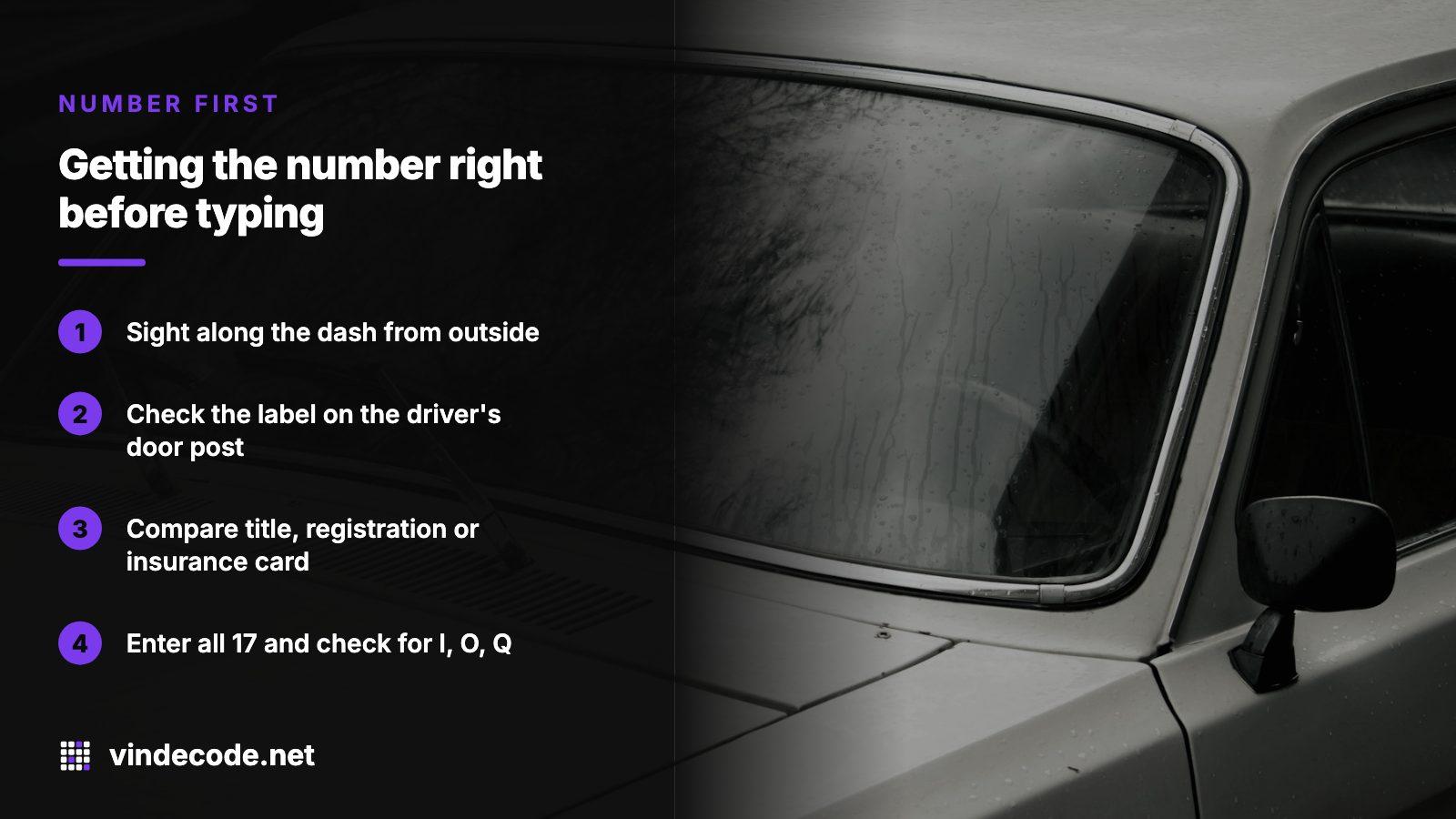
- Crouch outside beside the driver's side windshield pillar and sight along the dashboard. For cars, SUVs and light trucks the federal rule says the number must be legible through the glass from that spot.
- Check the label on the driver's door post, which repeats it.
- Lay the title, registration or insurance card alongside and compare every character.
- Enter all 17. The alphabet VINs draw on has no I, O or Q, so if the form balks, look first at characters that resemble 1 or 0.
A failed check digit usually means one typo. Vehicles built for some other markets skip the check, so a mismatch means look twice, not accuse. Etching on a window is not the VIN: the rule puts it on a part or plate that stays put, and excludes glass.
Where the decode stops and the history report starts
A decode comes out the same today and in ten years, because the build never changes. What happened to the car afterward sits in other records under the same number.
| Buyer's question | Where the answer sits |
|---|---|
| Was it wrecked, and where was it hit? | Accident and damage records |
| Is the title branded salvage, flood or rebuilt? | Title brand records |
| Does the mileage climb believably? | Odometer readings across the years |
| Has it been through an auction yard? | Auction lots, salvage records and photos |
| Does anyone hold a claim, or was it reported stolen? | Lien, impound and theft records |
| Is a safety recall still open? | Recall status for this exact VIN |
A car can decode as exactly what the advert says and still carry a salvage brand. The decode proves identity; the report shows the life.
The federal rules behind every decode
In the United States the format comes from 49 CFR Part 565, which follows the international standard ISO 3779. It demands 17 characters, sets the check digit at position 9 and bans I, O and Q. No two vehicles under the safety standards may share a VIN within sixty years counted from the 1980 model year, so the promise lapses after model year 2039. NHTSA does not issue maker codes: SAE International runs that registry under contract and the agency publishes the assignments.
Running the decode, and what happens after
- Read the VIN off the car and enter it in the form above.
- Compare the year, engine and body in the preview with the listing. The preview is free and needs no card.
- If the build fits, decide on the report. You pay once, for one report or for three, five or ten at once, and nothing recurs. Current amounts sit on the pricing page.
- Run the same VIN through NHTSA's recall tool, which the agency offers at no charge, and have a mechanic you chose inspect the car before money moves.
Where this information comes from
- NHTSA: vPIC VIN decoder — The federal database used to confirm the sample decode, the maker prefixes and the Chrysler example.
- eCFR: 49 CFR Part 565, VIN requirements — Sets the length, the check digit position, the allowed characters and where the number must be readable.
- NHTSA: recalls lookup — Checks one VIN for open recalls, repaired by the maker without charge.
- ISO 3779: VIN content and structure — The international standard behind the 17-character layout.
- NHTSA owner complaint 11056236 — owner experience, paraphrased
- NHTSA owner complaint 11653034 — owner experience, paraphrased
- NHTSA owner complaint 11494253 — owner experience, paraphrased
Sources and photos: Facts checked against the sources above in November 2026. Photos by Dennis Eusebio, Tigran Shishmanyan and Carrie Allen www.carrieallen.com on Unsplash; diagrams by VINDecode.
Keep reading
- NHTSA VIN Decoder: What It Returns, Where It Stops, What Comes NextThe federal database behind most decoders, and where it stops.
- Ford VIN Decoder: Decode a Ford VIN, Then Check Its HistoryFord prefixes, the engine character and the plant letters worked through.
- Classic Car VIN Decoder: Which Years It Reads and What Comes AfterNumbers from before the 17-character standard.
- Sample reportA finished report, to see what the history adds after the decode.
Frequently asked questions
Does a VIN decoder show accidents or title problems?
No. A decoder reads only what the maker recorded at the factory. Accidents, salvage brands and odometer readings come from title, insurance and auction records, so a clean decode says nothing about them. The history report searches those records under the same number.
Can I decode a VIN from a listing before seeing the car?
Yes, and it makes a useful first filter. If the decoded year, engine or body disagrees with the advert, you have a question for the seller before you travel. Confirm the number on the car afterward, since listing numbers get mistyped.
Why does the decoder name a different company than the badge?
Each maker code is registered to a company, and that company may not share a name with the badge. Codes also outlast brand sales and plant changes. A surprise in the maker field alone is usually normal; a surprise in year, engine or body deserves a question.
Will a VIN decoder work on a car from before 1981?
Not in a standard tool. The 17-character format dates from 1981, and earlier cars carry shorter numbers that each maker designed itself. The classic-car decoder guide explains how those are read.
Why do VINs never contain the letters I, O or Q?
The federal rule limits VIN characters to a set that leaves those three out, so a misread letter cannot pass for a 1 or a 0. If a decoder rejects your entry, check those positions first.
Now check the car itself
The guide explains what to look for. The report shows what this VIN has on record.