
THE SHORT ANSWER
Decoding a VIN means checking its 17 characters for typing errors, then matching them to the descriptions the maker gave NHTSA. You get the make, model, model year, body, engine and build plant. You do not get owners, accidents, mileage or title status, because no character records them. Those sit in separate files keyed to the same number, which a history report searches.
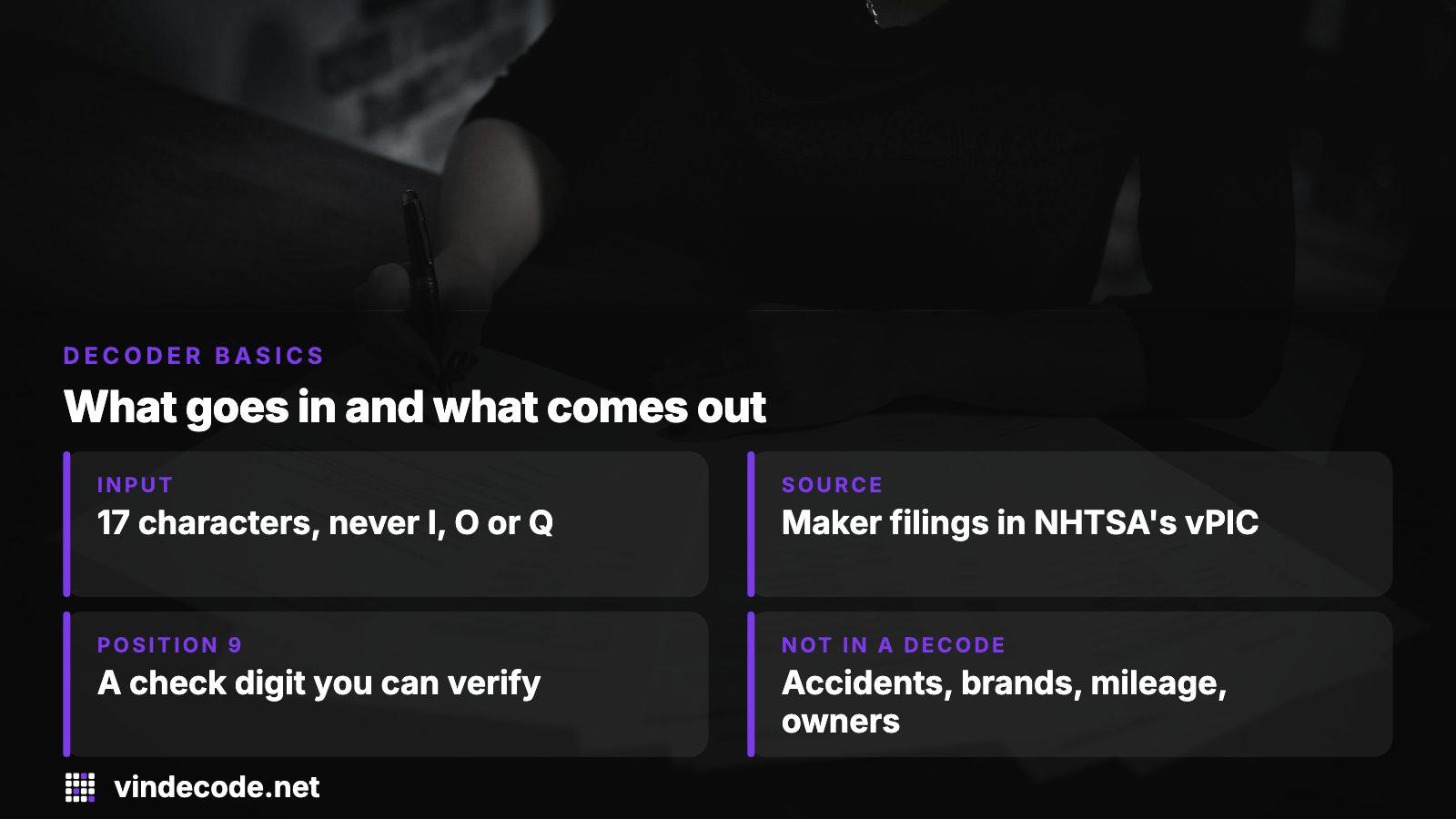
- Input
- 17 characters, never the letters I, O or Q
- Source
- Maker filings held in NHTSA's vPIC catalog
- Position 9
- A check digit you can verify with arithmetic
- Not in a decode
- Accidents, title brands, mileage, owners
Decoding is a lookup, not a code-breaking trick
The word suggests a cipher, but a VIN hides nothing. Each maker selling in the United States files a description with NHTSA of what its characters stand for, and the agency's vPIC catalog keeps those filings. A decoder matches your number to the right filing and prints the result.
That makes a decode only as detailed as the filing. When a field comes back empty, NHTSA simply has no entry for it; the car may well have the equipment. The answer is also stable, since the number describes the car as it was assembled.
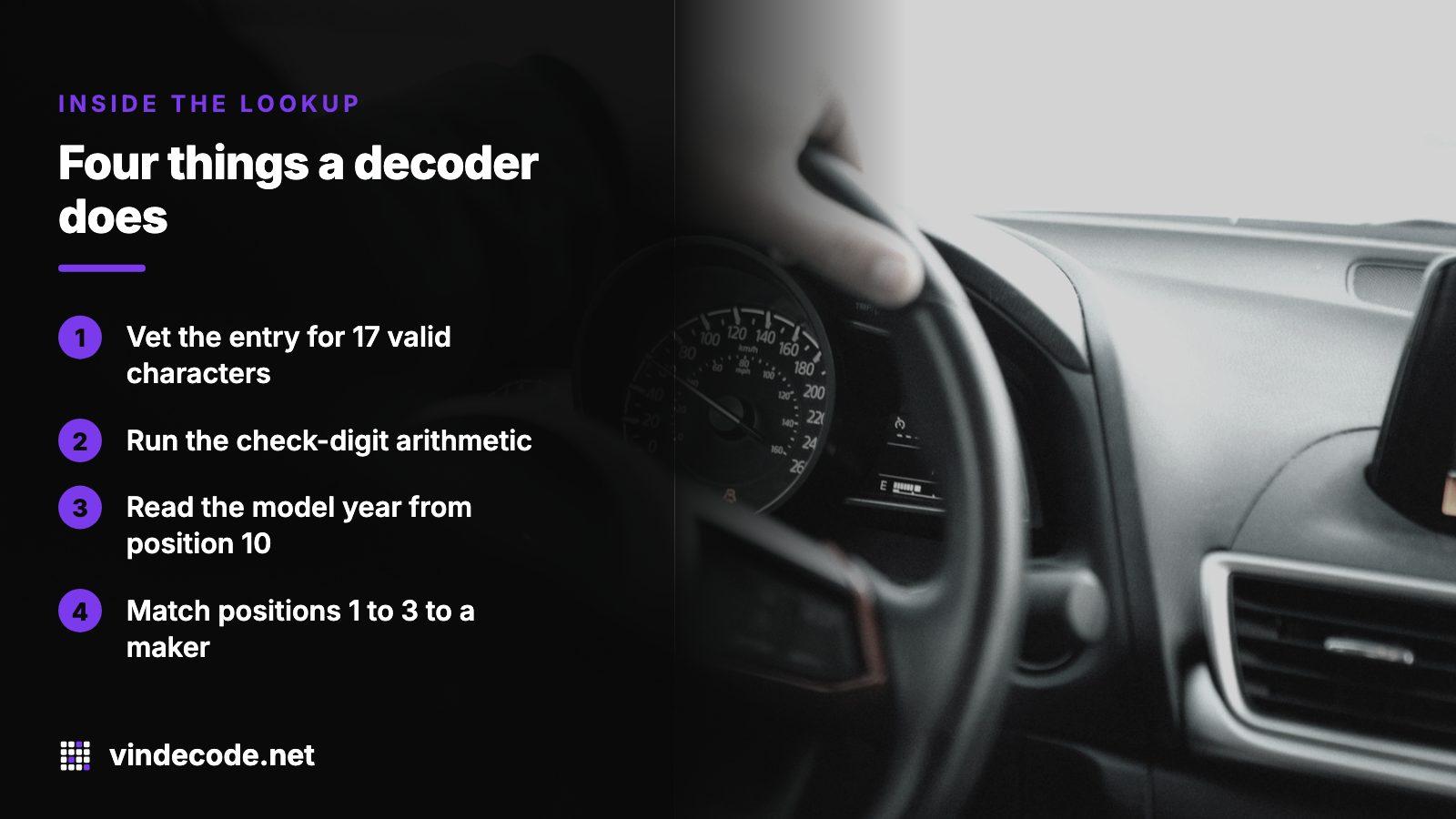
Four things a decoder does with your number
NHTSA's own list of result messages shows where a lookup can break. Roughly, a decoder does this.
- It vets the entry: 17 characters, none the format forbids.
- It runs the check-digit arithmetic on position 9, which exists to catch typing slips.
- It reads the model year from position 10, unless you typed a year into the year box, which wins.
- It matches positions 1 to 3 to a maker and positions 4 to 8 to that maker's filed descriptions, then reports the build plant from position 11.
The last six characters are the maker's production serial. They make the number unique and describe nothing.
The check digit, worked by hand
Position 9 is the one character you can check yourself, and the federal rule prints a worked sample.
- Give each character a number: digits keep theirs, and letters take values from a table in the rule (A is 1, G is 7, H is 8).
- Multiply each by its position's weight, a number from 2 to 10 listed in the rule, with zero for position 9.
- Add the products. The rule's sample, 1G4AH59H_5G118341, totals 411.
- Divide by 11. The remainder, 4, becomes the ninth character; a remainder of 10 is written X.
NHTSA's decoder accepts the finished number, 1G4AH59H45G118341, without a check-digit error, though it still warns that a few positions match no filed pattern. Change the ninth character to 5 and a check-digit error appears. The arithmetic proves careful typing, nothing more.
Position 7 decides which year cycle position 10 belongs to
Year symbols repeat. Digits 5 to 9 stand for 2005 to 2009 and again for 2035 to 2039, and the rule's year table runs letters from A for 2010 to Y for 2030. A symbol alone cannot say which cycle it belongs to.
The rule gives cars, SUVs and trucks rated at 10,000 pounds or less a tie-breaker in position 7: a letter means 2010 to 2039, a digit means 1980 to 2009.
| Number | Position 7 | Position 10 | Reads as |
|---|---|---|---|
| 3N1AB6AP9BL (Nissan Sentra) | A, a letter | B | 2011 |
| 1FTEW1EG9HK (Ford F-150) | E, a letter | H | 2017 |
| 1G4AH59H45G118341 (rule's sample) | 9, a digit | 5 | 2005 |
NHTSA's decoder returns those same years. Heavier vehicles sit outside the tie-breaker. And model year is not build date: one model year may cover as much as 24 months of production.
Decoding a number you only half have
NHTSA's decoder takes partial numbers, with an asterisk for each missing character, and does not need the ninth. The documentation's example, 5UXWX7C5*BA with the year 2011, returns a BMW X3 xDrive35i with a 3.0-liter six-cylinder engine rated at 300 horsepower, marked incomplete.
The year box is blunt: what you type replaces the year position 10 implies. Enter 2008 beside the Sentra number above and the decoder answers for 2008, then adds a year warning because the tenth character says 2011. Leave the box empty unless the number gives you nothing to read.
Reading the messages a decoder sends back
NHTSA numbers its messages, and six cover most results.
| Code | Meaning | What to do |
|---|---|---|
| 0 | Clean decode, check digit correct | Compare it with the listing |
| 1 | Check digit fails | Re-read the number off the car |
| 5 | Errors in a few positions, marked with ! | Check the marked positions |
| 6 | Incomplete number | Fine for a glance; complete it for detail |
| 12 | Entered year disagrees with position 10 | Clear the year box or fix the number |
| 14 | No data for some characters | Treat those fields as unknown |
Treat an empty field as unknown, not as a no: NHTSA says it means the agency lacks the data.
When the paperwork and the car decode differently
A decode doubles as a document audit. Run the VIN stamped on the car and the VIN typed on the paperwork, and year, make and body should agree. The FTC says a mechanic's written estimate should list the VIN, and to keep it handy when phoning a dealer about warranty cover.
From an NHTSA owner complaint
The owner of a 2011 Nissan Sentra told NHTSA that after a dealer visit in early 2023 the paperwork listed a different VIN, off by two characters, and gave the year as 2008. The shop said its system scans the number rather than typing it. Local police helped the owner find the correct VIN, and the owner worried the work was logged against someone else's car. The complaint centers on a brake failure; only the paperwork is cited.
NHTSA's decoder reads that fragment as a 2011 four-door sedan built in Aguascalientes, Mexico. A 2008 car would show an 8 in position 10. A year the number cannot produce is grounds to ask for corrected paperwork.
Where decoding stops and record searches begin
No character records a wreck, a brand or a rollback, so a decode cannot report one; those events live in other files filed under the same number. NMVTIS, the federal title system, was set up against title fraud, unsafe vehicles and the resale of stolen cars. The FTC notes that a history report may list crashes and flood damage but rarely mechanical faults, and does not replace an inspection.
From an NHTSA owner complaint
An owner of a 2017 Ford F-150 told NHTSA that both the maker's portal and NHTSA's VIN lookup showed no open recalls, even though the owner held a Ford recall letter about a transmission downshift defect. The owner called it a data error and asked NHTSA to examine how Ford reports on that truck. The complaint does not settle which record is right.
A recall lookup searches recall records, not the build. The truck's first characters decode as a 2017 SuperCrew built in Kansas City, Missouri. Keep the letter, ask the maker or a dealer to confirm status, and get the reply in writing.
From the decode to the history report
Start with the decode: enter the number in the form above and compare year, engine and body with the listing. The make-by-make decoder pages here cover how Ford, Nissan, Toyota and others fill positions 4 to 8. Then decide whether the history is worth buying.
- You see a free preview first. Buying afterwards is a single payment with nothing to renew, covering one report or a batch of three, five or ten. Check the pricing page for amounts.
- The report adds what a decode cannot: branded titles, crash and damage records, the mileage trail and any auction photos.
Either way, have a mechanic you chose inspect the car before money changes hands.
Where this information comes from
- NHTSA: vPIC API documentation — Explains where decode data comes from, partial numbers and the missing-value note.
- NHTSA: VIN decoder — The year box behavior, the pre-1981 warning and the plant section.
- eCFR: 49 CFR Part 565, VIN requirements — The check-digit method and sample, the year codes and the position 7 rule.
- FTC: Buying a used car from a dealer — What history reports show and miss, and why an independent inspection still matters.
- NMVTIS: vehicle history information — The federal title system and why it exists.
- NHTSA owner complaint 11508705 — owner experience, paraphrased
- NHTSA owner complaint 11753381 — owner experience, paraphrased
Sources and photos: Facts checked against the sources above in November 2026. Photos by Michal Biernat, Miles Loewen and Dimitri Karastelev on Unsplash; diagrams by VINDecode.
Keep reading
- VIN Decoder: Decode a VIN Number Online, Then Check Its HistoryThe decoder itself, with a full factory build read back from a real number.
- NHTSA VIN Decoder: What It Returns, Where It Stops, What Comes NextMore on the federal database behind most decoders and what it leaves out.
- Ford VIN Decoder: Decode a Ford VIN, Then Check Its HistoryHow Ford fills the descriptor block, with prefixes and plant letters.
- Sample reportA finished history report, to see what the decode leaves out.
Frequently asked questions
What does it mean to decode a VIN?
It means matching the 17 characters to the maker's filed descriptions to learn the make, model, year, body, engine and plant. The result covers the car as assembled and nothing after, so running the same number next year returns an identical answer.
Can anyone decode a VIN?
Yes. NHTSA runs a public decoder and an interface for developers, within traffic limits, and the format rules are published. The number has no field for a name or address, so a decoder cannot reach owner details, only the build the maker filed.
Why does my VIN decode as a different year than the title?
Suspect a mistyped tenth character first, then a year typed into the year box, which overrides the number. A third cause is model year versus build year, since one model year may span up to 24 months of production. Compare the car's number with the title.
Does a decode work on a car from before 1981?
Not through NHTSA's decoder, whose page flags a pre-1981 year as an invalid attempt. Older numbers need a reference written for that maker and era. Until you have one, treat any confident answer from a modern tool as a guess and check it against the title.
Is it safe to type a VIN into a decoder?
Generally. The rule makes the number readable through the windshield from outside, and the format holds no personal data. Judge the site instead: NHTSA's decoder asks only for the number and an optional year, while a page demanding a card for a basic decode is selling something else.
Now check the car itself
The guide explains what to look for. The report shows what this VIN has on record.