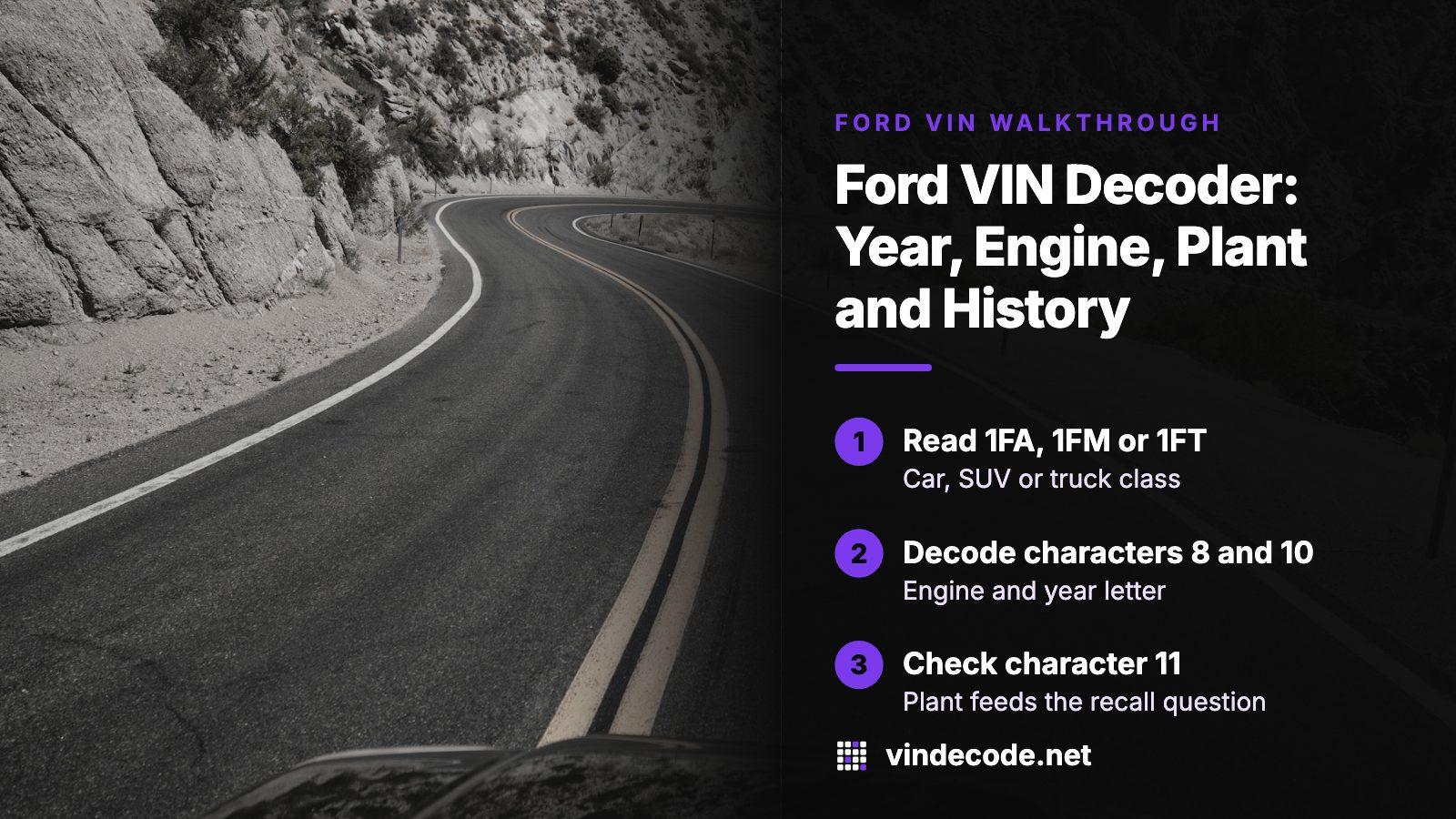
THE SHORT ANSWER
Enter all 17 characters of the Ford VIN in the decoder above. The first three give the maker and class: 1FA is a car, 1FM an SUV or crossover and 1FT a truck. The engine sits at position 8, the model year at 10 and the plant at 11. The decode shows what left the factory. Accidents, title brands and odometer history sit in other records, which the history report searches.
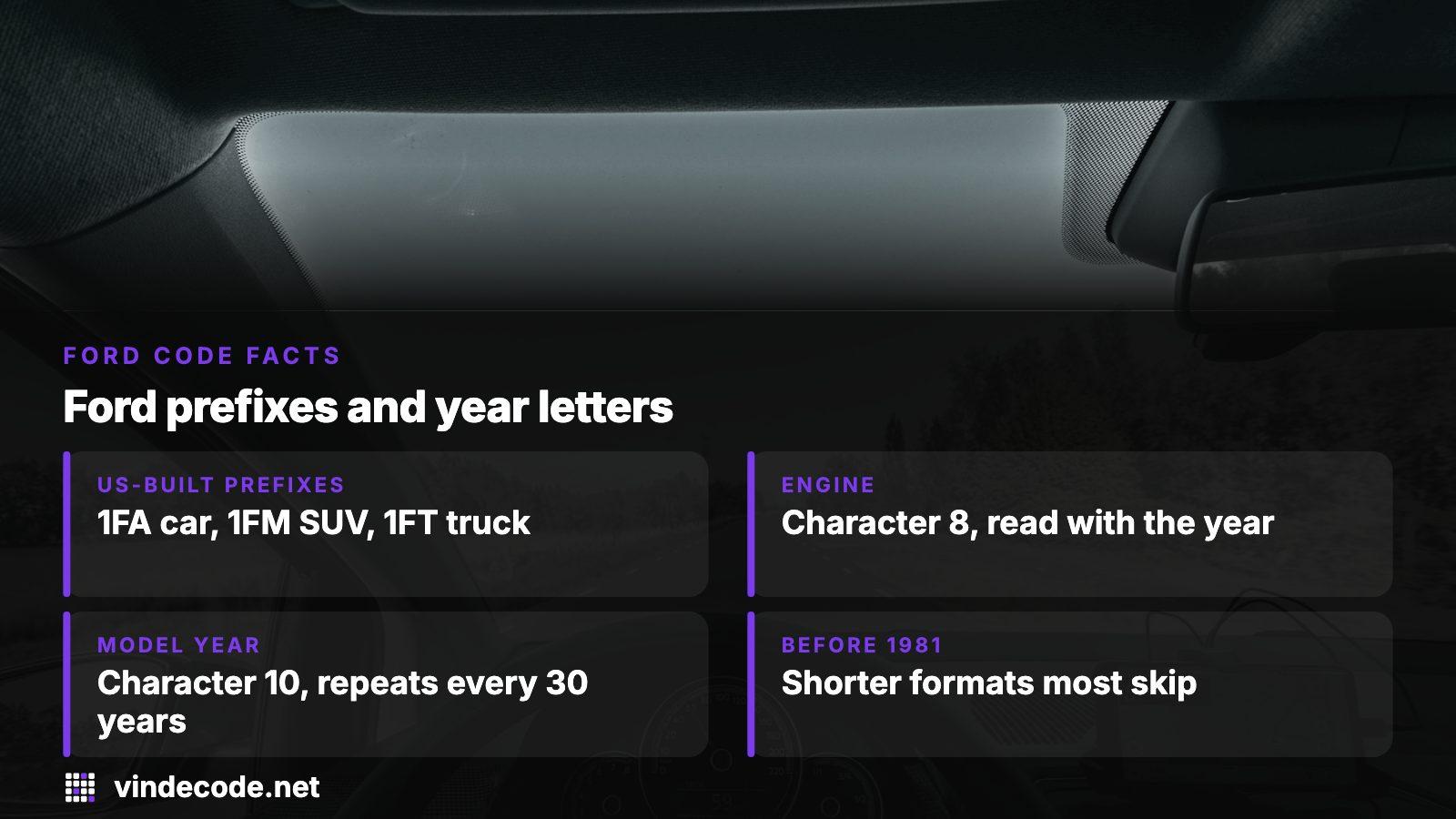
- US-built prefixes
- 1FA car, 1FM SUV, 1FT truck
- Engine
- Character 8, read against the model year
- Model year
- Character 10, a letter cycle that repeats every 30 years
- Before 1981
- Shorter formats that most decoders skip
What a Ford VIN decode returns
Two Fords with the same badge can differ in engine, drive and body, and the price follows. Below is what NHTSA's public database returns for a 2013 F-150 test string, 1FTFW1ET3DFC10001.
| Field | Result for 1FTFW1ET3DFC10001 |
|---|---|
| Model and year | Ford F-150, model year 2013 |
| Body | Pickup |
| Engine | 3.5-liter six-cylinder, gasoline |
| Drivetrain | Four-wheel drive |
| Assembly plant | Dearborn, Michigan |
| Status line | VIN decoded clean, check digit correct |
Restraint system and country of manufacture come back too. If the status line reports a problem, retype the number before you trust any field.
Reading the number off the Ford, not the advert
A number copied from a listing or a text message invites a wrong character, and one wrong character returns an error or a different vehicle. Read it from the metal.
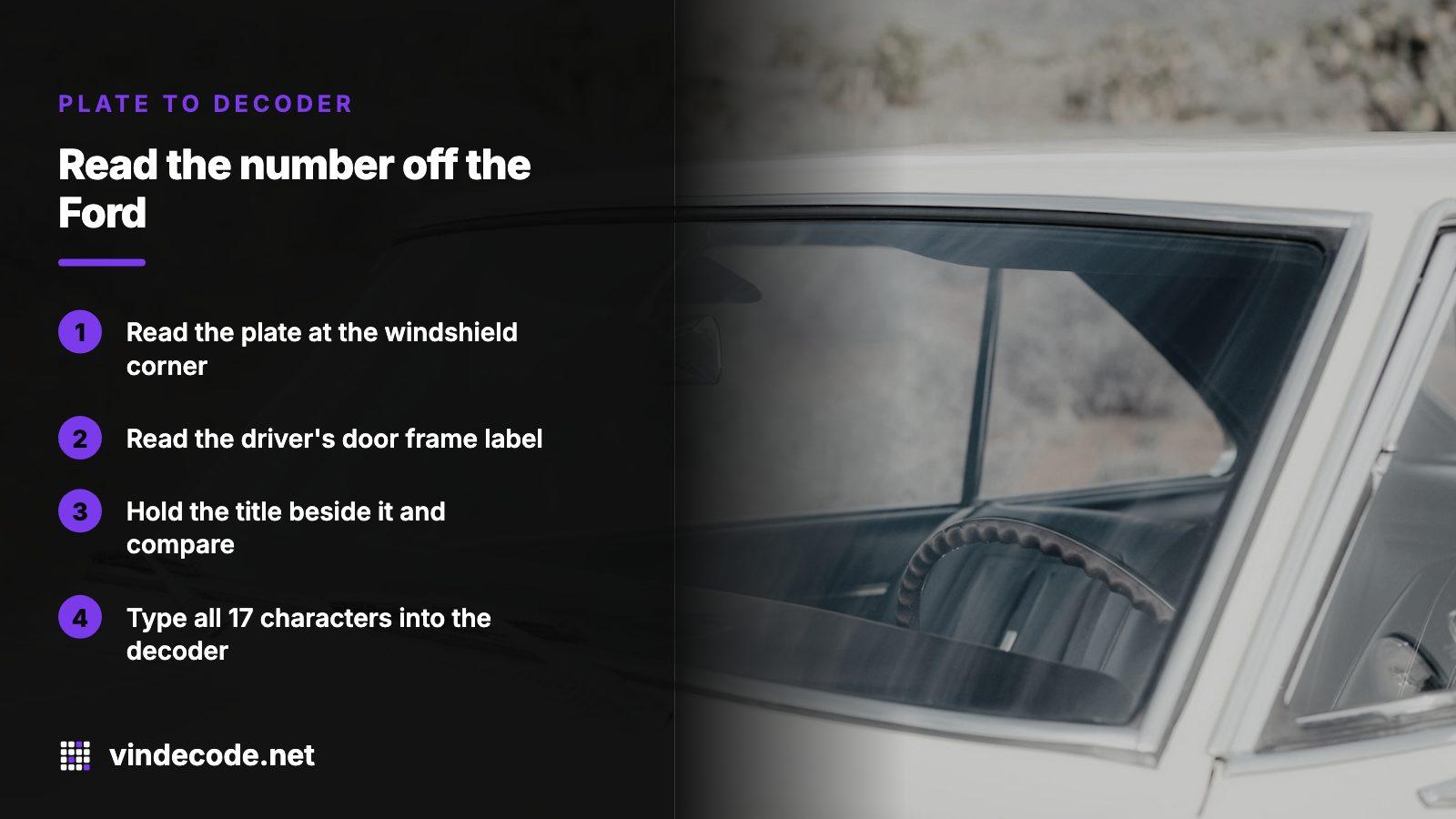
- From outside on the driver's side, bend to the lower corner of the windshield and read the small plate through the glass.
- Open the driver's door. The label on the frame repeats the number and shows the month the truck or car was built.
- Hold the title, registration or insurance card beside it. Every character should match the plate.
- Type all 17 characters into the decoder above. The letters I, O and Q do not occur in any VIN, so an error on one of them means a misread character.
A plate that disagrees with the door label or the paperwork should stop the sale until the seller explains it. A replaced or tampered plate is among the clearest signs of a cloned identity.
Characters 1 to 3: the Ford prefixes
The first three characters name the country, the maker and the vehicle class. Class is a legal category rather than a size, so a crossover registered as a multipurpose vehicle gets 1FM even if its platform is shared with a 1FA car.
| Prefix | What it marks |
|---|---|
| 1FA | Ford car built in the United States |
| 1FM | Multipurpose vehicle, such as an Explorer or Escape |
| 1FT | Truck, such as an F-Series or Ranger |
| 1FD | Incomplete vehicle, a chassis finished by another company |
| 2FA, 2FM, 2FT | Canadian-built: car, multipurpose vehicle, truck |
| 3FA | Ford of Mexico, passenger car |
| 1LN, 5LM | Lincoln car and Lincoln SUV, filed under Ford Motor Company with codes of their own |
Two prefixes that surprise buyers
A VIN opening 1FD belongs to a chassis that a second company turned into an ambulance, box truck or camper, and nothing in the number describes that work. A Mustang opening 1ZV came from a joint-venture plant and is filed under another manufacturer name, though to a buyer it is a Ford like any other.
Characters 8 and 10: engine and model year
Character 8 is the engine code, and Ford decides what each letter means, so the meaning shifts between generations. The same letter can mean a plain V6 on an older model and a boosted four on a newer one. Read it against the model year, then look in the engine bay, because a swapped engine affects insurance, emissions compliance and resale.
Character 10 carries the model year, as a letter or digit that repeats every 30 years. Five letters are skipped: I, O, Q, U and Z. Before 2010 the digits 1 to 9 stood for 2001 to 2009, and letters ran from 1980 to 2000, which is why a letter alone settles nothing until you know the generation.
| Letter | Model year |
|---|---|
| A | 2010 |
| D | 2013 |
| H | 2017 |
| L | 2020 |
| P | 2023 |
| T | 2026 |
Model year is not build date. The door label carries the month it was assembled.
Character 11: the plant, and the recall question
Character 11 is the assembly plant. F is Dearborn Truck in Michigan and K is Kansas City Assembly in Missouri, two common ones on F-Series trucks. Codes have been reassigned over the years, so read the character with the model year. It matters because a recall is often scoped to one plant and a window of build dates.
From an NHTSA owner complaint
A 2008 Ford Escape owner told NHTSA the power steering failed while leaving a parking lot. A mechanic pointed to a recall, but the dealer ran the VIN and found nothing open. The owner said the recall notes pointed to Escapes assembled in Kansas City, and that the VIN placed this one there.
Take from it that the plant is worth reading before you call anyone. If a notice names your plant and the dealer's lookup shows nothing, ask for the answer in writing and check the same VIN in NHTSA's recall tool.
When the VIN lookup and the listing disagree
Recalls attach to VIN ranges, so the question is whether this vehicle has one open, not whether the model ever had one. NHTSA publishes the answer by VIN, and the manufacturer repairs recalls at no cost to the owner, however many owners the car has had.
From an NHTSA owner complaint
A 2016 Ford Focus SE owner told NHTSA that listings for the model showed an open recall, yet a search by VIN found nothing for their car. The dual-clutch transmission began warning of overheating soon after the purchase, and by the owner's account the dealer would not inspect it under warranty.
Record what the lookup says before you buy. The decode names the exact build, and that build is the one to read owner complaints about.
Where the decode stops and the history report starts
A VIN describes the car as built. Everything after the factory sits in other records, which the decoder never reads and the history report searches under the same number.
| Question after the decode | Where the answer sits |
|---|---|
| Has it been wrecked or claimed on? | Accident, damage and insurance records |
| Is the title branded salvage, rebuilt, flood or lemon? | Title brand records |
| Does the mileage rise believably? | Odometer readings over the years |
| Was it sold at auction? | Salvage and auction history, with photos |
| Does anyone hold a claim on it? | Liens, impounds and theft reports |
| How many hands, and what use? | Ownership and use type |
A Ford can match its advert on engine and year and still carry a salvage brand. The decode shows the car is what the seller says it is, and the report shows what happened to it.
Running the check, and what it costs
The preview that appears after you enter the VIN is free and needs no card. Nothing renews after a purchase. Choose one report or a bundle of 3, 5 or 10, and see the pricing page for the current amounts.
- Decode the number from the car and compare year, engine and drive with the listing.
- Check the same VIN in NHTSA's recall tool and keep a copy of what it says.
- View the preview, then buy the report if the build adds up.
- Have a mechanic you chose inspect the car before any money moves.
Where this information comes from
- NHTSA: vPIC VIN decoder — The federal database behind the model, engine and plant fields, used to confirm the F-150 example and the prefixes.
- eCFR: 49 CFR Part 565, VIN requirements — The federal rule that fixes what each block of the VIN covers and how the check digit works.
- NHTSA: recalls lookup — Checks one VIN for open recalls, which the manufacturer repairs without charge.
- NICB: VINCheck — A theft and salvage lookup from participating insurers, useful beside a decode.
- NHTSA owner complaint 11144073 — owner experience, paraphrased
- NHTSA owner complaint 11669543 — owner experience, paraphrased
Sources and photos: Facts checked against the sources above in November 2026. Photos by Will Truettner, Wesley Tingey and Sander Jeurissen on Unsplash; diagrams by VINDecode.
Keep reading
- Ford F-150 VIN Decoder: Read the Truck's Build, Then Check Its HistoryCab, bed and engine detail for the F-150 specifically.
- Lincoln VIN Decoder: Decode the Build, Then Run the HistoryLincoln's own prefixes, for vehicles filed under a code that is not Ford's.
- Mustang VIN Decoder: Read the Build, Then Check the HistoryThe same decode applied to the Mustang.
- Sample reportA finished report, to see what the history adds after the decode.
Frequently asked questions
Can I decode a Ford built before 1981?
Not with a standard decoder. The 17-character format became mandatory for the 1981 model year, and earlier Fords use shorter formats of 11 to 13 characters set by Ford itself. NHTSA's database generally does not cover them, so owners of classic Fords rely on marque references and owner club records instead of a lookup.
Why does the decoder say the check digit is wrong?
Character 9 is a checksum worked out from the other 16 characters, so a failure usually means a typo or a misread character. Retype it from the car. An X in that position is normal, because it stands for a remainder of ten. A VIN that passes can still be copied from a different car.
Is a Lincoln decoded the same way as a Ford?
The layout is identical, because federal rules fix it for every maker. The codes differ: Lincoln cars open with 1LN and Lincoln SUVs with 5LM, though Ford Motor Company is the manufacturer behind both. A Ford prefix on a vehicle sold as a Lincoln means the badge or the title has a problem.
Can the VIN tell me the trim level?
Partly. Characters 4 to 8 carry model line, body style and series, which often narrows the trim, but exact trim names and option packages are not reliably in the number. Confirm them on the vehicle itself and in the seller's paperwork before you rely on an advert.
If the decode comes back clean, is the car's history clean too?
No. A clean decode only means the 17 characters are consistent and match a Ford build record. Wrecks, branded titles, rolled-back mileage, liens and theft reports are filed elsewhere. Run the history report on the same VIN before paying, and have a mechanic look at the car.
Now check the car itself
The guide explains what to look for. The report shows what this VIN has on record.