THE SHORT ANSWER
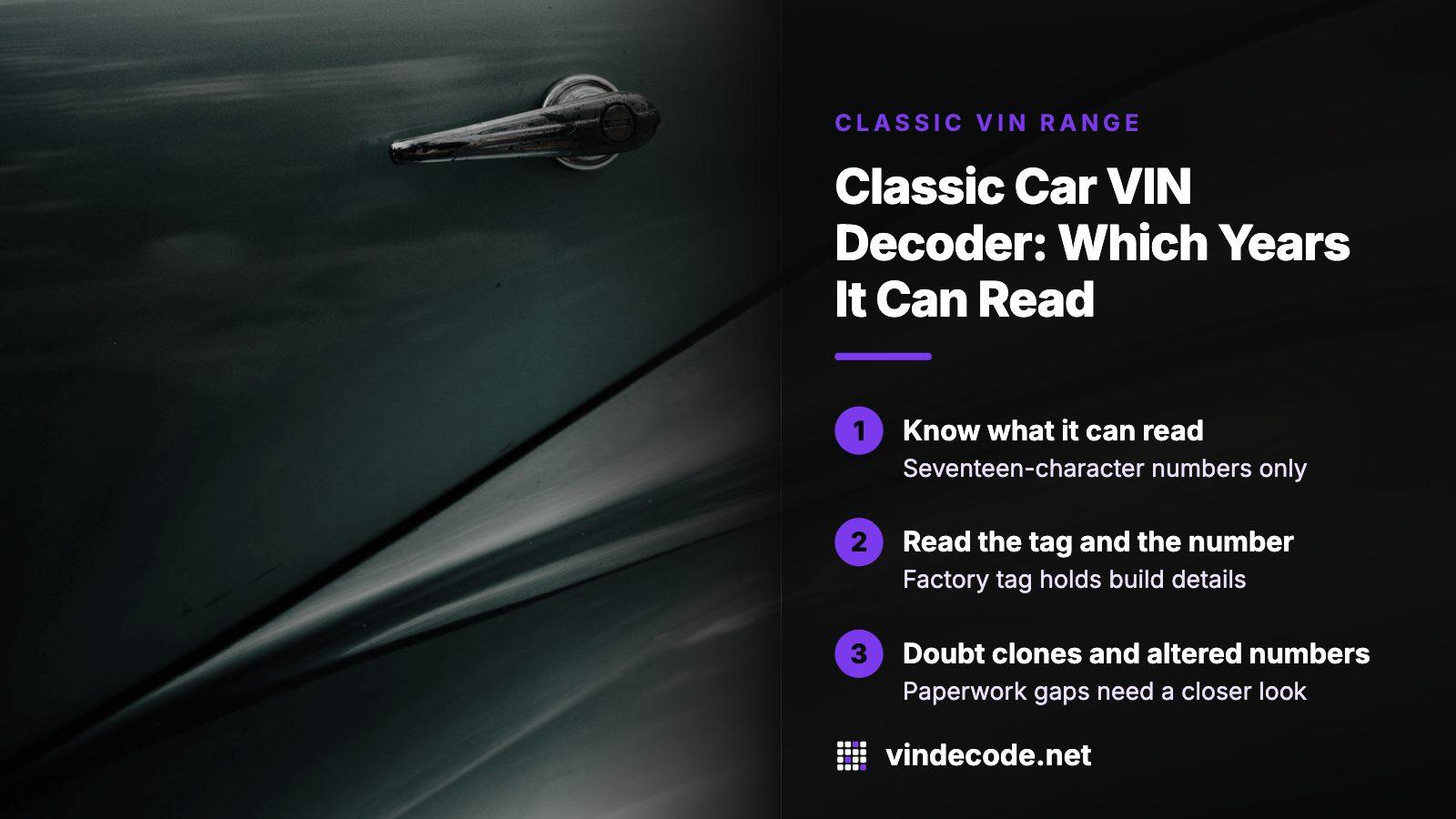
A classic car VIN decoder works on 17-character numbers, which began with the 1981 model year. Type one into the decoder above for the maker, model, body, engine and plant. A car built earlier has a shorter number, usually 10 to 13 characters long and lacking a check digit, and a decoder returns nothing for it. Read the factory tag and a marque reference instead, then run a history report on any car with a standard VIN.
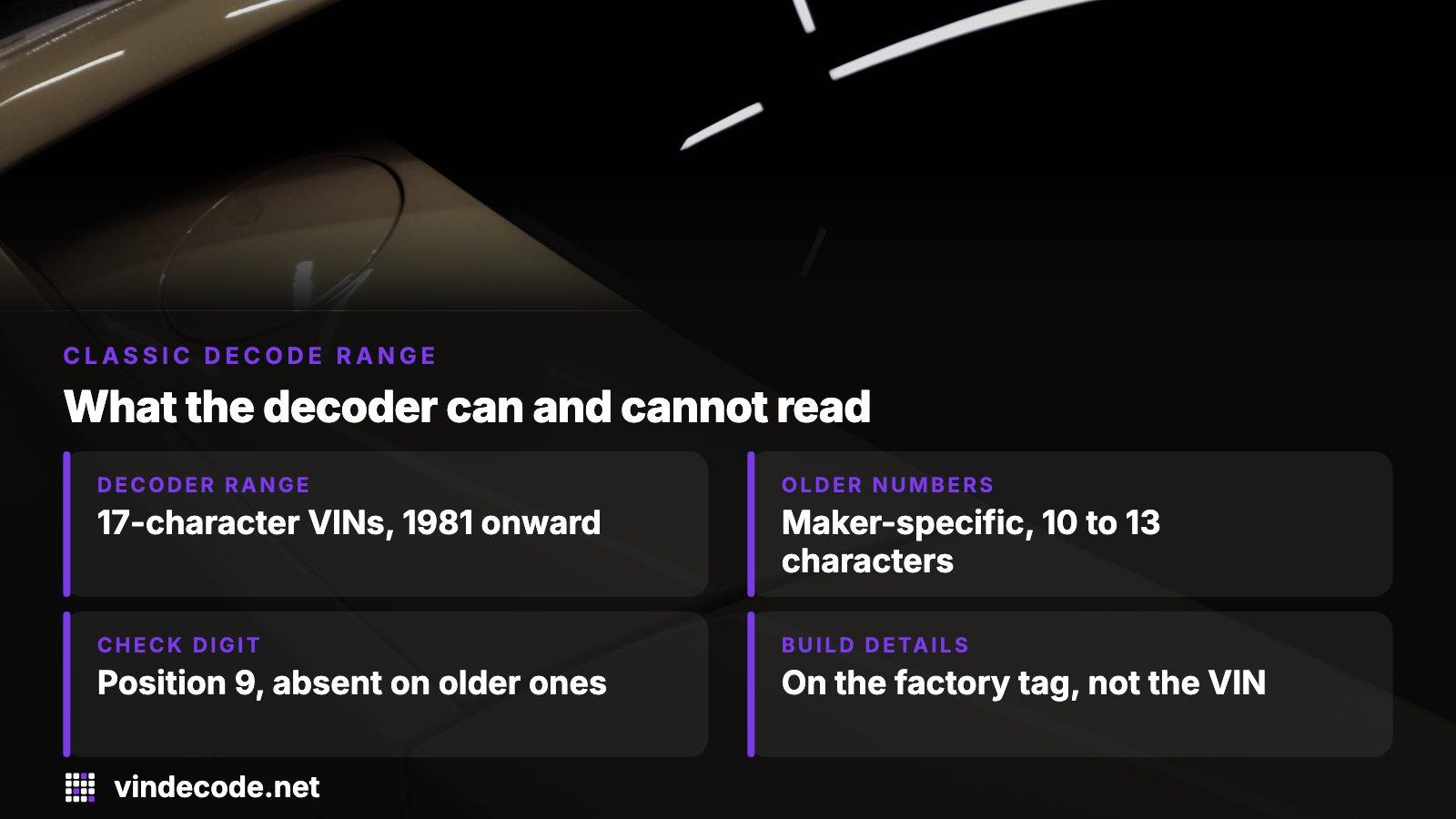
- Decoder range
- 17-character VINs, 1981 model year onward
- Older numbers
- Maker-specific, typically 10 to 13 characters
- Check digit
- Position 9 on modern VINs, absent on older ones
- Build details
- On the factory tag, not in the number
Which classic cars the decoder can read
Classic is a loose word, and the decoder only cares about the number on the car. Every vehicle from the 1981 model year forward has a 17-character VIN in a fixed layout, so an eighties coupe decodes the same way a new car does. Earlier cars were numbered under private schemes. Public decoders draw on patterns that makers file with NHTSA under the modern standard, and older cars predate that filing. NHTSA's own decoder page answers a pre-1981 year with an error.
| Number on the car | What the decoder does | Your next step |
|---|---|---|
| 17 characters, model year 1981 or later | Reads maker, model line, body, engine, year and plant | Order a history report for that VIN |
| Typically 10 to 13 characters, older car | Returns an error or an empty result | Read the tag, then a reference for that maker and year |
| 17 characters but the decode fails | Usually a misread or mistyped character | Retype it from the metal, not from the advert |
Reading the number and the tag off an old car
Photograph first, interpret later. Build tags sit in different places by maker: on the firewall, on the cowl, on a fender apron or along the door edge. On a 1981 or newer car, the plate at the driver's lower windshield corner and the label on the door frame repeat the VIN.
- Photograph every plate and tag whole, including codes that mean nothing to you yet.
- Count the characters in the number. Seventeen goes to the decoder; fewer points to a maker's own scheme.
- Match the plate against the title and registration, character for character.
- Look at the tag's rivets, edges and alignment. A disturbed tag is a question for the seller, not proof of anything.
- Take the tag codes to a reference for that maker and exact year, never to a general decoder.

A 1981-and-later classic: what the decode returns
A 17-character number splits by position under the federal layout. Here is what each block states.
| Positions | What they state |
|---|---|
| 1 to 3 | Country and maker, plus the vehicle type |
| 4 to 8 | Model line, body and engine, coded by the maker |
| 9 | Check digit, a calculated value that validates the rest |
| 10 | Model year, written as a letter or a digit |
| 11 | Assembly plant |
| 12 to 17 | The production sequence number |
Position 10 reuses its letters on a long cycle. On cars and light trucks, position 7 settles it: a digit there points to the older cycle, a letter to the newer one. That is how a decoder tells an eighties car from one built thirty years on. The brand decoders for Mustang, Camaro, Corvette and Mopar go further, since each maker uses positions 4 to 8 in its own way.
What the factory tag adds that the VIN cannot
On a classic, the number names the car and the tag describes it. Paint, interior trim, axle ratio and body style sit on the tag in codes tied to one maker and one year. A repaint in a new color is common and harmless. A tag that disagrees with the number is a reason to stop and ask.
- Does the paint code match the color on the car, or the color the seller claims it left the factory in?
- Does the body code fit the model named in the listing?
- Does the trim code agree with the interior you can see?
- Is the tag missing on a car being sold for its originality?
Reproduction tags are sold openly for restorers replacing a damaged original. That same supply is how a copy gets passed off as the real thing.
Clones, tributes and altered numbers
A clone is a common model dressed as a rare one, and the gap in price between a base car and the performance version it imitates is why clones get built. Sold as what it is, a clone can be a fair purchase. Trouble starts when the badges set the price instead of the car.
- The seller will not say in writing whether the car is genuine or a tribute.
- Tag codes describe a different model than the badges on the car.
- Stamped characters have uneven spacing or depth, or the pad looks filed or machined.
- Grinding marks, filler or the wrong style of rivet surround a tag.
- The original paperwork was lost, on a car priced as original.
Settle the identity before the price
A tribute priced as a tribute is a fine car to own. Decide which one you are looking at first, and when a large premium depends on it, pay a marque specialist to authenticate the stampings and the tag.
Paperwork gaps, bonded titles and imports
Old cars lose titles over the decades, and some never had one because their state asked for none. Treatment depends on where you will register the car: a bonded title after an inspection, a title issued on a bill of sale, or no title at all for vehicles of a certain age. Learn that state's route before you pay.
Imports follow a separate rule. A vehicle at least 25 years old can generally be brought in without conforming to the federal safety rules for newer vehicles, so cars never sold here turn up as they pass that mark. Their home-market numbers will not decode in a US database. Confirm the import was done properly, since a badly imported car can be hard to register.
A brand written on a title stays with the car. The federal title system also notes that some states exempt vehicles of a certain age from titling, so a quiet record on an old car is not the same as a clean one.
Where the history report fits after the decode
A decode tells you how a 17-character car was built. It says nothing about what happened afterward. A history report searches the records that build data cannot show: a title brand, odometer readings that contradict one another, a past salvage auction, a theft report and any lien.
An older car has had more years to pick up one of those marks, and a restoration can hide any of them. You see a free preview before paying anything. The report itself is a single purchase rather than a subscription, and prices sit on the pricing page. Both start from the 17-character number.
The order to work in before you pay
- Count the characters. Seventeen goes to the decoder above; fewer goes to a marque reference.
- Photograph the number and every tag before you form a view of the car.
- Decode the 17-character VIN and compare model, engine and year with the listing.
- Ask the seller in writing what the car is: genuine, tribute or clone, and which parts match.
- Order the history report for that VIN and read its title, odometer and theft lines against the seller's story.
- Confirm you can title the car in your state, and commission authentication where a premium rides on identity.
Where this information comes from
- NHTSA: vPIC VIN decoder — The federal decoder, whose error text for a year before 1981 supports the cutoff described here.
- eCFR: 49 CFR Part 565, VIN requirements — The rule that fixes the 17-character layout, the check digit position and the model year and plant positions.
- NMVTIS: information for consumers — What the national title system reports, and its note that some states exempt old vehicles from titling.
- NICB: VINCheck — A theft lookup from the insurance industry, worth running beside a decode on a private purchase.
Sources and photos: Facts checked against the sources above in November 2026. Photos by Anshul Gurjar, Masjid MABA and Franck V. on Unsplash; diagrams by VINDecode.
Keep reading
- Mustang VIN Decoder: Read the Build, Then Check the HistoryHow Ford encodes a Mustang, including the older short numbers.
- Camaro VIN Decoder: Decode the Car, Then Check Its HistoryChevrolet's layout for the Camaro, and the tag that proves what a car is.
- Classic Truck VIN Decoder: What It Reads, Where It Stops, What Comes NextThe same older-number problem on pickups and work trucks.
- Sample reportA finished report, to see what the records add once the decode is done.
Frequently asked questions
Why does the decoder return nothing for my muscle car's VIN?
Cars from before the 1981 model year were numbered under each maker's own scheme, and the public database behind decoders holds no patterns for them. The blank is expected, and it says nothing about whether the number is genuine. Use the factory tag and a reference for that maker and year.
Can a decoder tell me if the engine is the original one?
No. On a 17-character car the decode names the engine fitted at the factory, using position 8. Whether the engine in the car now is that unit takes a look at the block's partial VIN stamping or date codes, plus a specialist's opinion on anything valuable.
Does the 25-year import rule mean my old car has a pre-1981 VIN?
No, the two are unrelated. The rule concerns when a vehicle can be imported without meeting newer safety standards. VIN format follows the model year, so a car older than 25 years still has a 17-character number if it is from 1981 or later.
Where do I find the paint and option codes on a classic?
On the factory tag, not in the VIN. Look under the hood at the cowl, firewall or inner fender, and at the door jamb. Some manufacturers will certify a car's original specification from its number, and club registries often hold production records for popular models.
Does a clean history report prove a classic is genuine?
No. A report covers records attached to the VIN: brands, odometer entries, theft and the like. It cannot tell you whether the stampings and tag on the car are original. Treat it as one check beside tag inspection, registry research and, for valuable cars, authentication.
Now check the car itself
The guide explains what to look for. The report shows what this VIN has on record.