
THE SHORT ANSWER
A trailer VIN decoder reads the 17 characters and returns the builder, the model year from position 10, the body type, the length and the axle count. Those last three come from the middle of the number, which the federal rules reserve for exactly those traits on a trailer. A wrong check digit in position 9 usually means a misread character. Ownership, damage and theft are not in the decode.
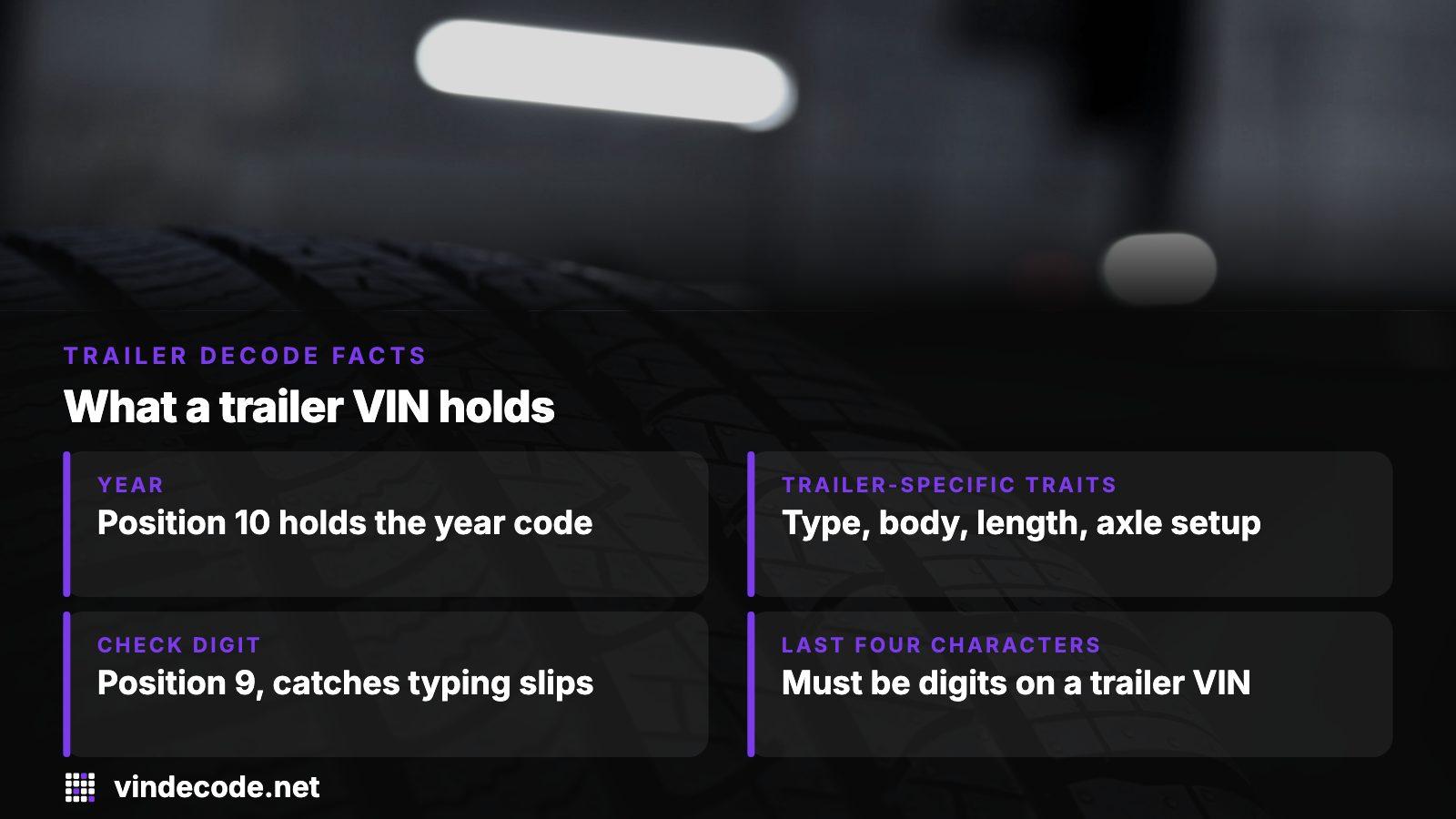
- Year
- Position 10 of the VIN holds the model year code
- Trailer-specific traits
- Type, body type, length and axle configuration
- Check digit
- Position 9, there to catch typing slips
- Last four characters
- Must be digits on a trailer VIN
What a trailer decode returns
A car decode talks about engines and airbags. A trailer has neither, so the useful fields are different. Under 49 CFR 565.15, the middle block of five characters (positions 4 to 8) has a job laid out per vehicle type. For trailers, the list is trailer type, body type, length and axle configuration, with the make alongside. How those facts are packed into the five slots is up to the builder, who gives NHTSA the key.
The decoder looks that key up and reports what it finds. Typical output, where the maker filed the data:
- Maker and make name, taken from the first three characters
- Model year, taken from position 10
- Body class, such as a box or van enclosed trailer
- Trailer length in feet and the number of axles
- Plant city and state, from position 11
Anything NHTSA holds no data on comes back blank. A blank field does not mean the trailer lacks the feature, only that the maker never filed it.
A test decode, line by line
To see the output for myself, I ran a made-up number through NHTSA's public decoder. It begins with the Utility Trailer Manufacturing prefix and is not a real trailer, but the answer shows what a filed trailer pattern produces.
| Field | What the decoder returned |
|---|---|
| Model year | 2018, from the letter J in position 10 |
| Make | Utility Trailer Manufacturer |
| Body type | Box or van enclosed trailer |
| Trailer type | Straight semi or semi trailer |
| Length | 53 |
| Axles | 2 |
| Plant | Marion, Virginia |
| Check digit | Correct, no error flagged |
It also added a notice that the model year may be off and that you should enter the year if you know it. That notice is routine, and the next section explains why it matters.
Getting the year right
Position 10 carries one character for the year. The letters cover 2010 to 2039, then digits take over. A J means 2018 and a K means 2019. Because the decoder prints a reminder to confirm the year, treat its answer as a first read and check it against the label.
I tested this. Handing the decoder the year 2017 with the same number returned 2017 along with a warning that the entered year disagrees with the tenth character. Swapping that character to K produced 2019. The tool follows what you tell it, so do not enter a year just to make the answer look tidy.
The label settles it
A trailer's certification label gives the month and year of manufacture. If that date and the year from position 10 disagree by more than a model-year rollover, the number has been copied wrongly or the label belongs to another trailer.
Finding the VIN on a trailer
There is no windshield plate to read. Start at the front, on the tongue or the A-frame where the coupler sits, and check the top and both sides. Then run a hand along the frame rails near the front, where a certification label or plate may be fixed.
Road film and rust bury stamped numbers. A wire brush, a rag and a flashlight usually bring one back. Photograph it rather than copying it by hand, then type it into the decoder from the photo. The tool wants all 17 characters, so count them before you press the button.
When the decoder complains about the check digit
Position 9 is arithmetic. Every character is turned into a value, multiplied by a weight that depends on its position, and the products are totaled. Dividing that total by 11 leaves a remainder that fixes the ninth character, and X stands in for a remainder of 10. A mismatch means the number was copied wrong or altered.
I changed only that character on my test number. The make, the year, the length and the axles still came back, but the tool raised an error saying the ninth position does not calculate properly. So a decode that fills in the fields is not proof the number is genuine.
- Re-read the number against the photo, one character at a time.
- Check the last four characters: on a trailer they must all be digits.
- Compare the label and the stamping on the frame; they should match exactly.
- If a clean copy still fails the check, ask the seller why before any money moves.
Small builders and blank results
Plenty of trailers come from small shops. The rule lets a low-volume maker share its identity across positions 1 to 3 and positions 12 to 14, and a 9 in the third position flags that six-character form. These makers file less, so the decode may return only a make, or nothing at all.
I looked up five trailer prefixes in NHTSA's register: 5KT returned Karavan, 1UY Utility, 4YM Carry-On, 4P5 PJ and 1PT Trailmobile, all classed as trailers. A prefix that does not resolve is common for tiny builders and kit assemblers. It is not an accusation, but it means the decode will not answer anything, and the paperwork has to do the work instead.
Homemade trailers
A trailer welded together at home has no maker VIN to decode. Ask your state motor vehicle agency how it numbers such trailers; a state-issued number will not appear in the federal decoder.
What the decode cannot tell you
The decoder describes the trailer as the factory built it. What happened once it rolled out of the plant is recorded elsewhere.
| You want to know | Where it lives |
|---|---|
| Was it reported stolen? | Theft records, plus NICB's free VINCheck |
| Has the title carried a brand? | Title records, including the federal NMVTIS |
| Was it damaged or sold at auction? | Damage and salvage records |
| Is a lien still on it? | Lien and impound records |
| Is a safety recall open? | NHTSA's recall lookup, run by VIN |
Recalls are tied to the VIN, so the lookup is worth running even on a plain utility trailer.
Cost and the step after the decode
Decoding costs nothing. Once the build fits the advert, run the same VIN through the history check. The preview costs nothing and shows the basics plus any title or auction entries on file. The report is a one-time charge per trailer, cheaper per VIN when bought three, five or ten at once; the pricing page gives each amount.
- Photograph the VIN and the certification label.
- Decode it above and compare year, length and axles with the advert.
- Run NHTSA's recall lookup and NICB's VINCheck.
- Open the preview, then buy the report if everything lines up.
- Tie the VIN to the title and the seller to the paperwork.
If the number refuses to decode cleanly after a careful re-read, treat that as a reason to slow down, not a bug in the tool.

Where this information comes from
- eCFR: 49 CFR 565.15 — Sets what positions 4 to 8, the check digit and the year code must carry on a trailer.
- NHTSA: vPIC Vehicle API — The federal catalog behind the decoder, built from manufacturers' filings.
- NHTSA: vPIC VIN decoder — Where the test decodes and prefix lookups were run.
- VehicleHistory.gov: NMVTIS — The federal title information system that title and theft records feed.
Sources and photos: Facts checked against the sources above in November 2026. Photos by Zoshua Colah, Masjid MABA and Pablo Alvarez on Unsplash; diagrams by VINDecode.
Keep reading
- RV VIN Decoder: Decode a Motorhome, Trailer or Fifth WheelTowables with living space follow the same rules, with their own makers.
- Semi Truck VIN Decoder: Decode the Tractor, Then Check Its HistoryHeavy tractors and the trailers they pull share the last-four-digits rule.
- VIN Decoder Explained: What Decoding a VIN Means and How It WorksThe seventeen positions explained for any vehicle.
- PricingHow the free preview and the one-time report payment work, with pack sizes.
Frequently asked questions
Can you decode a trailer VIN for free?
Yes. NHTSA's public decoder and the one above read a trailer's 17 characters without charge. You get the maker, year and whatever the builder filed about body type, length and axles. Title, damage and theft records are a different set of data and need a history report.
What does the VIN tell you about a trailer's year?
Position 10 holds a code letter or digit for the model year. J means 2018 and K means 2019. The trailer's certification label shows the month and year it was built, so compare the two. If you know the year, enter it and the tool will flag a mismatch.
Why does my trailer VIN not decode?
The usual causes are a misread character, a failed check digit, or a small builder that never filed its pattern with NHTSA. Re-read the number from a photo first. If it still returns nothing, rely on the title and the label, and run a history check.
Do trailers have 17-character VINs?
The federal VIN format has 17 characters, and on a trailer the last four must be digits. A homemade trailer or one with a number in another format will not decode. Ask your state motor vehicle agency how it treats those.
Can a VIN decoder show if a trailer is stolen?
No. A decoder reads the build data only. For theft, use NICB's free VINCheck, then a history report that includes theft and title records. Also compare the VIN on the frame with the title, and walk away from any frame that looks filed down near the number.
Now check the car itself
The guide explains what to look for. The report shows what this VIN has on record.