
THE SHORT ANSWER
To decode a semi truck VIN, type all 17 characters into the decoder above. A Class 8 tractor comes back with its make, model, year, plant, engine and brake type, and NHTSA lists the weight class as 33,001 pounds and above. The engine shown is the one fitted at the factory, so compare it with the serial on the block. A decode shows no mileage, damage or liens; the history preview covers those.
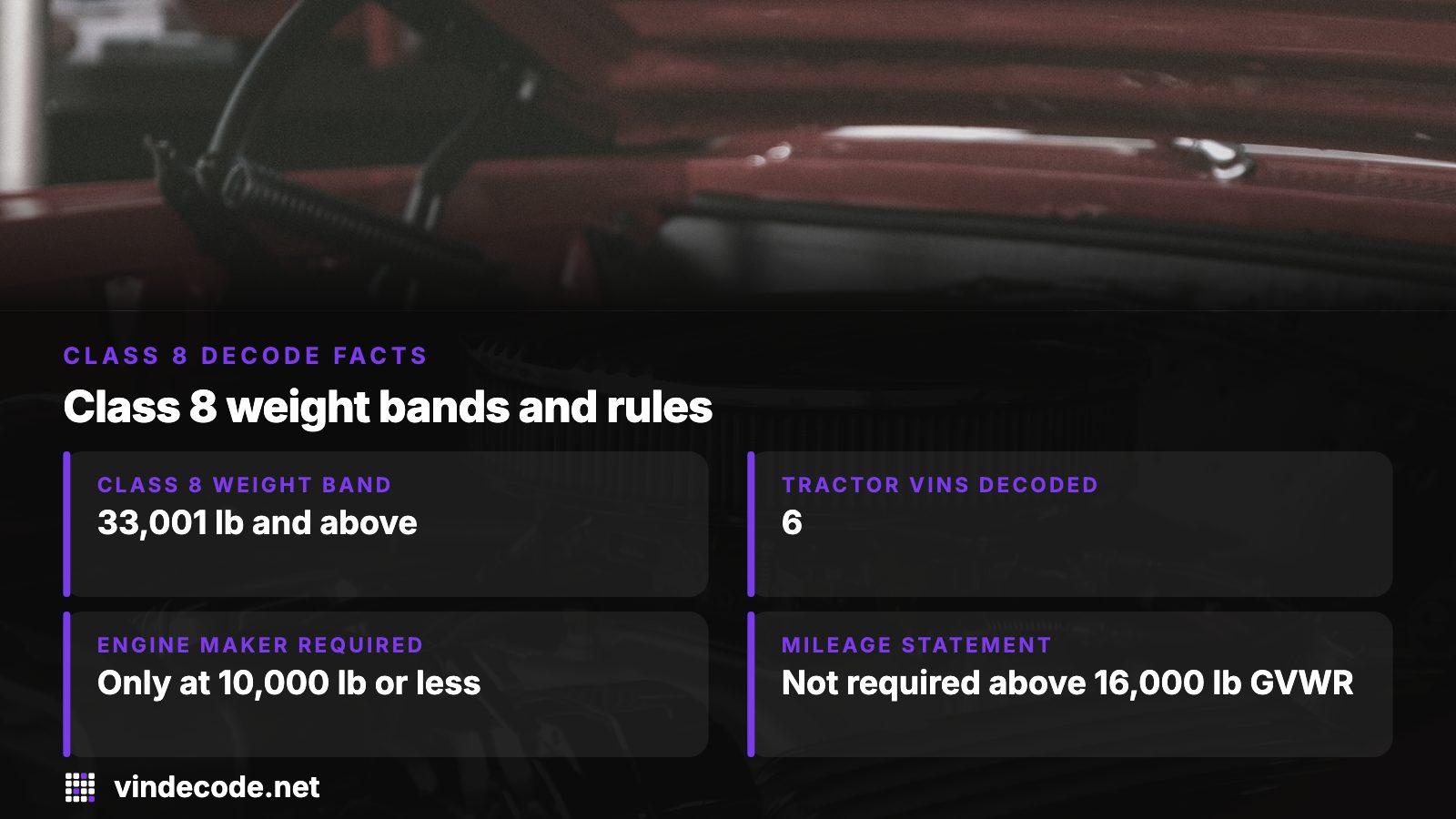
- Class 8 weight band
- 33,001 lb and above
- Tractor VINs decoded for this page
- 6
- Engine maker required in a truck VIN
- Only at 10,000 lb or less
- Mileage statement not required
- Above 16,000 lb GVWR
What the decoder returns for a Class 8 tractor
For this page we ran six tractor VINs through NHTSA's vPIC register, entering the first 11 characters of numbers copied from owner complaints. vPIC called each one incomplete and returned the build anyway. All six read as 6x4 truck-tractors, and the engine line is where they differ.
| VIN starts | Truck | Engine listed | Plant listed |
|---|---|---|---|
| 4V4 | 2019 Volvo VNL | Volvo D13, 12.8 L | Dublin, Virginia |
| 4V4 | 2019 Volvo VNL | Cummins ISX 15L | Dublin, Virginia |
| 1FU | 2019 Freightliner Cascadia | Detroit DD13, 12.8 L | Cleveland, North Carolina |
| 3AK | 2019 Freightliner Cascadia | Detroit DD13, 12.8 L | Saltillo, Mexico |
| 3AK | 2018 Freightliner Cascadia | Detroit DD15, 14.8 L | Saltillo, Mexico |
| 3HS | 2020 International LT625 | Cummins X15, about 15 L | Escobedo, Mexico |
An empty cell in a decode means NHTSA has nothing on file, not that the item is absent.
Two 2019 Volvos, two different engines
The first two rows make the point. Both are 2019 VNLs from the same Virginia plant, both listed at 425 horsepower. In positions four to eight, the build-pattern section, only the seventh character differs, E against T. One reads as a Volvo D13, the other as a Cummins ISX.
Federal rules explain the patchwork. A truck's VIN must make the engine type decipherable: fuel, cylinders, displacement, power. On a truck, naming the engine maker is mandatory only at 10,000 pounds or less. Above that, the Volvo and International results name the maker anyway, while the Cascadia results give a model with no maker.
Treat the engine line as a build sheet
It records what the factory fitted, and a later swap or rebuild will not change it. Photograph the data plate on the block and hold it against the decode and the service records.
The first three characters: who filed it, and where it was built
Two 2019 Cascadias in the table share a model year and an engine model. One starts 1FU and was built in North Carolina; the other starts 3AK and came from Saltillo, Mexico, under a different filing company. Read the opening characters as a group.
- Match the plant to the advert. A listing claiming a North Carolina build for a VIN opening 3AK deserves a question.
- Expect several prefixes per maker, plus separate codes for unfinished chassis.
- The Freightliner, Kenworth and Peterbilt decoders on this site list each maker's prefixes.
Getting 17 clean characters off the tractor
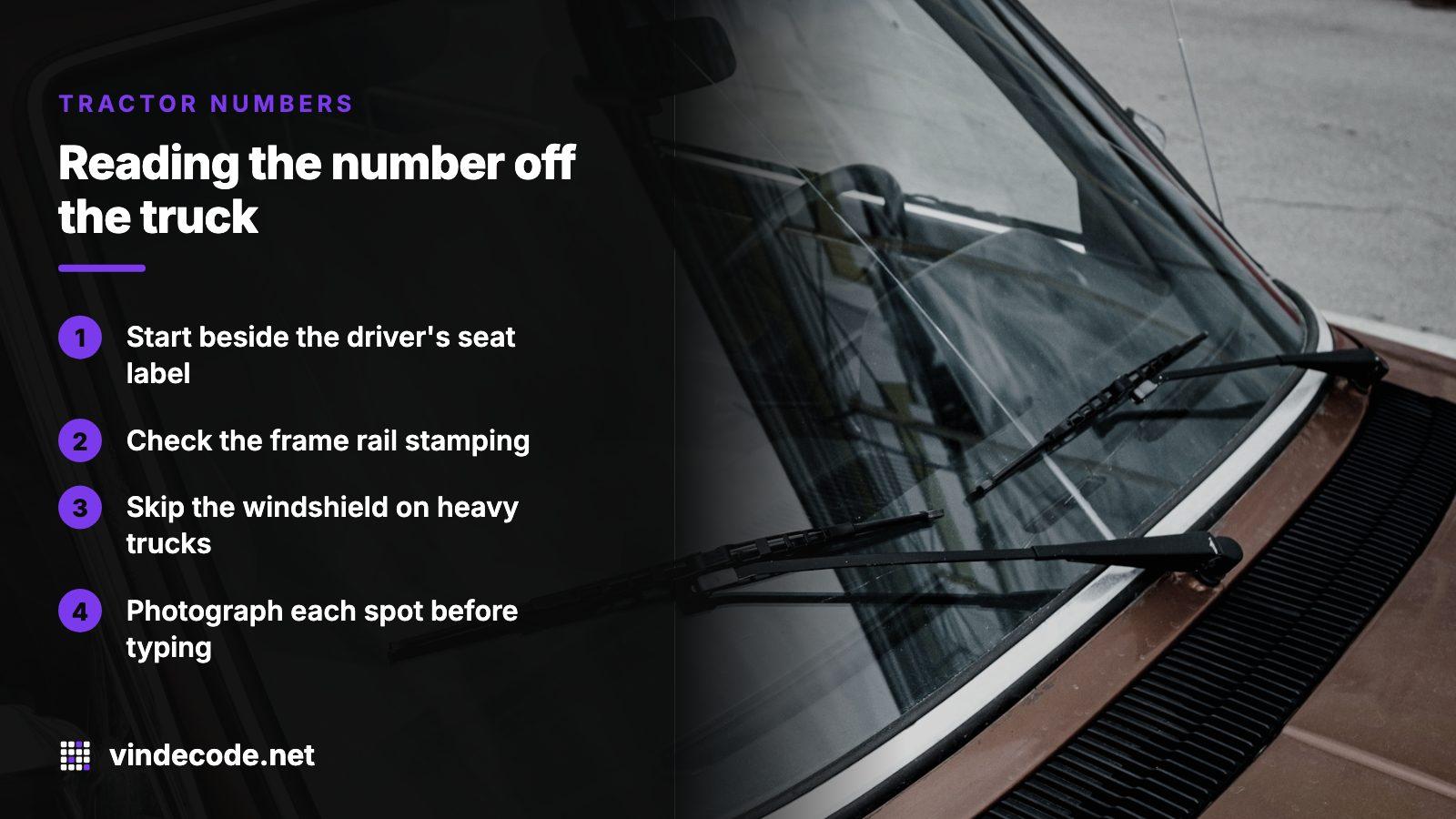
- Start beside the driver's seat, where the maker's label is riveted or otherwise fixed so it cannot be peeled off intact. Its fields include the VIN, the build date, the gross weight rating and one rating per axle.
- Check the frame rail, often on the driver's side toward the front, where the number is stamped into metal.
- Skip the windshield. The see-through rule applies to cars and trucks of 10,000 pounds or less.
- Compare label, frame and title character by character. A VIN never contains I, O or Q, so a round character is a zero, and position nine is a check digit.
- Photograph each spot before typing. If one character is unreadable, NHTSA's decoder takes a partial VIN with a star in the gap.
Numbers the decode does not cover
The VIN names the chassis. The parts that set a tractor's value carry identification of their own.
| Part | Where the number is | Why it matters used |
|---|---|---|
| Chassis VIN | Door-side label, frame rail | Title, registration, insurance and recalls attach to it |
| Engine | Block, with a data plate | Rebuilds and engine recalls come from the engine maker |
| Transmission | Tag on the housing | Sets gear ratios, parts and manual versus automated |
| Axles | Tags on the housings | Gives the ratio, which sets fuel use and suits the haul |
| Body builder | Its own label near the driver's door | Body faults and recalls belong to that company |
A tractor finished by a second company keeps the first maker's VIN, since the incomplete-vehicle maker assigns it and an alterer must keep it. The decode names the chassis builder, not the body shop.
Recalls follow the parts the decode lists
NHTSA lists 8 campaigns on the 2019 Volvo VNL, and several reach only trucks with one fitted part. The decode's engine line points to the engine campaign; the seller must confirm the transmission and sleeper fit.
- Cummins ISX15 engines, 2016 to 2019: a fuel line that can burst on long downhill grades (18V668000).
- Automated manual transmissions: a clutch assembly fault (19V032000).
- Sleeper models: a bunk window that can detach (19V208000).
- The label itself: on some 2018 to 2021 trucks the rear axle rating exceeded the hub rating (20V384000).
Only the VIN-based recall lookup shows whether a given truck is covered. Each remedy here is at no cost.
From an NHTSA owner complaint
A buyer partway through buying a 2019 Freightliner Cascadia at a Pennsylvania fleet sale told NHTSA that the cab shock and four rear shocks looked badly worn and that a recall was unrepaired. The buyer asked for replacements in the sale. NHTSA's summary stops before any outcome.
Take from it that open recalls and worn parts are bargaining points before the bill of sale.
Mileage is the gap a decode cannot fill
A decode carries no odometer reading, and heavy trucks leave a thinner paper trail than cars. A seller whose truck is rated over 16,000 pounds may skip the written mileage statement, a cutoff far below the 33,001 pounds where Class 8 begins. It removes a form, not the relevance of the reading.
From an NHTSA owner complaint
A buyer of a 2021 Peterbilt 389 from a dealer wrote that the contract and odometer both showed 411,000 miles. Running dry on the road led the owner to refill the fuel filters, and service notes written on them read 671,000. The summary is headed odometer fraud and gives no reply from the seller, so it is one owner's account.
Dated records beat a dash reading: service invoices that note mileage at each visit, the date and shop of the last overhaul, and the engine computer's stored hours and idle time.
After the decode: what a history report adds
The preview is free. A report is bought once, alone or in a set of 3, 5 or 10, and nothing renews. Current rates sit on the pricing page.
| Record | What it settles on a tractor |
|---|---|
| Odometer readings | Dated figures to hold against the dash and invoices |
| Auction and salvage history | Whether it was sold at auction, with photos if they exist |
| Liens and theft records | Whether a lender or a theft report is tied to the VIN |
| Damage records | Whether the rig was hit, and where |
| Title brands | Whether salvage, rebuilt or another brand was applied |
Read a clean result with care. Mandatory federal reporting stops at common automobiles and only some states add heavy equipment, so an all-clear can be false. The report follows the chassis VIN and says nothing about the engine.
A sensible order before you pay
- Photograph the door-side label, the frame stamping and any second certification label.
- Decode all 17 characters; compare make, year, engine and plant with the advert.
- Copy the engine, transmission and axle numbers and request the engine's records.
- Check the VIN in NHTSA's recall tool, then call the engine maker about its own campaigns.
- Read the history preview, and buy the report if the tractor still fits.
- Hire a heavy-truck inspector for the brakes, fifth wheel, frame and emissions equipment.
Where this information comes from
- NHTSA: vPIC API — How the public decoder takes partial VINs, wildcards and batches; the six decodes came from it.
- NHTSA recalls API: 2019 Volvo VNL — Campaign records showing which recalls depend on a fitted engine, transmission, window or label.
- eCFR: 49 CFR 565.15, VIN content — What a truck's VIN must make decipherable; the engine-type definition sits in section 565.12.
- eCFR: 49 CFR 580.17, odometer exemptions — The weight line above which a seller need not state mileage.
- NMVTIS: consumer information — The scope of the federal title database and why a search can miss records.
- NHTSA owner complaint 11698892 — owner experience, paraphrased
- NHTSA owner complaint 11765736 — owner experience, paraphrased
Sources and photos: Facts checked against the sources above in November 2026. Photos by Ümit Yıldırım, Max Tokarev and Victor Hughes on Unsplash; diagrams by VINDecode.
Keep reading
- Freightliner VIN Decoder: Tractor, Chassis or Coach UnderneathBrand decoder for Freightliner tractors, the Cascadia included.
- Kenworth VIN Decoder: Who Built the Truck and What Happened SinceKenworth's prefixes and its chassis-only codes.
- Peterbilt VIN Decoder: Read the Prefix, Then Check the Truck's RecordPeterbilt's prefixes and the finished-versus-chassis split.
- Sample reportA finished report to read before you decide to buy one.
Frequently asked questions
Do semi trucks use the same VIN format as cars?
Yes. A tractor's VIN has 17 characters under the same federal rule, check digit included, and any decoder that reads cars reads it. The number simply vouches for less of the truck.
Can a decoder tell me who made the engine?
Sometimes. The Volvo and International runs above named an engine maker, while the Cascadia runs gave only a model. Above 10,000 pounds it depends on the builder, so confirm the engine by its serial.
Is a USDOT number the same as a VIN?
No. A USDOT number belongs to a motor carrier and covers its whole fleet. It follows the company, not the truck, so it says nothing about one tractor's title or damage.
Will a decode show a salvage title or accident damage?
No. The decoder returns the build as the maker filed it. Brands, damage, liens and theft flags sit in other records, which a history report searches under the same VIN. Add an inspection, since heavy-truck reporting can be patchy.
What is a glider kit, and will a decode show one?
A glider pairs a new cab and frame with a used or remanufactured powertrain. It is titled as a new truck, so the decode looks new while the engine does not. Ask the seller directly and get the engine's records.
Now check the car itself
The guide explains what to look for. The report shows what this VIN has on record.