
THE SHORT ANSWER
An RV decode returns the model year, maker, body class, weight class and build plant for the number you enter. A motorhome returns its chassis builder, such as Ford or Mercedes-Benz. A travel trailer or fifth wheel returns the RV brand, trailer type and length. It cannot show accidents, title brands, liens, theft or odometer history.
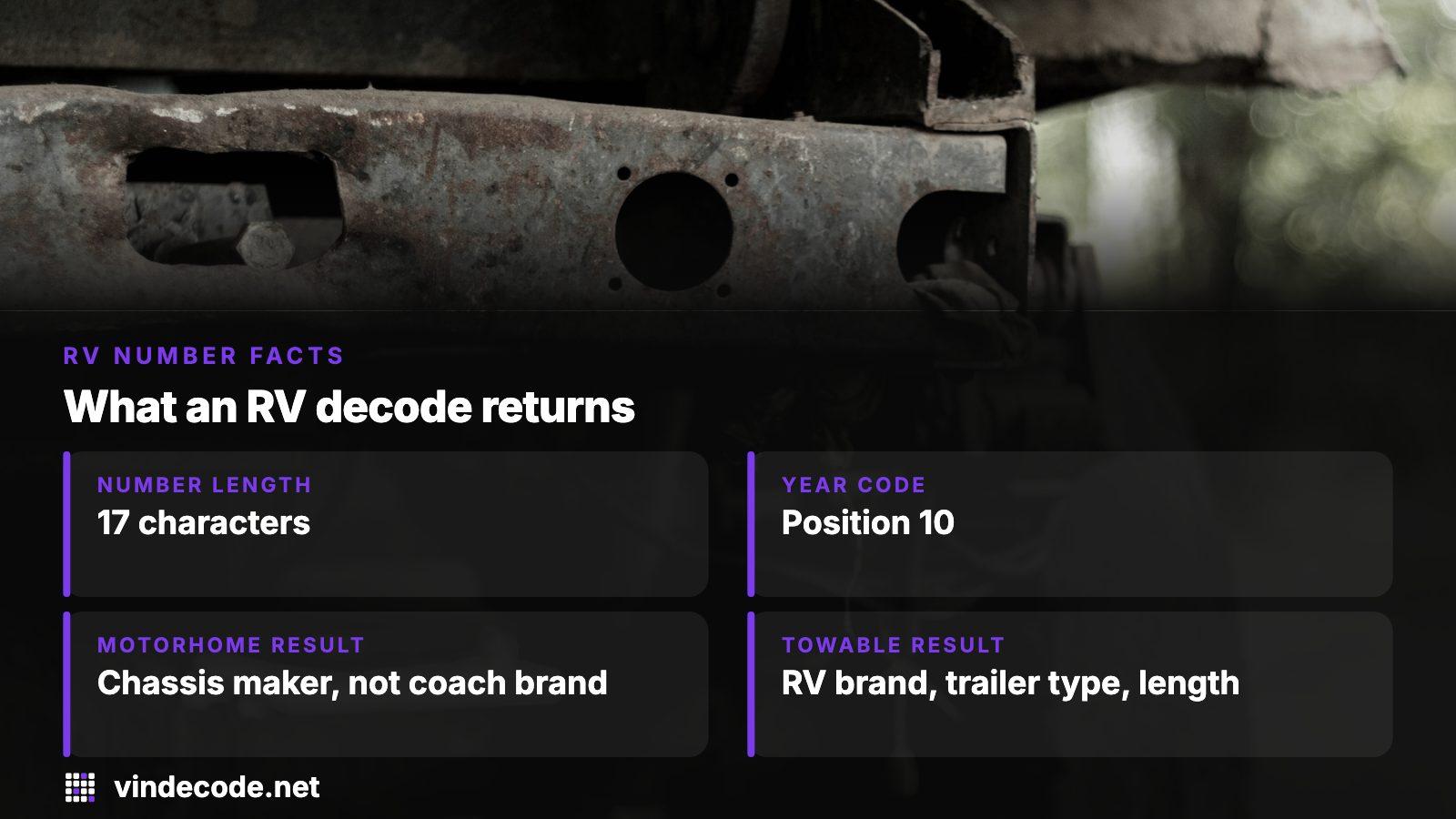
- Number length
- 17 characters
- Year code
- Position 10
- Motorhome result
- Chassis maker, not coach brand
- Towable result
- RV brand, trailer type, length
Whose name comes back depends on how the RV was built
Most buyers expect the decoder to say Winnebago or Jayco and are surprised when it names a company that builds trucks. The result follows the number, and the number follows whoever assembled the vehicle it was stamped on.
| RV type | Name in the result | What usually comes back |
|---|---|---|
| Class A on a bare chassis | The chassis builder | Year, weight class and plant; engine fields can be empty |
| Class C on a cutaway | The van or truck maker | Engine, fuel, weight class and plant |
| Camper van | The van maker | Diesel or gas, displacement, cylinders |
| Travel trailer or fifth wheel | The RV brand | Trailer type, body type, length, year |
Federal rules explain the split. A trailer's descriptor characters must reveal its type, body, length and axle layout, while an unfinished chassis describes its cab, engine and brakes. Neither one describes a kitchen or a floor plan.
Finding the number on a rig with several labels
Look toward the front of a towable, on its left-hand side: the maker's label has to be readable from the ground without opening anything. Motorhomes are less tidy. One builder's owner page puts a Class A plate on a wall near the driver's left shoulder, or inside a kitchen cabinet, and a Class C number at the windshield corner on the driver's side.
- Photograph every label before you type anything.
- Expect more than one on a motorhome: the chassis builder and the coach builder each affix their own.
- Confirm the characters match the title one by one, since the decoder trusts whatever you enter.
- If an owner offers a short unit serial instead, ask for the full 17 characters.
Four decodes run through NHTSA's own tool
To see the pattern for this page, I ran partial numbers through NHTSA's decoder, which accepts unknown characters. A full 17-character VIN fills in more. Each row shows what the federal database returned.
| Pattern entered | Year | Result |
|---|---|---|
| 1F66F5DY*L0 | 2020 | Ford motorhome chassis from Detroit Chassis LLC, stripped chassis, built in Detroit |
| 1FDXE4FS*KD | 2019 | Ford E-450 cutaway, gasoline 6.8 L, 10 cylinders, Avon Lake plant |
| WDAPF4CC*F | 2015 | Mercedes-Benz Sprinter chassis cab, diesel 3.0 L, 6 cylinders |
| 4X4TWDM2*L | 2020 | Forest River Wildwood travel trailer, ball hitch, 36 feet |
Three of the four name a company that never sold a finished RV. Only the trailer names the brand on the sidewall.
Reading the year letter on an older coach
The tenth character carries the model year, and it is the one that moves a result most. Swapping a single letter changed the Wildwood pattern above from 2020 to 2021 and the motorhome chassis from 2020 to 2021 as well.
| Tenth character | Year |
|---|---|
| M | 2021 |
| G | 2016 |
| L | 2020 |
| J | 2018 |
The letters repeat in a second cycle. The federal rule offers a tiebreaker using position 7, but it is written for cars and for trucks of 10,000 pounds or less. A heavy coach gets no such help in the text, so an older rig showing an L could be a 2020 or something far older. Use the build month on the maker's label to settle it. Typing a year into NHTSA's year box also overrides the letter, so leave that box empty.
Chassis maker and coach builder each answer for their half
The chassis builder labels the unfinished vehicle with its name, month and year, weight ratings and the number. The final-stage builder then adds its own certification label with the month it finished, and may not cover the earlier ones. So an RV can carry two dates, and the decoded year may disagree with the coach's sale year without anything being wrong.
From an NHTSA owner complaint
The owner of a 2016 Winnebago View, whose number begins with the Mercedes-Benz Sprinter code, complained to NHTSA about alignment, radio and GPS faults. A dealer told the owner that alignment trouble is common because the coach goes on after the chassis has already been aligned. The repair took more than two months.
Take from it that the number leads to the chassis, and a fault in the coach part may sit with a different company's paperwork.
Recalls can sit under the coach name, not the chassis name
NHTSA's recall search by vehicle returned very different counts for the four RVs above when I tried them on the day I wrote this page.
| Searched as | Recalls returned |
|---|---|
| Ford F-53, 2018 | 0 |
| Thor Motor Coach Windsport, 2019 | 2 |
| Winnebago View, 2016 | 4 |
| Forest River Wildwood, 2020 | 7 |
From an NHTSA owner complaint
A Thor Windsport owner from model year 2019, whose rig rides on a 2018 F-53 chassis from Ford, filed the complaint under Ford. At about 9,000 miles, screws holding the overhead unit above the driver's seat were pulling out of a wooden ceiling surface, and brackets were holding it up. The maker was told and gave no help. A Thor recall for detaching overhead cabinets was filed in February 2023.
Search under both the chassis name and the coach name. A zero under one proves nothing about the other.
Where the decode ends and a history report starts
The decoder reads what the maker filed for that number, so it returns the same answer for a clean rig and for one that was totaled, repaired and resold. A motorhome's chassis number is the one that title and insurance records attach to, which is why a report on it can answer questions the decode cannot.
| After the decode, you still need to know | The report on that VIN looks at |
|---|---|
| Was it written off? | Title brands, salvage auction listings and photos |
| Has it been hit by something? | Crash and damage records on file |
| Is the mileage believable? | Odometer readings from different dates |
| Is anyone else owed money on it? | Liens, impounds and theft records |
| Is a safety fix waiting? | Open recalls tied to the number |
Water damage in the coach walls is not on that list. An inspector has to find it.
The order to run things and what it costs
- Photograph the chassis label, the coach label and the title.
- Decode the number here and compare each field with the rig.
- Resolve any year-letter doubt using the build month on the label.
- Start the preview on the same number. The preview is free.
- Order the report once the rig still looks right.
Starting a preview takes only the VIN and no payment. Ordering the report is a single purchase tied to that number, with bundles of 3, 5 or 10 available if several rigs are on your shortlist. There is no subscription to cancel. See the pricing page for current rates, and open the sample report to read every section first.

Where this information comes from
- NHTSA vPIC: VIN decoder — Where the test decodes ran; its year box overrides the year letter.
- eCFR: 49 CFR 565.15, VIN content — What positions 4 to 8 must reveal on trailers and chassis, plus the year codes and the position 7 rule.
- eCFR: 49 CFR 567.4, certification label — Places a trailer's label on the forward half of its left side.
- eCFR: 49 CFR 567.5, vehicles built in stages — Sets out the chassis label and the final-stage label.
- Thor Motor Coach: owner FAQs — One maker's account of where Class A and Class C numbers sit.
- NHTSA owner complaint 10852641 — owner experience, paraphrased
- NHTSA owner complaint 11491692 — owner experience, paraphrased
Sources and photos: Facts checked against the sources above in November 2026. Photos by Alexander Lunyov, Scott Graham and Zoshua Colah on Unsplash; diagrams by VINDecode.
Keep reading
- Trailer VIN Decoder: Year, Length and Axles From the NumberTowables, where the RV brand itself is the answer.
- Forest River VIN Decoder: Reading Towable and Motorhome Numbers, Then the HistoryOne of the largest RV brands, with its own number prefixes.
- VIN Decoder Year Chart: Position 10 Codes for 1980 to 2039Every year letter laid out in one table.
- Sample reportA finished report, to see what follows the decode.
Frequently asked questions
Why does my RV VIN decode show Ford instead of my RV brand?
On most motorhomes the stamped number belongs to the chassis, and a truck or van maker built that part. The RV company finished the coach afterward, so the decode names the unfinished vehicle. That is normal. Towable RVs differ, because the RV brand assembles the whole unit and the decode names it.
Is there a free RV VIN decoder?
NHTSA runs a public decoder that returns what manufacturers filed for vehicles sold in the US from the 1981 model year. Starting a preview on this site also costs nothing. The full report is a separate purchase made for each VIN. A decode alone says nothing about wrecks, brands or theft.
Can I decode the model year of an RV from its VIN?
Yes, use the tenth character. It gives the year code, such as L for 2020. Because letters repeat across two runs of years, check it against the build month on the maker's label, especially on an older heavy coach. Leave NHTSA's separate year box empty, since a typed year overrides the VIN.
Does an RV VIN decode show the floor plan or appliances?
No. A motorhome decode describes the chassis, and a trailer decode covers type, body and length. Floor plans, slide-outs, appliances and tanks sit outside the number. For those details use the builder's own documents or ask the dealer, and have an RV inspector check the systems.
What if the RV VIN will not decode?
Re-read every character first, since I, O and Q never appear and a round shape is a zero. Next, check whether you typed a short unit serial rather than the full VIN. Other causes are a rig built before 1981 or one never sold in the US. Compare the number with the title.
Now check the car itself
The guide explains what to look for. The report shows what this VIN has on record.