
THE SHORT ANSWER
Type all 17 characters of the Toyota VIN into the decoder on this page. A US plant usually shows up as 4T or 5T at the start, Japan as JT, Canada as 2T and Mexico as 3T. The tenth character gives the model year, the eleventh the plant. Trim, battery health and past damage are not in the result, so open the free history preview next.
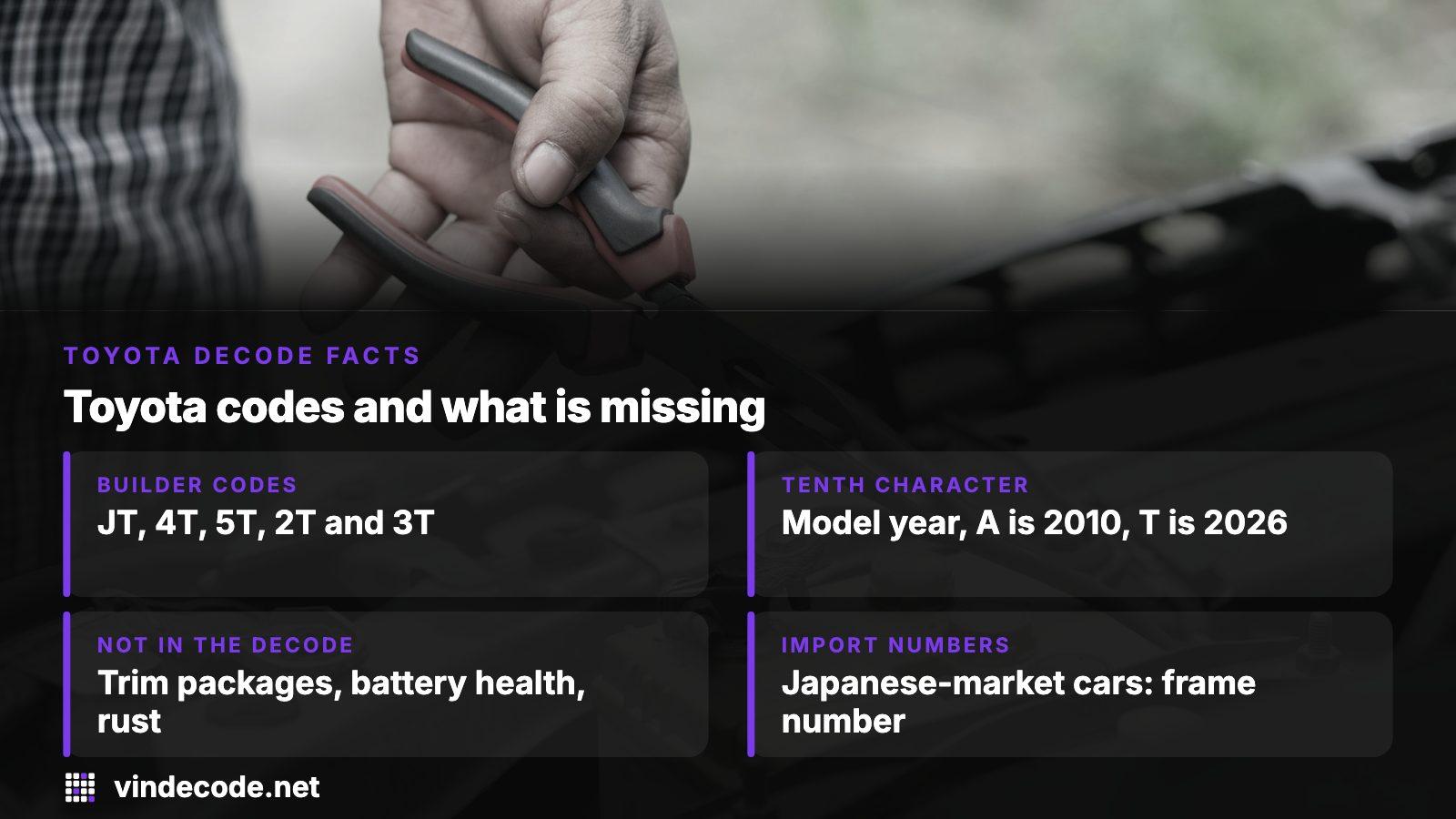
- Builder codes
- JT, 4T, 5T, 2T and 3T
- Tenth character
- Model year, A for 2010 up to T for 2026
- Not in the decode
- Trim packages, battery health, rust or crashes
- Import numbers
- Japanese-market cars carry a frame number, not a VIN
What the decoder returns for a Toyota
The decoder reads your number against the layout Toyota registered with NHTSA's public vPIC database, so the answer is the car as it left the factory. That makes it the tiebreaker when the ad, the badge and the seller's memory disagree.
- Model year, model line and body style
- Engine size, cylinder count and fuel, hybrid systems included
- Front, rear or all-wheel drive
- Assembly plant and country, plus open recalls on that exact number
Reading the number off the car, and typing it right
Skip the advert and read the VIN yourself. Standing at the driver's door, look through the glass at the dash corner for a small plate, then open the door for a second copy on the pillar label. Both should match each other and the title.
| Characters | What they tell you |
|---|---|
| One to three | Builder and country |
| Four to eight | Toyota's own model, body, engine and restraint coding |
| Nine | Check digit, a checksum on the other sixteen |
| Ten | Model year |
| Eleven | Assembly plant |
| Twelve to seventeen | Serial number of this one car |
One wrong character usually trips the check digit, so an error means read the plate again, not that the car is suspect.
Does the prefix match the seller's story?
Toyota has no single prefix: vPIC registers one code per plant and vehicle class. The first two characters still name the country, which is enough to test what you were told.
| Seller says | Look for | Example codes |
|---|---|---|
| Japan-built | JT | JTD on a car, JTM on a multipurpose vehicle |
| US-built | 4T or 5T | 4T1 for Kentucky, 5TF for a Texas truck |
| Canadian | 2T | 2T1 and 2T3 |
| Mexican truck | 3T | 3TM, from Baja California |
| Joint plant with Mazda | 7MU | Decode it in full before judging |
A clash is a question for the seller, not proof of a lie. Many of Toyota's best-selling US models are assembled in North America, so a 4T or 5T start is ordinary. Also, a prefix names a builder, not a badge: NHTSA's registry lists JTH and JTJ under Lexus and 5TD under both marques. Read the make field of the full decode before calling anything a mismatch.
Trim packages and hybrid batteries: where the decode stops
The coding settles model line, body and engine, but the number does not store trim names directly. Treat the decoded grade as a hint and confirm it against the car, the paperwork and a Toyota dealer.
Hybrids add a second gap. The decode shows the car was built as a hybrid and names the powertrain, yet the traction battery, which fades slowly and drives the price, is invisible to it.
- Find out if the hybrid battery has ever been changed, and ask for the receipt.
- Ask a Toyota dealer to confirm by VIN which hybrid-system coverage still applies.
- Compare real fuel economy with the EPA rating for that exact configuration.
From an NHTSA owner complaint
The owner of a 2010 Prius told NHTSA that the check hybrid system light came on following a sudden incident on the road, and that the inverter had gone bad. The owner says the recall fix meant to prevent this had already been carried out, but Toyota's 2021 move to cover inverter failures past the warranty period on certain 2010 Priuses did not extend to this VIN. The repair, the owner adds, would nearly equal what the car is worth.
Eligibility was drawn VIN by VIN, so two Priuses of one year can sit on opposite sides of the line. Ask a Toyota dealer what applies to the exact number before you agree a price.
Pickups and SUVs: a clean lookup does not clear the frame
On body-on-frame Toyotas, the pickups and older SUVs, the frame decides how long the vehicle is worth keeping. A decode can place the truck in a model year and plant but cannot say how many salted winters it sat through.
- Slide under with a flashlight and follow both rails, the crossmembers and the rear spring hangers.
- Press and tap doubtful spots. Light surface rust is normal; flaking scale or a hole is not.
- Ask for records of any frame inspection or rust treatment, and where the truck was registered.
From an NHTSA owner complaint
The owner of a 2008 Tacoma told NHTSA that an independent mechanic spotted severe subframe corrosion during an oil change. A Toyota dealer said the VIN had no recalls and quoted a repair. At 130,000 miles the truck went unrepaired, and the owner says Toyota offered no assistance.
A no-recalls answer covers recalls only. It says nothing about steel that has rotted for years, so time on a lift outweighs any lookup.
Recalls follow the VIN, not the mailing list
Recalls are written against VIN ranges, often limited to a plant and a build window, so a headline about a Toyota recall says nothing about one car. NHTSA's lookup answers for a single number, and the maker generally repairs open recalls at no cost to whoever owns the car now. The decode names the plant, and the label inside the door gives the build month that such a campaign hinges on.
From an NHTSA owner complaint
A second owner of a 2008 Camry told NHTSA the dashboard had gone sticky and shiny, distracting on warm days. Toyota replied that the warranty was over and that fixing it was the first owner's job. Having bought the car used, this owner says no notice of any coverage or repair was ever received, by post or by email.
A mailing list follows the people who owned the car, while the VIN follows the car. Look the number up yourself instead of waiting for a notice that may never reach you.
When the number will not decode: Japanese-market cars
A car built for sale in Japan never received a 17-character VIN. Its plate carries a frame number, a short model code joined by a hyphen to a serial, and a decoder made for the US standard has nothing to work with. A blank result is the expected outcome and tells you nothing against the car.
Vehicles 25 years or older can generally come in without meeting US safety standards, which is why such cars keep appearing for sale. A model code alone names a platform shared by many cars and is not an ID for yours, so photograph the plate and ask for the entry papers.
From decode to history: the order, and what it costs
The decode describes how Toyota built the car. Wrecks, title brands, rolled-back odometers and liens sit in other records, and a history report gathers those for the exact VIN.
- Read the VIN off the car and decode it against the ad.
- Test the prefix against the seller's story of where it was built.
- Run NHTSA's recall lookup on the same number.
- Inspect what no number shows: a truck's frame, a hybrid's battery.
- Open the history preview and pay for the full report once the build and prefix hold up.
You see the preview before paying and no card is needed. A full report is one payment for one VIN, or one of three packs covering 3, 5 or 10 VINs, and nothing renews. Prices are on the pricing page.

Where this information comes from
- NHTSA: vPIC VIN decoder — The public database where Toyota's VIN layout and builder codes are registered, which the decode reads.
- NHTSA: recalls lookup — Checks open recalls for one exact VIN; the remedy costs the owner nothing.
- EPA: fueleconomy.gov — Official economy ratings by engine and drivetrain, for judging a hybrid's real-world numbers.
- NHTSA owner complaint 11470034 — owner experience, paraphrased
- NHTSA owner complaint 11631849 — owner experience, paraphrased
- NHTSA owner complaint 11196802 — owner experience, paraphrased
Sources and photos: Facts checked against the sources above in November 2026. Photos by John Kakuk, Martin Fennema and Towfiqu barbhuiya on Unsplash; diagrams by VINDecode.
Keep reading
- Lexus VIN Decoder: Confirm the Build, Then Check the HistoryToyota's luxury marque, with codes and pitfalls of its own.
- VIN Decoder: Decode a VIN Number Online, Then Check Its HistoryEvery VIN position explained, including the check digit.
- NHTSA VIN Decoder: What It Returns, Where It Stops, What Comes NextHow the federal database behind this decode works.
- Sample reportA finished report, to see what the history adds beyond the decode.
Frequently asked questions
How do you decode a Toyota VIN?
Type all 17 characters into the decoder on this page. It matches them to the layout Toyota filed with NHTSA and lists the year, body, engine, drive and plant. An error usually means a misread character, so check the plate again.
Why do Toyota VINs start with JT, 4T or 5T?
Those letters name the builder's country: J is Japan, 4 and 5 usually mark US plants, and T is Toyota. Canada and Mexico use 2T and 3T. Lexus codes such as JTH start with JT too, so check the make in the decode.
Does the VIN tell me the trim?
Only in part. The coding narrows the model, body, engine and often the grade, yet Toyota's trim names are not stored as such. Check the badges, the paperwork and a Toyota dealer's record against the VIN before you pay for a particular trim.
Why will my imported Toyota not decode?
Japanese-market cars carry a frame number rather than a 17-character VIN, and US decoders and NHTSA's database are not set up to read it. Expect an empty result, photograph the plate, and keep the model code and serial together.
Does a Toyota VIN decode show accidents or mileage?
No. A decode describes construction only, so crashes, title brands and odometer readings sit outside it. The history preview for the same VIN shows what those records hold, and the full report is one payment if you want the detail.
Now check the car itself
The guide explains what to look for. The report shows what this VIN has on record.