
THE SHORT ANSWER
Enter all 17 characters of the Lexus VIN into the decoder on this page. The first three name Lexus and the country of manufacture and never match a Toyota code. The result gives the model, year, engine, fuel, drivetrain and plant. It shows no crashes, title brands or mileage, so if the build matches the ad, open the free preview of a history report before paying for anything.
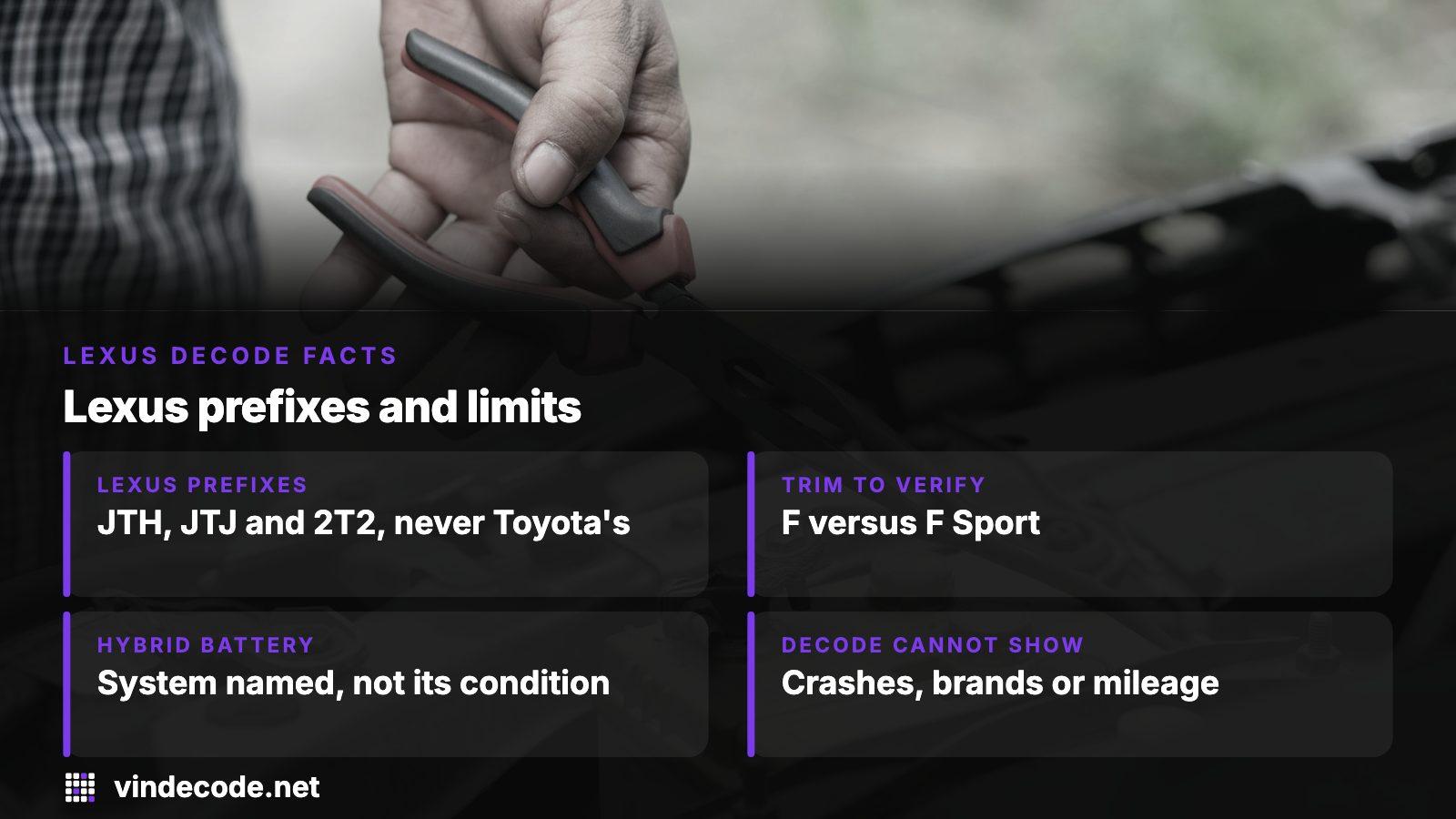
- Lexus prefixes
- JTH, JTJ and 2T2, never a Toyota code
- Trim to verify
- F versus F Sport
- Hybrid battery
- The decode names the system, not its condition
- Decode cannot show
- Crashes, title brands or mileage
What a Lexus decode puts on screen
The decoder reads your VIN against the layout Lexus filed with NHTSA's public vPIC database, so what comes back is the car in its original factory form. A decoded engine, drivetrain or model that disagrees with the seller's wording is your first question for them.
- The model, its year and how the body is classed
- Engine size, cylinder count, fuel, and hybrid hardware if fitted
- Whether the drive goes to the front, the rear or all four wheels
- Which assembly plant and country built it
- Open safety recalls recorded against that exact VIN
Finding the VIN and typing it in
Read the VIN on the car itself, never off the listing. Peer through the glass at the lower windshield corner on the driver's side, then match it to the label fixed to the driver's door. Both must agree with the title.
| Position | Meaning |
|---|---|
| First to third | Maker and country |
| Fourth to eighth | Description of the vehicle |
| Ninth | Check digit |
| Tenth | Model year |
| Eleventh | Plant |
| Twelfth to seventeenth | Serial number of this particular car |
If the decoder throws an error or returns a car that makes no sense, suspect a typo first and read the characters off the car again.
JTH, JTJ and 2T2: three Lexus prefixes, none of them Toyota's
Toyota sells Lexus as its luxury marque, and the two share platforms and engines, yet manufacturer codes are assigned marque by marque. No Lexus VIN opens with a Toyota code, and no Toyota VIN opens with a Lexus one.
| Starts with | Built |
|---|---|
| JTH | In Japan |
| JTJ | In Japan, across several model lines |
| 2T2 | In Canada, at Toyota's Ontario plant that assembles certain Lexus SUVs |
A Canadian code on a Lexus SUV is normal. Lexus holds further codes, so decode an unfamiliar prefix before judging it. The red flag is a clash: a car badged Lexus that decodes as a Toyota, or the reverse. Badges are cheap to swap and the VIN is not, so ask the seller to explain it.
F or F Sport: let the decode name the model
An F car is a performance model with its own engine and chassis engineering. F Sport is an option package on a regular model: styling, wheels, seats and tuned suspension. It is a good car, but not an F, and it is priced well below one.
| The decode returns | Probably what you are looking at |
|---|---|
| A distinct F model name | A genuine F car |
| The regular model's name | A package car, or an ordinary one with badges added later |
| A model unlike the one advertised | Price what the decode says, and ask why the ad differs |
Have a dealer check the original build from the VIN, and inspect the engine with your own eyes rather than believing the badge.
Shared with Toyota: cheaper parts, and sometimes shared faults
Much of what sits under a Lexus has a Toyota twin, sometimes the identical part under another number and price. An independent shop that knows Toyotas can often work on a Lexus for less than a dealer charges.
| Area | Overlap with Toyota |
|---|---|
| Engine and drivetrain | Frequently shared |
| Suspension and brakes | Often shared at platform level, with specifications that can differ by model |
| Electronics and trim | Mostly Lexus-only and priced that way |
| Air suspension | Where fitted, tied to the model and costly to fix, so ask whether the car has it |
From an NHTSA owner complaint
The owner of a 2012 Lexus CT 200h told NHTSA about a leaking brake accumulator, with a buzzing actuator and trouble code C1391. The owner says a Toyota Prius V uses the same part number, that Toyota replaced it for many owners under an extended warranty, and that Lexus seems not to. A Lexus dealer, the owner adds, ran the VIN and found no recalls.
Shared parts can bring shared faults, and warranty treatment may differ between the brands. A clean recall lookup covers recalls only, so read NHTSA's public complaints for your exact model and year.
Hybrid Lexus: the VIN names the system, only the car shows the battery
The decode tells you the car was built that way, not how the traction battery has aged, and that decides the price. These batteries fade slowly, with less electric-only driving and worse economy long before a warning light. The service file and a test drive tell you more than the spec sheet.
- Find out whether the hybrid battery was ever changed, and see the paperwork.
- Learn how long the hybrid-system warranty lasts, since it outlives the basic cover.
- Pull away gently and see whether the car moves on electric power alone.
From an NHTSA owner complaint
A 2012 Lexus CT 200h owner told NHTSA that a check hybrid system warning ended with the dealer replacing a non-hybrid battery for $350. The warning came back within a week, and the owner says the dash went dark mid-drive and the brakes and steering were lost. The dealer later reported a loose cap in the hybrid battery, and the owner describes a repeat.
A single owner proves nothing about the fleet. Still, a car that keeps returning to the shop for one hybrid warning deserves a pointed question to the seller.
Recalls follow the VIN, and a certified car still needs a check
Recalls are written against ranges of VINs, and a campaign can span Lexus and Toyota where a part is common to both. NHTSA's lookup answers for one exact car, at no charge, and the fix costs the owner nothing however many owners came before.
Lexus certified pre-owned adds manufacturer-backed coverage to what remains of the original warranty. That says nothing about the car's past, and the program's rules can allow a certified car with accident history. Run its VIN like any other.
What a decode cannot see, and where the answer lives
The number describes construction, not experience. Salvage brands, crashes, rolled-back odometers and unpaid liens leave no trace in it. They sit in title, damage and mileage records, which the history report assembles for the exact car.
| Your worry | Where the answer is |
|---|---|
| Real F or F Sport | The decode, then a dealer's check of the build |
| A hybrid battery that has faded | The test drive and the service file |
| Flood, salvage or another title brand | Title records in the history report |
| Mileage that does not add up | Odometer readings in the history report |
A brand the seller never mentioned, or mileage that drops between records, is reason enough to ask for a written explanation before a deposit, or to leave.
What it costs, and the order to run the checks
You see a preview before paying anything, and no card is needed for it. The full report is bought once, singly or in a pack of 3, 5 or 10, and nothing renews. Amounts are listed on the pricing page.
- Decode the VIN and set the result beside the ad.
- Settle F versus F Sport from the decoded model.
- Look up open recalls for the VIN at NHTSA.
- Open the history preview and buy the full report once the build holds up.

Where this information comes from
- NHTSA: vPIC VIN decoder — The public database where Lexus files its VIN structure, which the decode reads.
- NHTSA: recalls lookup — Free open-recall check by VIN, repaired at no cost to the owner.
- EPA: fueleconomy.gov — Official fuel economy ratings by engine and drivetrain, useful for judging a hybrid's real economy.
- NHTSA owner complaint 11600196 — owner experience, paraphrased
- NHTSA owner complaint 10949973 — owner experience, paraphrased
Sources and photos: Facts checked against the sources above in November 2026. Photos by Miles Loewen, Scott Graham and Towfiqu barbhuiya on Unsplash; diagrams by VINDecode.
Keep reading
- Toyota VIN Decoder: Check the Build, Then the Car's RecordThe parent brand, with shared hybrids and prefixes of its own.
- BMW VIN Decoder: Decode the Build and Spot a Real M CarThe same performance-versus-package question, settled by the VIN.
- VIN Decoder: Decode a VIN Number Online, Then Check Its HistoryAll 17 positions explained, including the check digit.
- Sample reportA finished report, to see what the history adds beyond the decode.
Frequently asked questions
How do I decode a Lexus VIN?
Type all 17 characters into the decoder on this page. It reads them against the layout Lexus filed with NHTSA and returns the model, year, engine, drivetrain and plant. One wrong character gives an error or a different car, so check the number against the vehicle.
Will a Lexus VIN decoder show accidents or mileage?
No. A decode describes the build, so crashes, title brands and odometer readings are outside it. Those live in title, damage and mileage records, which a history report collects. The decode confirms the car, and the report tells its story.
Why is my Lexus VIN missing Toyota's prefix?
Codes are issued per marque, not per parent company, so Lexus has its own, among them JTH, JTJ and 2T2, even when a model shares its platform and engine with a Toyota. A Lexus that decodes as a Toyota, or the reverse, calls for an explanation.
How do I tell an F from an F Sport?
Look at the model name the decode returns for your VIN. A true F car decodes as its own model, while an F Sport car decodes as the regular model with the package on top. Then have a dealer check the original build.
Is the hybrid battery a risk on a used Lexus?
It is something to check, not to fear. The VIN shows the car left the factory as a hybrid, but battery health is a separate question and the decline is slow. Ask for any replacement invoice and find out how long hybrid-system cover lasts.
Now check the car itself
The guide explains what to look for. The report shows what this VIN has on record.