THE SHORT ANSWER
Enter all 17 characters of the Suzuki VIN in the decoder above. The first three identify the builder and the vehicle class, and the tenth carries the model year. A year of 2015 or later means the vehicle is not a car, because NHTSA lists no Suzuki cars after 2014. The decode describes the machine as built, so a history report is the next step for title brands, damage, odometer readings and theft.
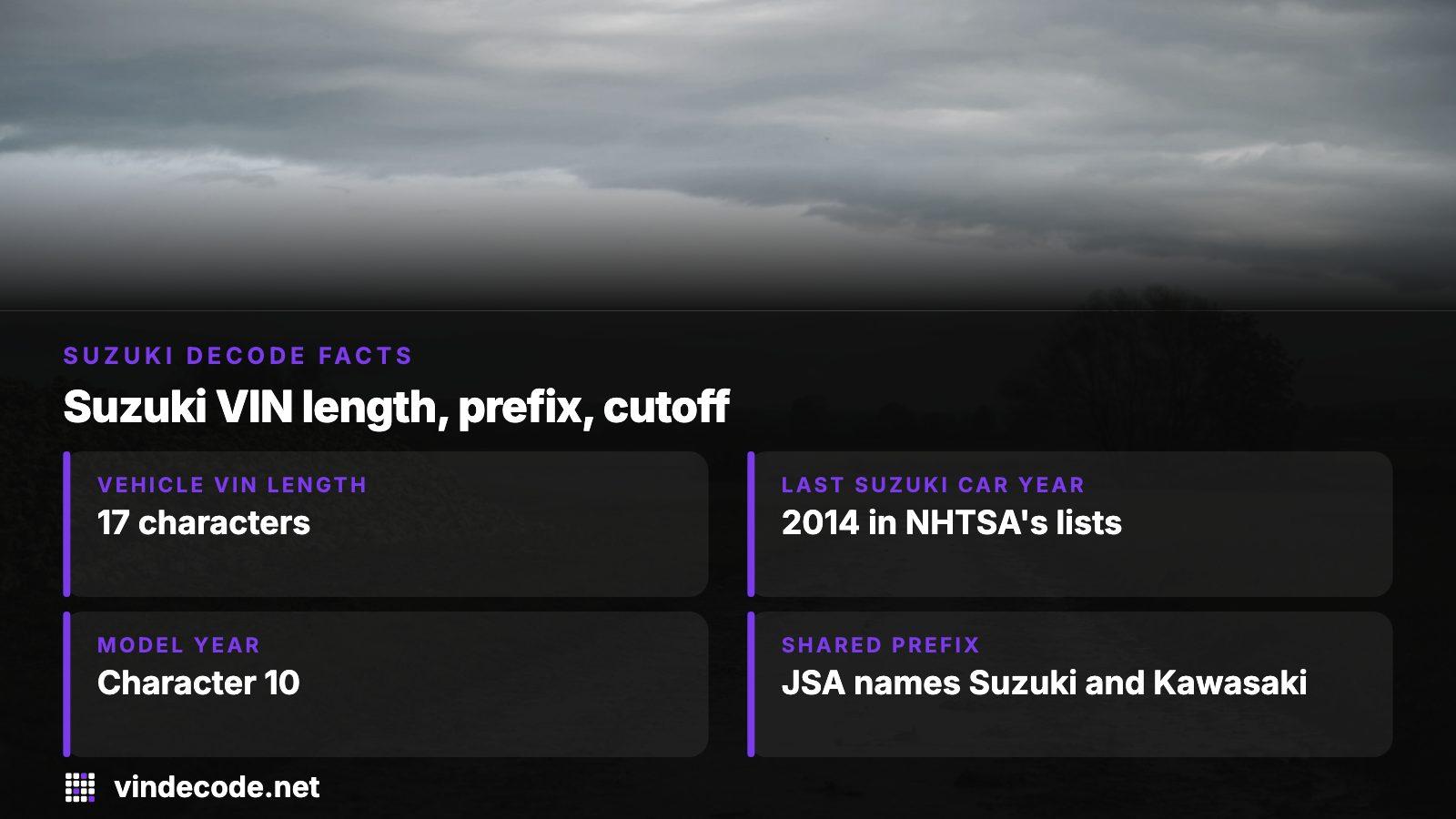
- Vehicle VIN length
- 17 characters
- Last Suzuki car year
- 2014 in NHTSA's lists
- Model year
- Character 10
- Shared prefix
- JSA names Suzuki and Kawasaki
What a Suzuki decode reports, and what it sorts first
The decoder matches the 17 characters against the build data Suzuki filed with NHTSA. For this marque the first thing it settles is the class of vehicle: a motorcycle, a quad, or one of the handful of cars Suzuki sold in the US.
- Builder and vehicle type, from the first three characters
- Model line, body style and engine, where the filing carries them
- Model year from character ten and plant from character eleven
- The production sequence number that closes the VIN
All of that dates from the day the machine was built. A decode records no crash, no salvage brand and no wound-back odometer. Those live in separate records, covered further down.
Suzuki prefixes: a VIN does not always start with JS
Machines built in Canada, South Korea and China open differently, so a tool that insists on JS fails on them. NHTSA's vPIC database lists these prefixes under Suzuki, grouped here by vehicle type.
| Vehicle type on file | Prefix | Built in, by first character |
|---|---|---|
| Motorcycle | JS1 | Japan |
| Motorcycle | LC6 | China |
| Passenger car | JS2 | Japan |
| Passenger car | KL5 | South Korea |
| Multipurpose passenger vehicle | JS3 | Japan |
| Multipurpose passenger vehicle | 2S3 | Canada |
The country letter comes from an international assignment scheme rather than the federal VIN rule, so treat it as a hint about origin. JSA is the prefix to handle with care. vPIC lists it under Suzuki and Kawasaki together, so the make settles nothing, and the model coded in positions four to eight has to name the marque.
Character ten shows whether a car is even possible
NHTSA lists three Suzuki cars for model year 2014 and none after it. The 2015 list holds 33 models and the 2016 list 37, all of them motorcycles, scooters or ATVs.
| Tenth character | Model year | What it allows |
|---|---|---|
| C | 2012 | A car is possible |
| E | 2014 | The last year with cars |
| F | 2015 | Powersports only |
| G | 2016 | Powersports only |
| M | 2021 | Powersports only |
A VIN that resolves to 2015 or later cannot be a Suzuki car, whatever the listing says. A 2012 Kizashi, for example, opens with JS2 and has C in position ten. The code repeats every thirty years, so E can mean 2014 or 1984, and on an old machine the model decides.
Finding and checking the number on a bike or an ATV
- On a motorcycle, check the steering head first and the frame tube trailing the forks next. A label repeats the number. On a quad, expect it low on the frame by the front left wheel, or under the footwell.
- Read each stamped character against the title and the advert.
- Skip the engine serial. It belongs to the motor, not the machine, and a decoder rejects it.
- Check that the prefix suits what is in front of you. A car prefix on a motorcycle needs an answer from the seller before any money moves.
Grinding marks or filler around a frame number are about as strong a theft warning as a motorcycle gives, and anyone with a flashlight can see them. Competition dirt bikes can break the 17-character pattern. Some carry shorter maker numbers that no decoder reads, since they were never titled for road use.
Suzuki outboards and boats do not decode here
Suzuki also builds outboard motors, and some searchers arrive holding that number. A motor like that has a maker serial, not a VIN. The hull has its own identifier under Coast Guard rules, and the engine may have been fitted long after the hull was built. A history report works from road-vehicle VINs, so it cannot look up a boat or its motor.
- Outboard motor: its own serial, never a VIN
- Boat hull: a 12-character hull identification number
- Trailer under the boat: a true 17-character VIN, which the decoder above reads
Open recalls on a Suzuki car outlast the dealer network
A safety recall is tied to the VIN, and it does not vanish because the marque stopped selling cars. NHTSA's free recall lookup takes a VIN and reports open campaigns. Finding the recall is easy. Getting it fixed is where owners report trouble.
From an NHTSA owner complaint
A 2008 Grand Vitara owner filed with NHTSA in 2024 after three letters about a passenger airbag recall. The closest working Suzuki dealer was about 3 hours off, wanted the car for an unspecified time and offered no loaner. The owner could not rent one, so kept driving while the airbag light flickered, even parked.
Run the recall lookup before buying an older Suzuki car, then ask where an open repair would actually happen. The seller saying it was handled is not a record.
What a decode cannot show about a used Suzuki
A factory record describes the vehicle on its first day. A seller can pass a decode and still be selling a branded title, a repaired crash or a tired drivetrain.
From an NHTSA owner complaint
Buying a 2012 Kizashi from a dealer left one owner, by their own account to NHTSA, with a car they could not use. The seller had called its problems a possible sensor fault and normal for the brand, but an inspection the next day found gearbox damage. The dealer refused both a refund and an exchange, and the owner says the car fails emissions and cannot be fixed because parts are unavailable.
The decode would have confirmed that car's year and builder, and nothing more. A failing gearbox shows up under inspection, so book one before paying, not after. The case also shows what a discontinued marque can cost: parts and service may be hard to find, and the price should reflect it.
What the history report adds after the decode
| Record | What it tells you about the Suzuki |
|---|---|
| Title brands | Whether it was ever titled as salvage, rebuilt or flood damaged |
| Accident and damage records | Whether it has been hit, and where |
| Odometer readings | Whether the numbers rise steadily or drop at some point |
| Salvage and auction history | Whether it passed through an auction, with photos |
| Theft records and liens | Whether it was reported stolen or a lender still has a claim |
On a motorcycle or ATV from a private seller, give theft and lien records the closest look. The preview that appears after you enter a VIN is free. You pay once, for a lone report or for a bundle of 3, 5 or 10 if you are shopping for several machines. There is no subscription and nothing renews. Current rates sit on the pricing page. An empty report means nothing was recorded, so read it beside an inspection.
A sensible order for checking a used Suzuki
- Read the VIN off the machine and count the characters. Fewer than 17 usually means a hull number, an outboard serial or a competition bike.
- Decode it above and compare vehicle type, model and year with the advert.
- Check character ten. A year of 2015 or later rules out a car.
- Run NHTSA's recall lookup and learn where an open repair would be done.
- Try NICB's free VINCheck for theft and salvage flags.
- Open the preview that follows a VIN entry. When the machine has survived the steps above, buy the full report.
- Have an independent mechanic inspect it before any money changes hands.
Where this information comes from
- NHTSA: vPIC VIN decoder — The federal database listing Suzuki builder prefixes and the model lists by year that this page's counts come from.
- eCFR: 49 CFR Part 565, VIN requirements — The federal rule that fixes the sections of a 17-character VIN, including the check digit and the year code.
- NHTSA: recalls lookup — Where open recalls are checked by VIN, whether or not the marque still sells the model.
- NICB: VINCheck — A theft and salvage lookup fed by participating insurers.
- NHTSA owner complaint 11606504 — owner experience, paraphrased
- NHTSA owner complaint 11614366 — owner experience, paraphrased
Sources and photos: Facts checked against the sources above in November 2026. Photos by Steve Smith, Owen Michael Grech and Andrew Dawes on Unsplash; diagrams by VINDecode.
Keep reading
- Kawasaki VIN Decoder: Year, Model and Plant From the Frame NumberThe other maker named on the shared JSA prefix, with its own prefixes and model codes.
- VIN Decoder: Decode a VIN Number Online, Then Check Its HistoryHow the 17 positions read on any make, before brand-specific codes enter.
- NHTSA VIN Decoder: What It Returns, Where It Stops, What Comes NextWhat the federal decoder behind these results covers, and where it stops.
- Sample reportA finished report, to see what the history adds after the decode.
Frequently asked questions
How do I decode a Suzuki VIN?
Enter all 17 characters in the decoder above. Characters one to three give the builder and vehicle type, ten gives the model year and eleven points to the plant. If nothing returns, recount and compare each character with the stamping, since one misread letter stops a decode.
My Suzuki VIN does not begin with JS. Is something wrong?
Not necessarily. Suzuki vehicles built in Canada open with 2S3, cars from South Korea with KL5 and motorcycles from China with LC6. Only the Japanese-built ones start with JS, so a tool that demands that prefix rejects valid numbers.
Does the decoder work on Suzuki ATVs and dirt bikes?
Yes, when the machine carries a full 17-character VIN. Some competition-only dirt bikes have shorter maker numbers that no decoder can read. Whichever machine you have, use the frame number, never the engine serial.
Can a Suzuki VIN decode show an accident?
No. A decode reads the factory coding, nothing that happened later. Accident, salvage and odometer records are filed under the VIN afterward, so they come from a history report, and even a clean one only means nothing was recorded.
Which Suzuki cars can I still find used?
The Grand Vitara, SX4 and Kizashi are the cars in NHTSA's 2014 list. The Equator pickup, built alongside the Nissan Frontier, no longer appears there. Any Suzuki with a model year of 2015 or later is a powersports machine, not a car.
Now check the car itself
The guide explains what to look for. The report shows what this VIN has on record.