THE SHORT ANSWER
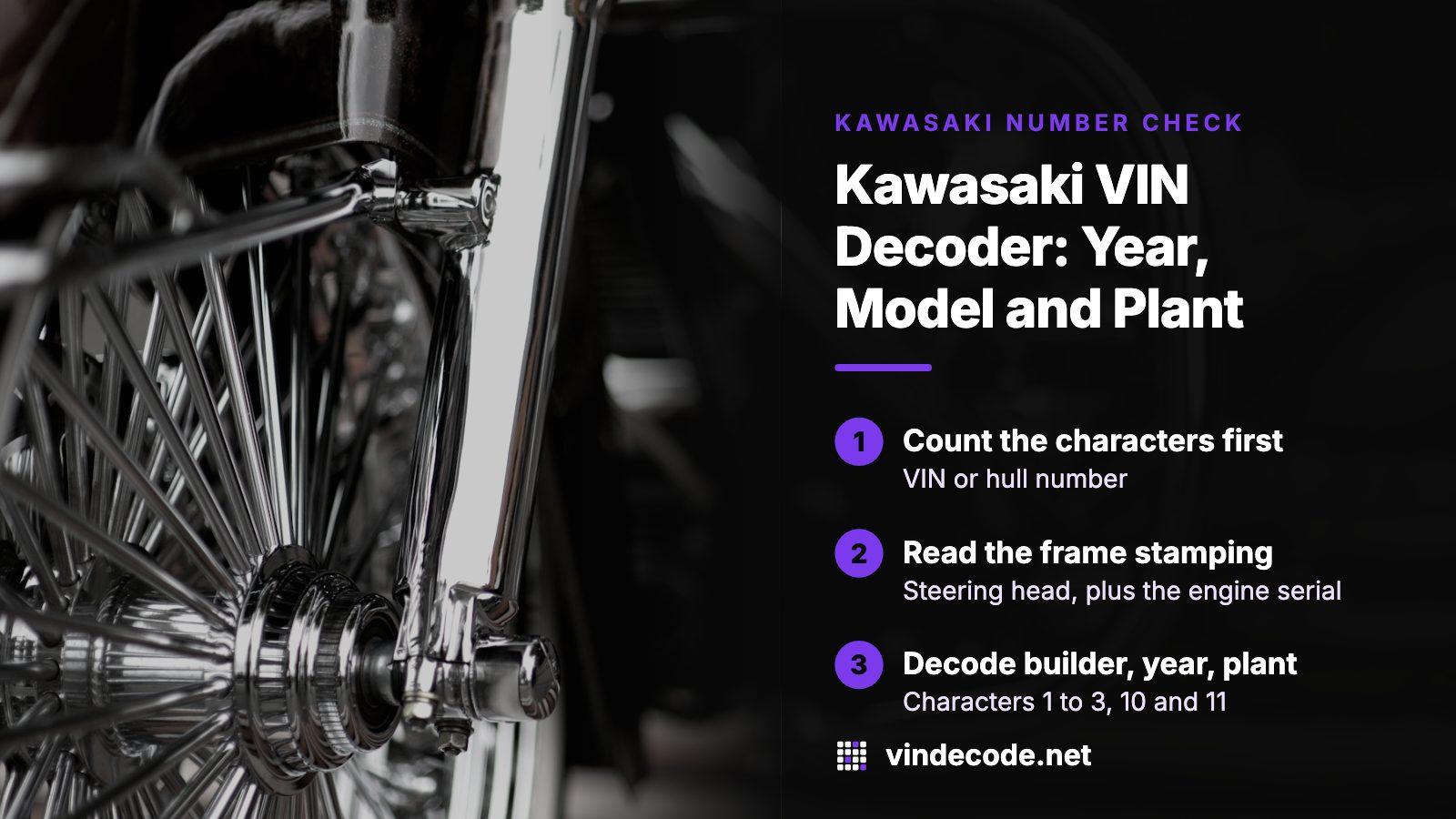
To decode a Kawasaki VIN number, enter all 17 characters in the decoder above. The first three name the builder, the tenth is the model year code and the eleventh is the plant. A Jet Ski has a 12-character hull number instead, which this decoder cannot read. The decode describes the machine as built, so check recalls by VIN and run a history report before you buy.
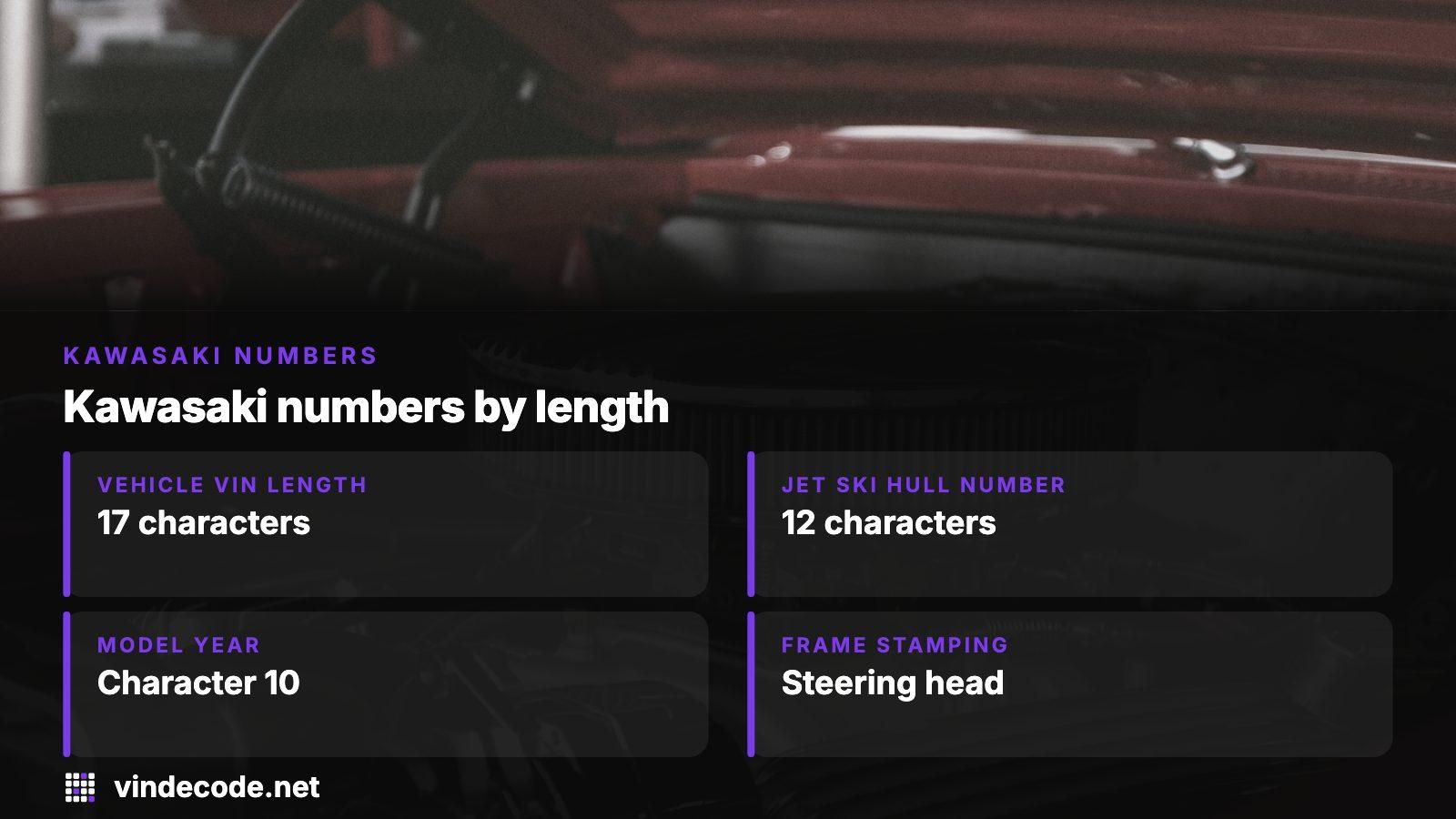
- Vehicle VIN length
- 17 characters
- Jet Ski hull number
- 12 characters
- Model year
- Character 10
- Frame stamping
- Steering head
What a Kawasaki VIN decoder tells you, and what it leaves out
The decoder matches the frame number to the data Kawasaki filed with NHTSA and returns a short profile of the machine as it left the factory.
- Builder, and the plant that assembled the machine
- Model and series, with a body style such as dual-purpose or sport
- Engine size and layout, where the filing includes them
- Model year, read from the tenth character
All of it dates from the build. A decode cannot say whether the engine is original, whether the frame was repaired or whether the odometer is honest. That gap is what a history report fills.
VIN or hull number: count the characters first
Kawasaki builds more than bikes. Motorcycles, ATVs and Mule side-by-sides carry a 17-character VIN. A watercraft is numbered under Coast Guard rules instead, and a hull number pasted into a VIN decoder returns nothing sensible.
| What you are holding | What it is |
|---|---|
| 17 characters | A vehicle VIN, which this decoder reads |
| 12 characters, no hyphens or spaces | A hull number, which follows boating rules |
| First three hull characters | A code for the builder, or for the importer |
| Hull characters nine and ten | A letter for the month, then the last digit of the year |
Jet Ski began as a Kawasaki trademark, registered in 1975, and now stands for every personal watercraft. Many people searching for a Jet Ski number own a Yamaha or a Sea-Doo, so read the builder code first. This decoder and the report after it handle vehicle VINs only.
Reading the frame number and the engine serial off the bike
Read the number off the machine, not the listing. The stamping that counts is on the steering head, the frame neck the forks pivot in, and a label repeats it. Check each character against the title.
The engine has its own serial on the case, but the title follows the frame. On an older bike the two need not match, because engines get swapped and a clean swap is ordinary maintenance. It still changes the price, so ask the seller and look for receipts. Matching numbers carry a premium on a collectible.
Stop if the stamping looks worked on
Grinding marks, filler or characters sitting unevenly around the frame number are a reason to leave, not to haggle. Walk away and report the machine through NICB.
What each of the 17 positions holds on a motorcycle
| Position | What it holds |
|---|---|
| 1 to 3 | Builder code, listed by manufacturer in NHTSA's database |
| 4 to 8 | Maker-coded attributes: bike type, model line, engine and power rating |
| 9 | Check digit, a calculated value that catches misread characters |
| 10 | Model year, in code |
| 11 | The plant that built it |
| 12 to 17 | Sequence number of this machine |
Federal rules say what each block must describe, but the maker chooses the codes inside it. A chart for another brand misreads a Kawasaki, so the decoder uses Kawasaki's own filing for the middle block.
The ninth character is calculated from the other sixteen, so a failed check usually means a typing slip. No VIN uses I, O or Q, which makes a round character a zero.
Year and builder: characters one to three and ten in practice
The tenth character comes from a federal table of letters and digits. The two bikes in the owner accounts below show it working.
| Tenth character | Model year | Machine |
|---|---|---|
| G | 2016 | Ninja ZX-10R |
| P | 2023 | KLR650 |
Treat the code as the model year; it is not the manufacture date. The letters were also used in an earlier cycle, so confirm a letter against the model before quoting a year.
The prefix is the second quick check. NHTSA lists JKA, JKB and JK1 under Kawasaki Motors, Ltd., and ML5 under Kawasaki Motors Enterprise Thailand. A 2023 KLR650 prefix decodes to a single-cylinder, dual-purpose bike of 652 cc built in Rayong, Thailand. A prefix you cannot place calls for a question to the seller.
Recalls depend on the machine, and on the VIN
A Kawasaki garage can hold a street bike, a quad and a watercraft, and each reports to a different recall system. One lookup clears only one of them.
| Machine | Where its recalls are published |
|---|---|
| Street-legal motorcycle | NHTSA, searchable by VIN |
| ATV or side-by-side | The Consumer Product Safety Commission |
| Personal watercraft | The Coast Guard, under boating rules |
From an NHTSA owner complaint
The owner of a 2023 KLR650 with 220 miles on it reported steering that caught at 5 to 15 mph. The recall check showed nothing, but the owner had read that bikes with a VIN beginning ML, meaning Thai assembly, shipped with wrong steering torque, and planned to see a dealer. It is the owner's account, not a finding by NHTSA.
An empty recall lookup means no campaign, not a clean machine. A prefix owners are discussing is a reason to have a dealer check the steering first.
When the lookup says resolved and the bike disagrees
From an NHTSA owner complaint
The third owner of a 2016 Ninja ZX-10R told NHTSA that a transmission gear broke with no warning, leaving the bike undriveable and in need of a trailer. A safety recall already existed for that problem, and the owner's VIN lookup through Kawasaki showed it as resolved.
A recall status attaches to the VIN and records that a campaign repair was logged. It says nothing about how well the work was done. On a second-hand bike, request the repair order, then get a mechanic to examine whatever the campaign covered.
Recalls follow VIN ranges, so a model name alone proves nothing. Use NHTSA's lookup for a street bike and the Consumer Product Safety Commission's list for an ATV or Mule.
What a history report adds after the decode
A decode is about the factory. A history report searches the records filed under the same VIN since, and a few of them move the price of a used Kawasaki.
| Record | What it settles |
|---|---|
| Title brands | Whether salvage, rebuilt or another brand was ever applied |
| Accident and damage records | Whether the machine went down, and where it was hit |
| Salvage and auction history | Whether it passed through an auction, with photos |
| Odometer readings | Whether the mileage climbs the way real use does |
| Theft records and liens | Whether it was reported stolen or a lender has a claim |
Powersports machines are light and quick to resell, so theft and lien records matter most on a private sale. The preview shown after a VIN entry is free. Buying is one payment, for one report or for a bundle of 3, 5 or 10, and nothing renews. The pricing page has current rates. A quiet report shows only that nothing was recorded, so read it beside an inspection.
A sensible order for checking a used Kawasaki
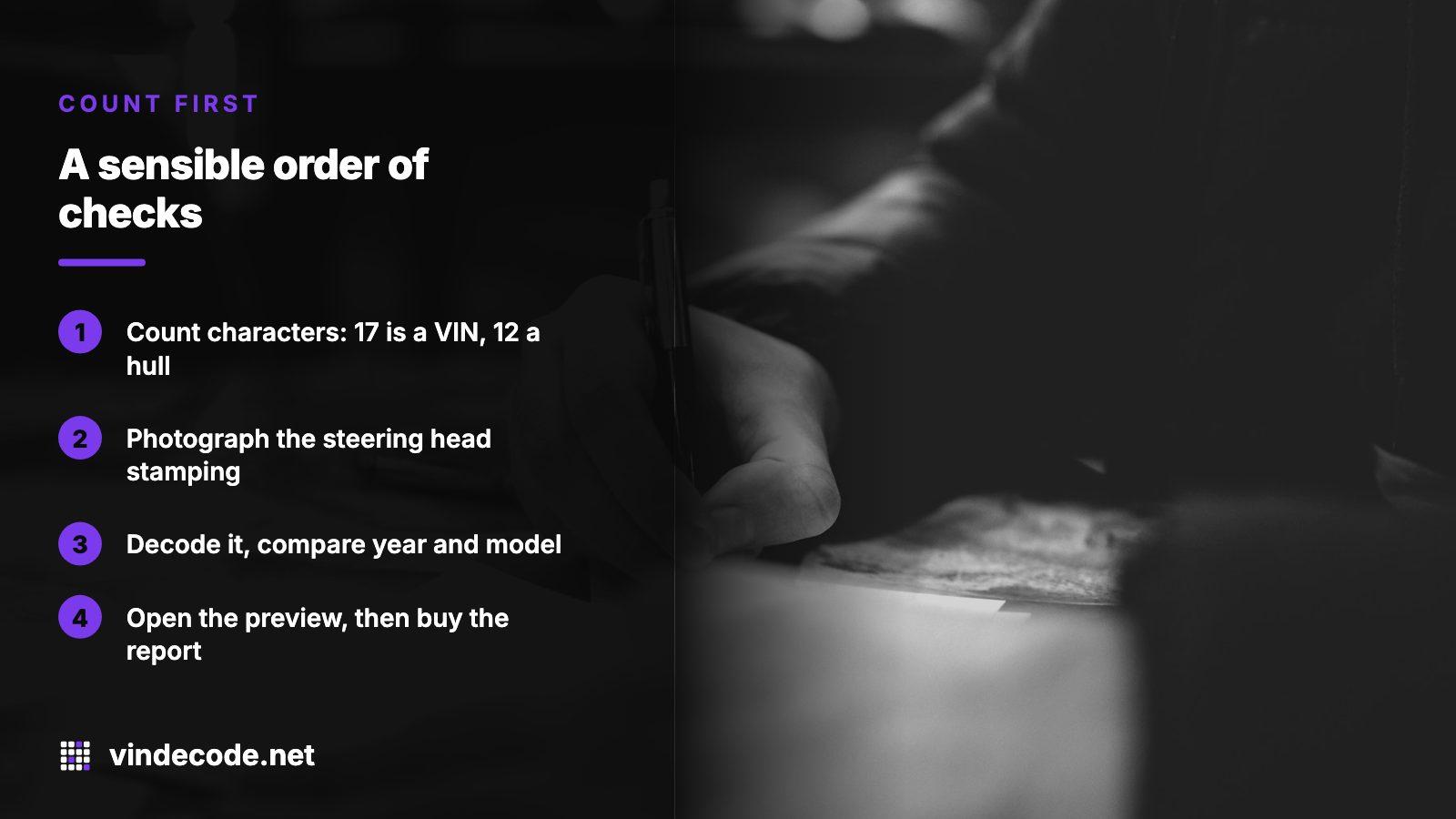
- Count the characters in the listing: 17 means the decoder, 12 means a hull number.
- Photograph the steering head stamping and compare it with the title.
- Decode the VIN above and compare year, model and engine with the advert.
- Run the recall lookup at the agency that matches the machine.
- Ask about the engine serial and any swap.
- Open the preview first, and buy the report if the machine still holds up.
- Have a mechanic you picked inspect the frame and any recall work before money moves.
Where this information comes from
- NHTSA: vPIC VIN decoder — The federal database that lists Kawasaki builder prefixes and the model data a decode reads against.
- eCFR: 49 CFR 565.15, VIN content requirements — Sets what each block of the 17 positions must carry, including the check digit and the year code.
- eCFR: 33 CFR 181.25, hull number format — Defines the 12-character hull number used on personal watercraft.
- NHTSA: recalls lookup — Where open recalls on a street-legal motorcycle are checked by VIN.
- CPSC: recalls — Where recalls on ATVs and side-by-sides are published.
- NHTSA owner complaint 11608635 — owner experience, paraphrased
- NHTSA owner complaint 11529287 — owner experience, paraphrased
Sources and photos: Facts checked against the sources above in November 2026. Photos by Steve Smith, Owen Michael Grech and Victor Hughes on Unsplash; diagrams by VINDecode.
Keep reading
- VIN Decoder: Decode a VIN Number Online, Then Check Its HistoryHow all 17 positions read on any make, with no brand-specific coding.
- NHTSA VIN Decoder: What It Returns, Where It Stops, What Comes NextWhat the federal decoder behind these results covers, and where it stops.
- Harley Davidson VIN Decoder: Year, Family and EngineAnother motorcycle maker, with its own engine stamping to compare.
- Sample reportA finished report, to see what the history adds after the decode.
Frequently asked questions
How do I decode a Kawasaki VIN number?
Enter the 17 characters stamped on the frame into the decoder above. If nothing comes back, recount first, since 12 characters means a hull number. One misread character, such as a zero taken for the letter O, also stops a decode, so rake a torch across the stamping and read it again.
Where do I find the VIN for a Kawasaki Jet Ski?
There is no VIN, only a 12-character hull number, and its first three characters name the builder. Kawasaki registered the Jet Ski trademark in 1975, which is why owners of other brands use the word too.
Can a VIN decoder show whether a Kawasaki has been in an accident?
No. A decoder reads the factory's coding and nothing that happened later. Accident, salvage and odometer records are filed under the VIN afterward, so they come from a history report, and even a clean one only means nothing was recorded.
Do Kawasaki ATVs and Mules use the same VIN format as the bikes?
Both carry a 17-character VIN, so the decoder reads them the same way. Recalls differ: ATV and side-by-side campaigns come from the Consumer Product Safety Commission, not NHTSA. Match the agency to the machine.
Which number do I use for a recall lookup, frame or engine?
The frame VIN. Campaigns are written against VIN ranges, and the title follows the frame as well. The engine serial helps a parts counter or a service manual, but it will not return a recall result.
Now check the car itself
The guide explains what to look for. The report shows what this VIN has on record.