THE SHORT ANSWER
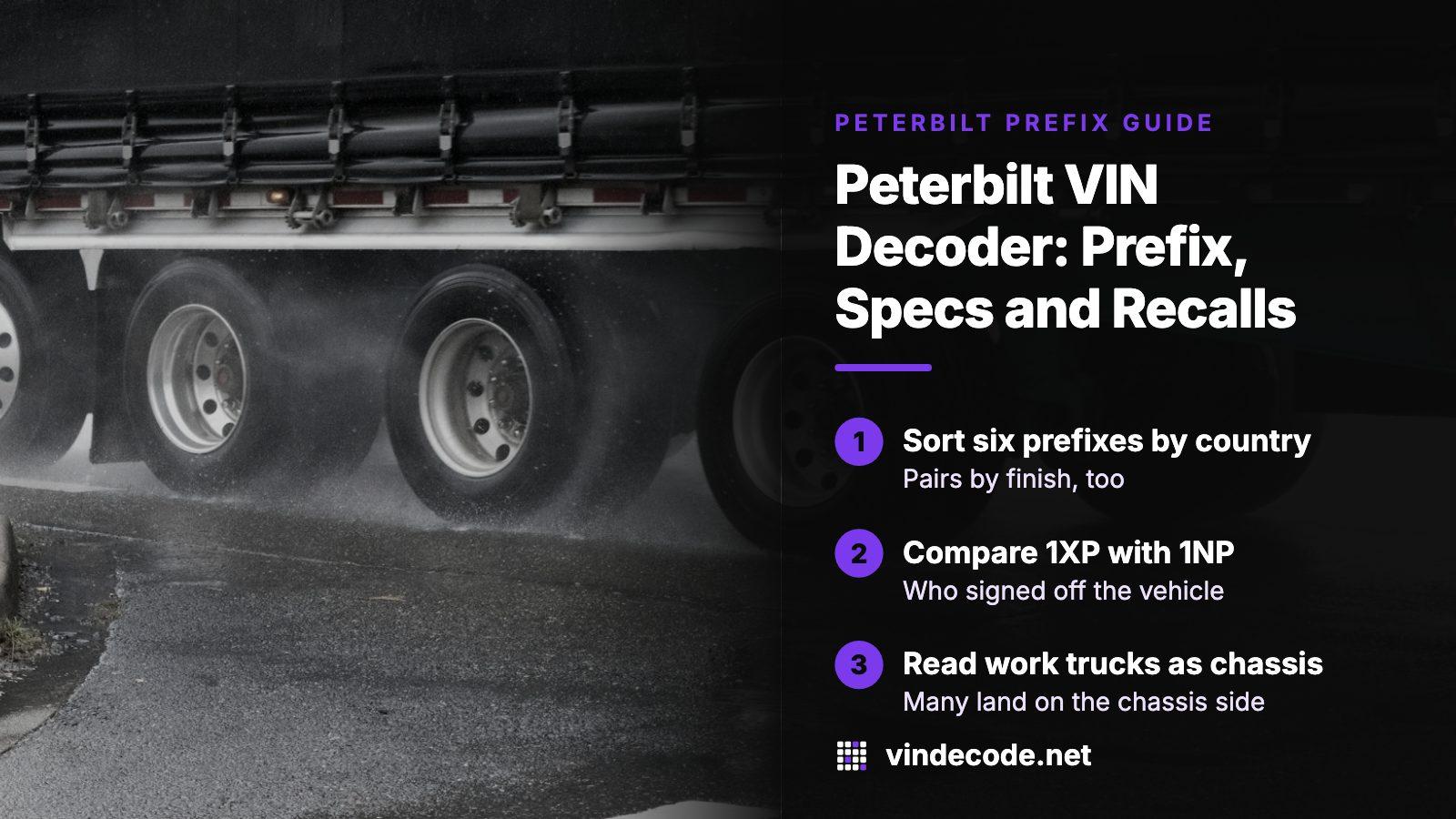
To decode a Peterbilt VIN, enter all 17 characters in the decoder above. Complete trucks start with 1XP, 2XP or 3WP, while chassis sold unfinished start with 1NP, 2NP or 3BP. The result shows the factory specification only. Accidents, title brands, liens and mileage live in other records, so decode first, then check the history before you pay for the truck.
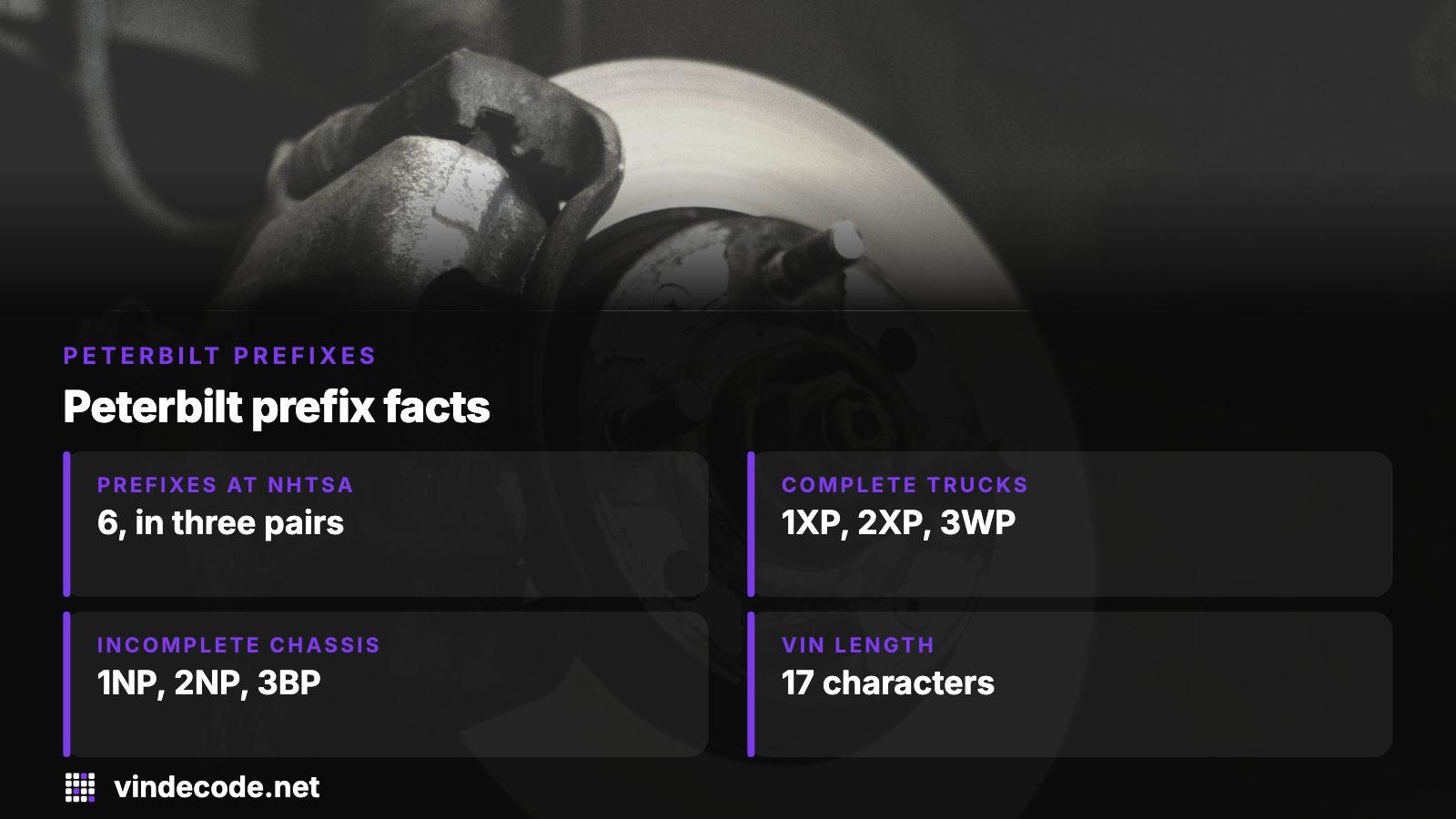
- Peterbilt prefixes at NHTSA
- 6, in three pairs
- Complete trucks
- 1XP, 2XP, 3WP
- Incomplete chassis
- 1NP, 2NP, 3BP
- VIN length
- 17 characters
What the decoder returns for a Peterbilt
The decoder matches your VIN to the filings Peterbilt made with NHTSA and prints a short profile of the truck as it was built. NHTSA's own vPIC tool does the same job and costs nothing, and it covers commercial vehicles.
- Make and model, as the manufacturer registered them
- Model year, read from the tenth character
- Body class, the federal category for what kind of vehicle it is
- Gross vehicle weight rating class for the chassis
- Whether the prefix belongs to a complete truck or an incomplete vehicle
Every line describes the build. Nothing in it reflects what the truck has done since, which is why the result is a starting point for a purchase and never the end of one.
Six Peterbilt prefixes, sorted by country and by finish
NHTSA holds six manufacturer prefixes for Peterbilt. The leading digit points to where the truck was built: a 1 is a U.S. plant, a 2 is Canadian and a 3 is Mexican. The middle letter separates finished trucks from chassis.
| Prefix | Country | NHTSA classification |
|---|---|---|
| 1XP | United States | Truck |
| 2XP | Canada | Truck |
| 3WP | Mexico | Truck |
| 1NP | United States | Incomplete vehicle |
| 2NP | Canada | Incomplete vehicle |
| 3BP | Mexico | Incomplete vehicle |
Compare the full three characters, not just the first. A 3 up front says Mexico for both a finished truck and a chassis, and only the next two characters say which one you have.
1XP versus 1NP: who signed off on the vehicle
A safety certification can only be given to a vehicle that is finished. A truck under 1XP left Peterbilt as a complete vehicle with Peterbilt's certification on it. A chassis under 1NP left with an incomplete vehicle document, which describes the bare chassis and the load it is designed to support.
The company that adds the body then certifies the finished vehicle. That final-stage builder, not Peterbilt, stands behind the completed truck, and its name appears on the final certification label.
Why this matters when you buy
Two manufacturers can be responsible for one truck. Ask the seller for paperwork from both. Many hold the chassis papers and nothing on the body, which can cost more than the frame and engine underneath.
Why work trucks land on the chassis side
A sleeper tractor is finished the day it is built. A dump truck, mixer, tanker, crane or refuse packer is not, because the equipment that defines its job comes from a specialist builder. That is why the incomplete prefixes turn up so often on vocational units.
| Document | What it states |
|---|---|
| Chassis maker's incomplete vehicle paper | What the chassis can support |
| Final-stage certification label | The completed truck as built |
| Weight ratings | The final label governs where the two differ |
| VIN | Usually stays the chassis maker's number |
If a seller quotes a gross weight from the chassis paper, check it against the final label. The label on the finished truck is the figure that applies on the road.
Reading the number off the truck itself
Begin at the frame rail on the driver's side, then look at the certification label by the door. On a finished work truck, find the second label too. It usually sits close to the first and names a company you may not know.
Photograph both before you type anything. Next, check each character of the VIN against both the title and the advert. No VIN contains the letters I, O or Q, so anything round is a zero.
Position ten holds the model year, and position eleven holds the plant. The last six are the serial of that particular truck.
Recalls when a truck has more than one maker
The chassis maker, the body builder and the component supplier can each issue campaigns, and each files its own. A VIN lookup at NHTSA finds the chassis side. A boom, hoist or body defect may need a call to the builder, using the serial on their label.
From an NHTSA owner complaint
The owner of a 2019 Peterbilt 567, whose VIN begins 1NP, reported that a driver had trouble shifting gears while towing. A dealer told the owner the one-year warranty had lapsed four days earlier, at 21,594 miles. The owner said the clutch serial number fell inside two clutch recalls, yet PACCAR and Eaton offered to cover just a share each, leaving almost 3K. The owner called it "a part that was on national recall." This is the owner's account, not an NHTSA finding.
Take from this that recall coverage can hinge on a component serial as well as the truck's VIN, and on timing. Ask for campaign status in writing before warranty runs out, and keep the repair order.
What the decode cannot see on a used Peterbilt
A decode reports the chassis specification. It says nothing about the body fitted on top, how hard the truck was worked, or what happened later. Collision damage, title brands and liens are all outside it.
From an NHTSA owner complaint
One 2018 Peterbilt 567 owner, whose VIN prefix is 1NP, wrote that the truck wandered within its lane at up to about 40 mph. With a load aboard, the steering wheel sat between 10 and 15 degrees to the left, even as the truck tracked straight. The account blames a steering box failure on a mounting bolt of the wrong length fitted at the factory. No recall is mentioned in it.
A decode lists the specification, not whether every part was fitted correctly. Odometer disclosure rules also exempt trucks over a federal weight limit, so no mileage may ever have been written down when one changed hands. A test drive and a mechanic's inspection cover what the record cannot.
After the decode: what a history report adds
A history report searches the records filed under the same VIN since the truck was built. For a used Peterbilt, a few of them move the price.
| Record | What it settles |
|---|---|
| Title brands | Whether salvage, rebuilt or another brand was applied |
| Accident and damage records | Whether the truck was hit, and where |
| Salvage and auction history | Whether it went through an auction, with photos |
| Odometer readings | Whether recorded mileage climbs the way real use does |
| Liens and theft records | Whether a lender has a claim or it was reported stolen |
The preview shown after you enter a Peterbilt VIN is free. For the complete report you pay one time, for a lone report or for a bundle of 3, 5 or 10, and no charge repeats later. Current rates sit on the pricing page. NICB's VINCheck is a separate free tool for theft and salvage records. A quiet report means nothing was filed, so read it beside an inspection.
A sensible order for checking a used Peterbilt
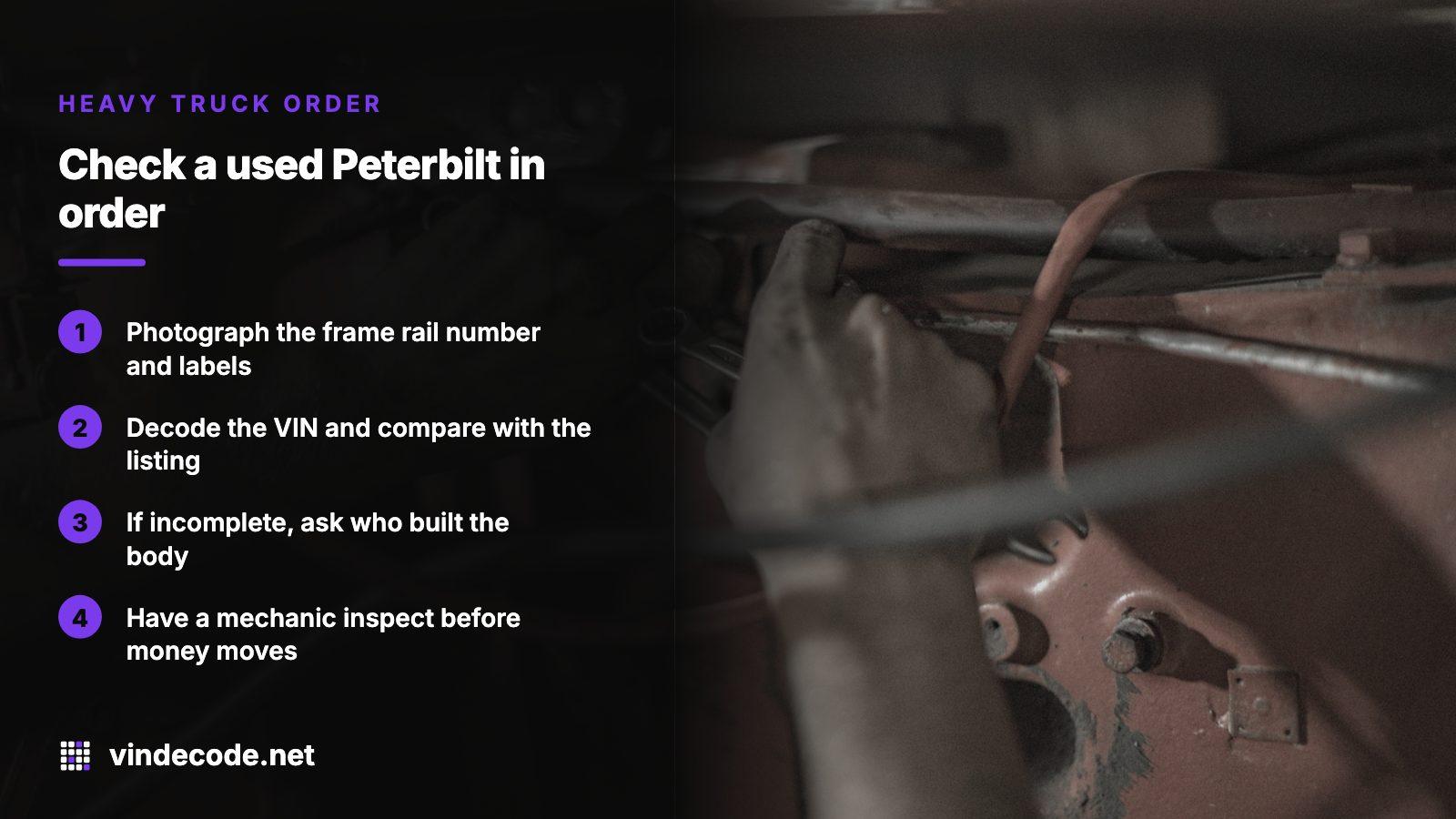
- Photograph the frame rail number and every certification label on the truck.
- Decode the VIN above and compare the prefix, year and model with the listing.
- If the prefix is an incomplete one, ask who built the body and request their papers.
- Put the chassis VIN into NHTSA's recall lookup, and then phone the body builder to ask about any campaigns it ran.
- Open the history report preview. If the truck still looks sound, buy the full report.
- Pay a mechanic you chose to inspect the frame, drivetrain and body before money moves.
Where this information comes from
- NHTSA: vPIC VIN decoder — The public register where Peterbilt's truck and incomplete vehicle prefixes are listed.
- NHTSA: recalls lookup — The federal check for open campaigns, searched by the chassis VIN.
- FMCSA: commercial vehicle regulations — Rules that apply once a completed truck operates in commerce.
- NICB: VINCheck — A separate free lookup for theft and salvage records on a VIN.
- NHTSA owner complaint 11321274 — owner experience, paraphrased
- NHTSA owner complaint 11083705 — owner experience, paraphrased
Sources and photos: Facts checked against the sources above in November 2026. Photos by fr0ggy5, Nina Mercado and Benjamin Brunner on Unsplash; diagrams by VINDecode.
Keep reading
- Semi Truck VIN Decoder: Decode the Tractor, Then Check Its HistoryThe commercial basics of heavy truck VINs, beyond one brand.
- Kenworth VIN Decoder: Who Built the Truck and What Happened SinceThe other brand under the same parent company, with its own prefixes.
- NHTSA VIN Decoder: What It Returns, Where It Stops, What Comes NextWhat the federal decoder behind these results covers, and where it stops.
- Sample reportA finished report, to see what the history adds after the decode.
Frequently asked questions
What does the start of a Peterbilt VIN tell you?
The first three characters name the maker, the country and whether the vehicle was finished. Trucks use 1XP, 2XP or 3WP. Incomplete vehicles use 1NP, 2NP or 3BP. A leading 1 is a U.S. build, a 2 is Canadian and a 3 is Mexican.
Is a Peterbilt with a 1NP VIN missing parts?
No. The prefix says the chassis left Peterbilt unfinished and another company completed the truck. The body you see was added afterward, and that builder issued the final certification. Ask the seller who it was and request their paperwork.
Which weight rating applies when the chassis paper and the final label disagree?
The final label, issued by whoever completed the truck. The chassis maker's paper states what the bare chassis supports, but the finished vehicle is the one on the road, so its label governs. Quote that figure when you compare listings.
Can a VIN decoder tell me if a Peterbilt was in a wreck?
No. A decoder reads the factory's coding and nothing after it. Accident, salvage and odometer records are filed under the VIN later, so they come from a history report, and a clean one only means nothing was recorded.
Does a recall lookup by VIN cover the body and the engine parts?
It covers campaigns filed against the chassis VIN. A body builder files its own, and a component supplier may recall a part by serial number. Ask each company directly, and ask the dealer which campaigns were completed on the truck.
Now check the car itself
The guide explains what to look for. The report shows what this VIN has on record.