THE SHORT ANSWER
To decode a Kenworth VIN, type the 17 characters into the decoder above. Prefixes 1XK, 2XK, 3WK and SFN belong to Kenworth Truck Company, 3WM, 3NM and 3XK to Kenworth Mexicana, and 1NK, 2NK, 3BK and 3NK mark unfinished chassis. The result describes the truck as built. Wrecks, title brands, liens and mileage sit in other records, so open the history preview before you pay for the truck.
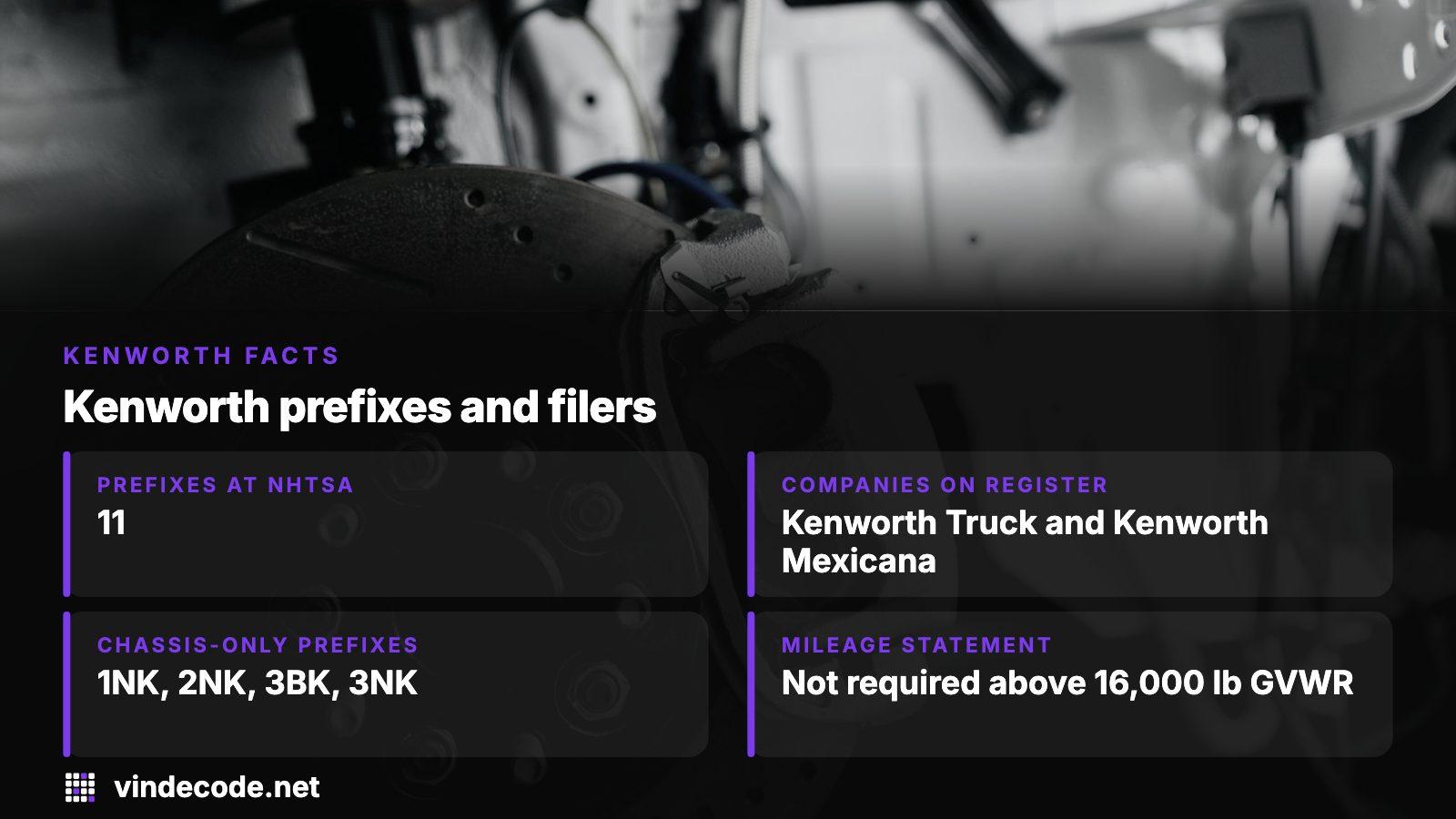
- Kenworth prefixes at NHTSA
- 11
- Companies on the register
- Kenworth Truck Company and Kenworth Mexicana
- Chassis-only prefixes
- 1NK, 2NK, 3BK, 3NK
- Mileage statement not required
- Above 16,000 lb GVWR
What a Kenworth decode actually returns
The register behind a decode is NHTSA's vPIC, and for Kenworth it says more than make and year. We ran public VIN fragments, copied from owner complaints, through it. Each came back with the same kinds of fields.
- Model and model year, read from character ten
- Body class and cab layout, such as a truck-tractor with the cab behind the engine
- Brake type and drive configuration, for example air brakes on a 6x4
- Engine maker, model, cylinders, displacement and a horsepower range
- Fuel type, weight class and assembly plant
A 2019 T680 fragment returned a PACCAR MX-13 engine, a range of 405 to 510 horsepower and a plant in Chillicothe, Ohio. A 2016 T880 fragment returned a Cummins ISX instead. A decode tells you what the truck left the factory with, so you can compare it with what sits under the hood now.
The 11 prefixes NHTSA lists for Kenworth
Seven prefixes cover finished trucks and four cover chassis. Two companies file them, and the country column is the one printed in the register.
| Prefix | Filed by | Country listed | Type |
|---|---|---|---|
| 1XK | Kenworth Truck Company | United States | Truck |
| 2XK | Kenworth Truck Company | Canada | Truck |
| 3WK | Kenworth Truck Company | Mexico | Truck |
| SFN | Kenworth Truck Company | United Kingdom | Truck |
| 3WM | Kenworth Mexicana | Mexico | Truck |
| 3NM | Kenworth Mexicana | None given | Truck |
| 3XK | Kenworth Mexicana | Mexico | Truck |
| 1NK | Kenworth Truck Company | United States | Incomplete vehicle |
| 2NK | Kenworth Truck Company | Canada | Incomplete vehicle |
| 3BK | Kenworth Truck Company | Mexico | Incomplete vehicle |
| 3NK | Kenworth Mexicana | Mexico | Incomplete vehicle |
Compare all three characters with this list. The leading digit alone fits trucks, chassis and both companies.
Kenworth Mexicana files on its own
Three truck prefixes and one chassis prefix sit under Kenworth Mexicana SA de CV. A VIN opening with 3WM, 3NM, 3XK or 3NK is filed by that company. One opening with 3WK or 3BK is filed by Kenworth Truck Company, even though the leading 3 points to Mexico.
Treat the answer as provenance. It records who filed the truck and where, not how it was specified. A letter in front is not a typo either: SFN is listed for Kenworth Truck Company with the United Kingdom as its country, so decode it as typed.
1NK, 2NK, 3BK and 3NK: trucks that left unfinished
When a truck is built in stages, federal rules put the incomplete-vehicle maker in charge of assigning the VIN, and a later alterer must keep it. A body builder who completes a Kenworth chassis therefore tends to leave Kenworth's number in place.
A 1NK fragment from a 2018 T880 came back from vPIC typed as an incomplete vehicle, with a warning that the truck may have been altered and may not reflect its current condition. Read that literally. The decode describes the chassis, not whatever was fitted afterward.
Ask the seller
Find out who finished the truck and request that company's paperwork next to Kenworth's. The decode cannot name the builder or describe the body.
Getting 17 clean characters off the truck
Under 49 CFR 565.13 the number has to be indelible: marked on a component that is meant to stay on the vehicle, or on a plate permanently attached to one. The added requirement of visibility through the windshield covers cars and lighter trucks, up to 10,000 pounds. A heavy Kenworth is not guaranteed to have that plate, so start at the frame rail on the driver's side, then check the certification label near the door.
Photograph each spot before typing. Position nine is a check digit, and the alphabet skips I, O and Q, so anything round is a zero. One misread character sends a lookup back empty.
The VIN is not the only serial on the truck. Separate identification is stamped or tagged on the engine, the transmission and each axle. After a repower or rebuild, those can disagree with what the VIN decodes to.
Open recalls: the lookup is quick, the repair may wait on parts
Run the VIN through NHTSA's recall lookup. One PACCAR campaign shows why. Number 20V199000 lists Kenworths from model year 2008 through 2020, plus Peterbilts from 2008 through 2019, fitted with NAMUX software. The ABS warning light may stay dark if the controller loses power. NHTSA counts 460,515 vehicles potentially affected, with a dealer software update at no cost.
From an NHTSA owner complaint
The owner of a 2014 Kenworth T660 told NHTSA about receiving a notice for that campaign and then finding the repair part unavailable. The report says the maker had taken longer than a reasonable time, and that the truck had not failed. It is the owner's version, filed with NHTSA, and the agency drew no conclusion from it.
Take from it that an open recall on the screen is not a repaired truck. Ask the dealer whether the part is on the shelf, get the answer in writing, and keep the notice.
What no decode says about a used Kenworth's mileage
A decode is a factory record. It cannot show a wreck, a title brand, a lien or an odometer reading. Mileage is murkier on trucks than on cars. The odometer disclosure rule in 49 CFR 580.17 skips anything rated over 16,000 pounds gross, so the seller of a Class 8 tractor need not put a reading on paper.
From an NHTSA owner complaint
A buyer of a 2016 Kenworth T880, bought in a private sale, reported that the truck stalled. After a dealer visit and a vehicle history report, a mileage mismatch turned up: 133,000 miles at purchase against 700,000 found. The complaint opens with the label odometer fraud. Treat it as one buyer's story, not a ruling.
Heavy trucks are rebuilt and repowered often, so mileage, service paperwork and an inspection each matter. A history report lists dated odometer readings in one place, where a sudden jump stands out.
After the decode: what the history report checks
Once a VIN is entered, the preview is free. After that the full report is one payment, sold singly or in packs of 3, 5 or 10, with no recurring charge. The pricing page lists today's rates.
| Record | What it settles for a Kenworth buyer |
|---|---|
| Odometer readings | Whether mileage climbs the way a working truck's would |
| Title brands | Whether salvage, rebuilt or another brand was applied |
| Accident and damage records | Whether the truck was hit, and where |
| Salvage and auction history | Whether it went through an auction, with photos |
| Liens and theft records | Whether a lender holds a claim or the truck was reported stolen |
NICB's VINCheck is a separate free lookup for theft and salvage records. An empty result from any lookup only shows that nothing was reported, so read it beside an inspection.
A sensible order before money changes hands
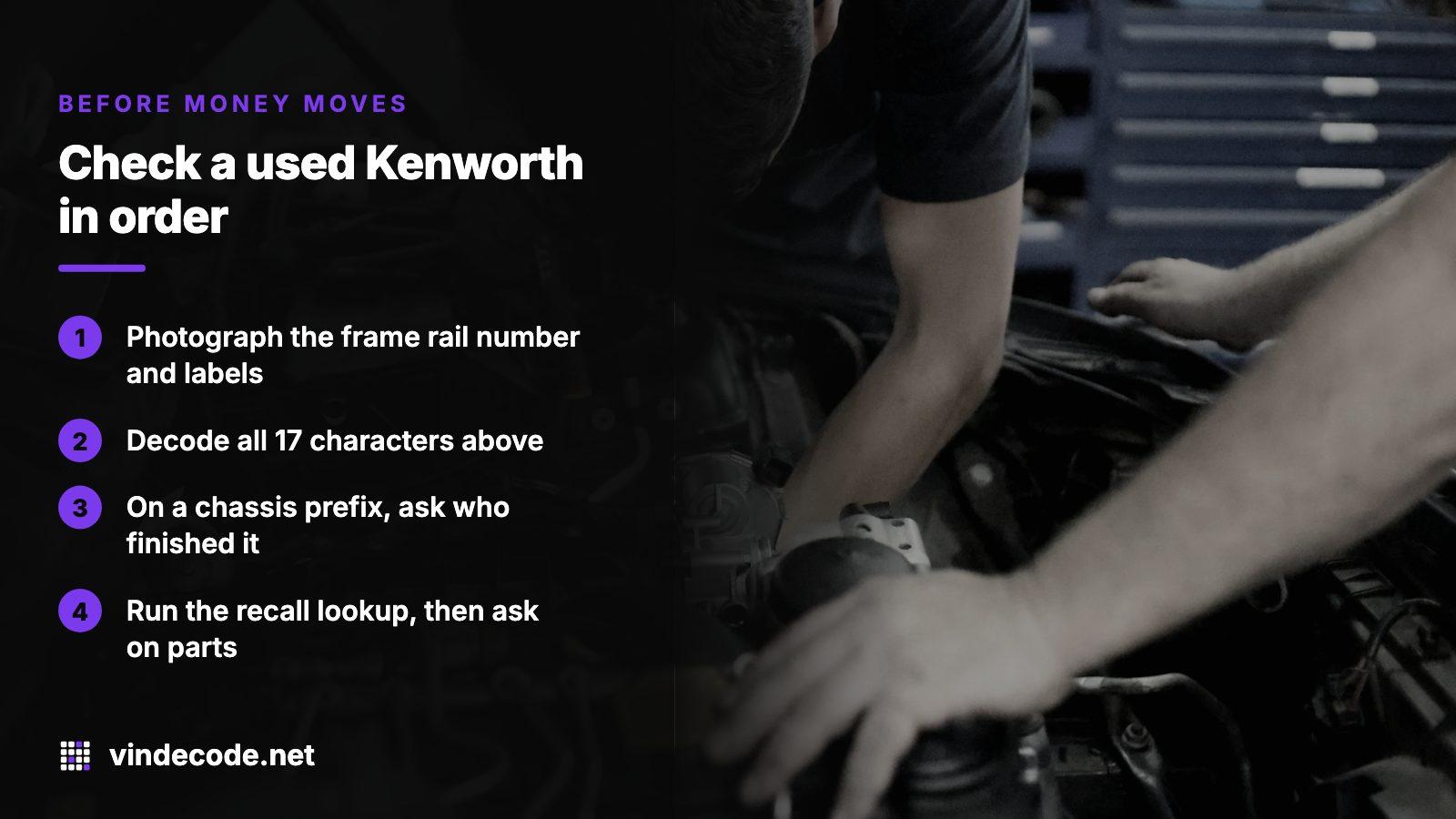
- Photograph the frame rail number and every certification label, including any second label from a body builder.
- Decode all 17 characters above and compare the prefix, year, model and engine with the advert.
- On a chassis prefix, ask who finished the truck and request their papers.
- Run NHTSA's recall lookup, then ask the dealer about parts for anything still open.
- Read the history preview, and buy the full report if the truck still passes.
- Have a mechanic you chose inspect the frame, drivetrain and body before you pay.
Where this information comes from
- NHTSA: vPIC VIN decoder — The public register that lists Kenworth's eleven prefixes and returns the decoded build.
- NHTSA: recalls lookup — The federal check for open campaigns, searched by VIN.
- eCFR: 49 CFR 565.13, VIN requirements — Rules on VIN length, who assigns it on staged builds, allowed letters and placement.
- eCFR: 49 CFR 580.17, odometer exemptions — The weight line above which a mileage statement is not required.
- NICB: VINCheck — A separate free lookup for theft and salvage records on a VIN.
- NHTSA owner complaint 11441510 — owner experience, paraphrased
- NHTSA owner complaint 11673257 — owner experience, paraphrased
Sources and photos: Facts checked against the sources above in November 2026. Photos by Peter McCrae-Hokenson, Mustafa Sheikhmouss and Erik Mclean on Unsplash; diagrams by VINDecode.
Keep reading
- Peterbilt VIN Decoder: Read the Prefix, Then Check the Truck's RecordThe other PACCAR brand, with its own prefixes and chassis codes.
- Semi Truck VIN Decoder: Decode the Tractor, Then Check Its HistoryCommercial truck basics that apply to any Class 8 brand.
- NHTSA VIN Decoder: What It Returns, Where It Stops, What Comes NextWhat the federal decoder behind these results covers, and where it stops.
- Sample reportSee a completed report before deciding whether to buy one.
Frequently asked questions
Does a Kenworth VIN tell you which engine is in the truck?
It names the engine the factory fitted, as NHTSA's decoder lists it: maker, model, cylinders and a horsepower range. It cannot say whether that engine was swapped or rebuilt later. Compare the serial on the engine with the service records.
Is a Kenworth whose VIN starts with 3 built in Mexico?
The register shows Mexico for those prefixes, bar 3NM, which lists no country. Who filed it varies: 3WM, 3NM, 3XK and 3NK belong to Kenworth Mexicana, while 3WK and 3BK are Kenworth Truck Company. Read all three characters.
Can you decode a Kenworth VIN at no cost?
Yes. NHTSA's vPIC decoder is public and costs nothing. The preview on this site is free as well. Only the full report, with title, damage, odometer and lien records, is a one-time paid purchase.
Why does my Kenworth decode say incomplete vehicle?
The prefix is a chassis one: 1NK, 2NK, 3BK or 3NK. Kenworth shipped the chassis and another company finished the truck, so the result warns that it may have been altered. Ask who built the body.
How can I tell whether a used Kenworth's mileage is real?
A decode never shows mileage, and a federal rule lets sellers skip a written statement on trucks above 16,000 pounds. Compare dated odometer readings from a history report with service records, the dash and the wear on the cab.
Now check the car itself
The guide explains what to look for. The report shows what this VIN has on record.