THE SHORT ANSWER
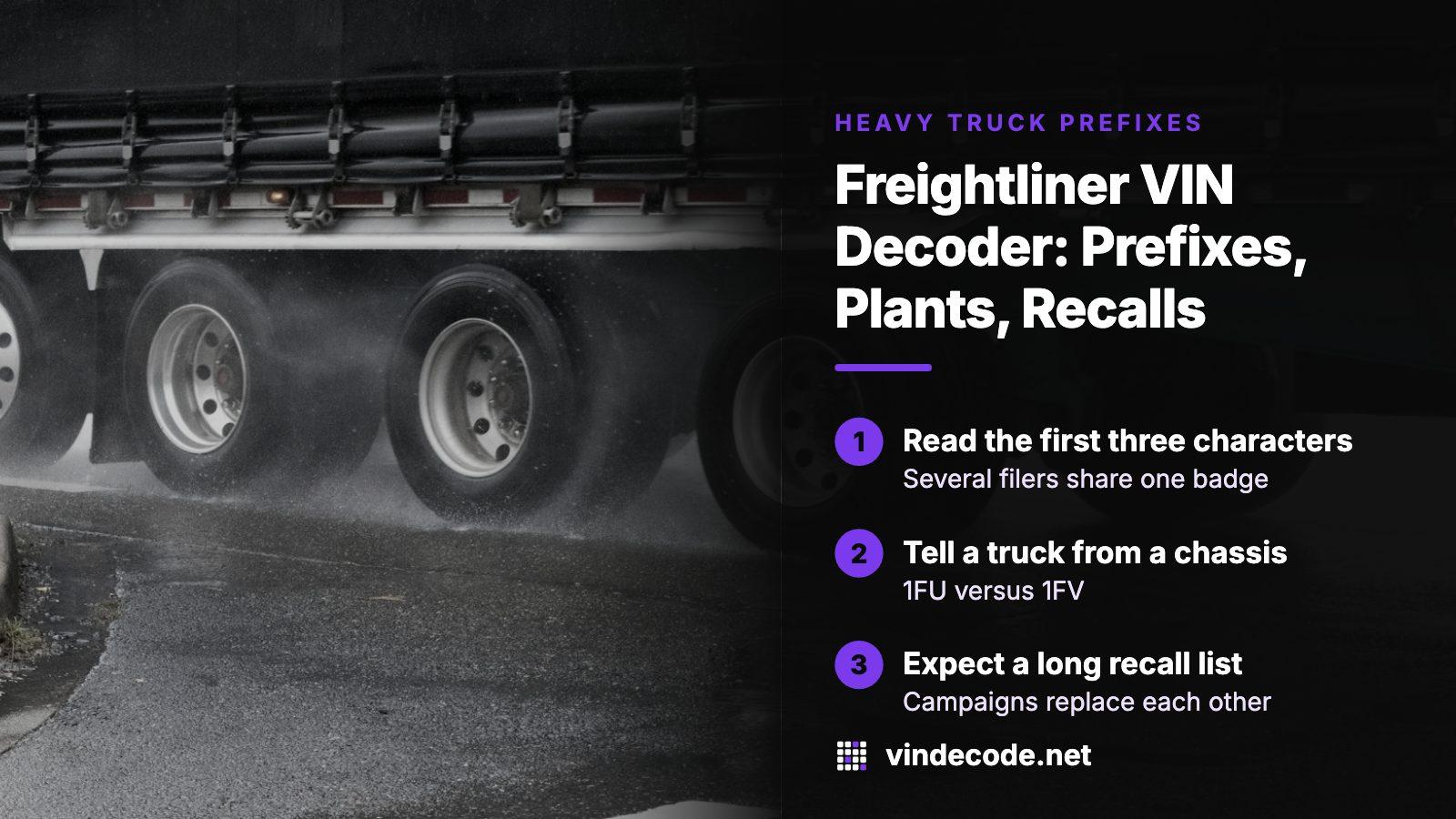
To decode a Freightliner VIN, enter the 17 characters in the decoder above. A prefix of 1FU or 3AK marks a finished truck filed by Daimler in the United States or Mexico. A prefix of 1FV, 3AL or 4UZ marks a chassis that someone else completed, often a coach or a van. The decode describes the build only. Title brands, damage, liens and mileage need a history check.
- Freightliner model names in vPIC
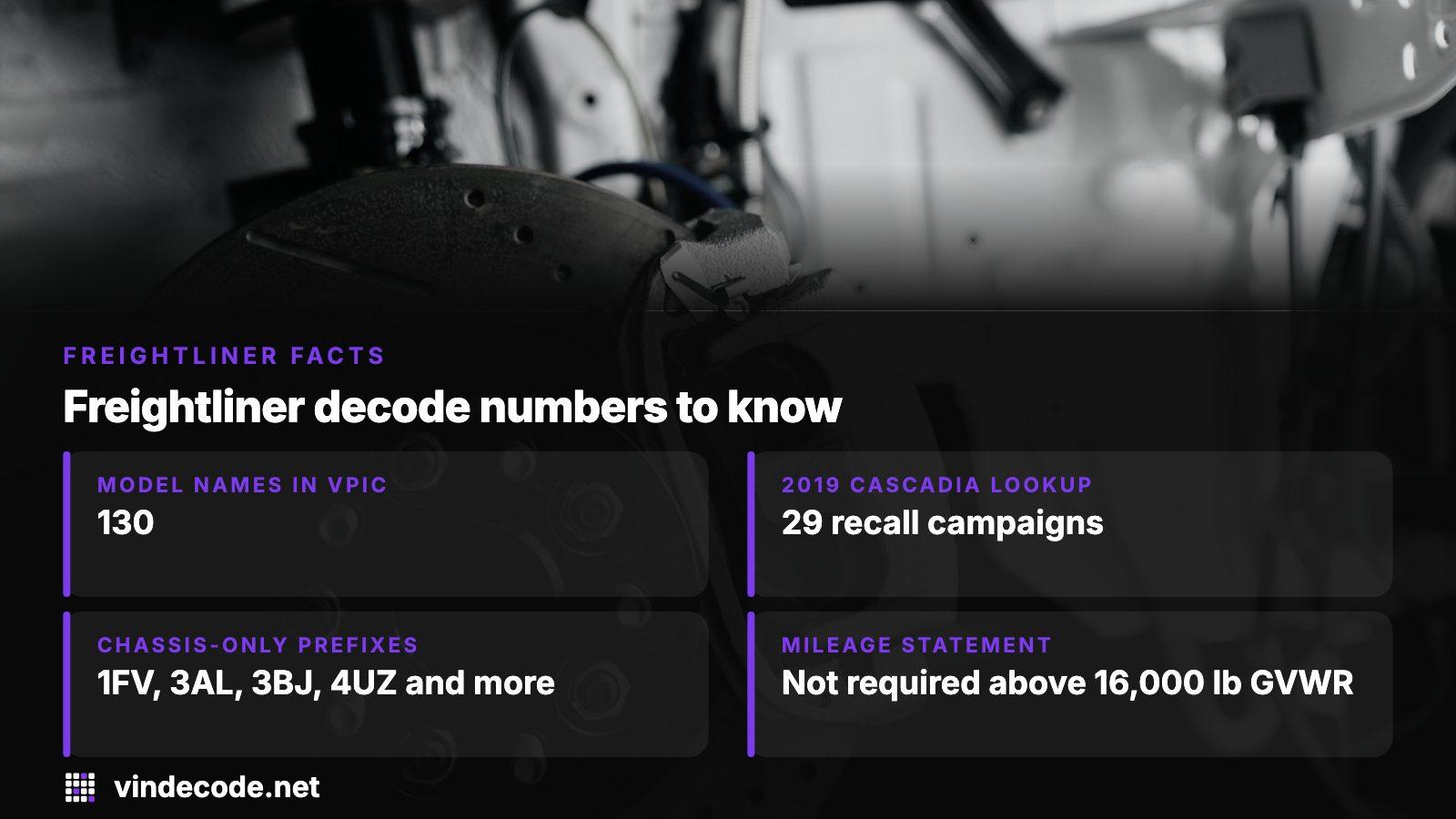
- 130
- Recall campaigns on a 2019 Cascadia lookup
- 29
- Chassis-only prefixes
- 1FV, 3AL, 3BJ, 4UZ, 2FV, 3FF, RSA
- Mileage statement not required
- Above 16,000 lb GVWR
What a Freightliner decode returns, with real examples
The source is NHTSA's vPIC register, and it knows a lot of Freightliner: 130 model names, from Cascadia and M2 tractors to motorhome, van and bus chassis. We ran public VIN fragments, copied from owner complaints, through it. A 2019 Cascadia starting 3AKJG came back with a Detroit DD13 of 12.8 liters in a 125-inch sleeper cab, built in Saltillo, Mexico. Another 2019 Cascadia, starting 1FUJG, returned the same engine in a 113-inch sleeper cab built in Cleveland, North Carolina.
- Model line and model year, with the year read from character ten (K stands for 2019)
- Body class, drive layout such as 6x4, and brake type
- Engine maker or model, cylinders and displacement
- Cab trim, weight class and the assembly plant
A 2007 Columbia fragment returned a 14-liter Detroit Series 60, again from Cleveland. Read the engine line as what the factory fitted. A later repower or rebuild will not appear in it.
Several filers, one badge: reading the first three characters
Freightliner prefixes do not come from a single office. The register spreads them across companies, and a type column marks each one as a truck or an incomplete vehicle.
| Prefix | Filed by | Country listed | Type |
|---|---|---|---|
| 1FU | Daimler Truck North America | United States | Truck |
| 1FV | Daimler Truck North America | United States | Incomplete vehicle |
| 3AK, 3BH | Daimler Vehículos Comerciales México | Mexico | Truck |
| 3AL, 3BJ | Daimler Vehículos Comerciales México | Mexico | Incomplete vehicle |
| 4UZ | Freightliner Custom Chassis Corp. | United States | Incomplete vehicle |
| 2FU, AFV, KFB, RSB | Freightliner Corporation | Canada, South Africa, Israel, Saudi Arabia | Truck |
| 2FV, 3FF, RSA | Freightliner Corporation | Canada, Mexico, Saudi Arabia | Incomplete vehicle |
Most of the 2019 Cascadia fragments we read opened with 3AK, so a Mexican plant on that decode is ordinary, not a warning sign. Prefixes 3BH and 3BJ cover Freightliner and Western Star together. Daimler's 5KJ and 5KK belong to Western Star alone and do not decode as Freightliner.
When the VIN describes a chassis and the vehicle is a coach
An incomplete vehicle is a frame with running gear that another company finishes. Under 49 CFR 565.13 the chassis maker assigns the VIN on a staged build, and whoever completes the vehicle keeps that number. A motorhome, shuttle or walk-in van can therefore carry a Freightliner VIN while the body wears another name.
The decodes show it. A 2005 XC fragment starting 4UZ returned a motorhome chassis in Class 8, built in Gaffney, South Carolina. A 2016 M2 starting 1FV returned a Class 7 chassis with an 8.9-liter Cummins ISL from Mt. Holly, North Carolina. NHTSA flagged both as possibly altered since leaving the factory.
From an NHTSA owner complaint
The owner of a Dynamax DX3 told NHTSA that its slideout moved out during a drive, and that two repair attempts did not stop it. The VIN fragment in the report is the 1FV M2 chassis described above. It is one owner's account, and it names no cause.
Take from it that the chassis decode cannot speak for the coach. Ask who finished the vehicle, request that company's paperwork, and treat the living quarters as a separate inspection.
Finding and copying 17 characters from a heavy truck
Federal rule 49 CFR 565.13 wants the VIN permanently stamped on a component that stays with the vehicle, or on a plate attached to such a component for good. The demand that it be legible through the windshield covers trucks of 10,000 pounds or less, so a tractor need not show it at the glass. Check the frame rail and the certification label at the door. A finished coach may carry a second label.
Photograph each spot before typing. Position nine is a check digit, and the alphabet never uses I, O or Q, so a round character is a zero. One misread character changes the answer, so match the result against the advert's year and engine.
Recalls: a long list on one cab, and campaigns that replace each other
Put the VIN into NHTSA's recall lookup before money moves. The recall data for a 2019 Cascadia returns 29 campaigns, most with a free dealer remedy, and many span several model years and families. A steering campaign from December 2018 names Freightliner trucks alongside Custom Chassis lines used for coaches and vans, so a motorhome chassis can share a list with a tractor.
Campaigns also supersede one another. Number 20V390000 covered corroded front modulator valves that make a truck pull to one side during automatic braking. It was expanded and replaced by 22V817000, and 23V073000 later covered the same corrosion in stability-control braking. A notice in a seller's folder can be out of date, so read the live lookup.
What a decode cannot say about a used Freightliner's mileage and condition
A decode is a factory record, so it shows no wrecks, brands or liens. Under 49 CFR 580.17 a seller need not put an odometer reading on paper when the vehicle's gross rating tops 16,000 pounds, and a Class 8 tractor clears that line easily.
From an NHTSA owner complaint
A buyer in the middle of purchasing a 2019 Cascadia from a Pennsylvania fleet-sales lot told NHTSA that the left cab shock and four rear shocks looked rusted and worn, and that the truck still carried an unrepaired recall. The seller was unsure those parts matter for DOT inspection and had not agreed to replace them. It is one buyer's account, filed before the sale closed.
Take from it that an open campaign and tired parts are bargaining points before signing, not after. Under 49 CFR 396.17 a commercial vehicle has to pass the listed inspection within every 12-month stretch, so ask for the dated report, and get any promised repair in writing.
After the decode: what the history report adds
Entering a VIN opens a free preview. Buying the full report is one payment, either for a single VIN or as a bundle of 3, 5 or 10, and nothing recurs. Today's rates sit on the pricing page.
| Record | What it settles for a Freightliner buyer |
|---|---|
| Odometer readings | Whether dated mileage climbs the way a working truck's would |
| Title brands | Whether salvage, rebuilt or another brand was applied |
| Accident and damage records | Whether the cab or frame was hit, and where |
| Salvage and auction history | Whether it passed through an auction, with photos |
| Liens and theft records | Whether a lender holds a claim or it was reported stolen |
A clean result only shows that nothing was reported, so read it beside an inspection by a mechanic you chose.
A practical order for checking a used Freightliner
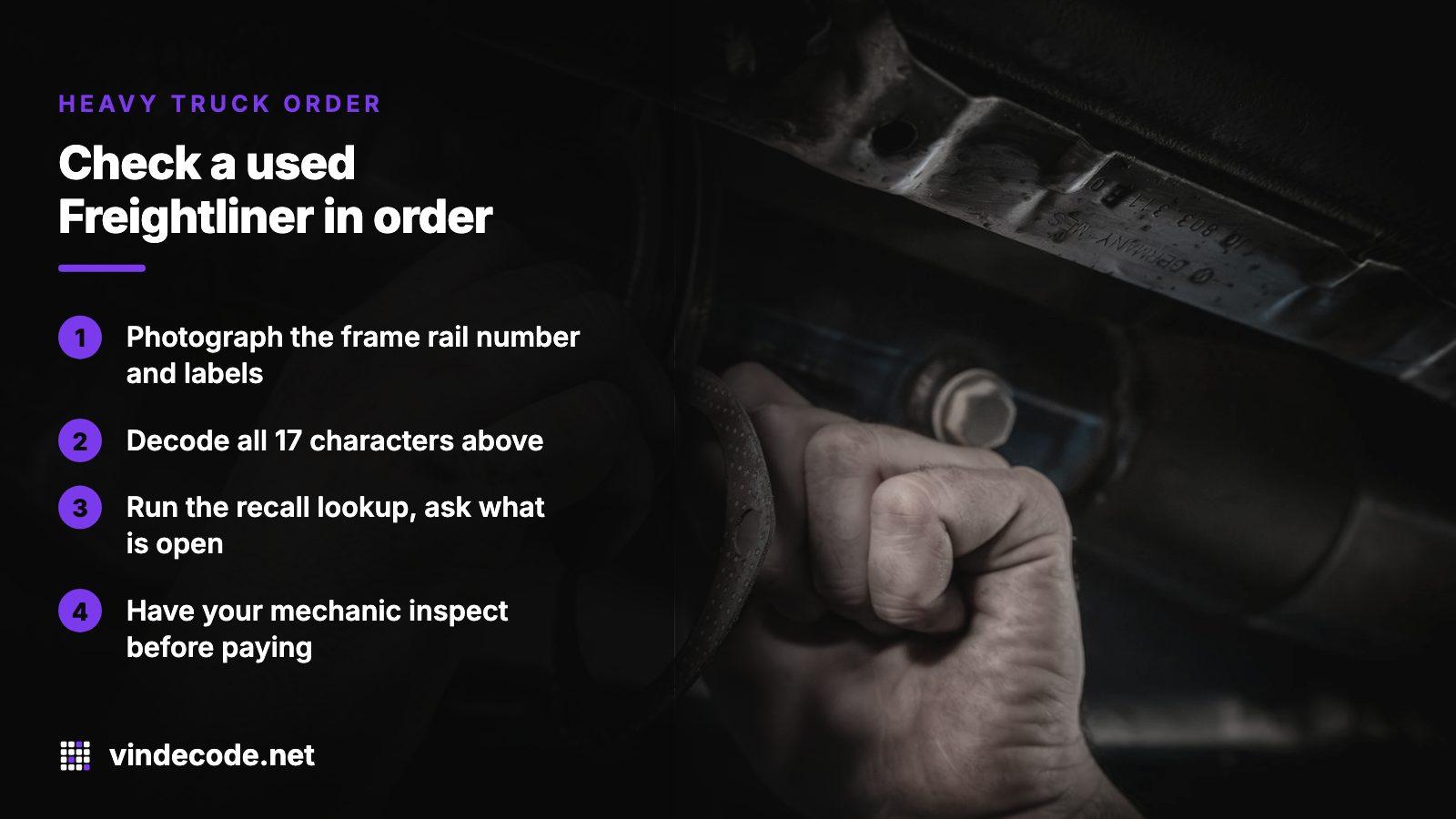
- Photograph the frame rail number and every certification label, including a second one from a coach builder.
- Decode all 17 characters above, then hold the model, year, engine and plant against what the advert claims.
- On a chassis prefix, ask who finished the vehicle and request their paperwork.
- Run NHTSA's recall lookup, then ask the dealer what is still open and whether parts are in stock.
- Open the history preview, and buy the full report if the vehicle still looks right.
- Have your own mechanic go over the frame, drivetrain and body before you pay.
Where this information comes from
- NHTSA: vPIC WMI register for Freightliner — Lists the prefixes, their filers, countries and truck or incomplete vehicle types.
- NHTSA: recalls lookup — The federal check for open campaigns, searched by VIN.
- eCFR: 49 CFR 565.13, VIN requirements — Rules on length, allowed letters, marking, and who assigns the number on staged builds.
- eCFR: 49 CFR 580.17, odometer exemptions — The weight line above which a mileage statement is not required.
- eCFR: 49 CFR 396.17, periodic inspection — The yearly inspection a commercial vehicle must pass.
- NHTSA owner complaint 11765736 — owner experience, paraphrased
- NHTSA owner complaint 11185190 — owner experience, paraphrased
Sources and photos: Facts checked against the sources above in November 2026. Photos by fr0ggy5, Martin Fennema and Erik Mclean on Unsplash; diagrams by VINDecode.
Keep reading
- Semi Truck VIN Decoder: Decode the Tractor, Then Check Its HistoryCommercial truck basics that apply to any Class 8 brand.
- International Truck VIN Decoder: Read the Prefix, Then Check the TruckAnother heavy truck brand, with its own prefixes and plants.
- NHTSA VIN Decoder: What It Returns, Where It Stops, What Comes NextWhat the federal decoder behind these results covers, and where it stops.
- Sample reportSee a completed report before deciding whether to buy one.
Frequently asked questions
Does a Freightliner VIN tell you which engine is in the truck?
Often it does. NHTSA's decoder returned Detroit engines on the Cascadia and Columbia fragments we ran, and a Cummins on an M2. It reports what the factory fitted, so a later repower will not show. Compare the engine's own data plate with the decode.
Why would a motorhome carry a Freightliner VIN?
On a staged build the chassis maker assigns the number, and the company that finishes the vehicle keeps it. Prefixes such as 4UZ and 1FV are registered as incomplete vehicles. Freightliner supplied the frame and running gear, and another company built the living space on top.
Is a Freightliner built in Mexico a different truck?
The decode shows the plant and nothing more. A 3AK prefix is filed by Daimler Vehículos Comerciales México, and the 2019 Cascadia fragments we ran under it came back from Saltillo. They decode with the same make and model line as a 1FU truck, so judge the truck, not the prefix.
Can you decode a Freightliner VIN at no cost?
Yes. NHTSA's vPIC decoder is public and costs nothing, and so is its recall lookup. The preview on this site is free as well. Only the full history report, with title, damage, odometer and lien records, is a one-time paid purchase.
Does a used Freightliner come with a mileage statement?
Not necessarily. Under federal odometer rules a seller can skip the written statement when a vehicle is rated above 16,000 pounds gross, which takes in Class 8 tractors. Compare dated odometer readings from a history report with service records, the dash and the pedals.
Now check the car itself
The guide explains what to look for. The report shows what this VIN has on record.