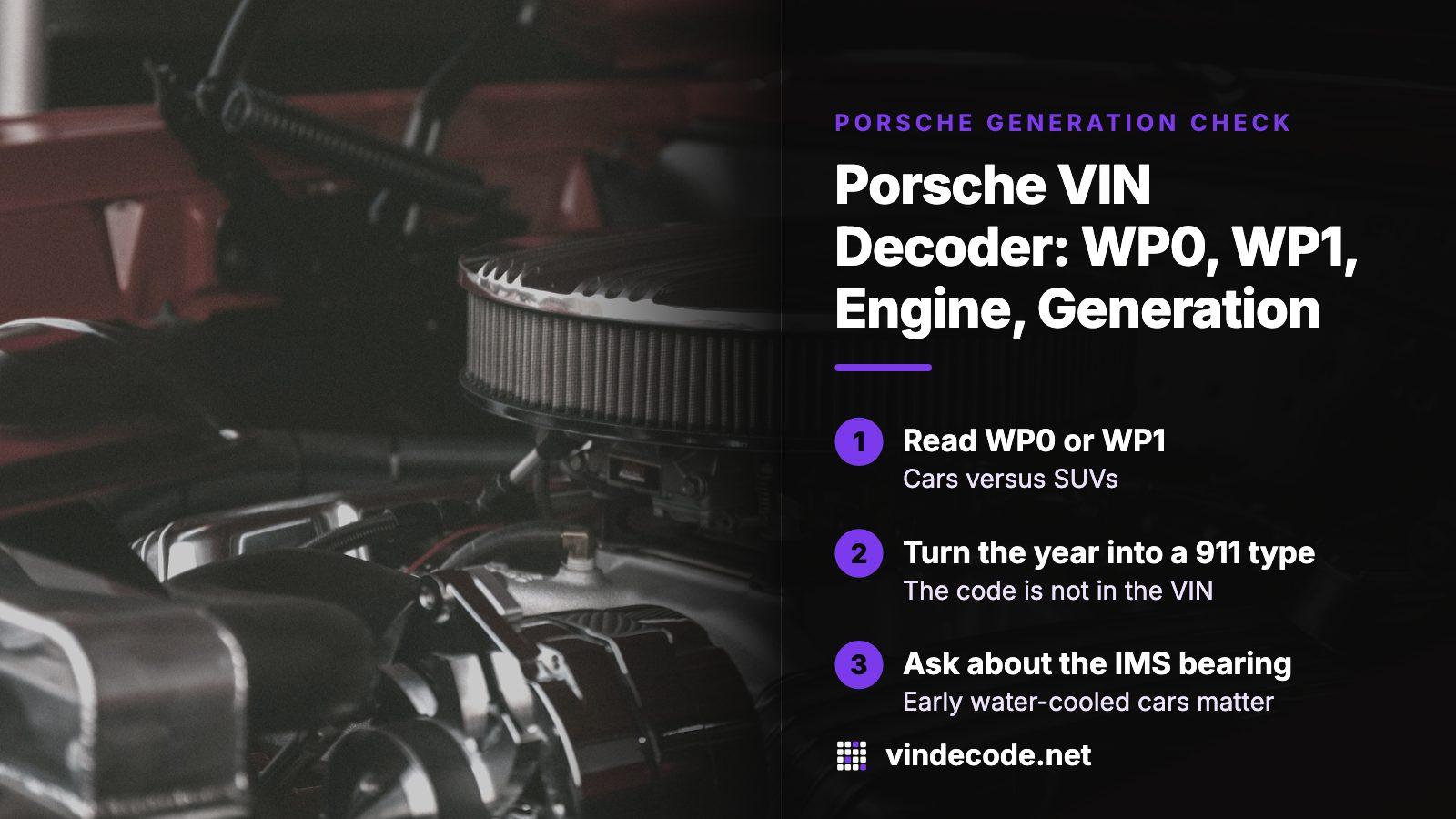
THE SHORT ANSWER
To decode a Porsche VIN, type all 17 characters into the decoder on this page. WP0 marks a Porsche passenger car and WP1 a multipurpose vehicle such as an SUV. Character ten encodes the model year and character eleven the plant. The result gives model, body, engine and plant, but not the 911 generation code, the factory option list, or any crash and title history. Open the history preview for the last of those.
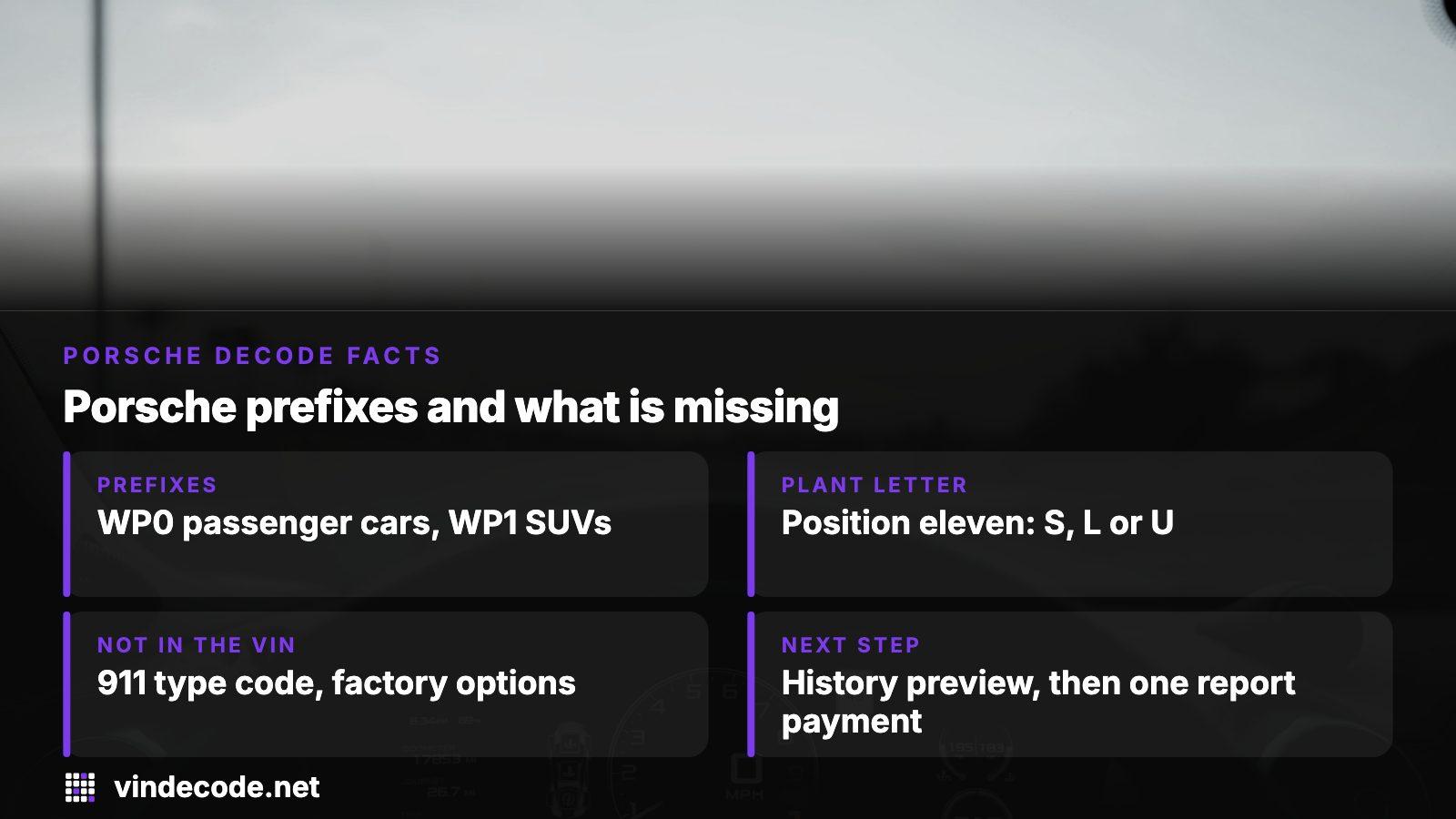
- Prefixes
- WP0 for passenger cars, WP1 for SUVs
- Plant letter
- Position eleven: S, L or U in the decodes checked
- Not in the VIN
- 911 type code and factory option list
- Next step
- Free history preview, then one payment if you want the report
What a Porsche decode puts on screen
The decoder reads your VIN against NHTSA's vPIC database, where Porsche's German maker files its VIN pattern. The answer is the car as built, which no advert can rewrite. A listing that promises a V8 Cayenne over a decode that says six cylinders is your first question for the seller.
- Model, model year and body style
- Engine size, cylinder count and fuel
- Electric or gasoline drivetrain
- Assembly country and plant
- Drive layout, where Porsche filed one
NHTSA's record leaves drive layout empty on several Porsches, so a blank there says nothing about the car.
WP0, WP1 and the plant letter, on real Porsche VINs
NHTSA lists WP0 and WP1 against the same maker, Dr. Ing. h.c. F. Porsche AG, one as a passenger car and one as a multipurpose vehicle. The prefix names maker and vehicle type, not the factory, and position eleven names the plant. The rows below decode the first eleven characters of VINs found in NHTSA owner complaints.
| Decoded car | Prefix | Plant | Engine |
|---|---|---|---|
| 1999 911 | WP0 | Stuttgart, Germany | 3.4 L, 6 cylinders |
| 1999 Boxster | WP0 | Uusikaupunki, Finland | 2.5 L, 6 cylinders |
| 2009 Cayman | WP0 | Uusikaupunki, Finland | 2.9 L, 6 cylinders |
| 2012 Cayenne | WP1 | Leipzig, Germany | 4.8 L, 8 cylinders |
| 2014 Panamera | WP0 | Leipzig, Germany | 3.6 L, 6 cylinders |
| 2019 Macan | WP1 | Leipzig, Germany | 3.0 L, 6 cylinders, all-wheel drive |
| 2020 Taycan | WP0 | Stuttgart, Germany | Battery electric |
A Boxster that decodes to Finland is normal, and so is a WP0 sedan built in Leipzig. The worrying mismatch is a decode that contradicts the badge, such as a car sold as a 911 whose VIN decodes to another model.
Reading the VIN off the car, not the advert
Copy the number from the metal, since listings carry typos and sometimes worse. The plate sits at the driver's end of the dashboard and reads through the glass; the label is on the door pillar. On older cars check the front luggage compartment too. All three should match the title.
Position nine is a check digit, so a mistyped VIN usually returns a check-digit error from NHTSA: recopy before blaming the tool. Position ten is the year, shown as 3 on a 2003 car and C on a 2012 car.
Turning the model year into a 911 type code
Enthusiasts, parts sellers and workshops sort the 911 by type number, which the VIN does not print. The decode gives the year, and the table turns it into a generation. Changeover years can fall either side, so check the body and the engine the decode names.
| Type code | Roughly when | Claim to fame |
|---|---|---|
| 993 | Second half of the 1990s | Final air-cooled generation |
| 996 | Around the turn of the century | Water cooling arrives |
| 997 | Mid 2000s into the early 2010s | Replaces the 996, still water-cooled |
| 991 | The 2010s | Third water-cooled generation |
| 992 | End of the 2010s onward | Current generation |
The 1999 911 with the 3.4-liter six above sits in the 996 band. Research that generation alone: a search on 911 reliability averages cars decades apart, and air-cooled and water-cooled cars trade like separate markets.
The intermediate shaft bearing on early water-cooled cars
Early water-cooled engines carry one well-documented weak point, the intermediate shaft bearing. It touches certain engines of the first two water-cooled generations, not every Porsche of the era. Many cars were fixed in time and others failed and got a new or rebuilt engine, so for one car the question is paperwork, not theory.
From an NHTSA owner complaint
A 1999 911 owner told NHTSA the 3.4-liter flat six seized at 95,500 miles with "no warning sign". The car was switched off at home and would not crank the next day. A local shop blamed the bearing and quoted upwards of $13,000 for a replacement engine.
The decode named the engine size, not whether the bearing was dealt with. On an early engine, ask:
- Was the bearing replaced, and where is the invoice?
- Has the engine ever been rebuilt or swapped, and by whom?
- Has a Porsche specialist, not a general shop, inspected the car?
- What would the job cost if no record exists?
Low miles, option codes and entry papers
From an NHTSA owner complaint
A 2003 Boxster owner, who says the car was bought new, reported a dealership mechanic suggesting the bearings be replaced at 32,480 miles, for $3,500. The owner says no notice about the part ever reached them and that Porsche's records did not list them as the owner.
Low mileage settled nothing there, so ask for records whatever the odometer says. Options also matter more on a Porsche than on most cars, since they cost a lot new and still hold value. The factory keeps a build record per VIN, and Porsche or a dealer can supply the option codes it lists.
- Get the build record before agreeing a price.
- Confirm the wheels, seats and brakes still match it.
- Look for harness mounting holes, heat-marked brake discs and shoulder tire wear, the marks of track use.
- On a European-market model, ask how it entered the country, since every import comes in under a declared category in federal rules.
What the decode cannot say, and which record can
A VIN records how a car was made and nothing after. A rebuilt salvage car, a crash that went unreported or a wound-back odometer leaves no mark in the 17 characters. Those sit in title, damage and mileage records, which a history report gathers for the single VIN.
| Question about the Porsche | Where the answer is |
|---|---|
| Model, year, engine, plant | The decode |
| Option list from the factory | Porsche's build record |
| Bearing work, engine rebuilds | Invoices and a specialist inspection |
| Salvage or other title brand | History report: title records |
| Crash damage, with photos | History report: damage and auction records |
| Mileage that adds up | History report: odometer readings |
| Loan still owed, theft | History report: lien and theft records |
| Open safety recalls | NHTSA's recall lookup, at no charge |
On a car this costly a title brand hurts twice, in the repair and again at resale. Mileage that dips between two readings deserves a written explanation before you pay.
Cost, and the order to run the checks in
The preview is free and needs no card. The full report is paid once: a single report or a set of three, five or ten, with no subscription after that. Amounts are on the pricing page.
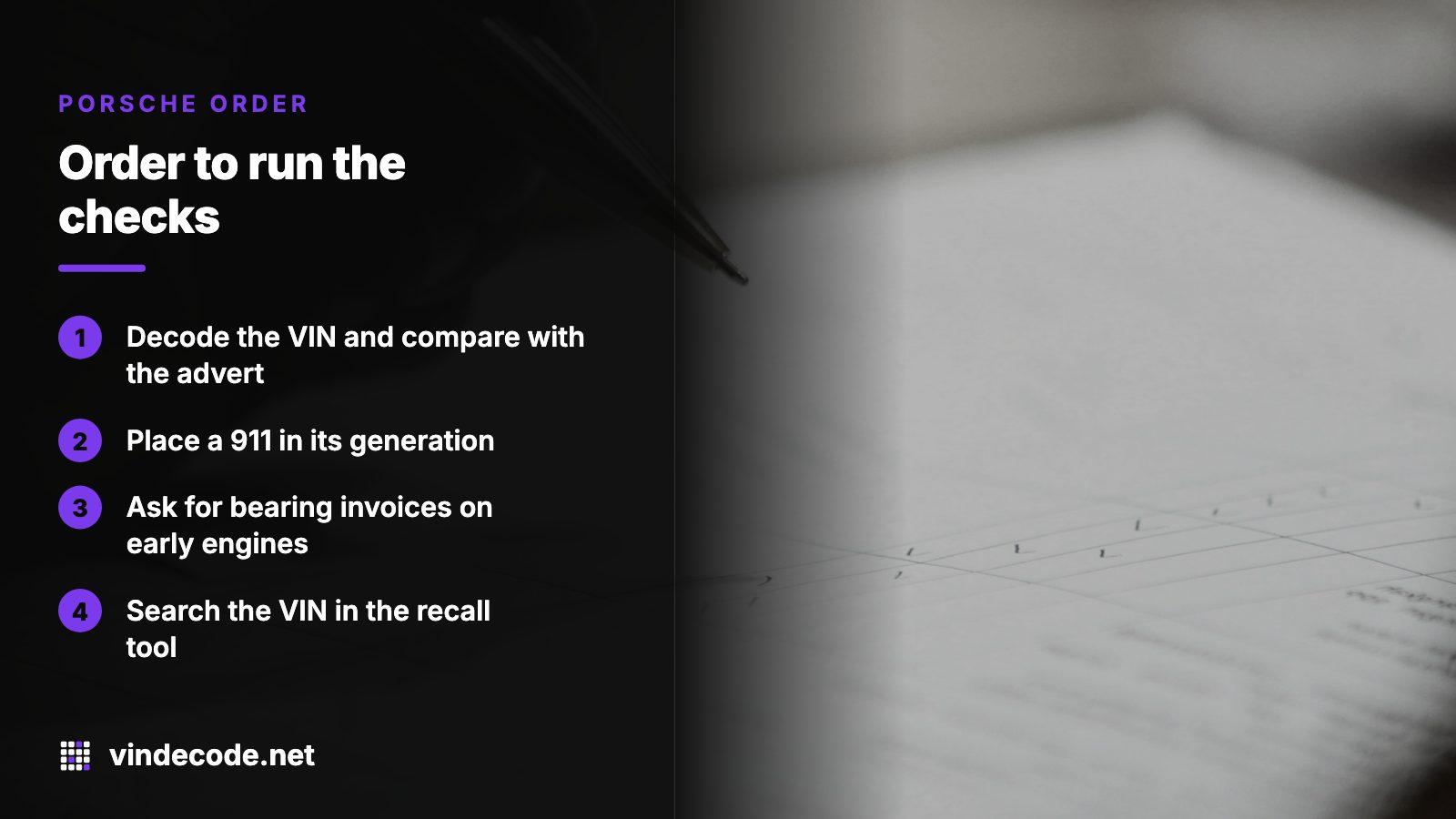
- Take the VIN from the car, decode it, and hold the result against the advert.
- Place a 911 in its generation, or confirm the model on a Boxster, Cayman or SUV.
- On an early water-cooled engine, ask for bearing and service invoices.
- Search the VIN in NHTSA's recall tool.
- Open the history preview; order the full report only when the car has cleared steps one to four.
A specialist's inspection comes after all of this, not instead of it.
Where this information comes from
- NHTSA: vPIC VIN decoder — The public database where Porsche's maker records and VIN pattern sit, and where the decodes in the table were run.
- NHTSA: recalls lookup — Open-recall check by VIN, with the repair done at no cost by the manufacturer.
- NHTSA owner complaint 11179953 — owner experience, paraphrased
- NHTSA owner complaint 11265610 — owner experience, paraphrased
- eCFR: 49 CFR 591.5, import declarations — Lists the categories a vehicle must be declared under when imported into the United States.
Sources and photos: Facts checked against the sources above in November 2026. Photos by Victor Hughes, Masjid MABA and Dennis Eusebio on Unsplash; diagrams by VINDecode.
Keep reading
- BMW VIN Decoder: Decode the Build and Spot a Real M CarAnother German marque where the chassis code and option list sit outside the VIN.
- VIN Decoder: Decode a VIN Number Online, Then Check Its HistoryEvery VIN position walked through, check digit included.
- NHTSA VIN Decoder: What It Returns, Where It Stops, What Comes NextHow the federal database behind these decodes works.
- Sample reportA finished report, to judge what history adds to a decode.
Frequently asked questions
How do I decode a Porsche VIN?
Enter all 17 characters in the decoder on this page and read back the model, year, body, engine and plant. Take the number from the car, since one wrong character gives an error or a different car. The result follows Porsche's own filing with NHTSA, so compare it with the advert line by line.
What does the WP0 prefix on a Porsche VIN stand for?
NHTSA lists WP0 for Porsche passenger cars and WP1 for multipurpose vehicles, a group that covers the Cayenne and Macan. The prefix names the maker and vehicle type, not the factory. Boxster and Cayman decodes show a plant in Finland and still begin WP0.
Is the 911 type code, like 996 or 992, printed in the VIN?
No. Those numbers are Porsche's internal labels, and the VIN carries no trace of them. Decode the car for its model year, map the year to a code, and check the body and engine, because changeover years can land on either side of a line.
Does a Porsche VIN decode show accidents or mileage?
No. A decode covers the build only. Crashes, title brands, odometer readings and loans are filed elsewhere, in records a history report pulls together. Decode first to confirm the car matches the advert, then open the free preview to see what the report would add.
Where can I find the factory options on a Porsche?
Ask Porsche or a dealer for the car's factory build record, which lists its option codes. A decode will not show them. Get the record before agreeing a price, then check that the wheels, seats and brakes on the car still match it.
Now check the car itself
The guide explains what to look for. The report shows what this VIN has on record.