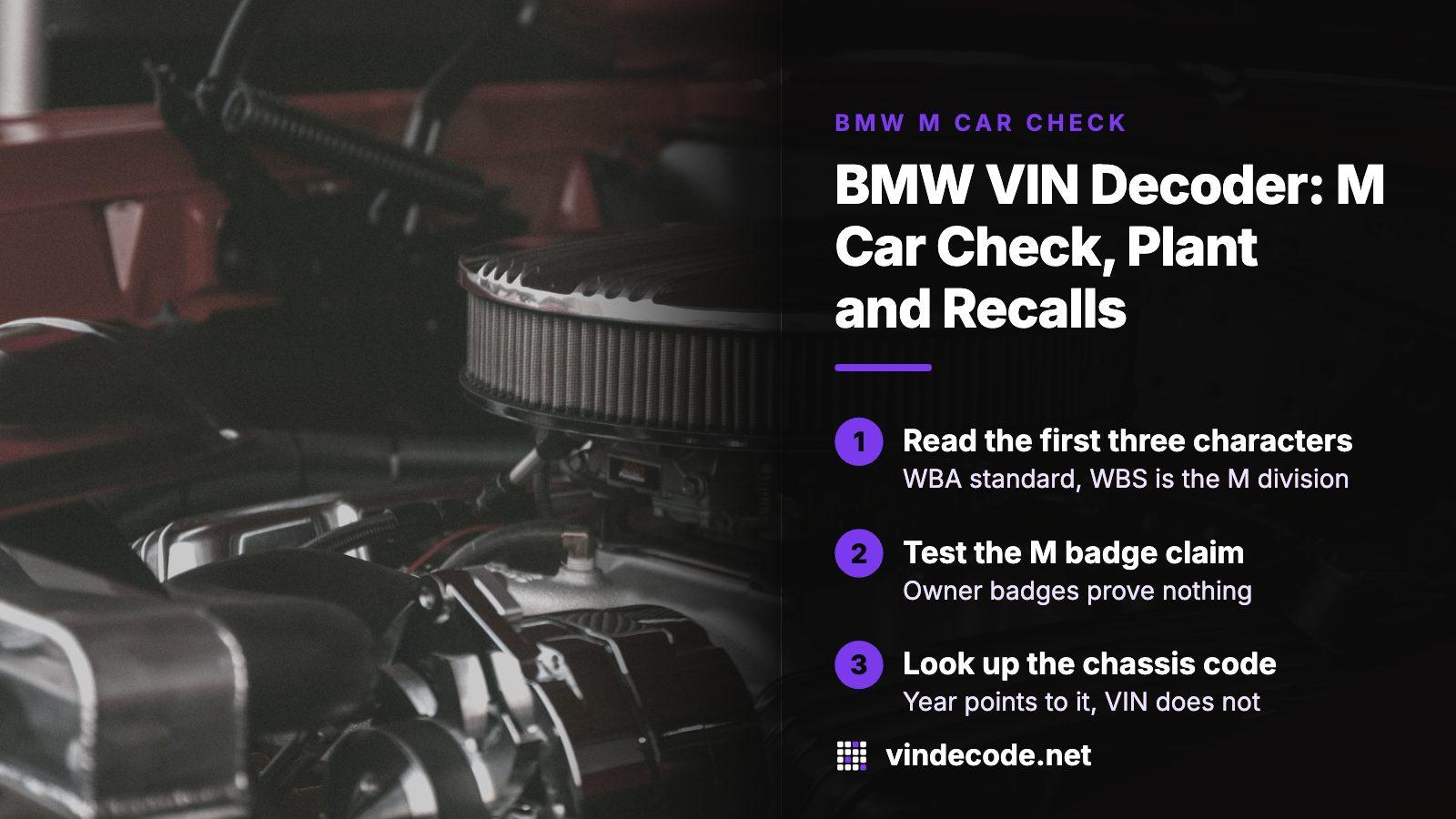
THE SHORT ANSWER
To decode a BMW VIN, type in all 17 characters. You get back the year, model line, body style, engine, drivetrain and assembly plant, and the opening three characters show whether the car is a standard BMW, an M division car, an electric model or a US-built X model. The chassis code, option list, crashes and mileage are not in the number. A preview of the history report costs nothing.
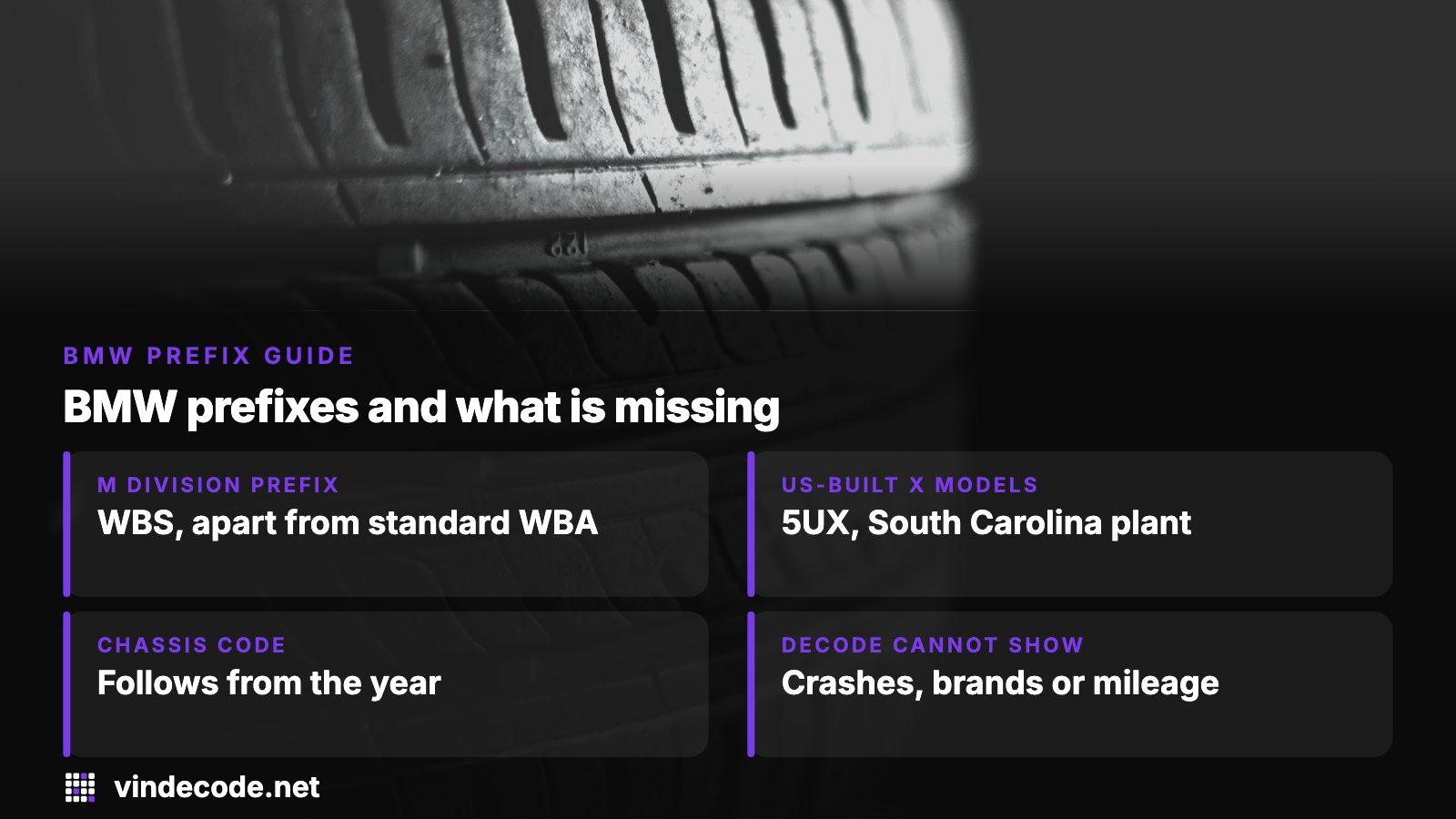
- M division prefix
- WBS, apart from standard WBA
- US-built X models
- 5UX, South Carolina plant
- Chassis code
- Not in the VIN, follows from the year
- Decode cannot show
- Crashes, brands or mileage
What a BMW VIN decoder tells you about the car
Decode a BMW VIN online and the answer comes from the layout BMW registered with NHTSA, not from the listing. That is why it is worth doing first: an ad can claim anything, while the number was assigned when the car was built.
| Decoder field | What it settles on a BMW |
|---|---|
| Year, model line, body style | Whether the car is the generation and shape the seller describes |
| Engine size, cylinders, fuel | The engine to research before you inspect the car |
| Drivetrain | Rear-wheel or all-wheel drive as built |
| Restraint system | What the factory fitted |
| Country and plant | Germany or South Carolina, and so which prefix to expect |
| M division identifier | Whether it is a genuine M car |
| Open recalls | Campaigns not yet repaired on that exact VIN |
Hold every line against the ad. Any line that disagrees needs an answer from the seller.
WBA, WBS, WBY and 5UX: what the prefix says
Start with the prefix. It names the maker and the country of build, and BMW splits its output across several identifiers, so on this brand it says more than usual.
| Starts with | What it identifies |
|---|---|
| WBA | Standard BMW car, German-built |
| WBS | BMW M division vehicle |
| WBY | BMW electric model |
| 5UX | BMW built at the South Carolina plant, the X models |
BMW uses more identifiers than these four, since production spans several countries and vehicle types. A prefix you do not recognize is a prompt to decode, not a warning. What should worry you is a number that decodes to a different make or model than the car in front of you.
BMW builds its X-model SUVs in South Carolina for the home market and for export, which is why they carry a US identifier. It is simply where BMW chose to build them, not a gray import and not a lesser car.
Genuine M car, M Sport package or owner badges
BMW sells two things that look alike and sit far apart in price. One is the M division car, built with its own engine, chassis, brakes and drivetrain. The other is a standard car with the M Sport package, which adds badges, bumpers, wheels and trim. Sellers sometimes blur the two.
| The car | What the VIN shows | What the M content is |
|---|---|---|
| Genuine M car | The M division prefix, WBS | M division engine, chassis, brakes and drivetrain |
| M Sport package car | A standard prefix such as WBA | Appearance, trim, wheels and suspension tuning |
| Standard car, badges added | A standard prefix | None, and nothing in the VIN to suggest any |
Read the prefix before the first offer
An M Sport car is a good car, but it is not priced like an M car. Reading the prefix takes seconds, and it gives a definite answer that the badges on the trunk lid never will.
Find the VIN and decode it without a typo
One wrong character returns an error or a different car, so copy the number from the vehicle, not from the advert.
- Read the VIN through the windshield, at its base on the driver's side.
- Check the sticker on the driver's door jamb against it. The two must match.
- Compare both with the title or registration.
- Enter all 17 characters, then go through the decoded result one line at a time.
Characters four to eight carry the model, body and engine details, and the ninth is a check digit that catches typos. The tenth encodes the year and the eleventh the plant. The last six make up the serial.

What the number leaves out: chassis code and option list
BMW generations are named by chassis codes: E46, F30, G20 and so on. The VIN does not print them. The decode gives model and year, and the pair points to the generation, with E for the older cars, F for the middle era and G for recent ones. Research that generation, since one model name covers engines, weak points and parts that differ.
The equipment list is a separate record. Ask a dealer to look up the factory build record for the VIN, which shows the option codes the car left with. These move the price:
- Seats and upholstery
- Wheel specification, and whether the wheels are the originals
- Adaptive suspension
- Driver-assistance and technology packages
- Gearbox choice, which sets the value on some models
- Special-order paint and trim
Wheels and interiors get swapped after delivery, so confirm the car still has what the price assumes.
Engine code, and the bills the specification forecasts
The decode names the engine as built. BMW uses its own family designations, and one engine turns up across several model lines, so what specialists and owners have documented follows the engine. Ask for the engine code and research that. EPA's fueleconomy.gov then lists official economy figures for the configuration.
- Adaptive suspension is excellent while it works, costly once it fails.
- All-wheel drive means more parts to service.
- Larger wheels mean dearer tires and more risk from potholes.
- A turbocharged engine rewards strict oil service and punishes neglect.
- Brakes, tires and fluids on an M division car all cost more.
Skipped maintenance compounds faster on a BMW than on a mainstream used car. On an older one, ask for proof of work on the cooling system, the gaskets and the suspension bushings.
After the decode: open recalls, then the history behind the car
A recall covers a span of VINs, so look up the exact number rather than the model name. NHTSA's lookup costs nothing to use, and whoever owns the car now, the maker must do the repair without charging for it.
Past the recall, the decode ends. A salvage brand, a crash, a rolled-back odometer or a lien is not recorded in the number. The history report gathers those records:
- Ownership and use type
- Odometer readings across the car's life
- Title brands, plus accident and damage records
- Salvage and auction records, photos included
- Liens and impounds, theft and insurance records
- Market value, factory specs and any open recalls
What it costs, and the order to run the checks in
Put the VIN in the box at the top of this page and the preview loads first. It costs nothing and needs no card details. After that, one payment buys the full report, and packs come in 3, 5 or 10 reports. Nothing renews, and the pricing page has current prices.
- Decode the VIN and read the prefix.
- Match engine, drivetrain and plant to the ad.
- Map the year to a chassis code and get the build record from a dealer.
- Run NHTSA's recall lookup on the same number.
- Open the history preview, and buy the report once the build holds up.
- Have an independent BMW specialist inspect the car.
A pack suits you if you are weighing several cars. The decoders for other brands on this site follow the same pattern.
Where this information comes from
- NHTSA: vPIC VIN decoder — The federal database where manufacturers file how their VINs are structured, behind the model, engine and plant fields.
- NHTSA: recalls lookup — Where a VIN is checked for open recalls, which the manufacturer fixes without charge.
- EPA: fueleconomy.gov — Official economy figures by engine and drivetrain, useful once the decode names the configuration.
Sources and photos: Facts checked against the sources above in November 2026. Photos by Victor Hughes, Scott Graham and Benjamin Brunner on Unsplash; diagrams by VINDecode.
Keep reading
- VIN Decoder: Decode a VIN Number Online, Then Check Its HistoryAll 17 positions explained, including the check digit and the year character.
- Mercedes Benz VIN Decoder: Prefix, Class, W-Code and HistoryThe German rival, with its own prefixes and its own build record.
- Audi VIN Decoder: Decode the Build, Then Check the HistoryAnother German marque where the option list drives value.
- Sample reportA finished report, to see what the history adds after the decode.
Frequently asked questions
How do I decode a BMW VIN online?
Enter all 17 characters into the VIN box on this page. The decoder reads the layout BMW registered in the federal vPIC database and returns the year, model line, body style, engine, drivetrain and plant. Take the number from the car itself, since one wrong character gives an error or the wrong vehicle.
Can a VIN decoder show whether a BMW is a true M car?
Usually. BMW gives its M division cars their own manufacturer identifier, WBS, separate from the one on standard cars. A car with M Sport badges and a standard prefix is a package car, whatever the seller calls it. Check the engine field against the M model you expect.
Is a chassis code like E46 or F30 in a BMW VIN?
No. Chassis codes are BMW's internal names for a model generation, and the VIN does not print them. The decode returns model and year, and the code follows from that pair. Look the generation up in a reference for the model line.
Does a BMW VIN starting with 5UX mean a gray import or a fake?
No. 5UX is the prefix on X models built in the United States, at the South Carolina plant, for sale here and abroad. A German prefix such as WBA is just as normal. Be wary of a number that decodes to a different make or model than the car in front of you.
Will a BMW VIN decoder show accidents, mileage or the option list?
No. A decode describes the factory build and any open recalls. Crashes, brands, odometer history, liens and theft come from history data, and the full option list comes from a dealer's build record. Use the decode to confirm the car, then the history preview to learn its past.
Now check the car itself
The guide explains what to look for. The report shows what this VIN has on record.