THE SHORT ANSWER
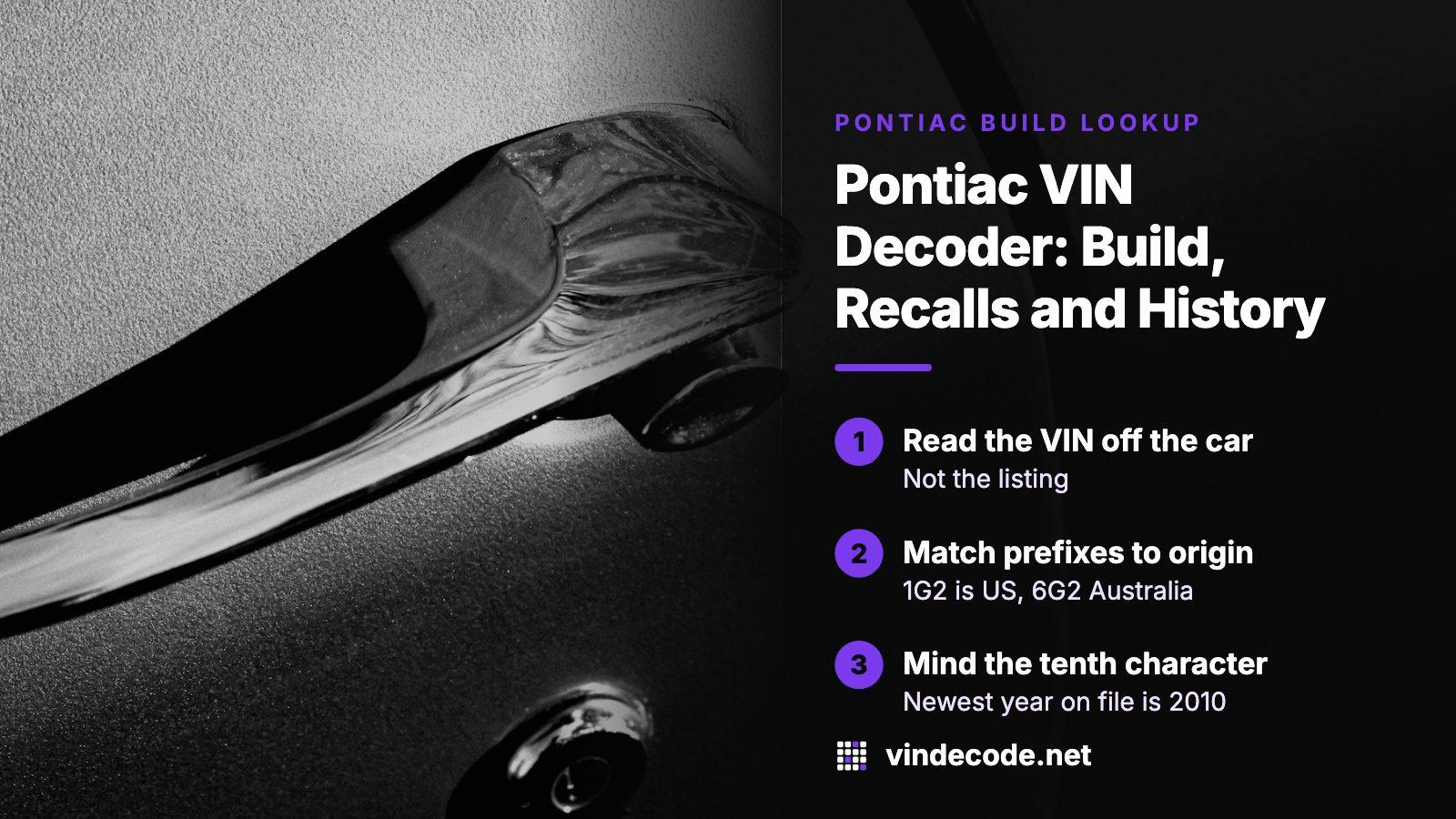
Enter all 17 characters of the Pontiac's VIN in the decoder above. It returns the model, body style, engine, plant and any open recall. Most prefixes, such as 1G2 for United States cars and 6G2 for Australian-built ones, show General Motors as the maker, and the tenth character never points later than 2010. Title brands, damage and mileage history are not part of a decode; a history report on the same VIN covers them.
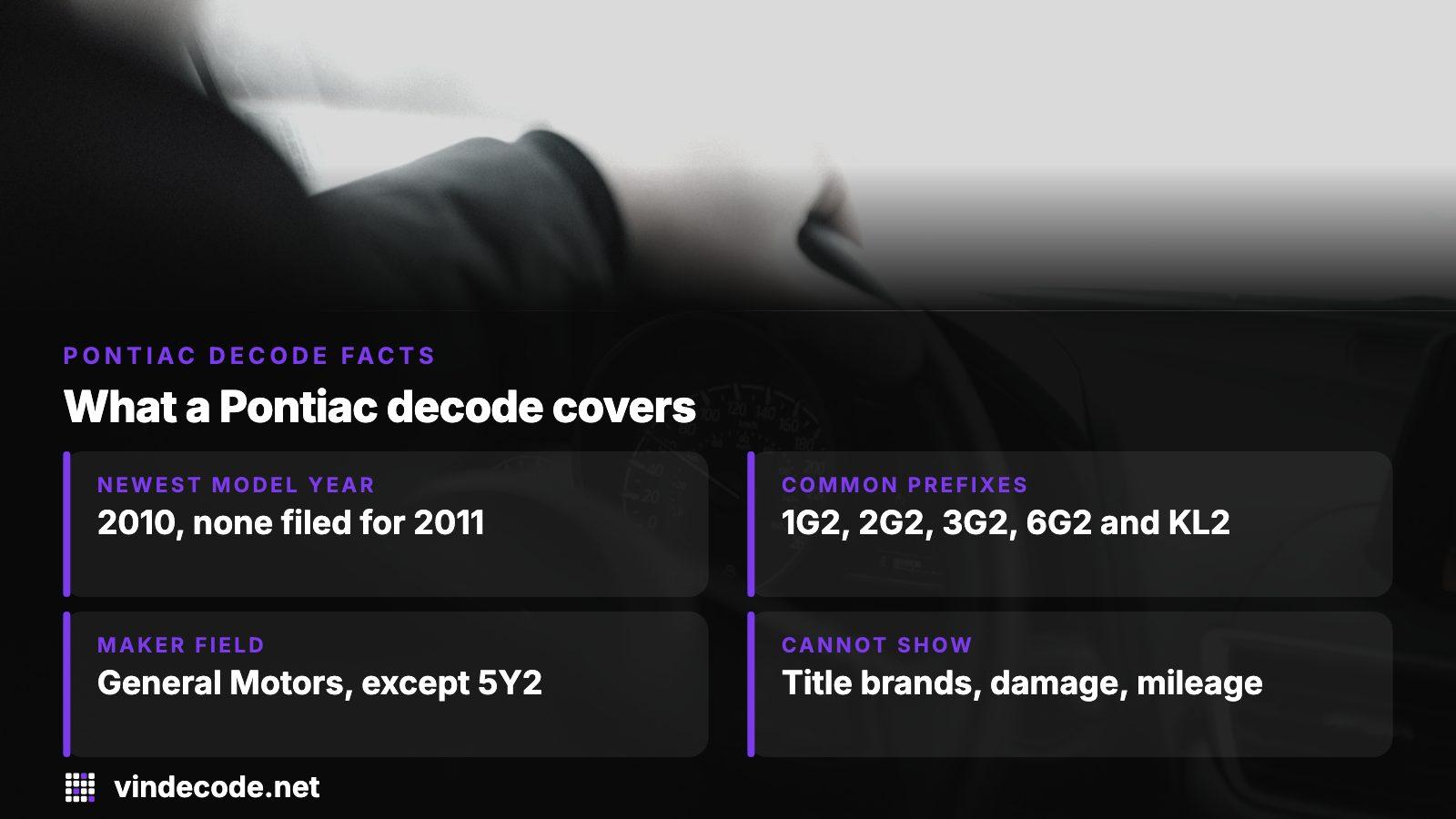
- Newest model year
- 2010, none filed for 2011
- Common prefixes
- 1G2, 2G2, 3G2, 6G2 and KL2
- Maker field
- General Motors, except 5Y2
- A decode cannot show
- Title brands, damage or mileage
What the decoder returns for a Pontiac
The decoder applies the pattern the manufacturer registered with federal regulators, so the result reflects what the plant built rather than how a seller words it. Expect these fields.
| Field | What it settles |
|---|---|
| Model and body style | Whether the car is the G6, Grand Prix or Vibe the listing claims |
| Model year | Which generation it is, and whether the advertised year is possible |
| Engine and drivetrain | The powertrain you are about to own |
| Plant and country | Where it was assembled |
| Open recalls | Safety campaigns not yet repaired on that particular VIN |
Reading the VIN off the car, not the listing
Copy the number from the metal itself. From the driver's side, find the plate on the dash that shows through the windshield, then open that door and check the label on the pillar. The pair must match, and match the seller's paperwork, because one wrong character decodes as a different car or throws an error. If they disagree, pause until someone explains it. A swapped plate is a reason to walk away. Photograph both, then type the number from the photo while the car is still in front of you.
Pontiac prefixes and what each one decodes to
Run a partial number through NHTSA's decoder and the opening characters resolve to a make and a maker. These prefixes all return Pontiac as the make.
| Prefix | Country | What the federal decoder returned |
|---|---|---|
| 1G2 | United States | G6 from the Orion plant and Solstice from Wilmington, both General Motors |
| 2G2, 3G2, 4G2 | Canada, Mexico, United States | Passenger car codes filed by General Motors |
| 6G2 | Australia | G8 sedan from the Elizabeth plant, General Motors |
| KL2 | Korea | Passenger car code filed by General Motors |
| 1GM | United States | Multipurpose vehicle code filed by General Motors |
| 2CK | Canada | Torrent from the CAMI plant, General Motors |
| 5Y2 | United States | Vibe from the Fremont plant, built by New United Motor Manufacturing |
Two rows deserve a second look. The 2CK prefix also decodes for GMC and Geo, so those three characters cannot name the badge and the model characters after them do that job. And 5Y2 returns a maker other than General Motors, so a Vibe that shows another company is not a decoding error.
Why the maker field says General Motors
Pontiac sold the cars, but NHTSA's register holds no manufacturer record under that name. Ask for the identifiers filed by Pontiac and the list comes back empty, while General Motors has 110. The decoder therefore names the parent company, which is the correct reading of the record and not a lost badge. It also tells you who owns the recall duty: a company that still operates. A decode that names General Motors is a sign the tool is working, not a sign you typed in the wrong car.
The tenth character and the 2010 ceiling
Position ten holds the model year, as a digit or a letter. On a Pontiac the usable range ends early: the federal model list returns seven models for 2010 and none for 2011. A VIN that decodes to anything later is a typo or a question for the seller.
| Tenth character | Model year |
|---|---|
| S | 1995 |
| Y | 2000 |
| 5 | 2005 |
| 7 | 2007 |
| 8 | 2008 |
| 9 | 2009 |
| A | 2010 |
The letters repeat after a long cycle, so read the character beside the prefix and body style. The lineup thins as the years pass: eleven models in 2005, ten in 2008, seven in 2010.
Recalls on a car whose badge no longer exists
A recall attaches to the manufacturer and the VIN, not the nameplate. General Motors still operates, so open campaigns on a Pontiac stay with that company and the repair is done at no charge to the owner. NHTSA's lookup checks one VIN at no cost, and the decoder above lists open campaigns for the number as well.
From an NHTSA owner complaint
The owner of a used 2008 Pontiac G5 told NHTSA that, until they looked, they had never heard of the recall system and only looked the car up on the agency's site the following year. The lookup showed an open ignition switch recall, which they had fixed, but the airbag system also misbehaved, and they said it had done so since the day they bought the car.
Run the same lookup before the sale, while the seller can still be asked about it.
When a title brand follows the car into the repair bay
A decode is silent on title status. That gap matters on older Pontiacs, which may have been repaired and retitled along the way. Two owners told NHTSA how a brand surfaced at the service counter.
From an NHTSA owner complaint
Two weeks after buying a used 2008 Pontiac G5, a buyer listed three open recalls on it, plus stalling over bumps and a strong gasoline smell. GM's phone line, the buyer wrote, would not schedule the recall work because of a "branded title" from Oklahoma, and pointed to the state instead.
From an NHTSA owner complaint
An owner preparing to sell a 2008 G5 wrote that parts for the ignition and start switch recall finally came in and a visit was booked. About 50 minutes into the wait, the dealer relayed that GM would not authorize the repair because of an altered title. The owner said the cause was front-end damage fixed with original parts at around 50,000 miles earlier, and no recall letter had warned about it.
These are single accounts, not statements of GM policy, and they do not show how every dealer treats branded cars. They do show why the title record is worth reading before the money moves.
What the history report adds after the decode
Once the build checks out, the same VIN opens what a decode cannot reach. A history report gathers:
- Brands on the title, salvage or rebuilt, with the accident and damage records behind them
- Odometer readings over time, so a rollback or a gap stands out
- Salvage and auction appearances, with photos
- Liens, impounds and theft records
- Insurance records, ownership and use type
Mileage needs extra care here. Under 49 CFR 580.17, the odometer disclosure rule exempts a car from the 2010 model year or earlier once ten or more years have passed since its model year opened on January 1. Every Pontiac is past that point, so a seller may legally leave the figure off the transfer form, and recorded readings carry more weight than a number on paper.
What it costs, and the order to run the checks
The preview after you enter the VIN is free and asks for no card. Paying for the full report happens once: a single report, or bundles of 3, 5 or 10. Nothing renews afterward. Prices are on the pricing page.
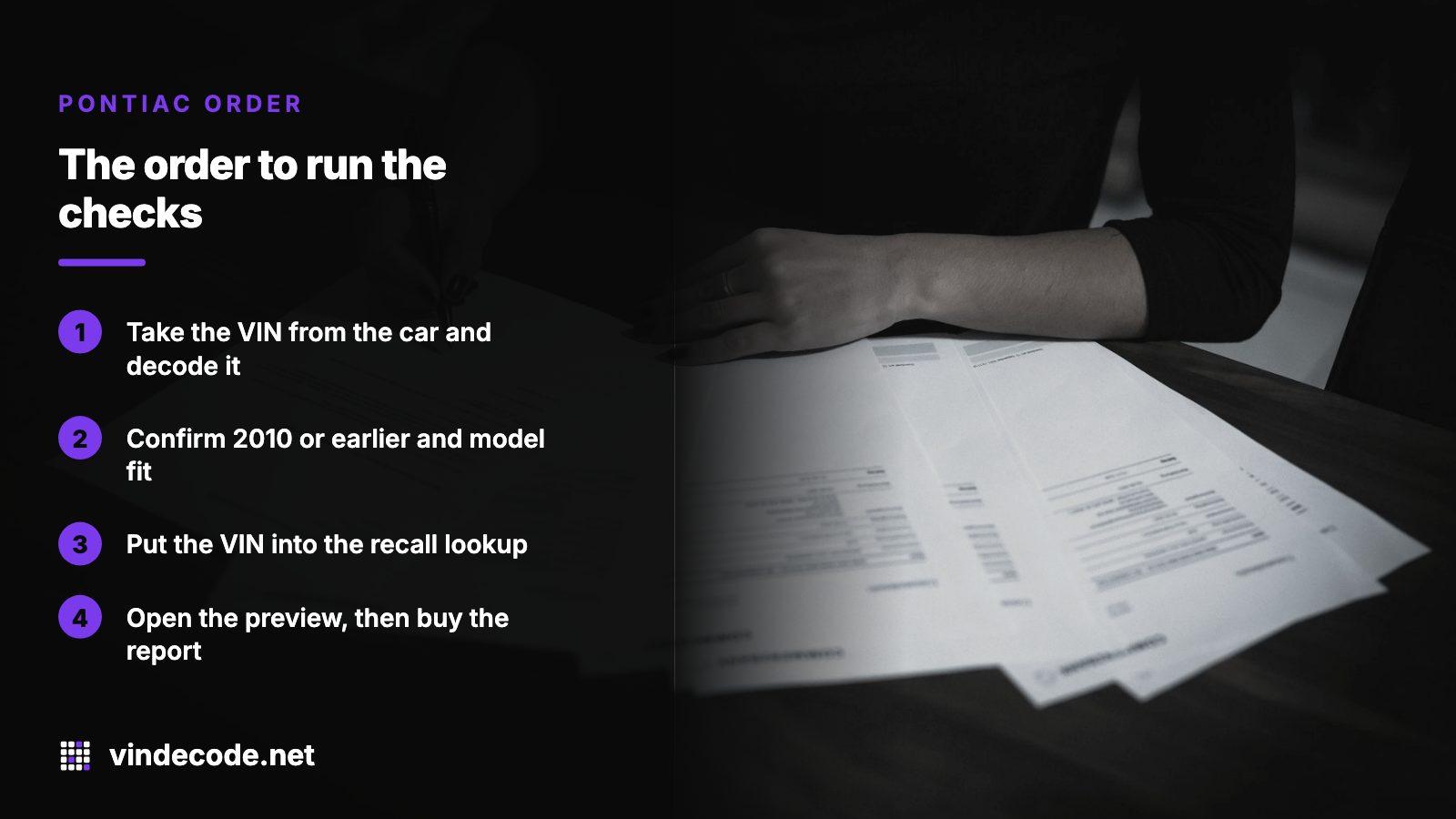
- Take the VIN from the car itself and run the decode.
- Confirm the model year is 2010 or earlier and the model fits the prefix.
- Put the VIN into NHTSA's recall lookup and note anything still open.
- Open the preview, then buy the report if the build adds up.
- Have a mechanic you chose inspect the car before you pay.
Where this information comes from
- NHTSA: vPIC decoder and API — The federal decoder behind the maker, model and plant fields, where the prefixes and model-year lists on this page can be re-run.
- eCFR: 49 CFR 580.17 — The odometer disclosure exemption that now covers every Pontiac.
- NHTSA: recalls lookup — Where to check a single VIN for open recalls at no cost.
- NHTSA owner complaint 10894457 — owner experience, paraphrased
- NHTSA owner complaint 10658733 — owner experience, paraphrased
- NHTSA owner complaint 10630644 — owner experience, paraphrased
Sources and photos: Facts checked against the sources above in November 2026. Photos by Linus Belanger, Dimitri Karastelev and Miles Loewen on Unsplash; diagrams by VINDecode.
Keep reading
- GM VIN Decoder: Decode Any GM VIN, Then Check Its HistoryThe prefix map across every General Motors division, Pontiac included.
- VIN Decoder: Decode a VIN Number Online, Then Check Its HistoryAll 17 positions explained, including the check digit and the year character.
- Classic Car VIN Decoder: Which Years It Reads and What Comes AfterFor older Pontiacs, what a decode reads and what the factory tag adds.
- Sample reportA finished report, to see what the history adds after the decode.
Frequently asked questions
Why do Pontiac VINs show General Motors as the maker?
Pontiac was a General Motors division, and NHTSA's register has no manufacturer record under the Pontiac name. The identifiers on these cars were filed by General Motors, so the decoder names the parent. A Vibe with the 5Y2 prefix is the exception and returns New United Motor Manufacturing.
What is the newest Pontiac model year a VIN can show?
2010. NHTSA's model list for Pontiac returns seven models for that year and none for 2011. A tenth character of A means 2010, so a listing that claims a newer year has a typo or a problem worth asking the seller about.
Does every Pontiac VIN begin with 1G2?
No. 1G2 is the usual code for United States cars, but 2G2, 3G2, 4G2, 6G2 and KL2 also decode to Pontiac, as do 1GM, 2CK and 5Y2. A leading 6 or K points to Australia or Korea and is not unusual on these cars.
Will the decoder show if a Pontiac was in an accident?
No. A decode describes the build and any open recall, nothing that happened afterward. Accidents, title brands, mileage readings, liens and theft records sit in separate databases, and a history report gathers them by VIN. The preview shows what exists before you decide to buy.
Who fixes a Pontiac recall now that the brand is gone?
General Motors, because a recall duty rests with the manufacturer and that company still operates. Where a campaign covers the car, the repair carries no charge to the owner. Check the VIN in NHTSA's lookup and ask the seller for repair receipts.
Now check the car itself
The guide explains what to look for. The report shows what this VIN has on record.