THE SHORT ANSWER
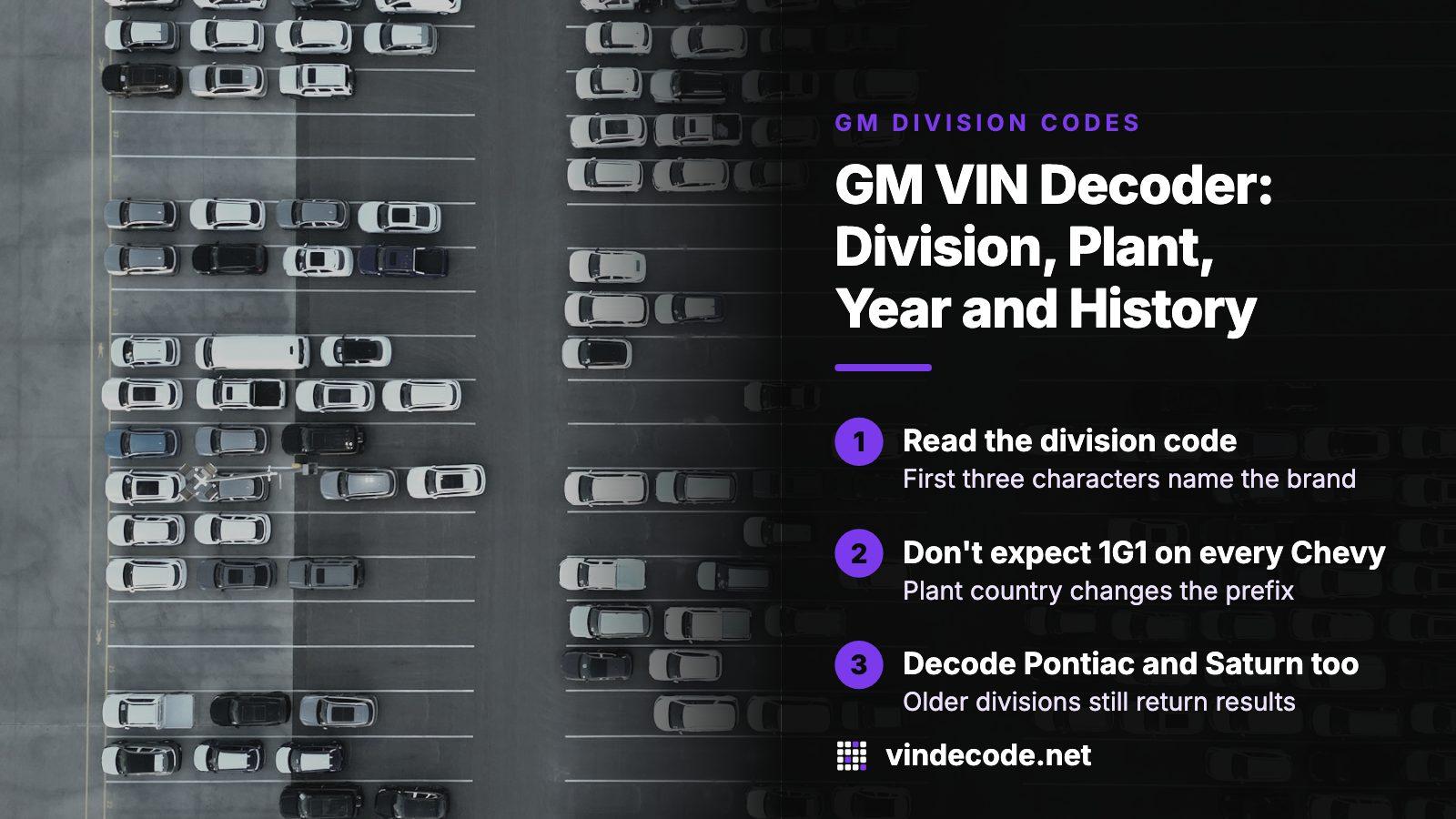
To decode a GM VIN number, enter all 17 characters in the box above. The first three name General Motors and narrow it to a division, a vehicle class and a build country: 1G1 is a Chevrolet car, 1GT a GMC truck, 1G6 a Cadillac car. Characters 4 to 8 are GM's own descriptor, the 10th is the model year and the 11th the plant. Options, accidents and title brands are not in the number.
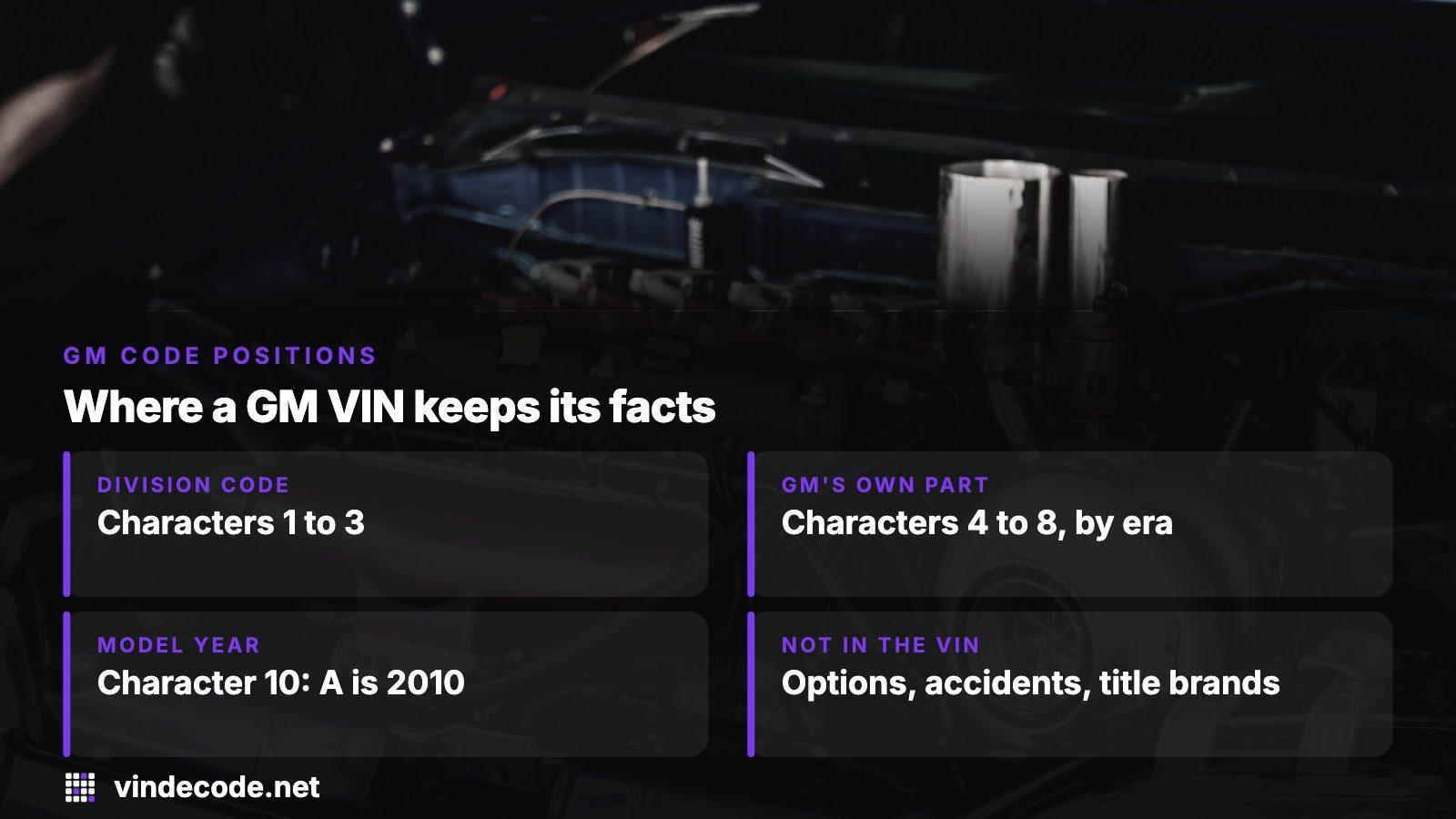
- Division code
- Characters 1 to 3, such as 1G1 or 1GT
- GM's own part
- Characters 4 to 8, redefined by era
- Model year
- Character 10: A is 2010, T is 2026
- Not in the VIN
- Options, accidents and title brands
What a GM VIN decode returns
General Motors has sold vehicles under many badges from plants on four continents, so the name on the grille says little about how one vehicle was built. The decoder applies the rules GM filed with the federal register to your number, and for a current Chevrolet, GMC, Cadillac or Buick the table below is usually the whole answer.
| Field | What it settles on a GM vehicle |
|---|---|
| Division | Whether the badge in the advert matches the number |
| Vehicle class | Car, truck, SUV-type or unfinished vehicle |
| Plant country | Where it was assembled, and which code to expect |
| Model year | Whether the year in the listing is the real one |
| Body and engine | Which variant the seller is describing |
Decode first. A number that fails to match the advert should end the conversation before any history is bought.
The first three characters: GM division codes
The opening three characters make up the manufacturer identifier in the international scheme. The third separates vehicle types inside a division, which is why Chevrolet cars, trucks and SUV-type models each carry their own code. Each one below was read back from NHTSA's register.
| Division | Code | What it marks |
|---|---|---|
| Cadillac | 1G6 | Car |
| Cadillac | 1GY | SUV-type vehicle |
| Buick | 1G4 | Car |
| GMC | 1GT | Truck |
| GMC | 1GK | SUV-type vehicle |
| GMC | 1GD | Incomplete vehicle |
| Chevrolet | 1G1 | Car |
| Chevrolet | 1GC | Truck |
| Chevrolet | 1GN | SUV-type vehicle |
Every one of them names General Motors LLC as the manufacturer of record. The division is a label on top of that, not a separate company.
Why your Chevrolet may not start with 1G1
The first character carries the build region. A leading 2 means Canada, 3 means Mexico, a K means South Korea, and 1, 4 or 5 mean a US plant. Chevrolet has built cars in all four places, so the brand legitimately appears under several codes. Cars starting 2G1 are Canadian builds, 3G1 Mexican and KL8 Korean, yet all three decode to Chevrolet. A VIN that fails a chart listing only 1G1 has not failed anything.
One code, two badges
Identifiers belong to a manufacturer, not to a showroom. The code 1GH returns two makes, Holden and Oldsmobile, so one code can sit behind two nameplates. Read all three characters. The leading digit alone gives a region and nothing else.
Pontiac, Saturn and Oldsmobile VINs still decode
Oldsmobile stopped building cars in 2004, and Pontiac and Saturn in 2010. The register still lists their codes, since the vehicles are still driven: 1G3 returns an Oldsmobile car, 1GM a Pontiac multipurpose vehicle and 1G8 a Saturn car. They decode like any current Chevrolet, and the party answerable for a safety campaign is still General Motors.
From an NHTSA owner complaint
The owner of a 2005 Saturn Ion, a 1G8 car, told NHTSA in April 2023 that they had been trying to book the open recall repairs without success. A Chevrolet dealer said the car was discontinued and "they can't find the parts", and suggested calling somewhere else. The complaint does not record how it ended.
The takeaway: a retired badge does not retire the recall. A dealer who cannot source a part that day has not ended the obligation. Run the VIN through NHTSA's recall lookup, print the result and take it to a different GM dealer if the first turns you away.
Characters 4 to 17: what GM sets and what is fixed
Federal rule 49 CFR 565.15 gives each part of the VIN its job. Characters 4 to 8 describe the vehicle, and the rule leaves their code to the manufacturer, which must hand NHTSA the rules for reading them.
| Characters | What they carry | Who decides |
|---|---|---|
| 1 to 3 | Manufacturer and class | International assignment |
| 4 to 8 | Model, body, engine, restraints | General Motors |
| 9 | Check digit | A federal formula |
| 10 | Model year | A federal table |
| 11 | Assembly plant | General Motors |
| 12 to 17 | Production sequence | The plant's own serial run |
The five descriptor characters are the ones a fixed chart gets wrong, because nothing obliged GM to keep them stable between divisions or generations. A decoder that applies the rules filed for that specific vehicle avoids the trap.
The model year character and the 1980 trap
Character 10 gives the model year for every manufacturer on a cycle that repeats every thirty years. On an old vehicle the letter alone can mislead: A means 2010 on a recent GM vehicle and 1980 on a very old one.
| Character 10 | Model year |
|---|---|
| T | 2026 |
| R | 2024 |
| L | 2020 |
| A | 2010, or 1980 on an older vehicle |
| 1 to 9 | 2001 to 2009 |
| Y | 2000 |
The federal rule supplies a tiebreaker. On cars, and on trucks and multipurpose vehicles rated at 10,000 pounds or less, look at character 7: a digit there means 1980 through 2009, and a letter means 2010 through 2039. Heavier vehicles, which include incomplete-vehicle codes such as 1GD, fall outside the rule.
Recalls follow the VIN, not the badge
GM shares parts across divisions, so a safety campaign opened under one badge can reach vehicles wearing another. The NHTSA lookup works from the VIN, so it reports what applies to your vehicle whichever division the news named, and it can also report that nothing is open.
From an NHTSA owner complaint
Another 2005 Saturn Ion owner reported that, at about 167,000 miles, the key jammed in the slot and the car refused to start. They learned that the VIN sat outside the safety campaign they had looked up, and said the manufacturer was informed but gave no help. The cause had not been found.
Coverage is decided by VIN range, so one car of a model can sit inside a campaign while its twin sits outside it. A "not included" result describes one number. It is not a verdict on the model.
What a GM decode cannot show, and the report that can
A decode describes a factory order, so a clean one is no evidence about what came later. Option content is separate too: GM records what was fitted as production option codes on a label in the vehicle, not in the VIN, and that label settles trim and package claims. The history report searches the later events under the same 17 characters:
- Title brands such as salvage, which change what a vehicle is worth
- Accident and damage records, with auction photos where they exist
- Odometer readings over time, to test whether mileage rises in a believable line
- Liens and impound records that a lender or lot may still hold
- Open recalls, ownership and use type, and market value
Running the check, from decode to report
- Read the VIN off the vehicle and check it against the title paperwork.
- Type all 17 characters into the decoder above and compare the division, class, plant country and year with the advert.
- Run the same number through NHTSA's recall lookup.
- Open the preview. It is free and asks for no card.
- Buy the report if the decode holds, and have a mechanic you choose inspect the vehicle before you pay the seller.
GM owners and shoppers pay once per report, or buy three, five or ten together; no charge repeats. See the pricing page.

Where this information comes from
- NHTSA: vPIC VIN decoder — Where each manufacturer code and vehicle type on this page was read back.
- NHTSA: recalls lookup — Searches one VIN for open recalls, including on retired GM brands.
- eCFR: 49 CFR 565.15 — The federal rule that sets the job of each VIN position.
- NHTSA owner complaint 11515552 — owner experience, paraphrased
- NHTSA owner complaint 11674938 — owner experience, paraphrased
Sources and photos: Facts checked against the sources above in November 2026. Photos by Iain, Scott Graham and Willian Cittadin on Unsplash; diagrams by VINDecode.
Keep reading
- Chevrolet VIN Decoder: Decode a Chevy, Then Check Its HistoryOne brand in detail: engine character, plants and the label inside the vehicle.
- GMC VIN Decoder: Read a Sierra or Yukon VIN, Then Check Its HistoryGMC trucks and SUVs, and how to tell a trim claim from fact.
- Pontiac VIN Decoder: Read the Build, Then Check the HistoryA retired GM brand whose VINs still decode and whose recalls still apply.
- Sample reportA finished history report, to see what comes after the decode.
Frequently asked questions
How do I decode a GM VIN?
Read all 17 characters from the vehicle, enter them in the decoder at the top of this page and compare the division, class, plant country and model year with the listing. Then check recalls by the same number.
What does a VIN starting with 1G1 mean?
A General Motors car built at a US plant, decoding to Chevrolet. The 1 marks the US and the third character gives the type, so Chevrolet trucks open with 1GC and GMC trucks with 1GT.
Do Pontiac, Saturn and Oldsmobile VINs still decode?
Yes. Their codes remain in the federal register, so 1GM, 1G8 and 1G3 return Pontiac, Saturn and Oldsmobile. Recall obligations stay with General Motors and any GM dealer can book campaign work, though parts for old models can be hard to find.
Does a GM VIN list the options on the vehicle?
No. Options are recorded as production option codes on a label inside the vehicle. The number gives the division, class, plant and year, and the label settles trim and package questions. Used together they test an advert better than either alone.
Will a GM decode show accidents or title brands?
No. The decode covers how the vehicle left the factory. Wrecks, branded titles, mileage history and liens live in other records, which the history report searches under the same VIN. The preview is free to open and the full report is one payment.
Now check the car itself
The guide explains what to look for. The report shows what this VIN has on record.