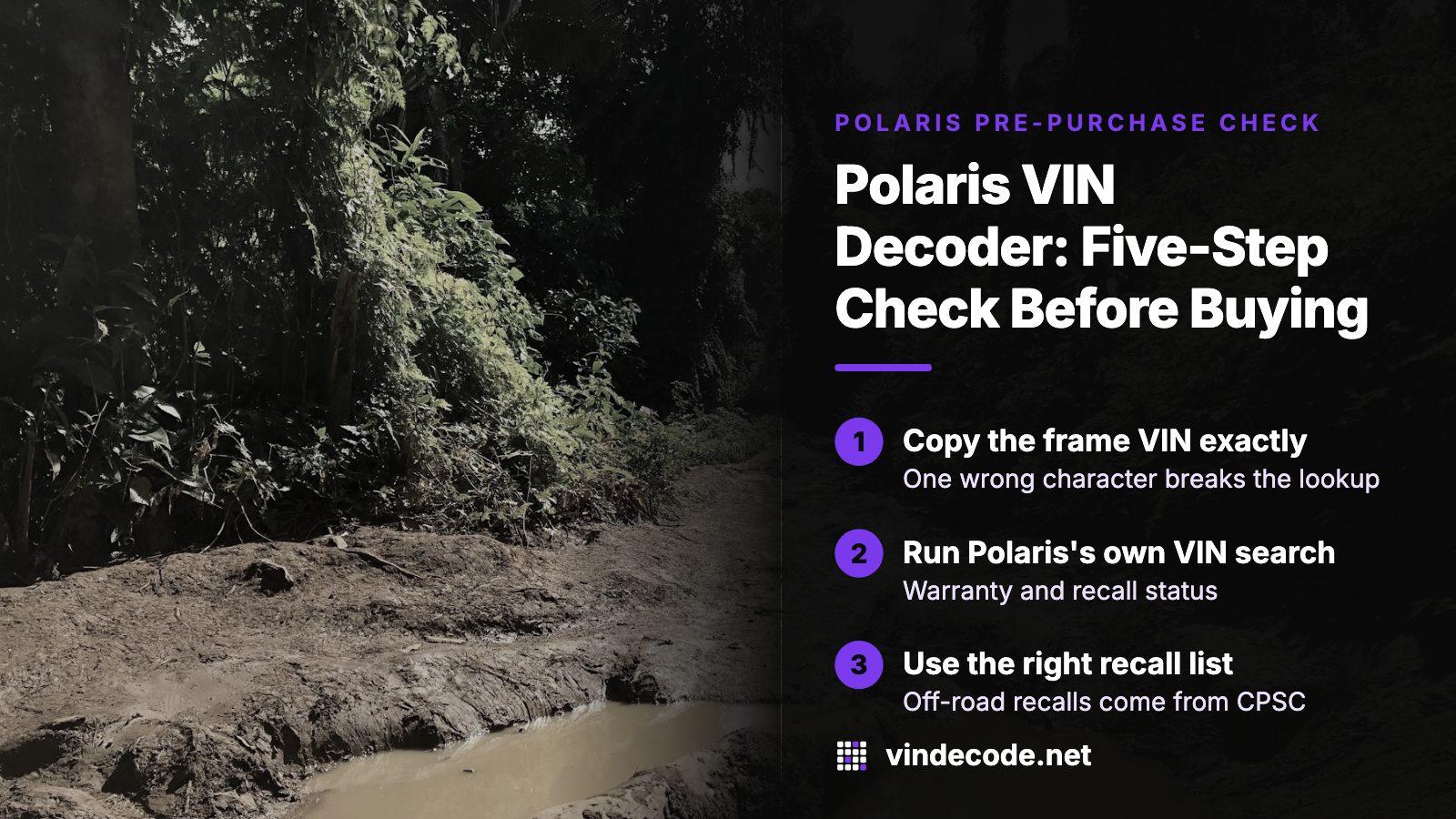
THE SHORT ANSWER
Find the VIN on the frame, enter it in the decoder, and read the maker, model year and plant. Then run the same number through Polaris's own VIN search for warranty and recall status, and through the recall lists for your machine type. A decoder cannot show accidents, brands, liens or theft, so order a history report before handing over money.
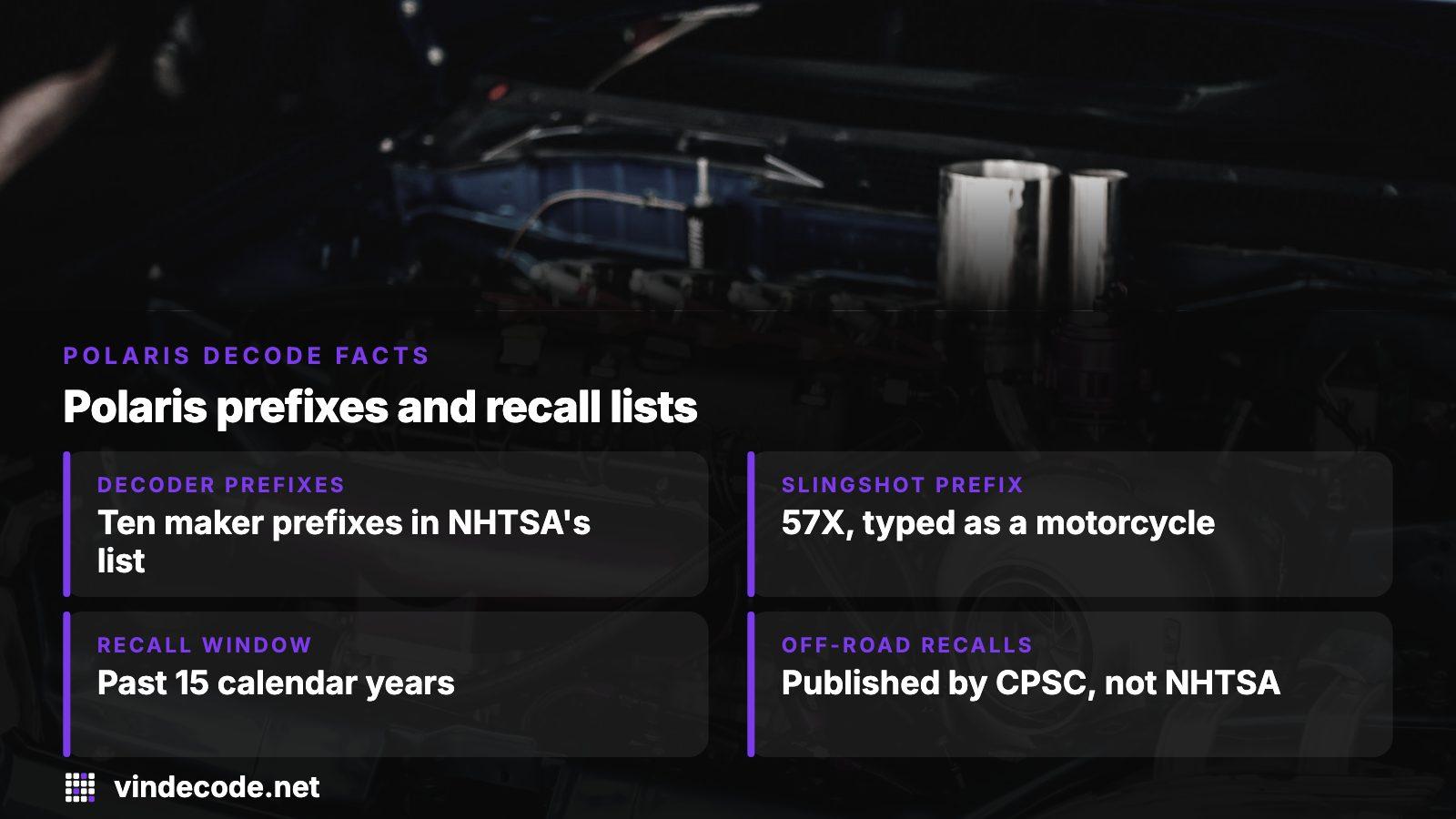
- Decoder prefixes
- Polaris holds ten maker prefixes in NHTSA's list
- Slingshot prefix
- 57X, typed as a motorcycle
- Polaris recall window
- Past 15 calendar years
- Off-road recalls
- Published by CPSC, not NHTSA
Step one: find the VIN and copy it exactly
Polaris builds road-legal three-wheelers, ATVs, side-by-sides and snowmobiles, and the place the number sits changes with the product. Recall notices from the Consumer Product Safety Commission show the spread. A Ranger carries it low on the driver's side at the back, beneath the cargo box. Snowmobile notices point to the frame's right-hand side. One RZR XP Turbo notice sends you to the rear wheel well on the left.
- Photograph the stamping or label before you type anything.
- Clean off mud and grease with a rag instead of guessing at a worn character.
- Count the characters. A road-legal machine should show 17, and a stamped I, O or Q means you misread something.
- Note the engine serial separately if you see one. It is a different number and a decoder will not read it.
If the seller will only send a photo, ask for a second one taken in daylight. A blurry digit is the most common reason a decode fails.
Step two: run the number through the decoder
Enter the full VIN in the decoder at the top of this site. The first three characters are the maker's identifier, and NHTSA lists Polaris Industries under several of them. The prefix tells you the product family, so a mismatch with the machine in front of you is worth a question.
| Prefix | How NHTSA types it | Note |
|---|---|---|
| 57X | Motorcycle | Decodes to the Slingshot make |
| 5VP, 4XA | Motorcycle | Listed for Polaris Industries |
| 3NE, 3NS | Motorcycle | Listed for Mexico |
| TAP | Motorcycle | Listed for Poland |
| 52C, 5AS | Low Speed Vehicle | Listed for Polaris Industries |
| SN1, S21 | Off-Road Vehicle | Listed for the United States |
Those are the prefixes in NHTSA's list today, not a promise that every Polaris you meet will decode. A sparse result on a pure off-road machine is normal.
Step three: read what came back, and what did not
A clean decode gives you the maker, the model year, the assembly plant and the vehicle type. To see how the tool behaves, I fed NHTSA's decoder a partial Slingshot VIN starting 57XAAEAA with a 2016 model year. It returned a Slingshot built by Polaris Industries at the Spirit Lake plant in the United States, typed as a motorcycle, and flagged the number as incomplete. A short or mistyped VIN does not fail outright, it gives partial answers, which is why step one matters.
What a decode cannot tell you
It reads the build record. It shows nothing about crashes, rebuilt titles, liens, theft or odometer changes. NHTSA aims its decoder at 1981 and newer machines, so a vintage sled may return nothing at all.
Step four: ask Polaris about the same VIN
Polaris publishes its own VIN search. Enter the number and it returns the model year and model number, the engine serial, the factory warranty, any Extended Service Contract, manuals and open recalls or safety bulletins. Two of those fields are things a third-party decoder cannot produce. If the seller says the machine is still under warranty, this is where you check the claim.
The page states its limits plainly. It covers recalls still open and recalls done over the past 15 calendar years. It leaves out international vehicles and recalls older than that, so a clean answer on an older machine proves only that nothing turned up inside the window. Polaris also says the result is informational and does not by itself mean a unit is affected.
Step five: use the right recall list for the machine
Which agency tracks recalls depends on what you are buying. NHTSA covers the Slingshot, which is regulated as a motorcycle. CPSC takes the rest: quads, side-by-sides, work utility models and sleds. A search of the SaferProducts.gov recall service for Polaris titles turned up 133 entries, so expect a long list.
- Match the VIN, not just the model. Some notices cover certain VINs and others cover all VINs in a model-year range.
- Recall 25343 is an all-VINs example, covering the 2023 and 2024 Ranger XP Kinetic and the 2025 Pro XD Kinetic.
- Recall 24369 is a certain-VINs example, covering some 2023 and 2024 Sportsman ATVs.
- An NHTSA-only search on an ATV will show nothing even when a CPSC recall exists.
CPSC's own safety page puts the average at over 800 deaths each year across off-highway vehicles. An open fire or crash recall is not a detail to leave for later.

When a recall is open and the parts are not there
NHTSA lists nine recalls against the 2017 Slingshot alone, among them 19V750000 on battery fuse holder terminals for 2015 to 2019 machines. An open recall on a used Slingshot is common enough that you should ask for proof of completion.
From an NHTSA owner complaint
A 2017 Slingshot owner wrote that they had spent about a year trying to get the fuse block recall done and had contacted Polaris many times. Dealers nearby told them the parts could not be had. The owner's warning was that riding without the fix risks steering and lights quitting.
The lesson for a buyer is that an open recall can sit unrepaired for a long time through no fault of the owner. Get the status in writing before you pay, and price in the wait.
Step six: order the history report on the same VIN
The decoder and the factory lookup describe the machine as built. A history report picks up the years after the sale: brands on the title, crash and damage entries, mileage readings, salvage or auction listings with photos, liens, theft entries and who owned it. Start with the free preview to see whether anything is on file. If it is, one payment buys the full report, and nothing renews. The pricing page lists the options.
Road-legal machines with a 17-character VIN, the Slingshot above all, are the best fit. For pure off-road units without a standard VIN, the dealer and the certification label may tell you more, and a report may come back thin.
Red flags that should stop the sale
- The frame stamping and the paperwork carry different numbers.
- The prefix does not fit the product family you are looking at.
- The seller claims warranty that the factory lookup does not show.
- A recall is open and the seller has no proof of a scheduled repair.
- The history preview shows a brand, a claim or a theft entry the seller never mentioned.
One red flag is a reason to ask questions. Two or more is usually a reason to walk away and keep your deposit.
Where this information comes from
- Polaris: vehicles VIN search — what the factory lookup returns and its stated recall window
- NHTSA vPIC: VIN decoder — decoder scope, model year coverage and Polaris prefixes
- CPSC: recalls and product safety warnings — off-highway recall notices and VIN locations
- CPSC: OHV and ATV safety information — off-highway fatality figure
- NHTSA owner complaint 11363025 — owner experience, paraphrased
Sources and photos: Facts checked against the sources above in November 2026. Photos by Frederick Rosa, Owen Michael Grech and Willian Cittadin on Unsplash; diagrams by VINDecode.
Keep reading
- ATV VIN Decoder: Reading Quad and UTV Numbers, Then Checking the HistoryCovers ATVs from any maker, where CPSC rather than NHTSA tracks recalls.
- How to Decode a Motorcycle VIN: Year, Engine and Build PlantExplains each VIN position on a road-legal bike or trike.
- VIN Decoder Explained: What Decoding a VIN Means and How It WorksThe position-by-position basics behind every brand decoder.
- NHTSA VIN Decoder: What It Returns, Where It Stops, What Comes NextWhat the federal decoder reads and where it stops.
Frequently asked questions
Where is the VIN on a Polaris?
It depends on the product. Recall notices put it beneath the cargo box at the driver's-side rear of a Ranger, along the right of a snowmobile frame, and in a rear wheel well on one RZR model. Check the certification label too, and treat the engine serial as a separate number.
Does a Polaris VIN decoder show recalls?
A general decoder reads the build record and usually does not. Polaris's own VIN search lists open recalls and those done in the past 15 calendar years. For ATVs and side-by-sides, CPSC publishes the notices, so check there as well.
Why does my Polaris VIN not decode?
The number may be mistyped, partial, or in a format a road-vehicle database does not cover. NHTSA says its decoder was built for 1981 and newer vehicles. Re-read the stamping in daylight, count the characters, and try the factory lookup.
Can the decoder tell me if a Polaris is stolen or wrecked?
No. Decoding reads how the machine was built, not what happened to it. Theft, damage, title brands and liens live in separate records, which is what a history report on the same VIN pulls together.
Do I need a history report for an off-road Polaris?
It is most useful on machines with a standard 17-character VIN, such as the Slingshot. Start with the free preview to see what is on file. For off-road units with other number formats, lean on the dealer, the certification label and the recall lists.
Now check the car itself
The guide explains what to look for. The report shows what this VIN has on record.