THE SHORT ANSWER
Read positions 1 to 3 for the maker, 4 to 8 for bike type, line, engine and rated horsepower, 9 as a check digit, 10 for the model year, 11 for the build plant and 12 to 17 for the serial. That confirms the factory build. It cannot show wrecks, title brands, liens, theft or a swapped engine, so run a history report before paying.
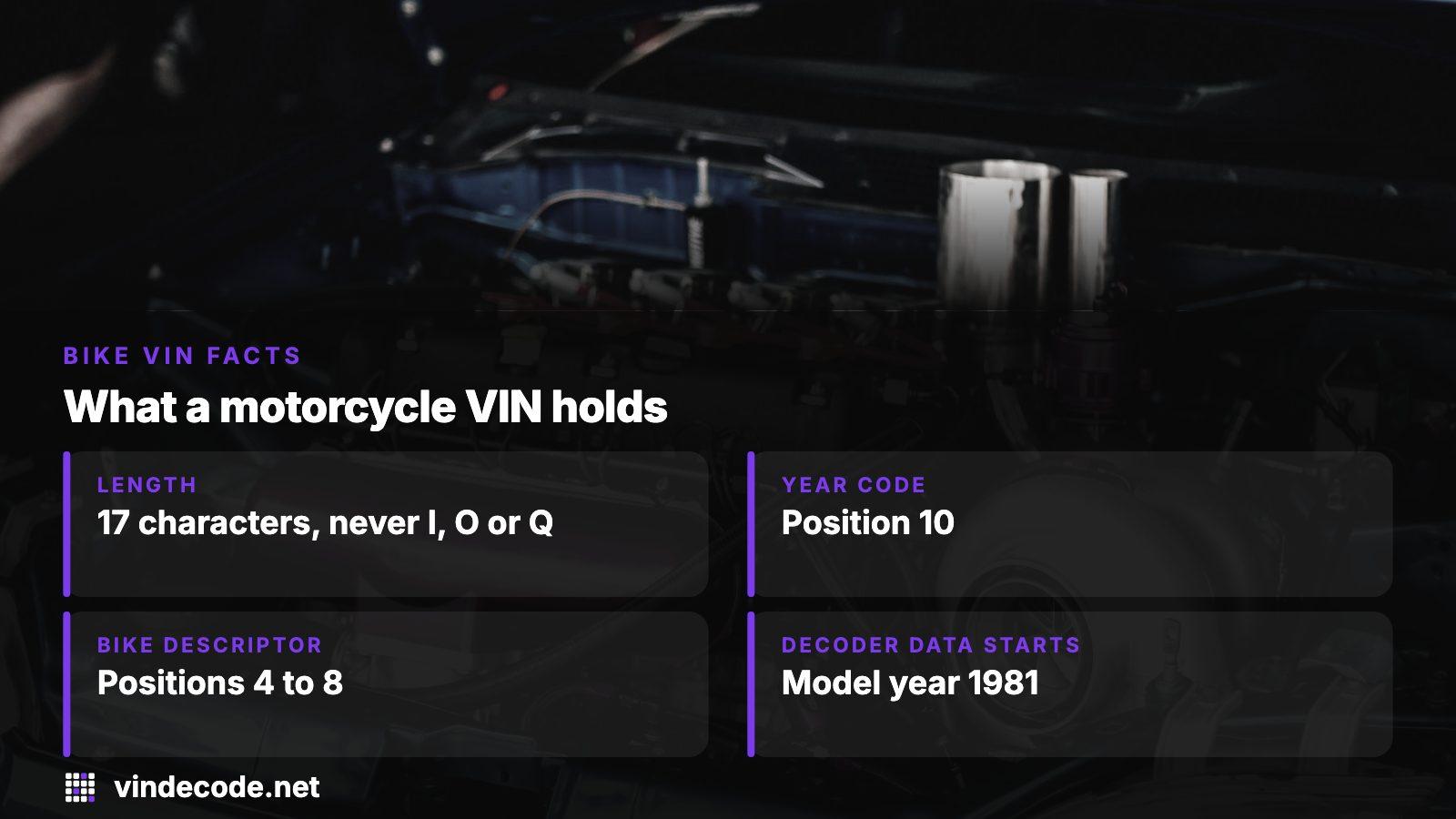
- Length
- 17 characters, never I, O or Q
- Year code
- Position 10
- Bike descriptor
- Positions 4 to 8
- Decoder data starts
- Model year 1981
Finding the number: start where the steering post meets the bars
Federal rules fix the maker's certification label to a permanent part of the bike near where the steering post and handlebars join, legible without disturbing anything but the steering. It carries the maker's name, the build month and year, and the VIN. The VIN itself must appear indelibly on a part not meant to come off, directly or on a plate fixed permanently to it.
- Photograph the label and any stamping before typing anything.
- Wipe off road film with a rag before deciding a character is unreadable.
- Because I, O and Q are excluded, read a round character as a zero and a single stroke as a one.
- Count to 17. A shorter string is not a current VIN. It may be an engine number or an older bike's serial.
What each position means on a motorcycle
| Position | What it holds | On a motorcycle |
|---|---|---|
| 1 to 3 | Maker and vehicle type | Small builders extend the code with positions 12 to 14, flagged by a 9 in third place |
| 4 to 8 | The maker's descriptor | Must reveal bike type, line, engine type and rated horsepower |
| 9 | Check digit | A digit or X, calculated from the other sixteen characters |
| 10 | Model year code | A letter or digit; I, O, Q, U, Z and 0 are not valid year codes |
| 11 | Plant | The plant where the maker affixed the VIN |
| 12 to 17 | Serial number | The final four characters are digits on a bike |
Horsepower is the odd one out: the rule lets the encoded figure miss the real rating by up to 10 percent, so treat it as a hint. Position 9 earns its keep while you type, since one misread character will usually break it.
Maker prefixes, and why brand decoders go further
The first three characters name the builder. NHTSA lists these codes for common makers:
| Prefix | Maker listed by NHTSA |
|---|---|
| 1HD, 5HD | Harley-Davidson |
| JH2 | Honda (MLH: Thai Honda) |
| JKA, JKB | Kawasaki |
| JYA | Yamaha |
| JS1 | Suzuki |
| WB1, WB3 | BMW motorcycles |
| VBK | KTM AG, whose makes include Husqvarna and GasGas |
| ZDM | Ducati |
| SMT | Triumph |
| 56K | Indian Motorcycle |
Positions 4 to 8 differ by maker. Each builder picks its own characters there and files the key with NHTSA, so no single chart reads them all. The brand pages here for Harley-Davidson, Kawasaki, KTM, Suzuki and Yamaha cover those codes.
Position 10: how one letter moves the whole result
A test decode through NHTSA's own tool shows the weight position 10 carries. One Harley touring prefix, 1HD1KBM1, came back as a 1690 cc Street Glide each time. Only the tenth character changed.
| Position 10 | Model year returned | Rated horsepower returned |
|---|---|---|
| D | 2013 | 74 |
| E | 2014 | 79 |
| F | 2015 | 79 |
Two traps hide here. NHTSA's decoder has a separate year box, and a year typed there overrides the letter in the VIN; the service warns when the two disagree. The codes are also reused: the rule describes one run of years from 1980 to 2009 and another from 2010 to 2039, and its position 7 tiebreaker is written only for cars and light trucks. On a bike, one letter can mean two years, so lean on the build date printed on the label.
When the frame and the paperwork disagree on the year
From an NHTSA owner complaint
The original buyer of a Harley-Davidson listed with NHTSA as a 2014 FLHX103 reported in October 2026 that the number stamped in the frame neck carries an F in the tenth position, a 2015 code. The dealer invoice and the state title show an E instead. The owner said the maker's own lookup treats the stamped number as invalid, and that customer service declined to audit the build records or put anything in writing.
A year letter that disagrees with the paperwork should be settled before money changes hands, because that letter drives the decode. Check the stamped number against the title, character by character. California's DMV, for one, demands a hands-on verification of the bike when the number on its certificates is not the one in its records.
What the decoder returns for a bike, and where it ends
A decode of a US-market bike returns the model name the maker filed, the year, a body class such as cruiser, sport, touring or scooter, displacement and cylinders, rated horsepower where supplied, and the build plant. Its limits matter as much:
- Bikes built before the 1981 standard fall outside it.
- A bike never meant for sale in the US returns thin results, which hits imports.
- It reflects what the maker filed, so a re-engined or modified bike still decodes as built.
- NHTSA files complaints and recalls under the maker's model code, such as FLHX for a Street Glide, and a complaint search by name for one 2013 model came back empty.
Checks only you can make: the bike, the title, the engine
- Do the body class, displacement and cylinder count match the machine in front of you?
- Does the build date on the label fit the model year the decode gave?
- Does the frame number match the title in every character?
- Is the engine original to the bike? Engines carry their own numbers, and the decoder reads only the VIN.
A decode cannot catch a cloned number either. A multistate case on the Justice Department's title-information site involved thieves who swapped numbers lifted from honest vehicles sharing the stolen one's make, model and year, so the numbers on the machine and the paperwork were legitimate. Registration offices can insist on hands-on checks too. California demands one to record a motorcycle engine case change, and it uses the federal safety label as a second source of the VIN.
Where a history report picks up from the decode
The decode says what the factory built. A report on the same VIN speaks to what happened afterward:
| Question after the decode | What the report looks at |
|---|---|
| Was it written off or rebuilt? | Brands on the title, plus salvage-auction listings and their photos |
| Has it been hit? | Accident and damage records |
| Does the mileage hold up? | Odometer readings from different dates |
| Does anyone else have a claim on it? | Liens, impounds and theft records |
| Is a safety repair outstanding? | Open recalls tied to the VIN |
The Justice Department's title system says federal reporting is required for common automobiles only, though some states send motorcycle records too, so a clean result is weaker evidence on a bike than on a car. Read the report next to an in-person inspection.
The order to run things, and what it costs
- Photograph the maker's label and the frame stamping.
- Run the number through the decoder on this page and read each position.
- Match the decode to the bike, the label and the title.
- Start the preview on the same VIN. The preview is free.
- Order the report once the bike still looks right.
The preview asks only for the VIN and costs nothing. Once it looks right, the report is a single payment for that number, with packs of 3, 5 or 10 for shoppers weighing several bikes. Nothing renews. Look up current rates on the pricing page, and open the sample report to see its sections.

Where this information comes from
- NHTSA vPIC: VIN decoder — Where the test decodes were run; its year box overrides the year letter in position 10.
- NHTSA vPIC: home page — States the 1981 starting year and that the data covers vehicles meant for US sale.
- eCFR: 49 CFR Part 565, VIN requirements — The federal rule for what each VIN position must carry, including the motorcycle row.
- eCFR: 49 CFR 567.4, certification label — Says where a motorcycle's label goes and what it states.
- NMVTIS: information for consumers — Justice Department page on title records, uneven motorcycle reporting and VIN cloning.
- California DMV: vehicle verifications — One state's rules on physical VIN checks, engine changes and mismatched certificates.
- NHTSA owner complaint 11769645 — owner experience, paraphrased
Sources and photos: Facts checked against the sources above in November 2026. Photos by Haberdoedas, Carrie Allen www.carrieallen.com and Willian Cittadin on Unsplash; diagrams by VINDecode.
Keep reading
- Harley Davidson VIN Decoder: Year, Family and EngineThe biggest US motorcycle brand, with its own family and engine coding.
- Kawasaki VIN Decoder: Year, Model and Plant From the Frame NumberAnother maker with its own code in positions 4 to 8.
- VIN Decoder Year Chart: Position 10 Codes for 1980 to 2039Every position 10 letter laid out in one table.
- Sample reportA finished report, to see what follows the decode.
Frequently asked questions
Is there a free motorcycle VIN decoder?
NHTSA runs a public decoder that covers US-market bikes from the 1981 model year and returns what the maker filed. Starting a preview on this site costs nothing. The complete report is a separate purchase made per VIN. A decode alone says nothing about wrecks, brands or theft.
Why won't my motorcycle VIN decode?
Usually a character was misread, since I, O and Q never appear, or the string is an engine number instead of a VIN. Other causes: a bike older than the 1981 standard, one never sold in the US, or a wrong year typed in the year box. Re-read the stamping first.
Does the tenth character always give the model year?
It gives the model year code, which is the maker's designation for a model, not the calendar year it was built. Those letters repeat across two runs of years, so check it against the date on the maker's label.
Can a VIN decode show whether a motorcycle was wrecked?
No. A decode reads the maker's filing for that number: model, engine, year and plant. Accidents, title brands, odometer history, liens and theft sit in other records, which a history report on the same VIN gathers. Bike coverage varies by state, so a clean result is no guarantee.
What if the title VIN differs from the frame VIN?
Hold off buying until the seller explains it. One character can be a clerical slip, but it can also mean a swapped frame or a paperwork problem. In California, a mismatch between the certificates and the DMV's record triggers a physical verification.
Now check the car itself
The guide explains what to look for. The report shows what this VIN has on record.