THE SHORT ANSWER
To decode an Oldsmobile VIN, type its 17 characters into the box above. You get the model, body style and model year, with General Motors as the maker on every Olds. Common prefixes are 1G3, 2G3 and 3G3, plus 1GH on the Bravada and Silhouette. Nothing was filed after 2004. The decode does not cover accidents, title brands or mileage, which sit in a history report run on the same number.
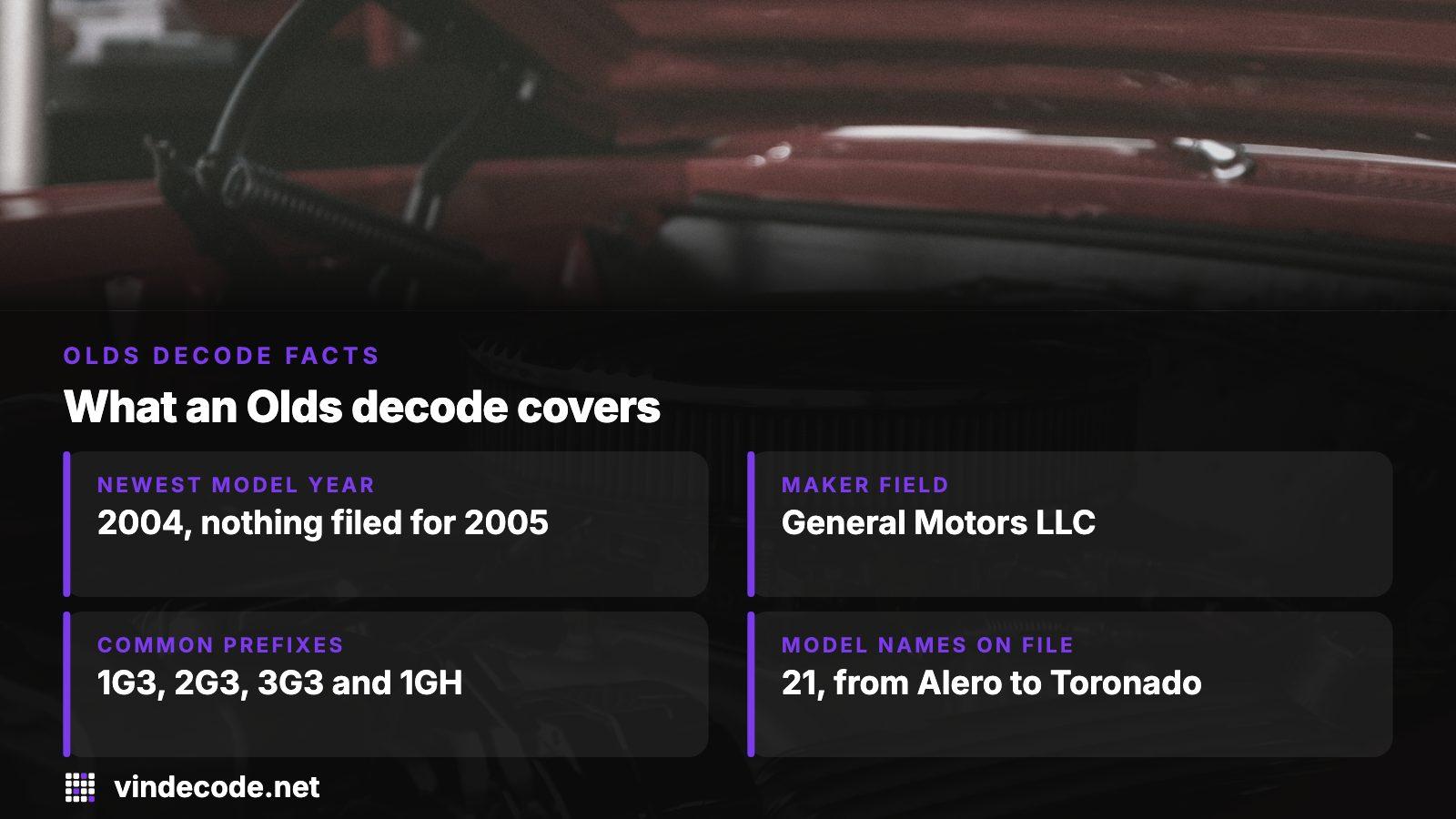
- Newest model year
- 2004, nothing filed for 2005
- Maker field
- General Motors LLC
- Common prefixes
- 1G3, 2G3, 3G3 and 1GH
- Model names on file
- 21, from Alero to Toronado
What an Oldsmobile decode shows and leaves out
A decoder matches your VIN against the patterns General Motors filed with federal regulators. What you get back is the car as the factory recorded it, a fast test of a seller's claims before you drive out to see it. It is only half of a purchase decision, so the table separates what it settles from what it cannot.
| Question | Answered by the decode? |
|---|---|
| Is this really an Intrigue, an Alero or a Bravada? | Yes, from the model field |
| Is the advertised year possible? | Yes, from the tenth character |
| Who is the manufacturer? | Yes, General Motors |
| Was it in a crash or flooded? | No, that is history data |
| Is the title branded or the mileage rolled back? | No, a history report covers it |
The prefixes that decode to Oldsmobile
Characters one to three point at the builder and where the car was assembled. Each partial number below was run through NHTSA's public decoder, and the table lists what came back.
| Prefix | Decoded make | Maker and vehicle type |
|---|---|---|
| 1G3 | Oldsmobile | General Motors LLC, passenger car |
| 2G3 | Oldsmobile | General Motors LLC, passenger car |
| 3G3 | Oldsmobile | General Motors LLC, passenger car |
| 1GH | Holden and Oldsmobile | General Motors LLC, multipurpose vehicle |
Do not assume that a VIN opening with 1G and ending its prefix in 3 belongs to an Olds. The neighbors 1G1, 1G2 and 1G4 return Chevrolet, Pontiac and Buick, and 4G3 and 6G3 decode to Chevrolet. Read the model field as well as the prefix.
Why your Olds decodes to General Motors
Oldsmobile was a division, and the federal database files it under the parent. Ask it which manufacturers filed under the Oldsmobile name and it returns nothing, while the make itself is listed with General Motors LLC as the manufacturer. General Motors holds 110 world manufacturer identifiers, so Olds codes are a small slice of a large list. The maker field showing GM is not a decoding fault or a sign that the car has been re-badged. It simply matches how the record is organized, and it points to the company that still exists.
Reading the year character on an Olds
Year of manufacture sits in character ten, written as a letter through 2000 and as a digit after it. Federal rules set the code, and for this brand the usable range runs from 1981 at the early end to 2004 at the late end.
| Tenth character | Model year |
|---|---|
| B | 1981 |
| L | 1990 |
| S | 1995 |
| X | 1999 |
| Y | 2000 |
| 1 | 2001 |
| 3 | 2003 |
| 4 | 2004 |
The letters start over after 30 years, so the code on a 1981 car is reused for a much newer one. No Oldsmobile can be that late. A listing whose tenth character points past 2004 contains a typo, a swapped plate or a story the seller needs to explain.
How the lineup shrank before the brand ended
The federal model list holds 21 distinct Oldsmobile names. How many were current in a given year changes a lot, and it helps to know what a plausible model looks like for the year on the title.
- 1981 and 1985: nine models each, led by the Cutlass family, Delta 88, Ninety Eight and Toronado
- 1995: eight models, now including Achieva, Aurora, Bravada and Silhouette
- 1999: nine models, with Alero, Intrigue and LSS on the list
- 2000: just four, Alero, Bravada, Intrigue and Silhouette
- 2003: four again, with Aurora in place of Intrigue
- 2004: three, Alero, Bravada and Silhouette, and none for 2005
If a 2004 listing decodes to a Cutlass Ciera, the numbers disagree and somebody should explain the mismatch before money changes hands.
When a decode comes back thin
Older patterns are not always complete in the federal data. A partial 1989 number returned the Oldsmobile make and year but a blank model, and the same happened with a 3G3 code on a 2003 pattern. The decoder's own notice says that a missing value means NHTSA lacks data, not that the feature is absent.
- Re-type the VIN from the plate and compare each character with the door-pillar label
- Remember that a check digit error means a typo or a doctored number, so recheck before assuming anything
- Ask the seller for the title and registration to confirm the same 17 characters
- Treat a blank model as a cue to look at the car itself and not a reason to guess
Photograph the plate through the windshield and the pillar label, then type the number from the photographs while you are still standing at the car.
Recall lookups and cars this old
NHTSA's VIN search shows only unrepaired campaigns, and its own page admits the gaps: repaired ones, and campaigns that predate the 15-year window, though a maker can choose to cover more. Every Oldsmobile is beyond that cutoff, so an empty result is weaker proof than it would be on a recent car. The model-level search is the better backstop. Searching by year and model also returns the recalls, investigations and complaints on file for that car.
From an NHTSA owner complaint
The owner of a 2001 Silhouette said the fuel tank failed and had to be replaced, and only afterward learned of a recall covering the same fault on the Chevrolet Venture. The company declined to repay the repair because the Oldsmobile was not named in that recall.
Sibling models share parts and may share faults, but only the recall notice settles who is covered. Run the VIN, then read the model's list too.
From an NHTSA owner complaint
The owner of a 2000 Alero with unreliable turn signals checked recalls for that fault and found their VIN missing from the list, even though others were on it.
Mileage and the history a decode cannot give
Under federal odometer rules, a 2010-or-older vehicle drops out of mileage disclosure when it changes hands a decade or more after its model year began. All Oldsmobiles qualify, so the seller may not be required to state the mileage on the title paperwork. The dash reading then carries little documentary weight, and service records matter more.
That is where a history report earns its place. For a car this old it can show title brands such as salvage or flood, damage and accident records, recorded odometer readings, auction listings with photographs, liens and theft records. A decode cannot reach any of that, and a clean-looking Olds can carry a brand from a state far away.
What it costs and the order to run checks
Entering the VIN brings up a free preview, no card needed. To see the records behind it, pay once for the Oldsmobile's report, or buy three, five or ten at a time if you are hunting several. Nothing recurs. See the pricing page for amounts.
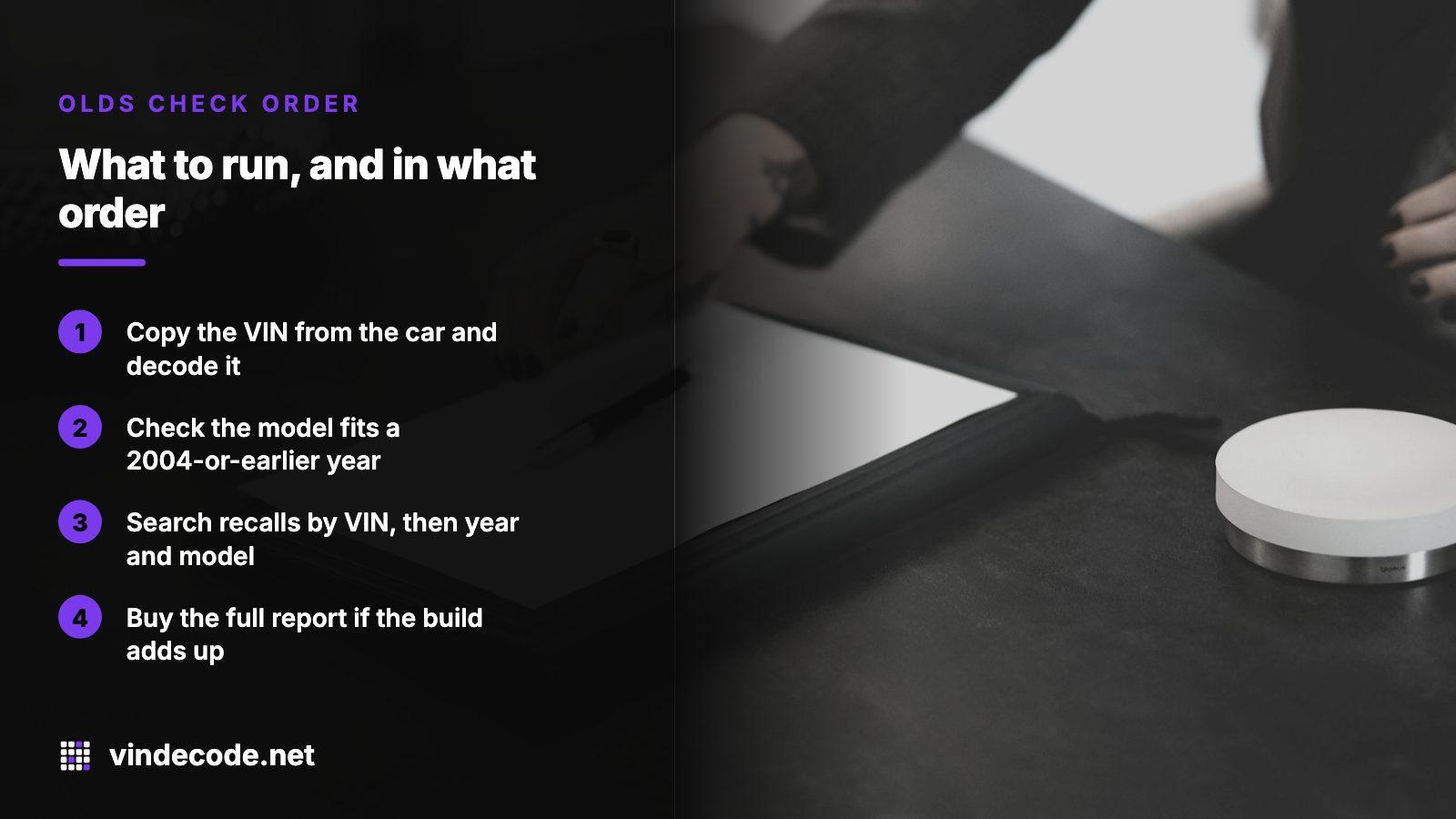
- Copy the VIN from the car and run the decode.
- Check that the model fits the year and that the year is 2004 or earlier.
- Search NHTSA by VIN, then by year and model, and note anything open.
- Look over the preview first, and buy the full report only when the build adds up.
- Have a mechanic you picked inspect the car before you pay.
Where this information comes from
- NHTSA vPIC: models filed for Oldsmobile — The list of model names behind the lineup notes, which you can re-run yourself.
- NHTSA vPIC: VIN decoding API — The decoder used for the prefix and partial-VIN results on this page.
- NHTSA: check for recalls — What the VIN recall search shows and omits, including the age cutoff.
- eCFR: 49 CFR 565.15 year codes — The table that assigns a letter or digit to each model year.
- eCFR: 49 CFR 580.17 — The age-based odometer disclosure exemption.
- NHTSA owner complaint 10254117 — owner experience, paraphrased
- NHTSA owner complaint 10870171 — owner experience, paraphrased
Sources and photos: Facts checked against the sources above in November 2026. Photos by Anshul Gurjar, Annika Wischnewsky and Victor Hughes on Unsplash; diagrams by VINDecode.
Keep reading
- GM VIN Decoder: Decode Any GM VIN, Then Check Its HistoryThe parent company's prefixes across every division, Oldsmobile included.
- Pontiac VIN Decoder: Read the Build, Then Check the HistoryAnother retired General Motors badge with the same maker-field quirk.
- Classic Car VIN Decoder: Which Years It Reads and What Comes AfterFor the oldest Olds, what a decode reads and where it runs thin.
- Sample reportA finished report, to see what the history adds after the decode.
Frequently asked questions
How do I decode an Oldsmobile VIN?
Type the full 17-character number into the box at the top of the page. The tool reads the pattern the maker registered and gives back the model, body, year and builder. Copy it off the metal on the car, never the ad, and check the dash plate against the pillar label.
What was the last Oldsmobile model year?
The federal model list shows 2004 as the newest year, with Alero, Bravada and Silhouette on file. A query for 2005 returns nothing. A VIN whose tenth character points to a later year is a typo or a discrepancy to settle with the seller.
Why does my Oldsmobile VIN say General Motors?
Oldsmobile was a General Motors division, and the federal register files the make under that manufacturer. No identifiers were filed under the Oldsmobile name itself. The decoder is reading the record correctly, and it names the company responsible for any recall.
Will an NHTSA recall search catch every recall on my Olds?
No. The VIN search skips repaired campaigns and, with a few exceptions the manufacturer controls, anything past the 15-year mark. Search by year and model as well, and read the notice for sibling models that shared parts.
Can a decode tell me if an Oldsmobile was wrecked?
No. A decode shows only how the car was built. Crash records, branded titles, auction past and logged mileage come from history data, so run the free preview on the same VIN before you decide whether to buy the report.
Now check the car itself
The guide explains what to look for. The report shows what this VIN has on record.