THE SHORT ANSWER
Enter all 17 characters of the Mitsubishi's number into the decoder. Mitsubishi has 22 manufacturer identifiers across 5 countries, so a J opening is common but not a given. You get model, year, body, engine, plant and vehicle type, and a truck code such as FE84D points to a Fuso. Title brands, crashes and mileage are not in the decode; the history preview covers them.
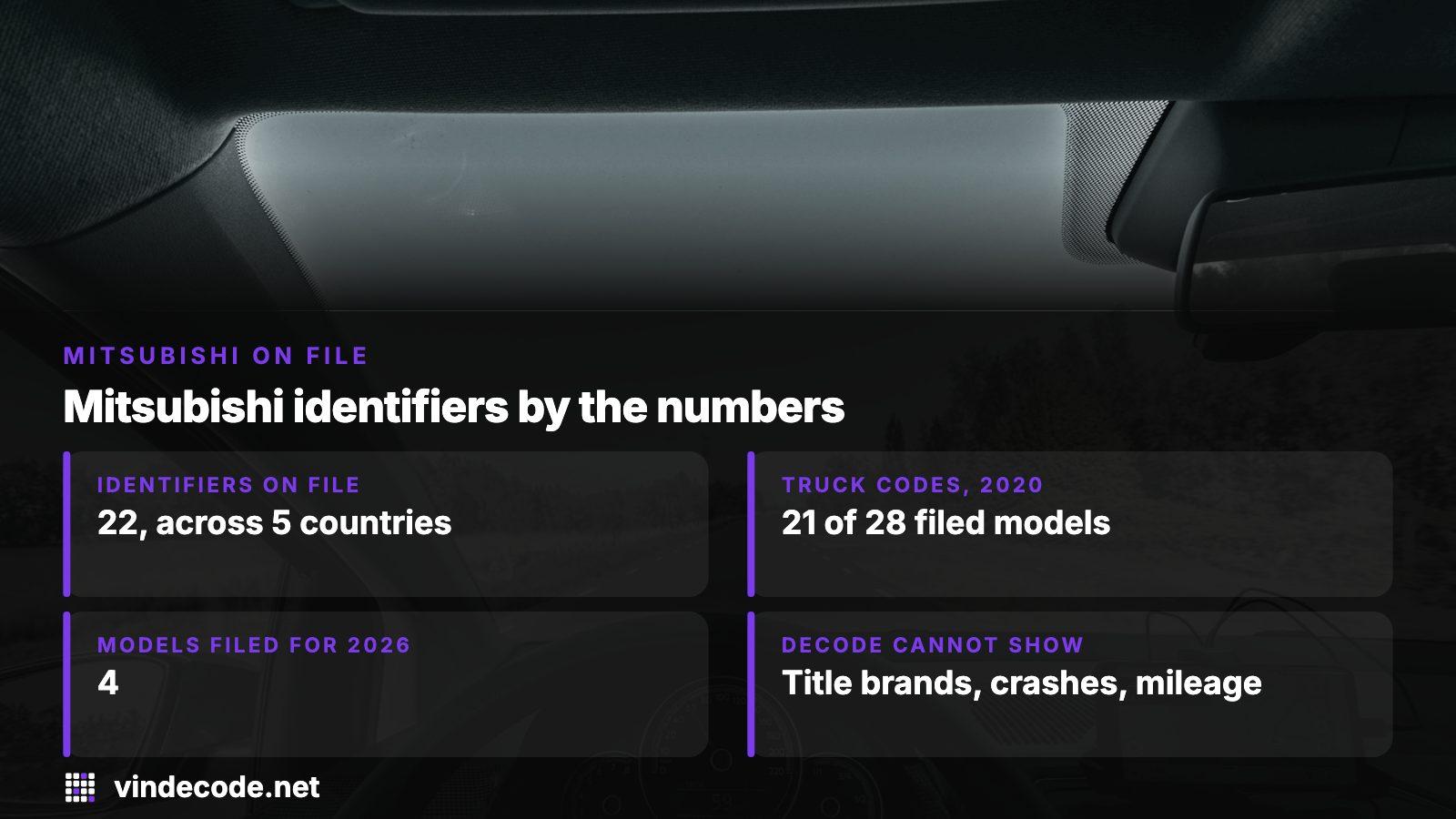
- Identifiers on file
- 22, across 5 countries
- Truck codes, model year 2020
- 21 of 28 filed models
- Models filed for 2026
- 4
- A decode cannot show
- Title brands, crashes, mileage
What a Mitsubishi decode puts on the screen
The decoder reads your number against the layouts Mitsubishi filed with NHTSA, so the answer is the factory's own description of the car. It is a sharp test for a listing and says nothing about the car's life since.
| Field returned | Use it to test |
|---|---|
| Make, model and model year | The headline of the ad and the paperwork |
| Body class and vehicle type | Whether you are looking at a car, an MPV, a truck or a bare chassis |
| Engine and drive | What the seller says is under the hood |
| Plant country and builder | The opening characters stamped on the car |
| Open safety recalls | A seller's claim that nothing is outstanding |
One name, two businesses: why a car VIN can decode as a truck
In the federal database the make Mitsubishi covers passenger cars and the Fuso commercial line. A decode that returns a model such as FE84D has worked as designed: the number belongs to the truck side. Commercial families are the model names starting FE, FG, FH, FK, FM or FT.
| Model year | Models filed | Of them, truck codes |
|---|---|---|
| 2000 | 15 | 8 |
| 2010 | 21 | 12 |
| 2020 | 28 | 21 |
| 2024 | 6 | 0 |
| 2026 | 4 | 0 |
The truck share climbed for two decades, then left the Mitsubishi filings altogether. On an older car, an unfamiliar model name is likelier a truck than a mistake. Fuso keeps identifiers of its own, described next.
The first three characters: not always a J
A common belief says every Mitsubishi VIN starts with J. The register disagrees: 22 identifiers, filed by 6 different companies, in countries well beyond Japan.
| Starts with | Built in | Filed by |
|---|---|---|
| J | Japan | Mitsubishi Motors Corporation, and Fuso for chassis |
| 4 | United States | Mitsubishi Motors North America |
| M | Thailand | Mitsubishi Motors Corporation and Mitsubishi Motors (Thailand) |
| 6 | Australia | Mitsubishi Motors Australia |
| T | Portugal | Fuso Truck Europe |
A Thai prefix is a plant location, not a gray-market warning, since the car was certified for sale here. Four of the 22 rows are incomplete vehicles, a bare cab and frame that a body builder completes as a box truck or tow truck. Three of those four belong to Fuso, so on a finished commercial body the VIN names a maker who did not build the body.
Working from half a number
Listing photos often crop the VIN, and some sellers send only the first part. NHTSA's decoder accepts a wildcard at the end. A test with eight characters and an asterisk, JA4J4UA8*, returned Mitsubishi, Outlander, the maker and the vehicle type, an MPV. In all, 44 of 154 data fields came back filled, and the response was marked incomplete rather than guessed.
Anything past the cut stays unknown: the year in position 10, the plant in position 11, the serial. Use a partial to judge whether an ad is plausible, then insist on the full number before any deposit.
Position 10 against the Mitsubishi lineup
Position 10 carries the model year, and on this make it rules candidates out. The 2026 filings list only four nameplates: Eclipse Cross, Outlander Sport, Outlander and a low-speed vehicle. Mirage and Mirage G4 appear for 2024 and not after.
| If position 10 reads | What the filings allow |
|---|---|
| A year from 2000 to 2020 | Cars plus a growing share of truck codes, so a truck result is likely, not a fault |
| 2024 | Six models filed, Mirage and Mirage G4 among them |
| Later than 2024 | Four models filed and no Mirage |
A listing that calls a car a Mirage while its tenth character points past 2024 has a problem, and the number is the side with a federal filing behind it. People misread that character more than any other, so read it twice.
Mismatches worth stopping for
Two older identifiers, JE3 and 4B3, are often tied to Mitsubishi-era cars, yet each decodes with Chrysler as the common name. The opening characters name whoever filed the identifier, which can differ from the badge.
| The decode shows | What it may mean | Next move |
|---|---|---|
| A truck code on a car listing | The number belongs to the Fuso side, or the ad is wrong | Decode the number printed on the vehicle itself |
| A Mirage with a year after 2024 | The ad and the number cannot both be right | Trust the number and ask the seller to explain |
| Windshield and door-frame numbers differ | A clerical slip or a swapped part | Pause the deal until the seller explains in writing |
Recalls follow number ranges, and records follow the dealer
Open safety recalls are matched to the VIN, and the dealer repairs them at no charge, however old the car or how many hands it has passed through. A lookup describes what is open today and says nothing about repairs made before.
From an NHTSA owner complaint
The owner of a 2018 Eclipse Cross filed a complaint in 2025 about warning lights, locked steering and brakes, and the car shutting down on the road. The owner says the recall for that fault covered other VINs but not theirs, and a dealer fixed it anyway without paperwork. That dealership closed, the manufacturer's case number lapsed after a year, and the next dealer found no history.
The partial VIN on that record begins JA4, one of the Japanese multipurpose-vehicle identifiers in the register, and decodes as a 2018 Eclipse Cross. The number was never in doubt; the paper trail was. Keep every repair order, because a VIN lookup shows what is open, not who fixed what.
What the history report adds after the decode
A decode shows the car as built. Collisions, title brands and mileage readings sit in other records filed under the same VIN, and the history report gathers them:
- Title brands, salvage or rebuilt among them
- Accident and damage records
- Odometer readings from earlier years
- Salvage and auction entries, with photos
From an NHTSA owner complaint
The owner of a 2016 Lancer filed a complaint in 2024. The car was bought pre-owned, showed just over 107k miles, and began losing power, hesitating and dropping into limp mode. A shop suggested a new transmission. Nobody could say whether the fault had appeared before or whether the recall work was done, although a VIN search showed no unrepaired recalls. The owner called the replacement out of reach.
That record's partial VIN starts JA3, the Japan passenger-car identifier, and decodes as a 2016 Lancer sedan. A clean recall lookup shows what is open today, not what the car has been through. Before paying for a pre-owned Mitsubishi, look at the title, odometer and damage records that a decode cannot supply.
Running the check, and what it costs
- Stand at the driver's door, look down through the glass at the dash corner, then check the label on the door frame. Both must match.
- Enter all 17 characters and compare model, year, vehicle type and plant with the listing.
- Read the vehicle type first: car, MPV, truck or incomplete vehicle.
- Run the recall lookup before price comes up.
- Open the history preview for the car, and buy the report only if the car still looks right.
Opening the preview costs nothing. A report is bought once, for a single car or as a bundle of 3, 5 or 10, and no plan renews afterward. The pricing page lists the amounts.
Where this information comes from
- NHTSA vPIC: identifiers filed by Mitsubishi — The 22 filed identifiers with their companies, countries and vehicle types.
- NHTSA vPIC: models filed by make and year — The per-year model census behind the truck-code table.
- 49 CFR Part 565: VIN requirements — The federal rule for the 17 positions and the manufacturer identifier.
- NHTSA: recalls lookup — Open-recall search by VIN, with repairs at no cost to the owner.
- NHTSA owner complaint 11682572 — owner experience, paraphrased
- NHTSA owner complaint 11618499 — owner experience, paraphrased
Sources and photos: Facts checked against the sources above in November 2026. Photos by Wesley Tingey, Dimitri Karastelev and Sander Jeurissen on Unsplash; diagrams by VINDecode.
Keep reading
- VIN Decoder: Decode a VIN Number Online, Then Check Its HistoryAll 17 positions of a VIN explained, including the check digit in position 9.
- NHTSA VIN Decoder: What It Returns, Where It Stops, What Comes NextHow the federal database behind this decode is built and what it returns.
- Chrysler VIN Decoder: Pacifica, Voyager and 300 BuildsThe marque that two older identifiers on this page decode to.
- Sample reportA finished history report, to see what comes after the decode.
Frequently asked questions
How do I decode a Mitsubishi VIN?
Copy all 17 characters from the car, not the ad, and enter them in the decoder. It reads the layout Mitsubishi filed with NHTSA and returns model, year, body, engine, plant and vehicle type. An error usually means a mistyped character.
Why did my Mitsubishi VIN return a truck model?
Probably because it belongs to the Fuso commercial line, which the federal database files under the same make. In model year 2020, 21 of the 28 models filed were truck codes, so a result like FE84D is the other half of the name, not a broken lookup.
Do all Mitsubishi VINs start with J?
No. The J stands for Japan, but cars built in the United States open with a 4, Thai cars with M, Australian ones with 6 and Portuguese-built Fuso trucks with T. A car starting ML or MP is a regular Mitsubishi made in Thailand.
Which Mitsubishi models are in the 2026 filings?
Four entries: Eclipse Cross, Outlander Sport, Outlander and a low-speed vehicle. Mirage and Mirage G4 show for 2024 and drop out after, so a Mirage whose tenth character reads later than 2024 does not add up.
Can a decoder show accidents or a salvage title on a Mitsubishi?
No. A decode is the factory record, so crashes, title brands and odometer history never appear in it. Open the free history preview to see whether any exist, and buy the report only if you want the detail.
Now check the car itself
The guide explains what to look for. The report shows what this VIN has on record.