THE SHORT ANSWER
To decode a Chrysler VIN, enter all 17 characters in the box above. The first three name the maker and plant country: 1C3 is a US-built Chrysler car, 2C3 a Canadian one, and 2C4 or 2A4 a Canadian-built minivan. Characters 4 to 8 describe model, body and engine, 10 is the model year and 11 the plant. A decode covers the build, not the car's life since. Accidents, title brands and mileage need a history report.
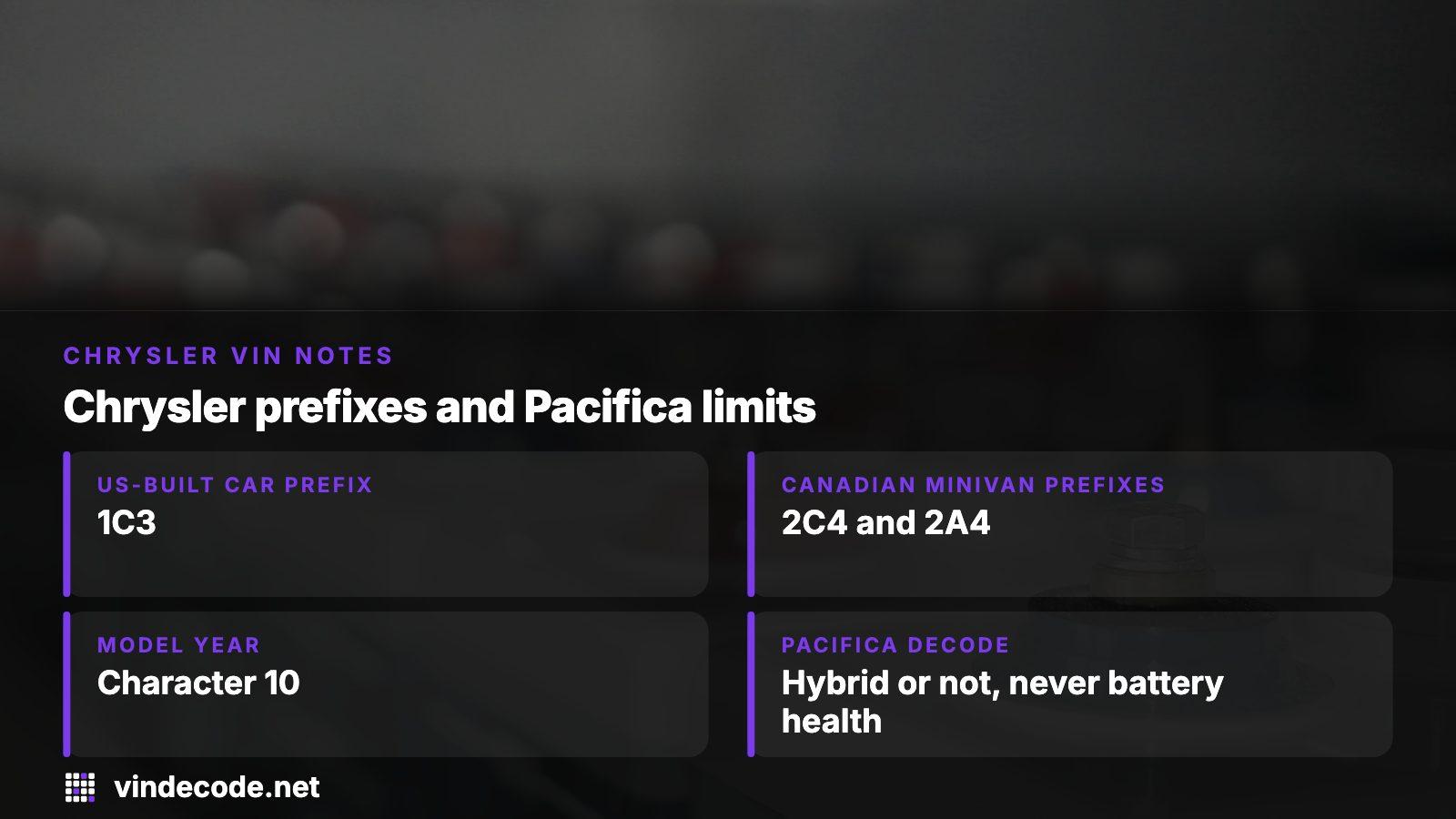
- US-built car prefix
- 1C3
- Canadian minivan prefixes
- 2C4 and 2A4
- Model year
- Character 10
- Pacifica
- Decode shows hybrid or not, never battery health
What the decoder reads back for a Chrysler
Chrysler sells a short range, and most of it rests on engineering shared with Dodge, Jeep and Ram, so the badge says less than usual. The decoder reads the record the manufacturer filed under your VIN with NHTSA and tells you which build you have.
- Year, model and body type
- Displacement, cylinders and fuel: gasoline, or a plug-in hybrid system
- Which wheels are driven
- Airbag and belt hardware
- Country and plant of assembly
Damage, owners and mileage fall outside it, since those sit in separate records.
Reading the VIN off the car
Take the number from the vehicle itself, because a typo in an advert returns an error or a different car. Photograph the plate and the sticker so you can recheck the digits at home.
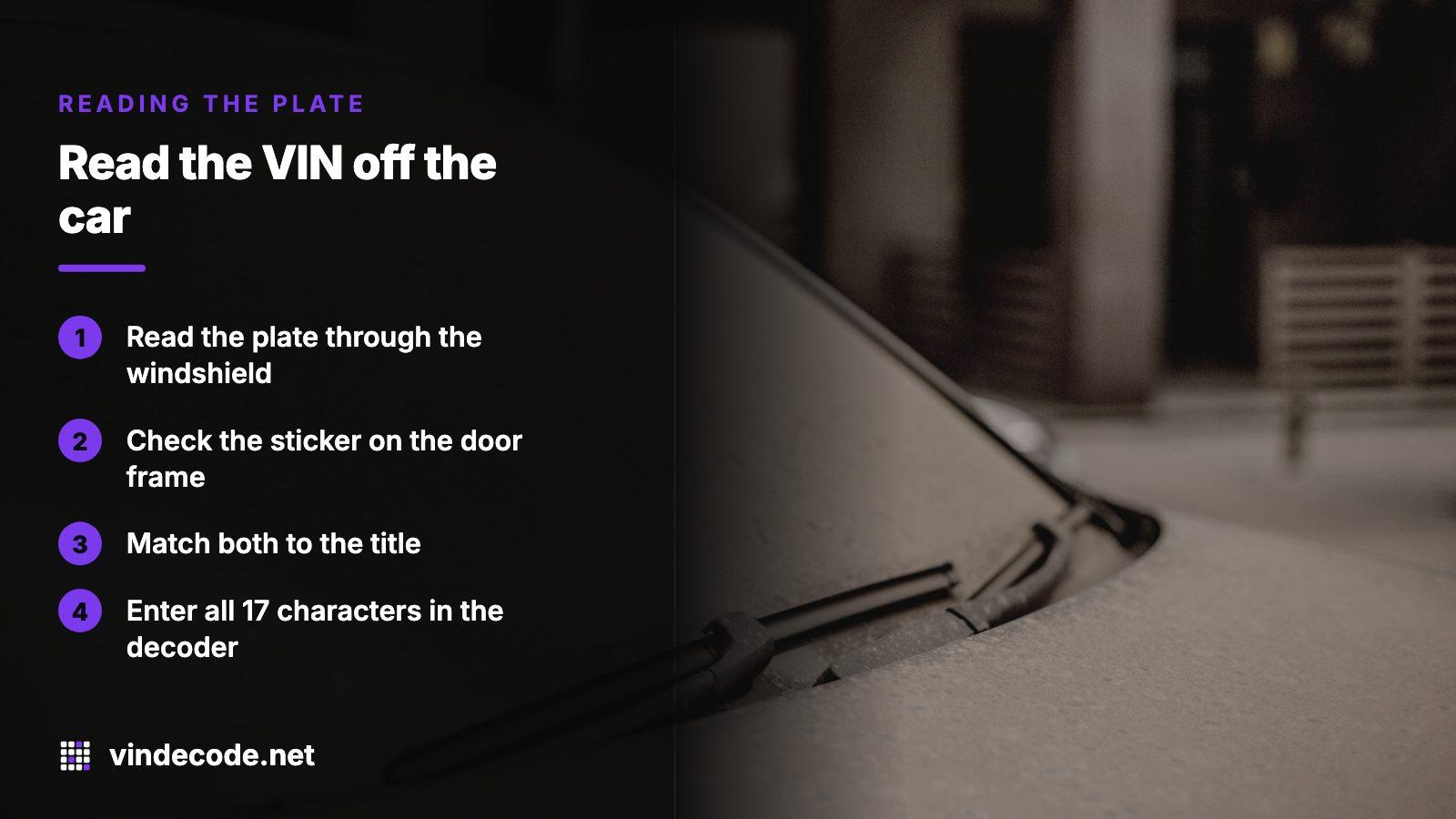
- Crouch at the driver's side and read the plate through the lowest edge of the windshield.
- Check the sticker on the door frame.
- Match both to the title, character by character.
- Enter all 17 characters in the decoder above.
Numbers that disagree end the price talk until the seller explains.
Reading the 17 characters, prefix first
The prefix is three characters long and is called the world manufacturer identifier. It names the builder and the country of assembly, and Chrysler buyers meet four families of it.
| Prefix | Meaning |
|---|---|
| 1C3 | Chrysler car, US assembly |
| 2C3 | Chrysler car, Canadian assembly |
| 2C4 or 2A4 | Chrysler minivan (a multipurpose vehicle), Canadian assembly |
| 3C4 | Chrysler vehicle, Mexican assembly |
A 2 at the front of a Pacifica or Voyager VIN is normal
Chrysler has long built its minivans in Canada. A prefix you cannot place proves nothing either way, since the group holds many codes across its brands. Decode the whole number and read what returns.
The rest follows one layout. Characters 4 to 8 hold the maker's descriptor for model, body and engine, and character 9 is a check digit that exposes a mistyped number. Then come the model year at 10, the plant at 11 and a serial from 12 to 17. Let the decoder translate the descriptor, since it is a private code.
Pacifica: find out which powertrain you are buying
Chrysler has offered the Pacifica with a gasoline engine and as a plug-in hybrid, and used, they are different cars to own. The decode names the powertrain your VIN was built with, so you can sort the listings before you drive anywhere.
No VIN says how the battery has aged. That single unknown moves a plug-in's price more than anything else, and a hybrid that never saw a charger hauled its extra weight for nothing. Put these to the seller:
- How often was it charged, and with what equipment?
- Was the traction battery ever serviced or replaced?
- What hybrid and battery coverage is still running, and does it follow the van to a new owner? A dealer can answer. A decode and a history report do not show warranty status.
- Does the electric range on the dash match the EPA figure for that model year?
- Is the charging cable included, along with any wall unit?
Checking a listing against the decode
Set the advert beside the decoder's answer. Some claims the decode settles on the spot, and others live elsewhere.
| Listing claim | What the decode settles | Where the rest lives |
|---|---|---|
| Plug-in hybrid Pacifica | Whether the VIN was built as one | Seller and dealer, for battery health |
| All-wheel drive | Which wheels the factory drove | A test drive |
| A given model year | The year filed for the VIN | Title and registration |
| Fully loaded trim | Body and engine only | The factory build record |
| Low mileage | Nothing | Odometer readings in a history report |
| Never in a crash | Nothing | Damage, salvage and auction records |
The 300 and the Dodge hardware under it
Under the 300 sits a rear-drive platform that its Dodge counterpart also uses. They are separate models with separate identifiers, styling and trims, yet much of the machinery overlaps. Research by engine and platform, not by model name alone, and the pool of documented faults, service intervals and parts prices grows.
| Area | Effect on a Chrysler buyer |
|---|---|
| Parts | Mechanical parts often fit several brands in the group, so supply is wider and prices can be lower. |
| Fault research | A defect logged against a Dodge, Jeep or Ram with your engine is a lead to follow on the Chrysler. |
| Servicing | Independent shops that work on group hardware are an alternative to dealer rates. |
| Trim and interior | Model-specific, so expect Chrysler prices. |
Minivan wear and the dealer's build record
A minivan is built to carry people and cargo, and wear from that work shows at the sliding doors, the hardware that folds the rear seats and the suspension.
Trim names also hide variation: seating, entertainment gear, safety packages and towing content can all differ inside one trim. The parts counter at a Chrysler dealer can pull the factory build record for the VIN, which lists what the van was delivered with. The decoder and the history report do not produce it, so ask before negotiating. Features the van has that the record lacks were fitted later.
Recalls attach to the VIN
A recall applies to a VIN range, so reading about a model settles little about the car in front of you. When a shared component is at fault, the group tends to issue campaigns for several brands in parallel, which makes a headline about a Dodge a prompt to check your Chrysler, not proof. NHTSA's lookup takes the exact VIN and charges nothing. An open recall is fixed by the manufacturer at no cost to the owner, whoever holds the title now.
What the history report adds
The report searches other records under the same VIN, and for a used Chrysler these are the ones that move the price.
| Record | What it shows |
|---|---|
| Title brands | Whether the title has ever been branded |
| Accidents and damage | Whether and where the car was hit |
| Odometer readings | Whether readings rise steadily or jump backward |
| Salvage and auction | Any auction sale, with photos |
| Liens and impounds | A lender's claim or an impound record |
| Theft and insurance | A stolen report or an insurance record |
| Recalls, use and value | Open recalls, how it was used, who owned it, market value |
A 300 can decode exactly as advertised and still have passed through an auction after a crash. The decode matches car to listing, and the report covers what came after.
Cost, and an order that suits a used Chrysler
The preview after you enter a VIN is free and needs no card. The full report is paid once, as one report or a bundle of 3, 5 or 10, and nothing renews. Amounts are on the pricing page.
- Decode the VIN from the car, noting whether a Pacifica is gas or plug-in.
- Request the dealer's build record and check each option against the van.
- On a plug-in, factor battery coverage and charging history into your offer.
- Run NHTSA's lookup on the exact VIN for recalls.
- Read the preview, and buy the report only if the car still fits.
- Have a mechanic of your choosing inspect it before you pay.
Where this information comes from
- NHTSA: vPIC VIN decoder — The federal database where manufacturers file how their VINs are built, behind the model, engine and plant fields.
- NHTSA: recalls lookup — Checks one VIN for open recalls, which the manufacturer repairs without charge.
- EPA: fueleconomy.gov — Official economy and electric range figures by configuration, handy for testing a Pacifica seller's claims.
Sources and photos: Facts checked against the sources above in November 2026. Photos by Bence Balla-Schottner, JavyGo and Vanya Smythe on Unsplash; diagrams by VINDecode.
Keep reading
- Dodge VIN Decoder: Hellcat Trim Checks and Pre-2013 Ram PickupsThe Dodge side of the platform the 300 shares, with its own prefixes.
- Jeep VIN Decoder: Read a Wrangler, Gladiator or Compass BuildAnother brand in the same group, decoded the same way.
- VIN Decoder: Decode a VIN Number Online, Then Check Its HistoryHow all 17 positions read on any make.
- Sample reportA finished report, to see what the history adds after the decode.
Frequently asked questions
How do I decode a Chrysler VIN?
Enter all 17 characters in the decoder above. Chrysler files its VIN structure with NHTSA, so model year, model, body, engine, drivetrain and plant come back. Copy the number from the car: the plate at the driver's corner of the windshield, or the sticker on the door frame.
Will a VIN show if a Pacifica is a plug-in model?
It will. The decode reports which powertrain the van was built with, so a plug-in hybrid separates from the gasoline model. Battery condition and charging habits stay invisible, and they drive most of the price, so put those questions to the seller.
Are the Chrysler 300 and the Dodge Charger one car?
No. Each has its own identifier, styling and trim levels, but both are built on a common rear-drive platform with overlapping hardware. A fault, service interval or parts price found under one badge can apply to the other, so research by engine.
Does decoding a Chrysler VIN show accidents or recalls?
Not by itself, because a decode reads the factory build and nothing later. Accidents, title brands and mileage records come from a history report. NHTSA's lookup checks open recalls against the exact VIN, and the report lists open recalls too.
Where do I get the factory build record for a Chrysler?
A dealer parts department can retrieve it by VIN. It lists the options the vehicle was delivered with, so it is the reliable test of equipment claims, since trim badges prove nothing. The decoder and the history report do not supply it.
Now check the car itself
The guide explains what to look for. The report shows what this VIN has on record.