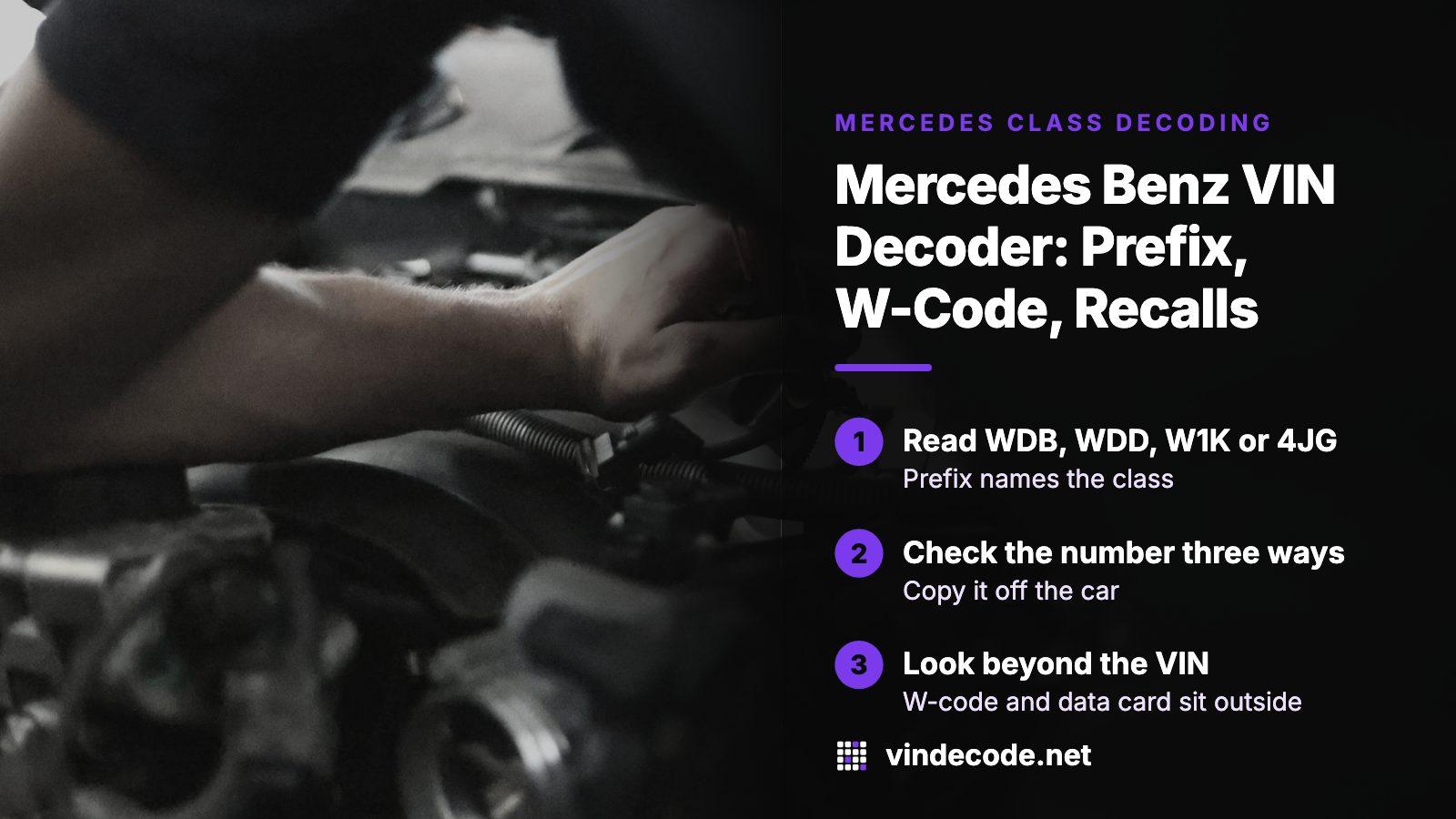
THE SHORT ANSWER
To decode a Mercedes-Benz VIN, enter all 17 characters. The result gives the year, model, body, engine, drivetrain, plant and open recalls, and the first three characters show whether the vehicle is a car, an SUV or van, a truck or a bare chassis. The W-code and the full option list are not in the VIN. Crashes, brands and mileage come from a history report, and its preview is free.
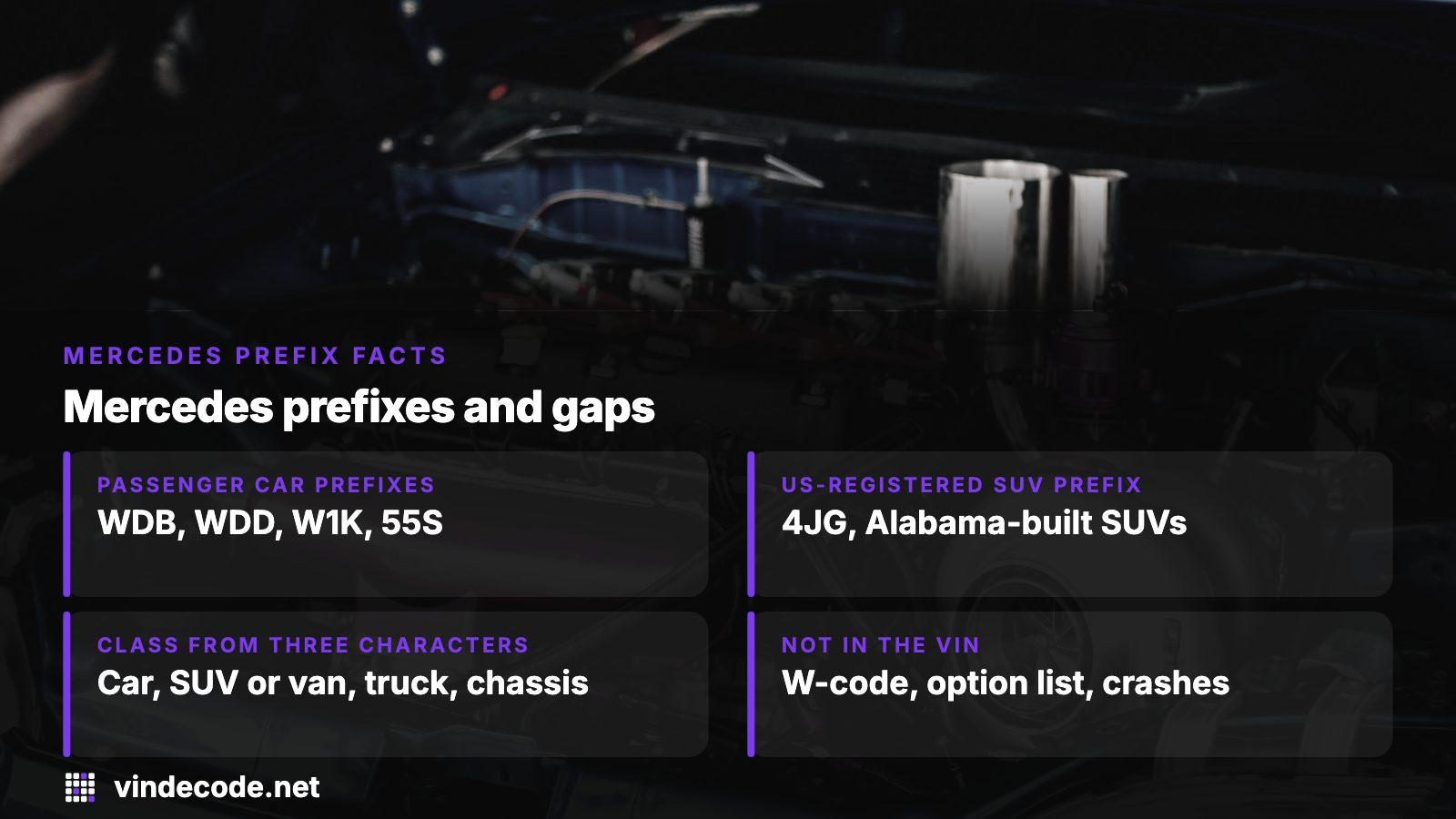
- Passenger car prefixes
- WDB, WDD, W1K, 55S
- US-registered SUV prefix
- 4JG, Alabama-built SUVs
- Class from three characters
- Car, SUV or van, truck, chassis
- Not in the VIN
- W-code, option list, crashes, mileage
What a Mercedes Benz VIN decoder puts on the screen
The decode comes from the layout Mercedes-Benz filed with NHTSA's vPIC database, so it is the one description of the car that the seller did not write. Check each line against the advert.
| Decoder line | What it settles |
|---|---|
| Year, model, body style | Whether the car is the generation and shape described |
| Engine and fuel | Which engine to research before the inspection |
| Drivetrain | Rear drive or all-wheel drive, as built |
| Prefix class | Car, SUV or van, truck, or bare chassis |
| Plant | Germany or Alabama, and so which prefix to expect |
| Open recalls | Repairs still owed on that exact VIN |
WDB, WDC, 4JG and the rest: the prefix names the class
Mercedes-Benz holds many manufacturer identifiers, each registered against a vehicle class, so three characters say what kind of vehicle you have. The classes below come from the federal register's own record for each prefix.
| Prefix | Class in the federal record |
|---|---|
| WDB | Passenger car, with Mercedes-Benz and Maybach both in the make field |
| WDD, W1K, 55S | Passenger car |
| WDC, W1N | Multipurpose passenger vehicle (SUVs and crossovers) |
| 4JG | Multipurpose passenger vehicle, held by the North American company |
| WD4 | Multipurpose passenger vehicle, with Freightliner also in the make field |
| WD3 | Truck |
| W1X | Incomplete vehicle, a chassis for another company to finish |
Alabama is where Mercedes builds several of its SUV models, hence 4JG. That car is not a gray import or a lesser build. WDB also covers Maybach, so Mercedes-Benz on that prefix cannot prove a grander badge was misdescribed.
Copy the number off the car, then check it three ways
One wrong character gives an error or a different vehicle, so work from the metal, not the listing.
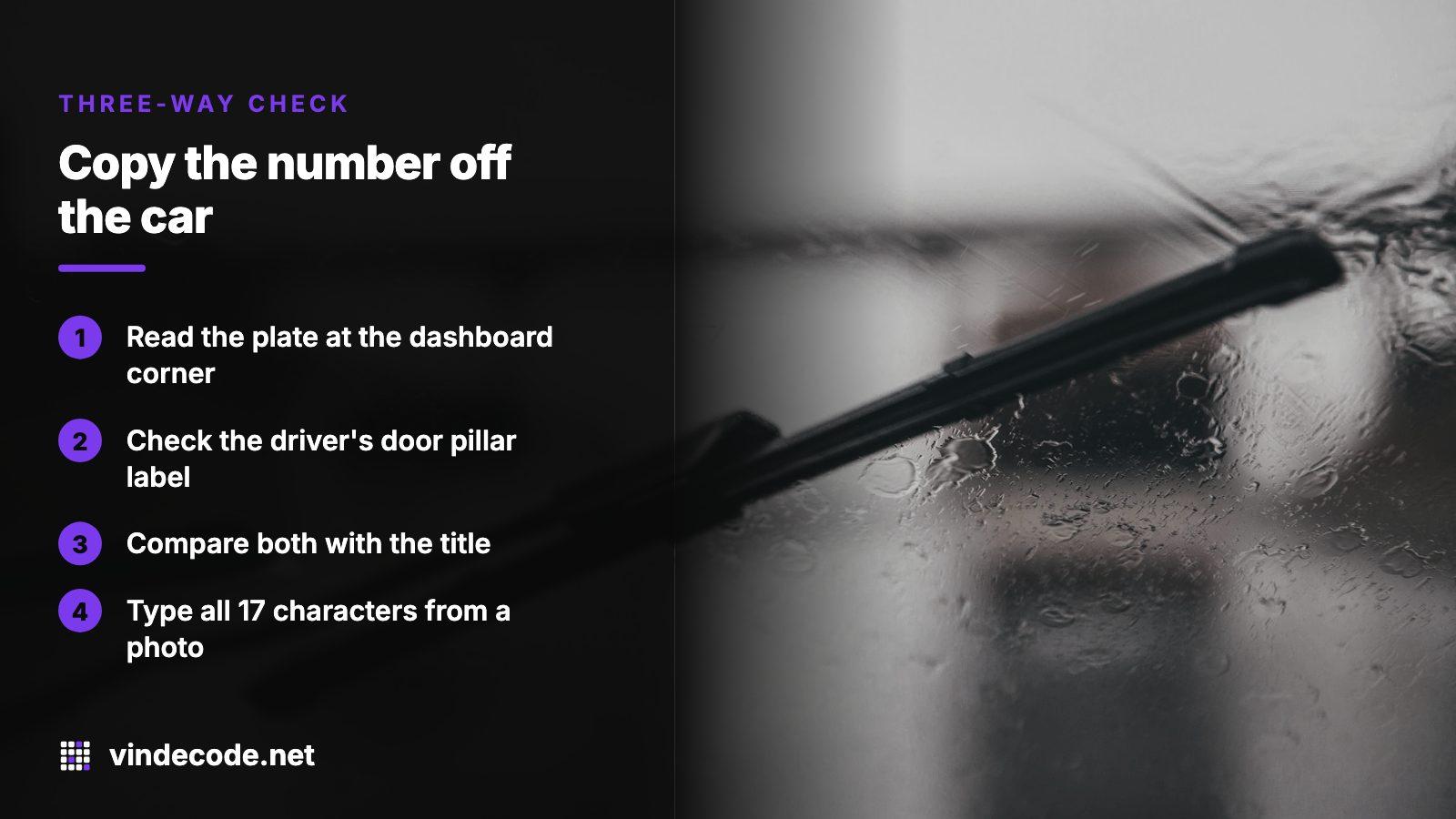
- Stand outside and read the plate on the dashboard corner nearest the steering wheel.
- Check the label on the driver's door pillar. It should agree with the plate.
- Compare both with the VIN on the title or registration.
- Type all 17 characters from a photo, then read the decoded lines one by one.
Characters four through eight hold model, body and engine, and the ninth is a typo-catching check digit. The year sits in the tenth and the assembly plant in the eleventh.
The W-code and the data card sit outside the VIN
Take the C-Class: the W204 car and the W205 car that followed it share little, because parts, service procedures and known faults follow the chassis code, not the model name. R marks the roadsters, the R129 among them. None of these codes is printed in the VIN, so decode for model and year, map the pair to a generation, and research that.
| Record | What it describes | Where it comes from |
|---|---|---|
| VIN | One car: title, insurance, recalls | The car itself |
| W-code | One generation: parts and fault research | Follows from model and year |
| Data card | Every factory option on one VIN | A Mercedes dealer |
The data card is the factory build record. A dealer's parts or service desk can pull it from the VIN, often at no charge. Walk the car with the list in hand: anything in the advert that has no code on the card was fitted later.
Engine codes, air suspension and the bills the build predicts
The decode names the engine and drivetrain, and both set the running costs. Engines carry Mercedes family names, M codes for gasoline and OM codes for diesel, so ask for the code and research it.
- Air suspension rides superbly while sound and costs a great deal once it fails, so check early whether the car is fitted with it.
- All-wheel drive means an extra driveline to maintain.
From an NHTSA owner complaint
A 2008 E550 buyer told NHTSA that the car, bought at about 100,000 miles after an inspection called it well kept, lasted seven days. The dashboard demanded a stop because the car was too low, it sagged within an hour of parking, and the compressor kept running without lifting it. The dealer said the fix could run a few thousand dollars, on a car that had cost about 20,000 dollars. The owner's verdict: a "great vehicle with a huge flaw".
Take from this that the build record settles whether a car has the system, and a repair belongs in the offer before the deal.
Vans, bare chassis and euro-spec cars: half a record
Some Mercedes vehicles were finished by another company. A W1X prefix means an incomplete vehicle: Mercedes supplied chassis and powertrain, and a second company built the camper body or service bed. The decode reads the chassis only.
- Look for a second certification label from the finisher, which may have set the weight ratings.
- Service records can sit with both firms, and a recall can come from either.
Euro-spec cars are the other case, since Mercedes varies lighting, emissions equipment, instrument calibration and options by market. Most reach the US through the twenty-five-year import route or after federalization. Both are legal, but they affect parts, emissions testing and insurance, so ask for the entry paperwork.
After the decode: open recalls, then the history behind the car
A recall applies to certain VINs, not to a model name, so run the exact number through NHTSA's lookup. The maker repairs it without charge for any owner, so an open recall means a dealer appointment, not a bill.
Past the recall, the decode stops: a salvage brand, a crash, a wound-back odometer or a lien is not in the number. Read these history report parts closely:
- Title brands, and odometer readings over the car's life to test the dash mileage
- Crash and damage records, and auction or salvage photos
- Liens, impounds, theft and insurance entries, in case another party has a claim on the car
- Use type and market value, to test the price against the decode
What the history report costs
Type the VIN into the box at the top and a preview loads before any payment is requested. That preview is free. The report itself is one payment per vehicle; if you are weighing several cars, bundles of 3, 5 or 10 exist. No subscription is involved and nothing bills again. The pricing page shows current costs for each option. A decode that contradicts the advert can end the deal before you spend a cent.
The order that suits a used Mercedes
- Decode the VIN and note the class the prefix gives.
- Match engine, drivetrain and plant to the advert.
- Map year and model to the W-code, then ask a dealer for the data card.
- Run the recall lookup on the same VIN.
- Open the history preview, and buy the report once the build holds up.
- Book a Mercedes specialist to inspect the car.
From an NHTSA owner complaint
Another owner described a 2010 E-Class bought in 2017 with roughly 100,000 miles on it. It seemed fine until both rear air suspension units gave out near 120,000 miles; they were replaced. About a year on, both fronts collapsed on the highway while the owner drove home from the airport. A red light said to pull over, and the front sat so low that the wheels could not turn.
Ask the specialist to test the suspension, and price a replacement into your offer.
Where this information comes from
- NHTSA: vPIC VIN decoder — The federal database where Mercedes-Benz files how its VINs are laid out, behind the model, engine and plant lines of a decode.
- NHTSA: manufacturer identifier lookup — Returns the make, registering company and vehicle class for any three-character prefix, the basis of the class table.
- NHTSA: recalls lookup — Where a VIN is checked for open recalls, which the manufacturer repairs at no cost to the owner.
- NHTSA owner complaint 10667948 — owner experience, paraphrased
- NHTSA owner complaint 11281658 — owner experience, paraphrased
Sources and photos: Facts checked against the sources above in November 2026. Photos by Mustafa Sheikhmouss, Thibault Valjevac and Willian Cittadin on Unsplash; diagrams by VINDecode.
Keep reading
- VIN Decoder: Decode a VIN Number Online, Then Check Its HistoryAll 17 positions explained, including the check digit and the year character.
- NHTSA VIN Decoder: What It Returns, Where It Stops, What Comes NextHow the federal decoder behind these results works, and where it stops.
- BMW VIN Decoder: Decode the Build and Spot a Real M CarThe German rival, with its own prefixes and an M-car check.
- Sample reportA finished report, to see what the history adds after the decode.
Frequently asked questions
How do I use a VIN decoder for a Mercedes Benz?
Copy all 17 characters off the car itself, enter them in the VIN box on this page, and read what comes back: year, model, body, engine, drivetrain, plant and class. Compare each line with the listing and the title, and ask about any mismatch.
What does the WDD at the start of a Mercedes VIN stand for?
The W marks Germany, and the next two characters name Mercedes-Benz and the vehicle class. WDD is registered for passenger cars, as are WDB and W1K. A prefix you have not seen before on a real Mercedes is no cause for alarm: decode it.
Does the VIN show my Mercedes chassis code, such as W212?
No. Chassis codes like W205, W212 and R107 name a generation, and the VIN never prints them. The decode returns model and year, and that pair points to the code. Parts catalogs and specialist workshops use the code, so look it up next.
Will a Mercedes VIN decoder show accidents, mileage or brands?
No. A decode describes the build and open recalls only. Crashes, salvage brands, odometer readings, liens and theft come from history records. A preview of the history costs nothing, and the full report is bought once, so you can decide after the decode.
Can a decode show that a Mercedes is a European-market import?
Only indirectly: a specification that no US-market car had is the hint. Ask how the car arrived and what entry papers came with it, then match the number to the title. Imports are legal, but they can change parts sourcing, emissions testing and insurance.
Now check the car itself
The guide explains what to look for. The report shows what this VIN has on record.