THE SHORT ANSWER
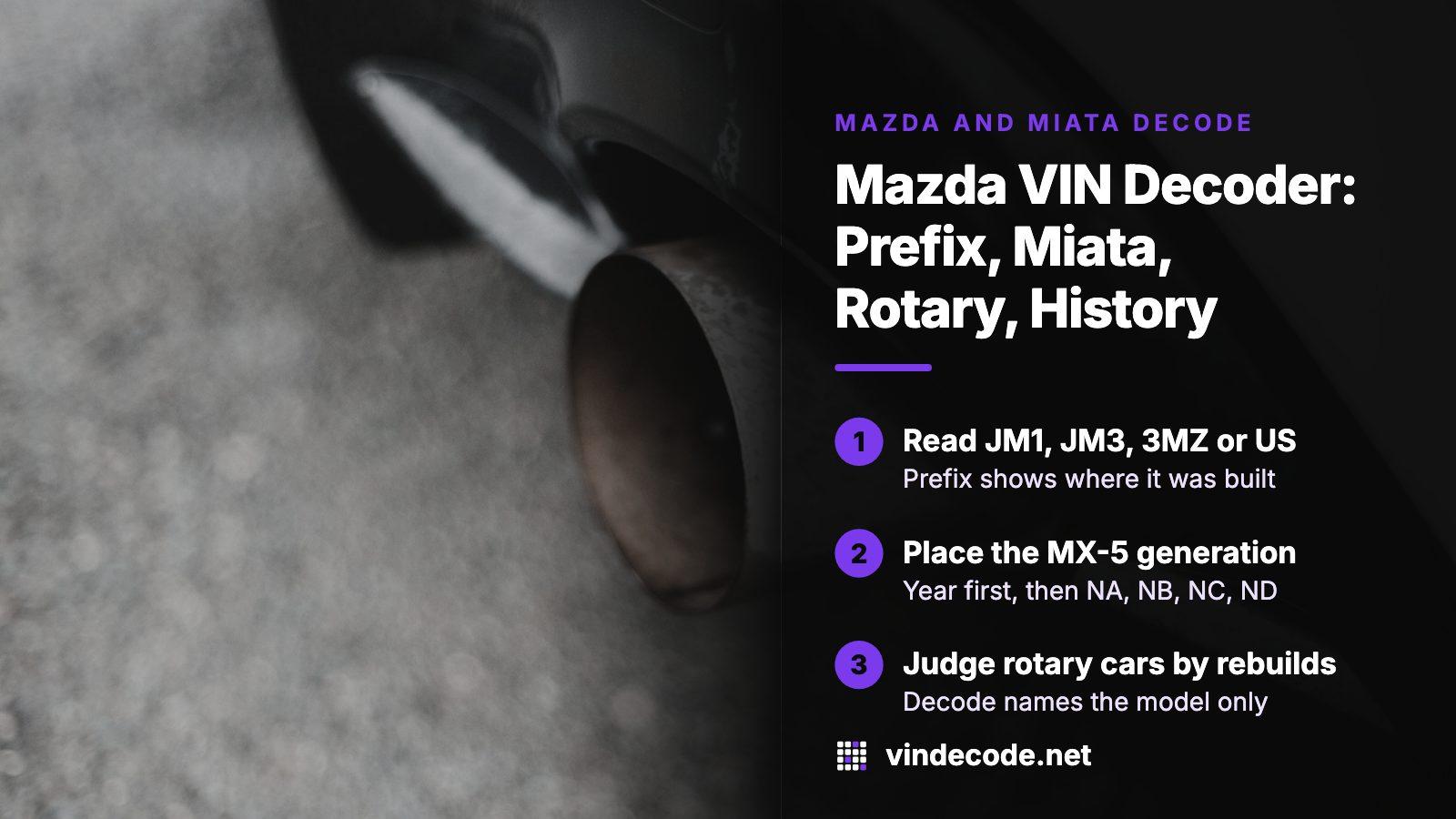
Put the full 17-character VIN through the decoder on this page for the model, year, engine, drive and plant. A JM1, JM3, 3MZ or US prefix is normal on a Mazda. Use the tenth character to place an MX-5 in its generation, and treat any RX as a rotary. Crashes, title brands and mileage are not in a decode, so open the history preview before paying.
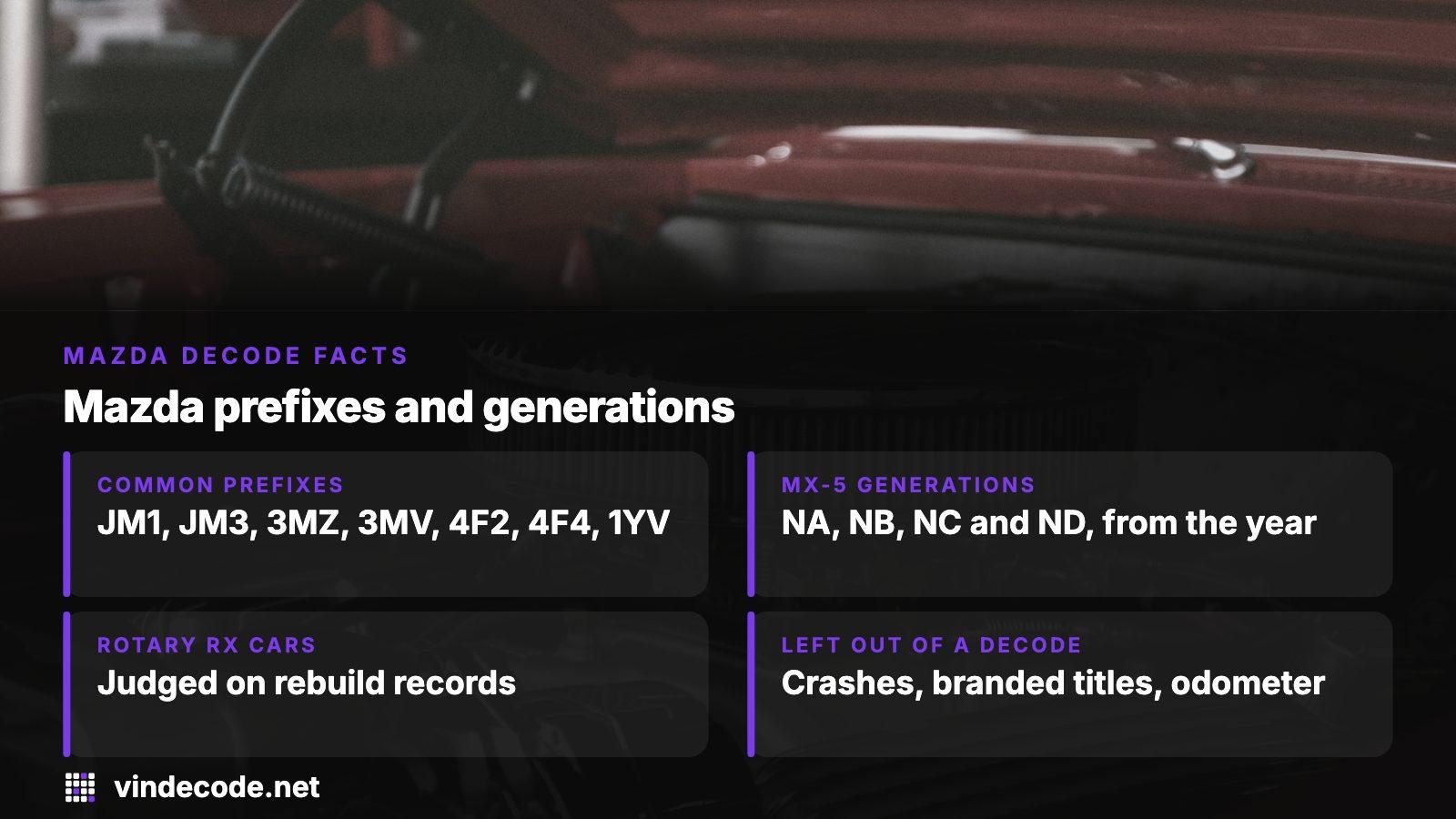
- Common prefixes
- JM1, JM3, 3MZ, 3MV, 4F2, 4F4 and 1YV
- MX-5 generations
- NA, NB, NC and ND, found from the model year
- Rotary RX cars
- Judged on engine rebuild records, not the decode
- Left out of a decode
- Past crashes, branded titles, odometer history
What a Mazda decode puts on screen
Mazda registered its VIN pattern with NHTSA's vPIC database, and the decoder reads yours against it. The answer is the car in factory form, which no advert can rewrite. A listing that says all-wheel drive over a decode that says front-wheel is your first question for the seller.
- Model, year and body style
- Engine size, cylinders and fuel
- Which wheels the engine drives
- Assembly country and plant
- Open recalls recorded for that VIN
Skyactiv is Mazda's name for engines and chassis work phased in over time. The decode names the engine family, and the model year shows the stage. Most Skyactiv gasoline engines use direct injection, so ask if the intake was ever cleaned of deposits.
Reading the number off the car
Start at the car, since a listing can carry a typo or worse. Crouch outside the driver's door, read the plate through the windshield, then check the label on the door frame. Plate, label and title must agree, and any mismatch is a question for the seller. Position ten encodes the model year and position eleven names the plant. A check digit in position nine lets decoders flag many typing errors, so if the result looks wrong, reread the characters first.
JM1, JM3, 3MZ, 4F2, 1YV: where the prefix says it was built
The opening three characters say who made the car and in which country. Mazda has built cars in Japan, Mexico and the United States, so a prefix that is not Japanese tells you nothing bad. NHTSA's registry lists the common ones this way.
| Prefix | Built in | NHTSA lists |
|---|---|---|
| JM1 | Japan | Passenger car |
| JM3 | Japan | Multipurpose vehicle |
| 3MZ | Mexico | Passenger car |
| 3MV | Mexico | Multipurpose vehicle |
| 4F2 | United States | Multipurpose vehicle, maker shown as Ford |
| 4F4 | United States | Truck, maker shown as Ford |
| 1YV | United States | Passenger car, maker shown as Auto Alliance |
A maker name that differs from the badge looks odd but is usually fine. The real warning runs the other way: a car sold as a Mazda whose VIN decodes to another make, or a body that does not fit the decoded model.
MX-5 generation: the year first, then the label
Parts sellers, forum threads and classified ads sort the MX-5 by generation code, and the code predicts fitment better than a model year. The VIN does not carry it. Position ten gives you the year, and this table turns the year into a generation.
| Code | Built | Spot it by |
|---|---|---|
| NA | 1989 to the late 1990s | Retractable headlights, the original |
| NB | Late 1990s to the mid 2000s | Fixed headlights, an updated NA |
| NC | Mid 2000s to the mid 2010s | Bigger than the NB |
| ND | 2015 onward | Smaller and lighter again |
Cars from a changeover year can land either side of a line, so confirm against the body. A general search on Miata problems mixes three very different decades of cars.
Rotary RX cars: the decode names the model, not the engine's wear
A rotary engine has no pistons. Apex seals sweep along the housing to hold the combustion in, and they wear in a way piston rings never do. A rebuild is therefore an expected event in rotary ownership, not a sign of abuse, which turns the usual used-car rule upside down. The decode says the car is an RX. Only records say when the engine was last opened.
- Get the date of the last rebuild and the name of the shop.
- Ask for a recent compression test, the key health check.
- Expect extra oil use; it comes with the design.
- Ask what warm-up and shut-down routine the owner followed.
- Locate a rotary specialist near you first.
From an NHTSA owner complaint
A 2004 RX-8 owner, who bought the car used from a dealer, told NHTSA it flooded with fuel on starting unless it ran until the temperature gauge reached halfway. A Mazda dealer ran the VIN, reported the related recall was already done, and said warming the engine up was the only remedy. The owner feared raw fuel and heat.
How a rotary was started and stopped is on no VIN record, so ask for invoices.
Road salt, rust and a recall that follows the car's address
On an older Mazda, structural rust outranks mechanical wear, because cutting out rotten steel rarely pays. Check the rear arches and sills, and on an MX-5 the rocker panels and frame rails. Fresh underseal on an old car deserves suspicion.
NHTSA's recall records back this up. A campaign for 2011 to 2013 Mazda6 cars covers a front cross member that can corrode after road salt exposure, limited to cars sold or ever registered in a belt of states including New Hampshire, Massachusetts, Ohio and Wisconsin. Where a car lived is part of its VIN-level risk.
From an NHTSA owner complaint
A 2011 Mazda6 owner, who bought the car used from a private seller, found a recall through a VIN search and took the car in for the repair. Told by the dealership that the body was "corroded beyond repair", the owner could not get the work done, and called it a major manufacturing flaw.
Ask where the car has been registered, then check the answer against the underside.
Open recalls: check before the deposit
A recall is written for a span of VINs, not a whole model, so a model-level search can list campaigns that miss your car and skip one that hits it. NHTSA's lookup answers for the exact VIN at no charge, and the maker repairs it free whoever owns the car now.
From an NHTSA owner complaint
In 2017 the owner of a 2014 CX-5 told NHTSA that, after buying it from a dealer, they learned of an open safety recall. They say the dealer never raised it, and Mazda reported the part was unavailable with no date given. Children ride in the car.
An open recall is a negotiating point, not an automatic no. Ask when the part arrives, or price in the wait.
Where the decode ends and the history report begins
A VIN records construction, nothing after it. A salvage brand, an unreported crash, a wound-back odometer or a loan still on the title leaves no trace in the number. Those live in title, damage, mileage and lien records, which a history report gathers for the VIN.
| Question about the Mazda | Where to look |
|---|---|
| Which MX-5 generation, or an RX? | The decode plus the model year |
| Rotary rebuild history | Service invoices, compression test |
| Rust underneath | Your own inspection |
| Flood, salvage or other title brand | History report: title records |
| Mileage that adds up | History report: odometer readings |
| Money still owed on the car | History report: lien records |
Anything the seller left out, or mileage that dips between two readings, merits a written explanation before you pay.
What it costs and which checks come first
The preview is free, and no card is needed to open it. The full report is paid for once, singly or in 3, 5 or 10 at a time, and no subscription follows. See the pricing page for amounts.
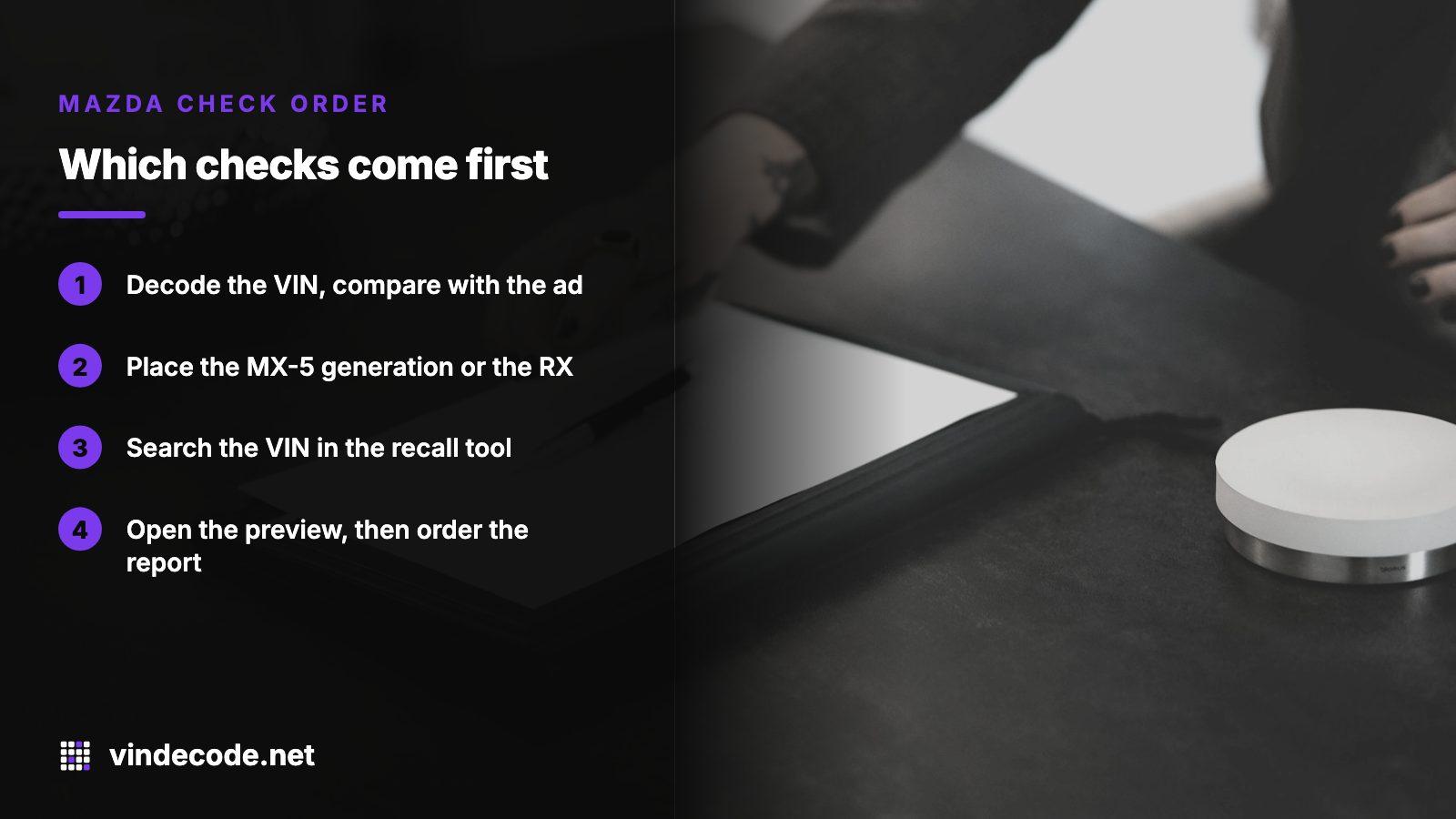
- Decode the VIN and compare the result with the ad.
- Place the MX-5 generation or confirm the RX model.
- Search the VIN in NHTSA's recall tool.
- Open the preview; order the full report if the car has passed everything above.
Where this information comes from
- NHTSA: vPIC VIN decoder — The public database where Mazda files its VIN structure and manufacturer codes, which the decode reads.
- NHTSA: recalls lookup — Open-recall check by VIN, with repairs done free of charge by the manufacturer.
- NHTSA: 2011 Mazda6 recall records — Lists the front cross member corrosion campaign and the states it covers.
- NHTSA owner complaint 10275887 — owner experience, paraphrased
- NHTSA owner complaint 11533800 — owner experience, paraphrased
- NHTSA owner complaint 10978527 — owner experience, paraphrased
Sources and photos: Facts checked against the sources above in November 2026. Photos by Erik Mclean, Annika Wischnewsky and Victor Hughes on Unsplash; diagrams by VINDecode.
Keep reading
- Ford VIN Decoder: Decode a Ford VIN, Then Check Its HistorySome US-built Mazda prefixes name Ford as the maker, so Ford's own codes are worth knowing.
- VIN Decoder: Decode a VIN Number Online, Then Check Its HistoryEvery VIN position walked through, check digit included.
- NHTSA VIN Decoder: What It Returns, Where It Stops, What Comes NextHow the federal database behind these results works.
- Sample reportA finished report, to judge what the history adds to a decode.
Frequently asked questions
How do I use a Mazda VIN decoder?
Enter the full VIN in the decoder on this page, then read the model, year, engine, drive and plant it gives back. One wrong character decodes a different car or throws an error, so take the number from the vehicle.
What does a JM1 prefix mean on a Mazda?
JM1 is the code for a Mazda passenger car built in Japan. US-market Mazdas also carry Mexican codes such as 3MZ and United States codes such as 1YV and 4F2, so a prefix that is not Japanese is common.
How do I find my Miata's generation?
Decode the VIN, take the year from position ten and match it to NA, NB, NC or ND. Years at a changeover are ambiguous, so compare headlights and body with photos before buying parts.
Is a rotary Mazda a bad buy?
Not by default, but it is a different kind of purchase. Rotary seals wear differently from piston rings, so a documented rebuild by a specialist is a point in the car's favor. The risk is an RX that comes with no engine history.
Will the decode reveal crashes or odometer problems?
No. A decode covers the build only, so crashes, title brands and odometer readings sit outside it. They turn up in damage, title and mileage files that a history report assembles. Decode first to confirm the car, then open the free preview to see what the report would add.
Now check the car itself
The guide explains what to look for. The report shows what this VIN has on record.