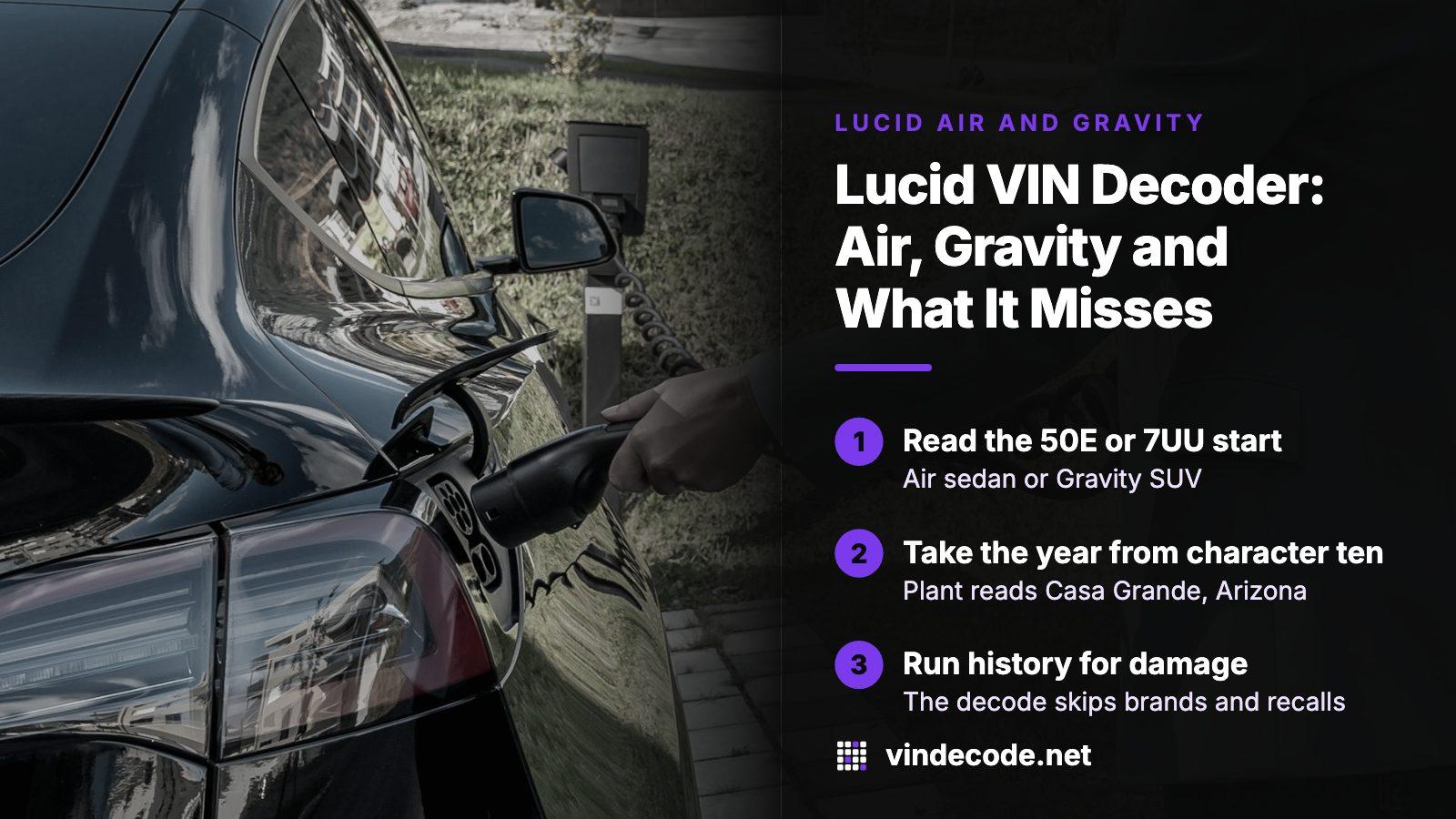
THE SHORT ANSWER
To decode a Lucid VIN, enter all 17 characters in the decoder on this page. A VIN starting 50E is a Lucid Air sedan and one starting 7UU is a Gravity SUV. Character ten gives the year, and the plant is Casa Grande, Arizona. The decode will not show accident damage, a title brand or open recalls. Run the history preview for those.
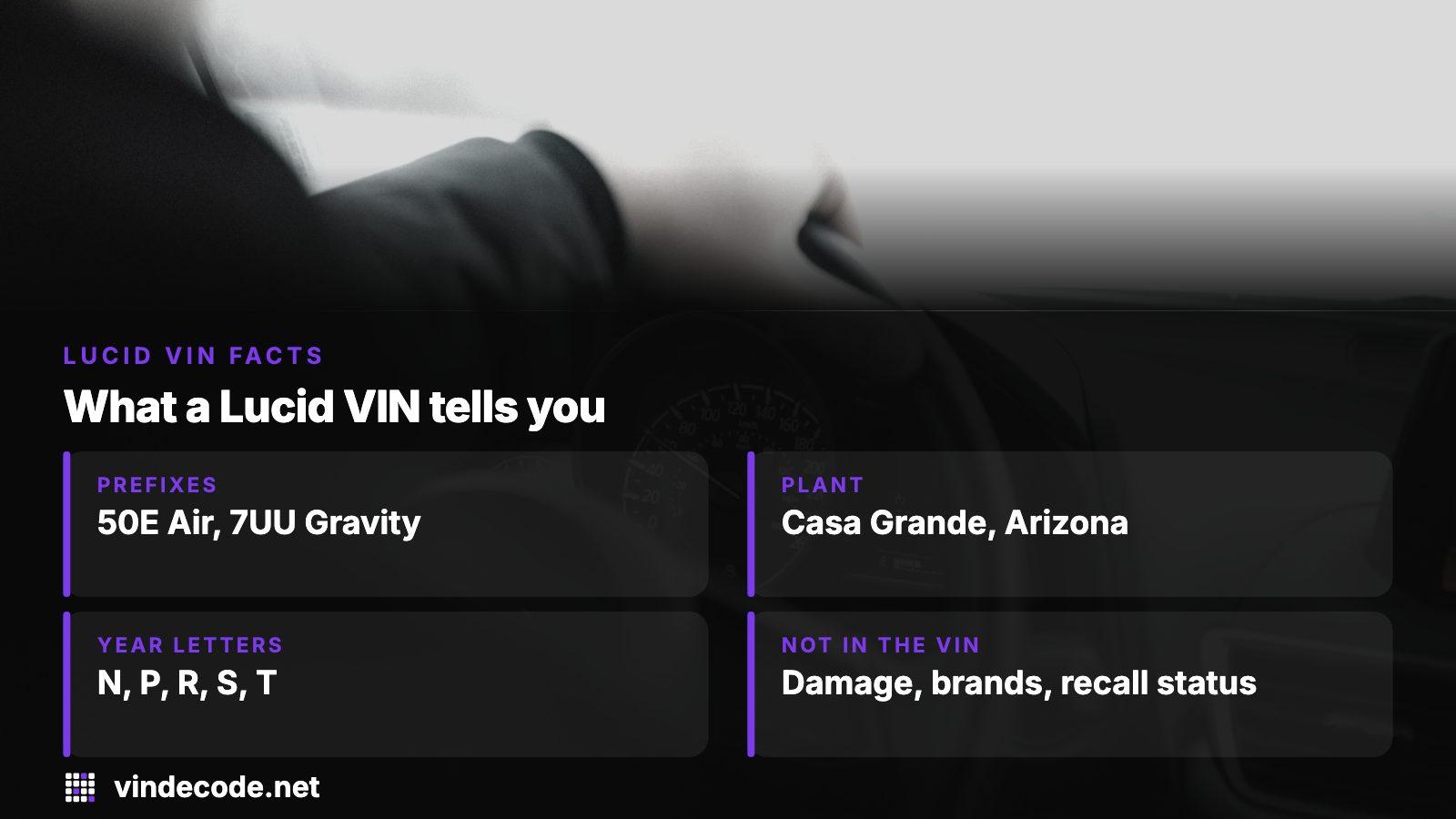
- Prefixes
- 50E for the Air sedan, 7UU for the Gravity SUV
- Plant in every decode
- Casa Grande, Arizona
- Year letters seen
- Position ten runs N, P, R, S, T across the model years 2022 to 2026
- Not in the VIN
- Damage, title brands, recall status
What a Lucid decode puts on screen
The tool reads your VIN against the patterns Lucid filed with NHTSA. What comes back describes the car as built, so use it as the first filter on a listing. If an advert says Grand Touring and the decode says Pure, you have a question for the seller before any test drive.
- Model year and model line, Air or Gravity
- Trim name, such as Pure, Touring, Grand Touring or Dream
- Body class: a four-door sedan, or an SUV
- Electric as the fuel
- Assembly plant, city and state
- A weight class, on most rows from 2023 on
Copy the number from the car itself or the signed title, not from the listing. One wrong character gives you an error or a different car, so recopy before you blame the tool.
50E, 7UU and the tenth character
NHTSA lists two manufacturer codes for Lucid USA. The code 50E was filed in 2021 as a passenger car, and 7UU was added in November 2024 as a multipurpose passenger vehicle, which is how the Gravity is classed. The table shows decodes of the first eleven characters from VINs that owners typed into NHTSA complaints.
| Decoded vehicle | Starts with | Trim returned | Weight class |
|---|---|---|---|
| 2022 Air | 50EA1 | Grand Touring | Blank |
| 2023 Air | 50EA1 | Pure | Class 2E |
| 2024 Air | 50EA1 | Touring | Class 1D |
| 2025 Air | 50EA1 | Pure | Class 1D |
| 2026 Air | 50EA1 | Grand Touring | Blank |
| 2026 Gravity | 7UUG1 | Touring | Class 2F |
All 63 distinct prefixes we ran decoded to Casa Grande, so the plant will not separate one car from another. The tenth character did the dating, stepping through the letters N, P, R, S and T as the model years moved from 2022 to 2026.
Where the decode goes quiet
Several fields came back empty on every row. Drive type was always blank, so the decode cannot tell you whether an Air is rear-wheel or all-wheel drive, and that matters later in this page. The 112.00 kWh battery figure showed up on 2022 rows only. Treat those blanks as gaps in the filing, not as a missing part.
Partial matches happen too. One 2023 prefix returned the model line and year but no body, fuel or trim, and its fifth character differed from the other Touring rows. When a result looks thin like that, suspect a mistyped character first and compare against the plate on the dash.
Check the sticker as well
Trim, drive layout and options are what the seller advertises. Match the decode to the door-jamb label and the on-screen vehicle information, and ask for anything that disagrees in writing.
Recall counts and why scope matters
NHTSA's feed shows 22 distinct Lucid campaigns so far. By model year, the 2022 Air carries 15, the 2023 Air 12, the 2024 Air 9, the 2025 Air 7 and the 2026 Air 4, while the Gravity shows 2 for 2025 and 3 for 2026. The subjects range from a front strut snap ring to drive-power loss, wiper arms, rear-camera software and a lighting circuit that could overheat.
A model-year list is only a starting point. Some campaigns apply only to Air Pure rear-wheel drive cars, others only to cars running certain software versions or equipped with a particular package. Lucid's own lookup takes a VIN and says its recall data begins on 2022-02-16, so use it, or NHTSA's VIN search, instead of reading the year table and guessing.
From an NHTSA owner complaint
The owner of a 2022 Air wrote that the dash warned "Defroster not Available" and the defroster stopped working. They linked it to defroster campaign 24V011000, yet the owner's VIN sat outside that recall's list of affected cars. The dealer confirmed the fault and it stayed unrepaired. The lesson: being on a model-year list neither puts your VIN in a campaign nor shows a fault was ever repaired.
Damage and title history, the part a decode skips
A VIN decode is built from a manufacturer's filing, so it holds nothing about the life of the specific car. Collision repairs, a salvage or total-loss brand on the title, odometer readings, liens and theft records live in other records, including the federal title system NMVTIS, a federal database aimed at title fraud and cars that are unsafe or stolen.
From an NHTSA owner complaint
An owner of a 2022 Air described a side impact at a left turn in which the air bags did not deploy. Nobody was hurt, but a month after the car went to an independent shop, they were told it was a total loss, at 7,495 miles. A repaired car like this can reach the market, and no decoder would flag it. That is reason enough to pull the title and damage record, however low the odometer reads.
Low mileage on an electric car is not reassurance. Ask for the title in hand, then run the report.
Running the check on a Lucid you are considering
- Write down all 17 characters from the Lucid and from the title, then confirm both agree.
- Decode them here and compare trim and model year with the listing.
- Search the same VIN on Lucid's recall page or NHTSA's lookup for open campaigns.
- Open the history preview for brands, damage and odometer entries.
- Buy the full report only if the preview and the decode agree with the seller.
Lucid also sells certified pre-owned cars, and its page says those come with clean titles and verified service histories. A private seller or independent lot offers no such promise, which is why steps three and four matter more there.

Reading the report next to the decode
Hold the decode up against the history rather than treating them as separate answers. A trim mismatch is worth a question. A title brand or an airbag-related damage entry on a car with very few miles should end the conversation or reprice it. Cars that show a repair after a crash deserve a close look at the structure, restraints and high-voltage system by a qualified shop.
Remote access is a last point to settle. Lucid's remote access page says turning off data sharing in the car disconnects remote vehicle access but does not cancel the Connectivity Services account, so ask the seller to clear their phone's link before you pay.
What the report costs
The free preview shows whether this Lucid's VIN has any records worth paying to open. Unlocking the full report is a single charge covering one vehicle. Packs exist if you are choosing among a few Lucids, and nothing renews. Today's amounts sit on the pricing page.
For a car this expensive to repair, a single report is a small step compared with an inspection or a title problem found after registration.
Where this information comes from
- NHTSA: vPIC VIN decoder — The public catalog where Lucid's VIN patterns sit and where these decodes were run.
- NHTSA: Lucid manufacturer codes — Lists the 50E car code and the 7UU multipurpose-vehicle code.
- NHTSA: recalls API for the 2022 Air — Campaign summaries and remedies behind the counts by model year.
- Lucid: vehicle recall lookup — The maker's VIN-based recall search and its start date.
- VehicleHistory.gov: NMVTIS — The federal title-record system behind vehicle history reports.
- NHTSA owner complaint 11762241 — owner experience, paraphrased
- NHTSA owner complaint 11656717 — owner experience, paraphrased
Sources and photos: Facts checked against the sources above in November 2026. Photos by smart-me AG, Alejandro Escamilla and Miles Loewen on Unsplash; diagrams by VINDecode.
Keep reading
- Tesla VIN Decoder: Plant Letter, Motor Line and What the VIN Won't ShowAnother electric brand, with plant letters and software limits.
- Rivian VIN Decoder: R1T and R1S Decodes, Recalls and Ownership TransferAn electric truck and SUV maker, with its own recall and ownership quirks.
- NHTSA VIN Decoder: What It Returns, Where It Stops, What Comes NextHow the federal database behind these decodes works.
- PricingWhat the report costs: one payment, or a pack, no subscription.
Frequently asked questions
How do I decode a Lucid VIN?
Enter all 17 characters in the decoder on this page. You get model, year, trim, body and plant. If it errors or returns very little, recheck each character against the car or the title, since a single wrong one changes or breaks the answer.
Which characters separate an Air from a Gravity?
The first three. NHTSA files 50E as a Lucid passenger car code and 7UU as a multipurpose passenger vehicle code, and the decodes we ran matched: Air sedans began 50E and Gravity SUVs began 7UU.
Can a Lucid VIN decoder show recalls?
No, a decode describes the build. Recalls are searched by VIN on NHTSA's tool and Lucid's recall page, and some campaigns apply only to certain drive layouts, software versions or equipment, so a list by model year can mislead.
Does the decode tell me if an Air has rear-wheel or all-wheel drive?
Not in the rows we ran, where drive type came back blank every time. Confirm the layout with the seller, the car's own screens and the window label, especially because a few recalls apply only to Pure rear-wheel drive cars.
Will a decoder show if a Lucid was in a crash?
No. Crash damage and title brands sit in title and insurance records, not in the manufacturer's VIN patterns. Run the history preview to see whether the VIN carries any of those records before you pay for the full report.
Now check the car itself
The guide explains what to look for. The report shows what this VIN has on record.