THE SHORT ANSWER
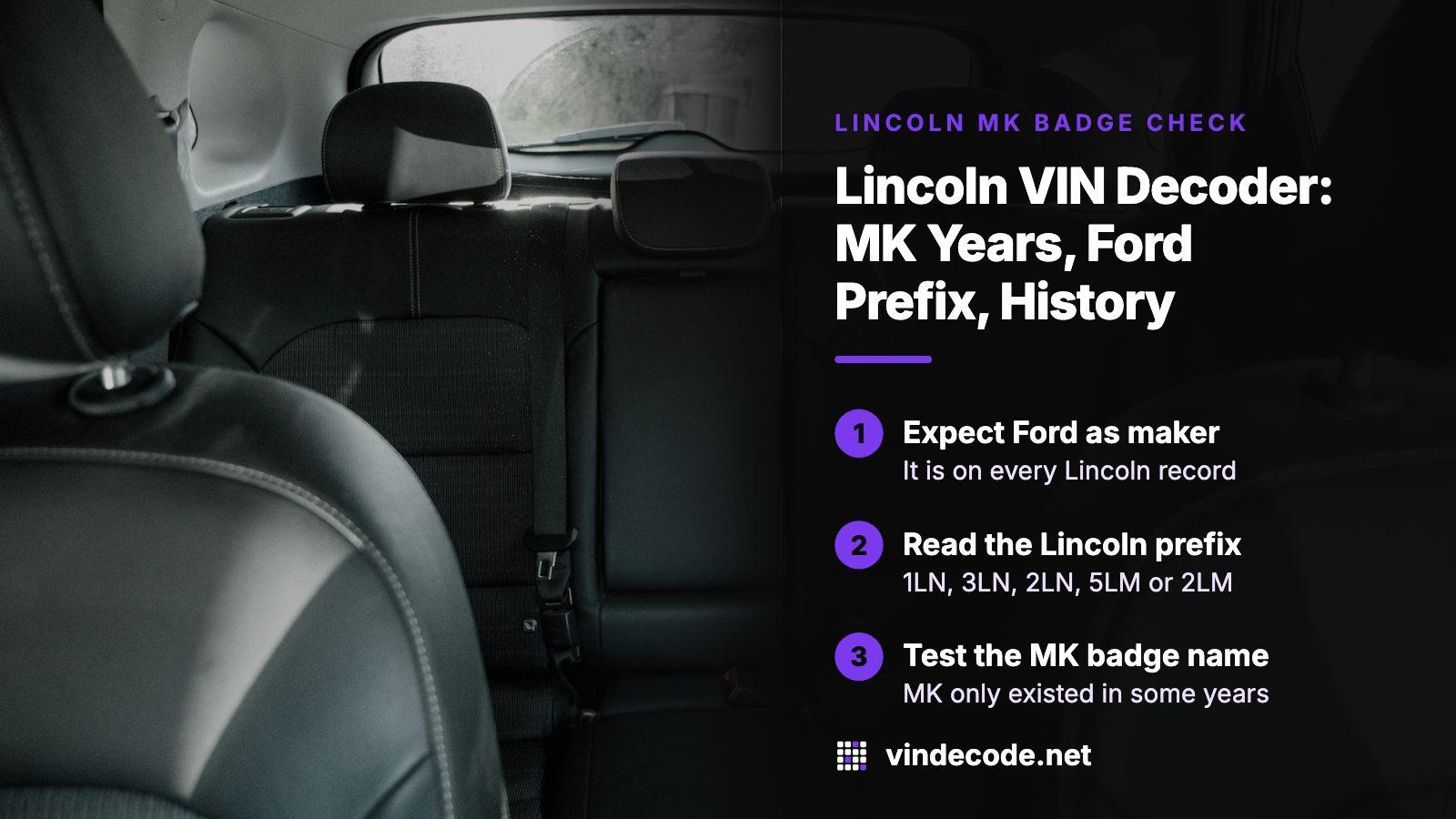
To decode a Lincoln VIN, put all 17 characters into the decoder on this page. The result names the model, year, body, engine, drive and plant, with Ford Motor Company as the manufacturer. Lincoln prefixes include 1LN, 3LN and 2LN for cars and 5LM and 2LM for SUVs, and the MK names ran only from 2007 to 2020. For title brands, damage and mileage, open the free preview of the history report.
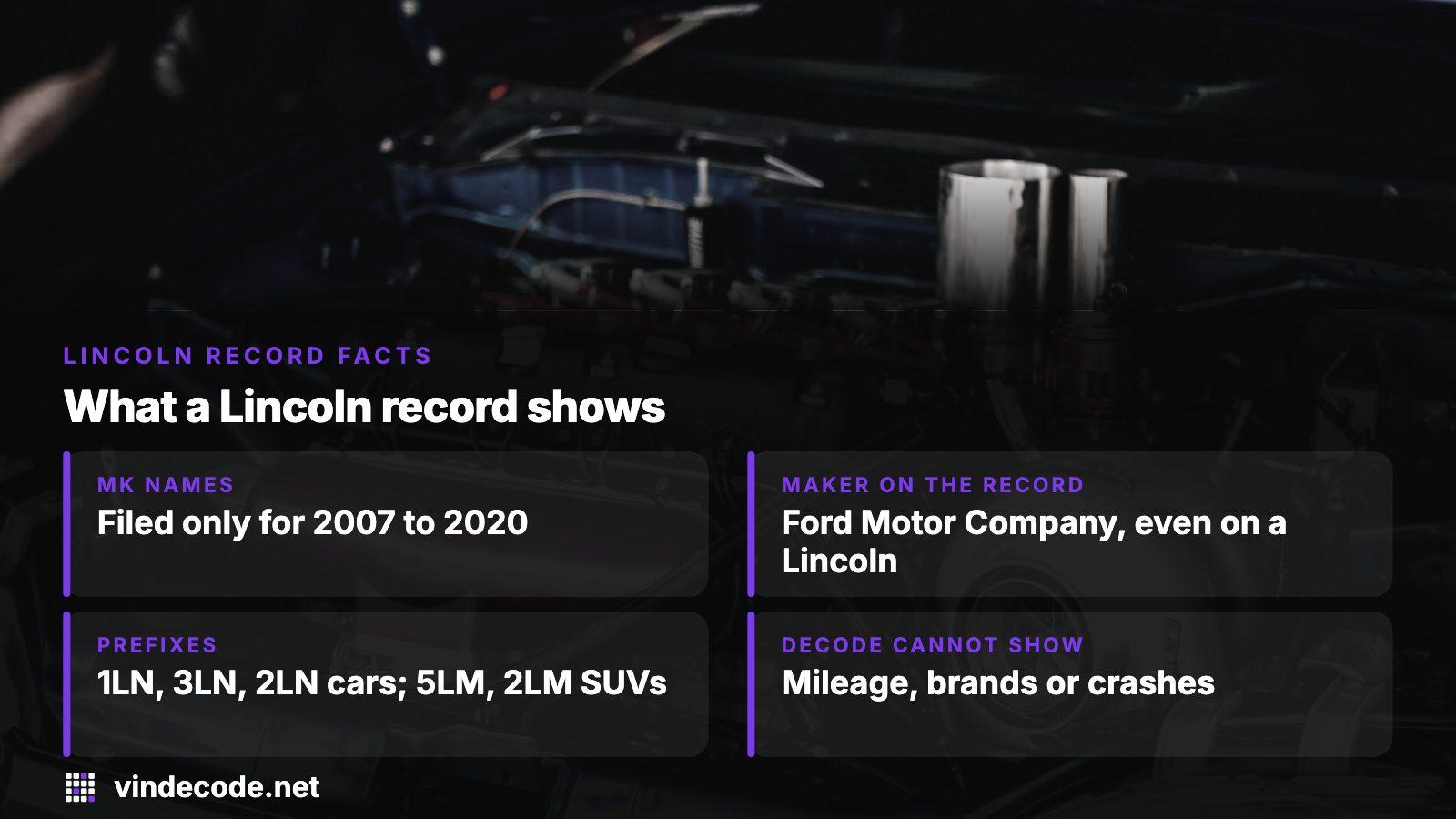
- MK names
- Filed only for 2007 to 2020
- Maker on the record
- Ford Motor Company, even on a Lincoln
- Prefixes
- 1LN, 3LN, 2LN cars; 5LM, 2LM SUVs
- A decode cannot show
- Mileage, title brands or crashes
What the decoder returns for a Lincoln
The decoder checks your 17 characters against the build record Ford Motor Company filed with NHTSA for its Lincoln line. What comes back is the car on the day it left the plant, the one description a seller cannot reword. This is what NHTSA's public decoder gave back for three Lincoln patterns.
| Pattern tested | What came back |
|---|---|
| 2019 Navigator, first 11 characters | Lincoln, Ford Motor Company, SUV, four-wheel drive, turbocharged six-cylinder, built in Kentucky |
| 2013 MKZ, first 11 characters | Lincoln, Ford Motor Company, Mexico, sedan, front-wheel drive, four-cylinder, built in Hermosillo |
| 2013 MKS, first 11 characters | Lincoln, Ford Motor Company, sedan, front-wheel drive, six-cylinder, built in Chicago |
Each was flagged incomplete, as expected with only the opening characters, yet the build fields came back. With all 17, the decoder can also test the check digit, which a typing slip usually breaks. Raise any mismatch with the seller.
Take the 17 characters from the metal, not the listing
Listings carry typos, and one wrong character gives an error or a different car. Take the number from the vehicle, not the ad copy.
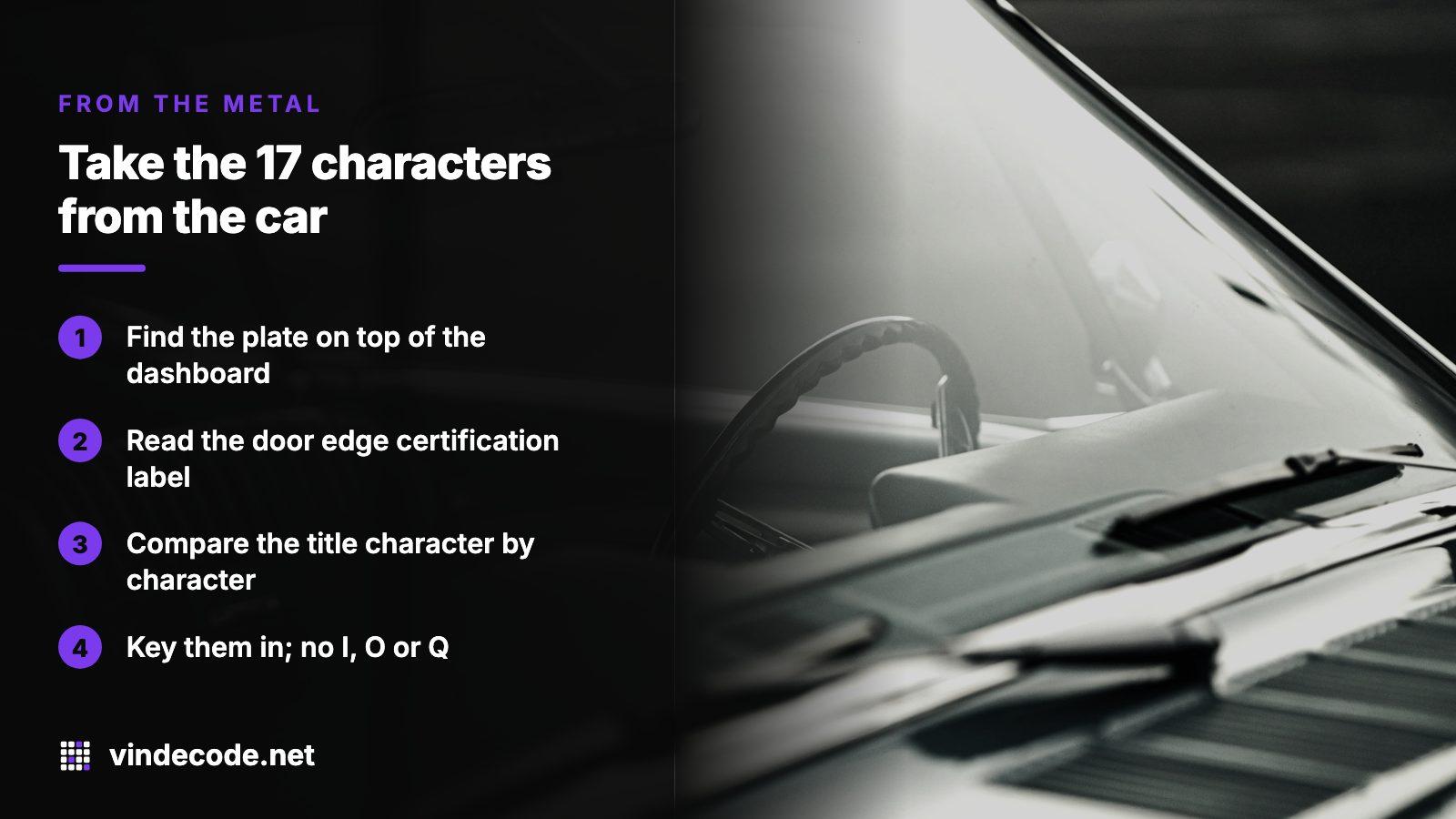
- From the driver's side, bend down to the glass and find the plate riding on top of the dashboard.
- The door edge carries a certification label with the same number, plus the month of manufacture.
- Lay the title or registration next to the car and compare all 17 characters one at a time.
- Key them into the decoder above. A VIN never uses I, O or Q, so if your entry has one, a character was misread.
A plate that disagrees with the label, or either one with the paperwork, should halt the sale until the seller explains it in writing.
Ford Motor Company on a Lincoln record: why, and what to read instead
Lincoln is a division, so the federal register files each Lincoln prefix under Ford. Seeing Ford named on the decode of a Lincoln is the register working as designed. The line worth questioning is the model, not the maker.
| Prefix | Vehicle type | Manufacturer on the record |
|---|---|---|
| 1LN | Passenger car | Ford Motor Company |
| 5LM | SUV or other multipurpose vehicle | Ford Motor Company |
| 3LN | Passenger car | Ford Motor Company, Mexico |
| 2LN | Passenger car | Ford Motor Company of Canada |
| 2LM | SUV or other multipurpose vehicle | Ford Motor Company of Canada |
A register quirk
Search NHTSA's manufacturer register for Lincoln and a single row returns, 1L9612, filed by a trailer builder with the same name. It has no link to the cars, so the prefix is the test, not the badge name.
The MK badge only exists from 2007 to 2020
Lincoln spent 14 model years naming cars MK-something, and NHTSA's filings put hard edges on that stretch: no MK name appears for 2006 or for 2021. A model name therefore becomes a date range you can hold a listing against.
| MK name | Model years filed |
|---|---|
| MKZ | 2007 to 2020 |
| MKX | 2007 to 2018 |
| MKS | 2009 to 2016 |
| MKT | 2010 to 2019 |
| MKC | 2015 to 2019 |
Say an advert offers an MKC from 2013. That nameplate was filed for only 5 model years, from 2015, so the listing contradicts itself, and the VIN shows which detail is false. The year sits in position 10, a designation the maker assigns, which is neither the build date nor the day of first sale.
Where the badge name is a weak test
Two situations blunt the name check. In 2019 the Lincoln filing lists Continental, Nautilus and Navigator beside MKC, MKT and MKZ, so old and new naming overlap and a decode that looks anachronistic may be right. Navigator is the other: it is filed before, during and after the MK era, so its year cannot be tested by name.
Navigator L is filed as its own model, apart from Navigator. When the decode returns one and the advert claims the other, you are looking at a different vehicle, not different wording, and the value moves with it.
Open recalls and campaigns on a used Lincoln
Matching the car to open safety recalls is the most useful part of a decode, since the repair costs the owner nothing, whatever the mileage or the number of owners. NHTSA's own lookup is free too, so run it before you talk price.
From an NHTSA owner complaint
Filed by the owner of a 2013 MKZ: a check-engine light and reduced power led to a $1200 estimate for a catalytic converter. The car came from a dealership, and the owner said nobody mentioned a Ford customer satisfaction program covering that part, and no letter about it arrived. By the time the owner heard of it, coverage had run out by a couple of months.
Safety recalls are only part of what can be open on a used car. After NHTSA's lookup, ask a Lincoln dealer to list every open campaign and program on that VIN, in writing, before the price is settled.
What the factory record leaves out
A VIN describes a Lincoln at the factory door. Everything after that sits in other records, and a decode reads none of them.
| Question about the car | Decode | History report |
|---|---|---|
| What did the factory build? | Yes | Yes, as factory specs |
| Is the title branded salvage? | No | Yes |
| Has it been in a collision? | No | Yes |
| What did the odometer read over the years? | No | Yes |
| Is there a lien, or a theft record? | No | Yes |
From an NHTSA owner complaint
Filed by a 2019 Navigator owner under the heading odometer fraud. The SUV came from a dealer with 81,183 miles showing, and a warranty company later told the owner, citing a history report, that the true reading was 97,000.
Neither the dash nor the advert proves mileage. The odometer record is where a gap like that would have shown before the sale.
A salvage brand sits on the title, not in the build
The decoder returns a clean model, year and engine whether or not the car was ever written off. A brand lives on the title, and only a title check on the same VIN will find it.
From an NHTSA owner complaint
A 2013 MKS owner told NHTSA the car carries a salvaged title and that a clogged sunroof drain sent water into the panels, damaging the electrics and air conditioning. Two independent mechanics worked on it, and the fault returned.
Water in a car is a cue to read the title record before you buy, not after the first repair bill.
What the report costs and the order to run the checks
Entering a VIN opens the preview, which is free and needs no card. Paying is a one-time step: a single report, or a bundle covering 3, 5 or 10 cars, with no renewals. The figures are on the pricing page.
- Copy the VIN from the vehicle and decode it.
- Test the model name against the MK years and the prefix against the table above.
- Run NHTSA's recall lookup, then ask a Lincoln dealer about open campaigns.
- Open the history preview, and buy the report if the build holds up.
- Book a mechanic you trust to go over the car before you hand over money.
Where this information comes from
- NHTSA: vPIC VIN decoder — The federal database behind the build fields, where 1LN, 5LM, 3LN, 2LN and 2LM list Lincoln under Ford.
- NHTSA vPIC: Lincoln models filed by model year — Source for the MK name runs; change the year in the address to check another.
- NHTSA: recalls lookup — Checks one VIN for open safety recalls.
- eCFR: 49 CFR Part 565, vehicle identification numbers — The federal rule behind the 17 positions and the manufacturer code.
- NHTSA owner complaint 11624473 — owner experience, paraphrased
- NHTSA owner complaint 11733564 — owner experience, paraphrased
- NHTSA owner complaint 11244246 — owner experience, paraphrased
Sources and photos: Facts checked against the sources above in November 2026. Photos by THLT LCX, Dylan Michaud and Willian Cittadin on Unsplash; diagrams by VINDecode.
Keep reading
- Ford VIN Decoder: Decode a Ford VIN, Then Check Its HistoryFord's own prefixes, from the manufacturer that sits behind every Lincoln record.
- VIN Decoder: Decode a VIN Number Online, Then Check Its HistoryHow all 17 characters are laid out, including the model-year position.
- NHTSA VIN Decoder: What It Returns, Where It Stops, What Comes NextThe federal database that fills the decoded fields and lists the prefixes.
- Sample reportA finished history report, to see what a decode cannot show.
Frequently asked questions
How do I decode a Lincoln VIN?
Paste or type the full 17 characters into the decoder above, copied from the plate seen through the windshield or the door label, not from a listing. The result gives model, year, body, engine, drive and plant, plus open safety recalls.
Why does my Lincoln VIN say Ford Motor Company?
Lincoln is a division, and the federal register names the parent as manufacturer. The 1LN and 5LM prefixes list the Lincoln make with Ford Motor Company behind it, while 3LN names Ford's Mexican arm. That is the record being accurate, so check the model field instead.
Which years can an MK Lincoln be?
Only 2007 through 2020. The MKZ spans all 14 of those model years, the MKX stops at 2018, the MKS runs 2009 to 2016, the MKT 2010 to 2019 and the MKC 2015 to 2019. An advert pairing an MK name with a year outside its run contains an error.
Can the decode tell a Navigator from a Navigator L?
Yes. NHTSA files Navigator L as a separate model, so the model field shows which was built. If the decode and the advert disagree, price the car as decoded. Trim and option fields are patchier, so do not read them as a build sheet.
Will a Lincoln VIN decode show accidents, mileage or a salvage title?
No. Those sit in title, insurance, auction and odometer records that a build decode never reads. The preview on the same VIN is free and arrives first, so you can see what it finds before paying for the full report.
Now check the car itself
The guide explains what to look for. The report shows what this VIN has on record.