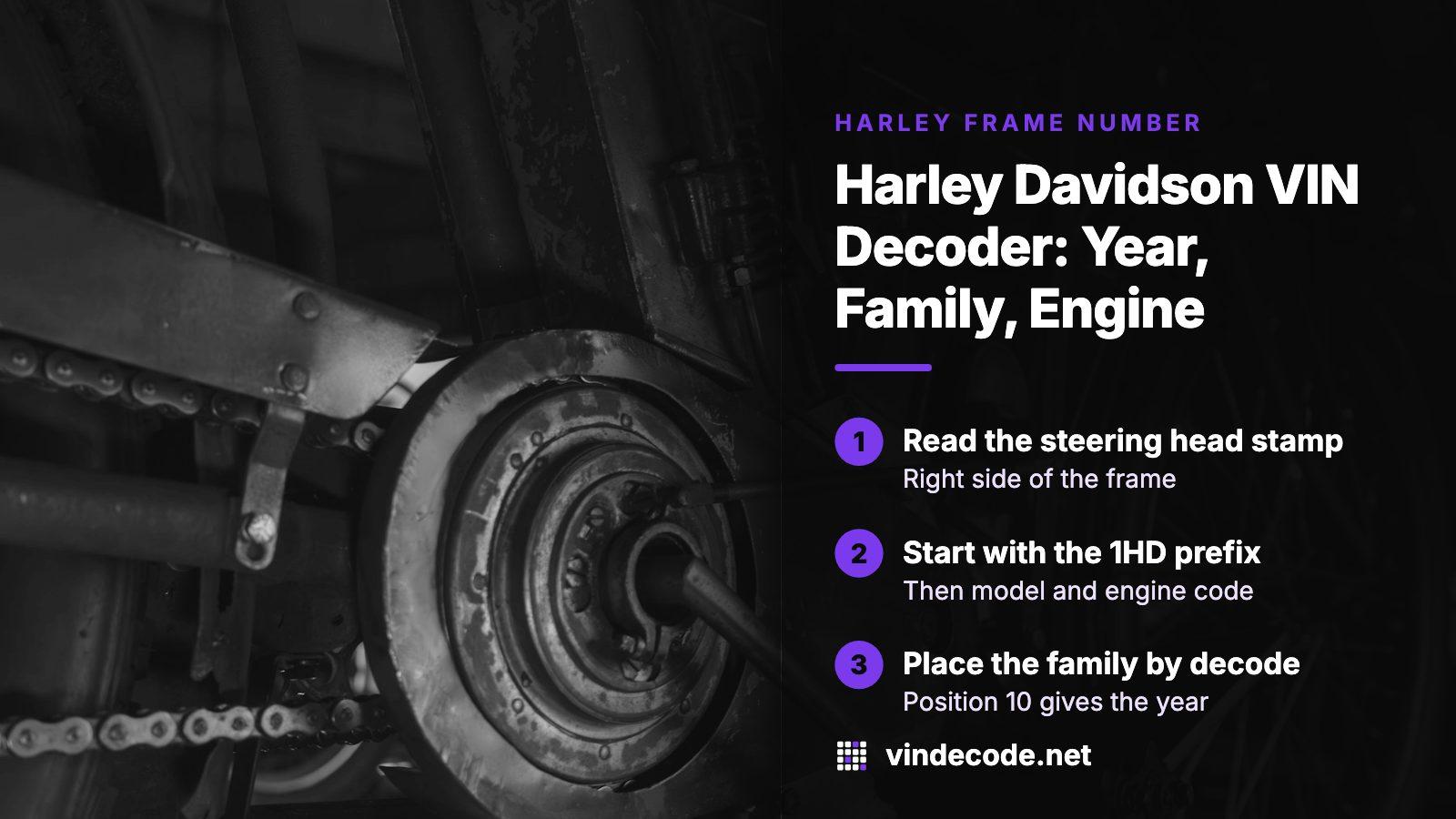
THE SHORT ANSWER
Type the whole frame VIN into the decoder. A US-built Harley starts 1HD, positions 4 to 8 are Harley's model and engine code, 9 is a checksum, 10 is the year and 11 is the plant. That is the factory build only. Engine originality, salvage brands, theft records and open recalls need an in-person engine check and a history report.
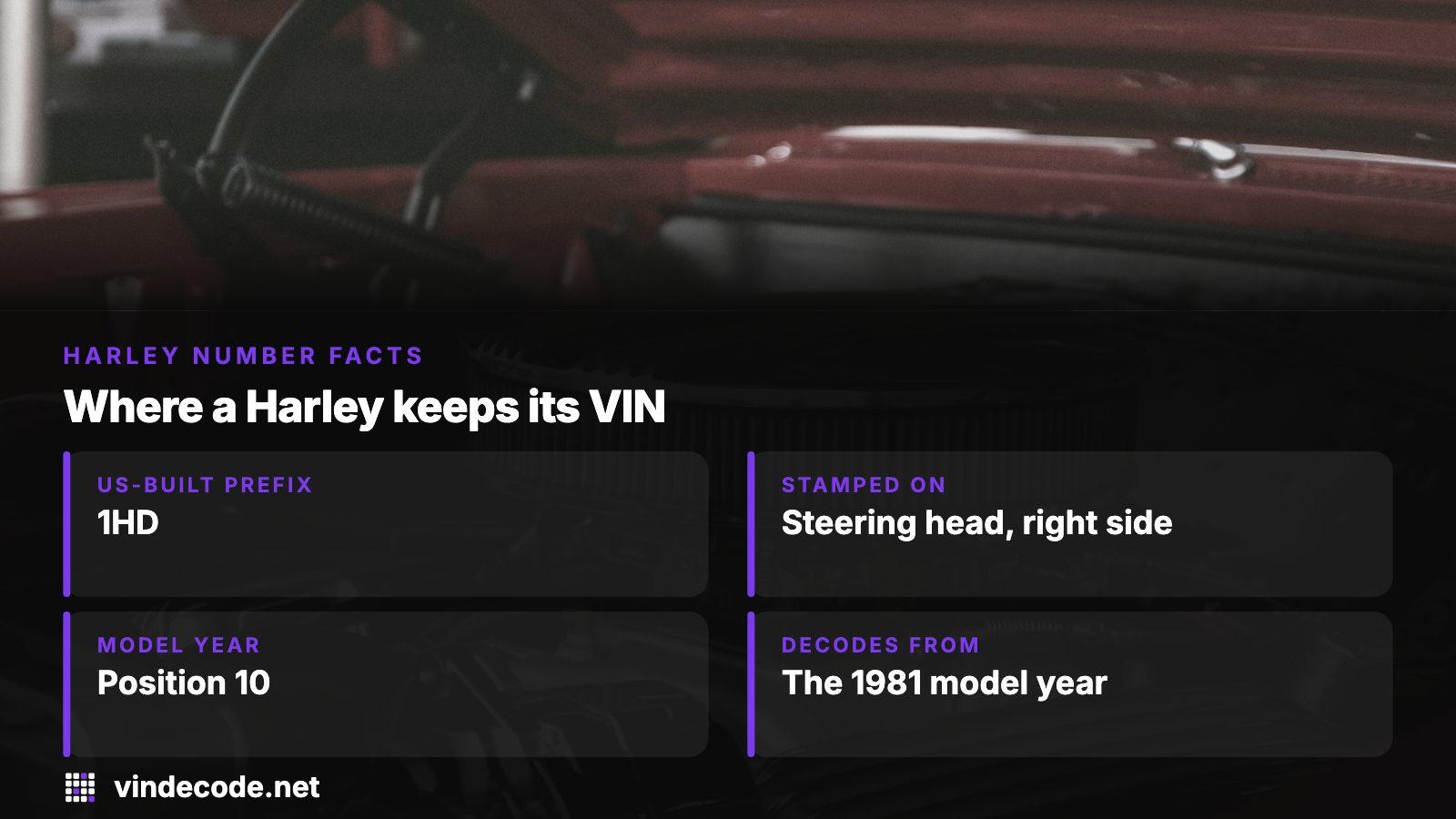
- US-built prefix
- 1HD
- Stamped on
- Steering head, right side
- Model year
- Position 10
- Decodes from
- 1981 model year
What the decoder returns, and where it stops
The decoder tests the number you type against the layout Harley filed for that model year and lists what it finds:
- Model year, from position 10
- Family and model as built
- Engine size and layout as fitted at the factory
- Assembly plant, from position 11
Every line describes build day. The decode cannot say whether that engine is still in the frame, what has been added since, or whether the bike was wrecked, stolen or sold through an auction. On a Harley that gap often sets the price, because customizing is normal.
Getting a clean reading off the frame
The stamping that counts is in the steering head: the neck of the frame that the forks pivot in. Turn the handlebars to full lock to expose its right side. The certification label on the frame carries the VIN too, plus the build date. Title, registration and insurance papers should match both.
Road film and chain lube pack into the characters there, so wipe the metal before calling anything unreadable. Light it from the side with a flashlight and photograph it. A VIN never contains I, O or Q, so read a round character as a zero and a single stroke as a one.
The 17 positions and the 1HD prefix
| Position | What it holds |
|---|---|
| 1 | Country of build, where 1 means the United States |
| 2 and 3 | Maker, with HD standing for Harley-Davidson |
| 4 to 8 | Harley's own code for line, model and engine |
| 9 | Check digit computed from the other sixteen |
| 10 | Year code |
| 11 | Plant of assembly |
| 12 to 17 | That bike's own serial |
A US-market bike that opens with anything other than 1HD is not automatically suspect, but the seller owes you an explanation: a lawful import, or paperwork for a different machine. Position 9 is arithmetic: character values weighted by place, summed and divided by eleven, with the remainder as the digit and ten written as X. A failed check usually means you misread a stamping on dirty metal. Harley redefined positions 4 to 8 over the years, so the decoder reads them by model year, not from one chart.
Position 10 for the year, and bikes the decoder cannot read
| Code | Year | Code | Year |
|---|---|---|---|
| F | 2015 | M | 2021 |
| G | 2016 | N | 2022 |
| H | 2017 | P | 2023 |
| J | 2018 | R | 2024 |
| K | 2019 | S | 2025 |
| L | 2020 | T | 2026 |
No year code uses I, O, Q, U or Z, and the sequence repeats every thirty years. Digits 1 to 9 meant 2001 to 2009, and A through Y covered 1980 to 2000, so a letter alone can fit two bikes thirty years apart. The family and the label's build date settle which.
Earlier Harleys carry a short factory serial with no check digit, and NHTSA's records leave them out, so this decoder starts at the 1981 model year, when the 17-character format arrived. For older bikes, use parts manuals, owner-club registries and marque specialists, and keep every paper.
Which Harley family the decode puts you in
The family tells you more about parts, riding position and running costs than the model name does.
| Family | What it is |
|---|---|
| Sportster | Smaller-displacement line, long the way into the range |
| Softail | Cruiser frame with the rear suspension hidden |
| Dyna | Cruiser with two visible rear shocks, now folded into Softail |
| Touring | Big chassis with fairing, hard bags and long-distance kit |
| Trike | Three wheels on the touring platform |
| CVO | Limited factory editions with upgraded engines |
| Street, Pan America and LiveWire | Small bikes, adventure touring and electric |
Engine cases against the frame VIN
Harley also stamps characters into the engine cases, and on an original bike they tie back to the frame number. The decoder sees only what you type, so this check is hands-on and done in person.
| What the cases show | What it means |
|---|---|
| Stamping ties to the frame VIN | Numbers-matching. Collectors pay more, especially on older bikes. |
| Stamping does not tie | The engine was replaced at some point. Normal on high mileage, but it needs disclosure and receipts. |
| Characters look ground, filed or restamped | Stop. Altered numbers are a police matter, not a haggling point. |
A swap is a price conversation
Re-engined Harleys are common, often to a bigger displacement and often done well. Ask who did the work and when, get receipts, and price the bike for what it is. What hurts is paying a numbers-matching price and discovering the swap later.
Recalls follow the VIN: two owners learned it late
Safety campaigns cover VIN ranges and build dates, not model names. A model-name search can therefore list campaigns that skipped your bike, so enter the frame VIN into NHTSA's lookup instead. A confirmed safety defect is generally repaired without charge for any owner.
From an NHTSA owner complaint
One rider bought a 2014 Road King in July 2025. A hard saddlebag came off on the highway and was wrecked, the rider told NHTSA, and only then did the rider find the saddlebag recall. Harley's reply, as reported, was that the previous owner should have mentioned it.
Run the lookup before you pay, not after a bag leaves the bike.
From an NHTSA owner complaint
A Tri Glide Ultra owner, on a 2014 model, described the rear brake pedal going dead at speed, so the trike stopped on the handlebar lever alone. A mechanic linked the failure to a rear master cylinder recall, but that campaign covered 2015-model trikes built in a narrow window of 2014. The VIN fell outside it, the cylinder needed replacing, and the bike was unrepaired.
A symptom that matches a recall does not put your bike on the list, and a no from the lookup does not make the part sound.
After the decode: what a history report adds
A decode ends at the factory gate. A history report searches records filed under the same VIN afterward, and on a used Harley they cover the years that set the price.
| Record | What it settles |
|---|---|
| Title brands, salvage and auction history | Whether it was branded or sold at auction, with photos |
| Accident and damage records | Whether it went down, and where it was hit |
| Odometer readings | Whether mileage climbs like a ridden bike's |
| Liens, impounds, theft and insurance records | Who else holds a claim on it |
| Open recalls and market value | What is outstanding and what it is worth |
Harleys hold value and strip into parts that sell, so run NICB's VINCheck before you travel for a private sale. It costs nothing and draws on participating insurers; a clean answer means only that none of them flagged the number. A salvage brand is not always a bent frame, because paint, chrome and fairings can push a minor tip-over past an older bike's value. Have a mechanic check that the frame is straight.
The order to run things, and what it costs
- Photograph the steering head stamping and the certification label before you travel.
- Decode the VIN and compare year, family and engine with the advert.
- Compare the engine cases with the frame number, in person.
- Look up recalls at NHTSA and theft at NICB using the frame VIN.
- Open the preview. If the bike still adds up, buy the report.
A VIN entry brings up a free preview. The full report is paid once, either singly or as a bundle of 3, 5 or 10, and nothing renews. The pricing page lists current prices.

Where this information comes from
- NHTSA: vPIC VIN decoder — The federal VIN database, which includes motorcycles and is what a model-year decode reads against.
- NHTSA: recalls lookup — Matches one VIN to open campaigns, which the maker repairs without charge to the owner.
- NICB: VINCheck — A no-cost theft and salvage lookup fed by participating insurers; a clean result is not proof.
- NHTSA owner complaint 11679641 — owner experience, paraphrased
- NHTSA owner complaint 11559110 — owner experience, paraphrased
Sources and photos: Facts checked against the sources above in November 2026. Photos by Haberdoedas, Owen Michael Grech and Victor Hughes on Unsplash; diagrams by VINDecode.
Keep reading
- VIN Decoder: Decode a VIN Number Online, Then Check Its HistoryHow the 17 positions read on any make, without brand coding.
- NHTSA VIN Decoder: What It Returns, Where It Stops, What Comes NextWhat the federal decoder behind these results covers, and where it ends.
- Kawasaki VIN Decoder: Year, Model and Plant From the Frame NumberAnother motorcycle maker, with its own coding in the middle of the number.
- Sample reportA finished report, to see what the history adds after the decode.
Frequently asked questions
How do I use a Harley Davidson VIN decoder?
Enter all 17 characters from the steering head, re-reading any that look like I, O or Q, which never appear. You get year, family, engine and plant. Before buying, add the engine comparison plus recall and theft lookups.
Where on the bike is a Harley's VIN?
On the right side of the steering head, visible at full lock, and on the certification label, which also shows the build date. Clean grime off before deciding the stamping is unreadable.
Does the engine number have to match the VIN?
On an original bike it does, and collectors pay extra for that. A mismatch means the engine was replaced, which is routine on older machines. Ask when and by whom, ask for receipts, and adjust your offer.
Which character of a Harley VIN gives the year?
The tenth. N is 2022, S is 2025 and T is 2026, and a digit from 1 to 9 means 2001 to 2009. Letters repeat every thirty years, so check against the family and build date.
Does a clean decode mean the history is clean?
No. A decode reads only the factory build, so a bike can decode as advertised and still carry a salvage brand, a lien or an open recall. A quiet history report shows only that nothing was recorded; pair it with an inspection.
Now check the car itself
The guide explains what to look for. The report shows what this VIN has on record.