THE SHORT ANSWER
Enter all 17 characters of the Isuzu VIN in the decoder above. The prefix tells you who built it and what class it belongs to; the year sits in character ten. NHTSA lists no Isuzu SUV or pickup after the 2008 model year, so a later year points to a commercial truck. The decode describes the vehicle as built. Title brands, damage, odometer readings and theft need a history report.
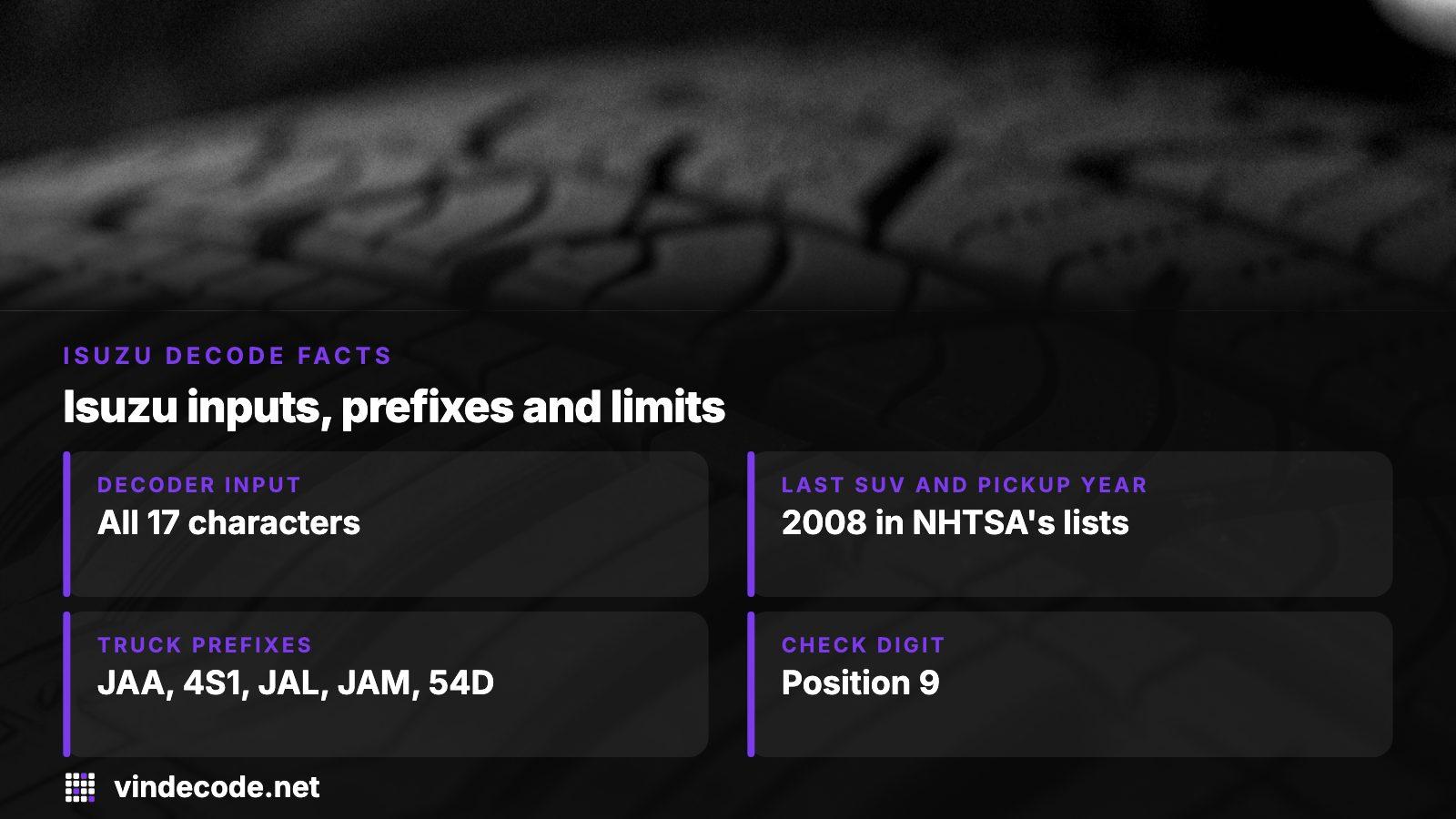
- Decoder input
- All 17 characters
- Last SUV and pickup year
- 2008 in NHTSA's lists
- Truck prefixes
- JAA, 4S1, JAL, JAM, 54D
- Check digit
- Position 9
What an Isuzu decode returns, and what it leaves out
The decoder compares your VIN with the build data Isuzu filed with NHTSA. For an Isuzu the answer is worth reading slowly, because the same badge sits on a family SUV, a small pickup and a chassis built to carry a delivery body.
- Vehicle type and builder, taken from the first three characters
- Model line and engine, read from positions four to eight
- Model year from position ten and the assembly plant from position eleven
- A check on the ninth character, which catches a mistyped number
Everything in that list was fixed on the day the vehicle was built. A decode never shows a wreck, a branded title, a wound-back odometer or an unpaid loan. Those facts are recorded later, under the same VIN, and a different kind of record carries them.
Isuzu prefixes, and the ones that do not say Isuzu
NHTSA's vPIC database files these first-three-character codes under Isuzu Motors or a related builder. A tool that expects every Isuzu to start with J will reject the 4S ones, which is why the table matters.
| Prefix | Vehicle type on file | Note |
|---|---|---|
| JAB | Passenger car | Isuzu |
| JAC | Multipurpose passenger vehicle | Isuzu |
| 4S2 | Multipurpose passenger vehicle | Isuzu |
| JAA | Truck | Isuzu |
| 4S1 | Truck | Isuzu |
| JAL | Incomplete vehicle | Chevrolet and Hino share this code |
| 54D | Incomplete vehicle | Filed under The Shyft Group, shared with Chevrolet and GMC |
| J81 | Passenger car | Filed under Chevrolet and Geo, not Isuzu |
Three of those rows show how a badge and a VIN can disagree. A truck chassis may carry a Chevrolet or GMC name, and a J81 car was sold as a Chevrolet or a Geo even though Isuzu built it.
Position ten and the 2008 dividing line
NHTSA's model lists show an Isuzu lineup that shrinks fast. The 2008 list still holds the Ascender SUV and the i-290 and i-370 pickups. The 2009 and 2010 lists hold only trucks, and every list after that is commercial too.
| Tenth character | Model year | What NHTSA lists for Isuzu |
|---|---|---|
| 5 | 2005 | Ascender SUV plus trucks |
| 6 | 2006 | Ascender, i-280 and i-350 pickups, trucks |
| 7 | 2007 | Ascender, i-290 and i-370 pickups, trucks |
| 8 | 2008 | Ascender, i-290 and i-370 pickups, trucks |
| 9 | 2009 | Trucks only |
| A | 2010 | Trucks only |
One more rule helps with older vehicles. On a car, SUV or light truck, a number in position seven means the year in position ten falls between 1980 and 2009. A letter there means 2010 to 2039.
When the Isuzu is a truck chassis
Today's Isuzu entries in NHTSA's lists are the NPR, NQR, NRR, FTR and FVR families. Many of these leave the factory as incomplete vehicles, so the VIN describes the chassis and cab, and a body builder adds the box, the dump bed or the tow equipment afterward.
That has two practical effects. The decode will not tell you what body is on the frame, and the weight class matters. Federal rules put the dividing line at 10,000 pounds of gross vehicle weight rating: above it, the last four VIN characters are digits instead of five, and the letter requirement in position seven falls away. A decoder that expects the light-vehicle pattern can mislabel a heavy chassis, so read its output against the plate on the door.
Running the decoder on an Isuzu you are considering
- Copy the 17-character number from the registration card and from the corner of the glass, and confirm the two agree.
- Count the characters. A shorter string is not a VIN you can decode, so recheck what you copied.
- Type it into the decoder above and compare the type, model and year with the advert.
- Look at position ten against the table in the section above. A 2009-or-later year on a listing for a Trooper or a Rodeo is a mismatch.
- Read the prefix. A JAA or 4S1 vehicle is a truck even if the seller calls it an SUV.
When the decode disagrees with the advert, you have learned something before spending a dollar.

Recalls on an older Isuzu are easy to miss
NHTSA's VIN recall search is free, but it leaves out recalls already repaired, and it omits safety recalls past 15 years of age unless the maker stretches its coverage. An Isuzu SUV from the early 2000s sits right in that gap. One example is campaign 10V436000: it reached the 1998 through 2002 Rodeo and the 2002 Axiom in salt-belt states, over rust at a rear suspension bracket, and NHTSA put the potential count near 149992.
From an NHTSA owner complaint
A 1999 Rodeo owner told NHTSA in 2013 that the frame had rusted until the bumper fell off. A notice about the suspension recall had come earlier, but the nearest Isuzu dealer sat more than 100 miles off, so the repair never happened. The vehicle was left unrepaired at 211,000 miles.
The lesson is practical. Before buying an older Isuzu, check the recall status, then ask where an open repair would be done and put a mechanic under the rear of the truck.
What a decode cannot show about a used Isuzu
A clean decode shows the number is genuine and the listing names the right model. How the owner treated the vehicle is outside its reach.
From an NHTSA owner complaint
One buyer of a 1998 Trooper wrote to NHTSA in 2006 about a vehicle they had just bought. Two weeks after an oil change the check-engine light came on, and the next day the engine began knocking. The oil was dry, and the quote to rebuild it was about $4000, before the owner had made a payment.
No decoder could have predicted that. A decode would have confirmed the year and engine, and an inspection plus the service history would have been the real protection. A history report adds the records that follow the vehicle from owner to owner.
What the history report adds after the decode
| Record | Why it matters on an Isuzu |
|---|---|
| Title brands | Shows a salvage, rebuilt or flood title on an older SUV or pickup |
| Accident and damage records | Shows where an earlier impact landed |
| Odometer readings | Shows whether mileage climbs steadily or drops |
| Salvage and auction history | Shows an auction stop, with photos where they exist |
| Liens and theft records | Shows a lender's claim or a theft report |
Entering a VIN brings up a preview at no charge. Going further costs one payment: buy a lone report, or choose a pack sized 3, 5 or 10 when several Isuzus are on your list. Nothing renews and no subscription exists. See the pricing page for current rates. A blank report only says nothing was recorded, so pair it with an inspection.
A sensible order for checking a used Isuzu
- Decode the VIN and confirm the type, model and year match the listing.
- Look up open recalls with NHTSA, and remember the 15-year gap.
- Run NICB's VINCheck, a free lookup of insurer theft and salvage reports.
- Look at the preview, and pay for the full report only when the vehicle still looks right.
- Pay a mechanic to inspect the frame, the engine and the service records before any money moves.
Where this information comes from
- NHTSA: vPIC VIN decoder — The federal database behind the prefix table and the model lists by year on this page.
- eCFR: 49 CFR Part 565, VIN requirements — The federal rule for what each VIN position means, including the year codes and the position-seven test.
- NHTSA: check for recalls — The VIN recall search, with its notes on repaired recalls and the 15-year limit.
- NICB: VINCheck — A free theft and salvage lookup fed by participating insurers.
- NHTSA owner complaint 10497698 — owner experience, paraphrased
- NHTSA owner complaint 10156024 — owner experience, paraphrased
Sources and photos: Facts checked against the sources above in November 2026. Photos by Zoshua Colah, Scott Graham and Yvette S on Unsplash; diagrams by VINDecode.
Keep reading
- VIN Decoder: Decode a VIN Number Online, Then Check Its HistoryHow the 17 positions read on any make, before brand-specific codes.
- NHTSA VIN Decoder: What It Returns, Where It Stops, What Comes NextWhat the federal decoder behind these results covers and where it stops.
- Honda VIN Decoder: Decode the Build, Then Check the HistoryThe Passport shared the Rodeo's recall, so Honda's own codes are worth a look.
- Sample reportA finished report, to see what the history adds after the decode.
Frequently asked questions
How do I decode an Isuzu VIN?
Enter all 17 characters in the decoder above. The first three give the builder and vehicle type, year comes from the tenth and the plant from the eleventh. If nothing comes back, recount and compare each character with the stamping, since one wrong letter stops a decode.
Does an Isuzu VIN always start with J?
No. NHTSA files Isuzu trucks and SUVs under 4S1 and 4S2 as well, and some chassis prefixes also list Chevrolet or GMC. A tool that insists on a J rejects valid numbers, so judge the vehicle by the full decode and not by the first letter.
What was the last year Isuzu sold SUVs and pickups here?
NHTSA's model list for 2008 still includes the Ascender, i-290 and i-370. The 2009 list holds only trucks. If a VIN resolves to 2009 or later, expect a commercial chassis, and treat a seller's claim of an SUV as a red flag.
Can the decoder show an accident or a salvage title?
No. A decode reads the factory coding and nothing that happened afterward. Accidents, title brands and odometer readings are recorded later, so they come from a history report, and even a clean one only means nothing was reported.
Why does a recall search show nothing on my old Rodeo?
NHTSA's VIN search leaves out recalls repaired already and, unless the maker extends coverage, those older than 15 years. A blank result on a 1999 vehicle is therefore weak evidence. Check the campaign list for the model year and ask a dealer or mechanic.
Now check the car itself
The guide explains what to look for. The report shows what this VIN has on record.