THE SHORT ANSWER
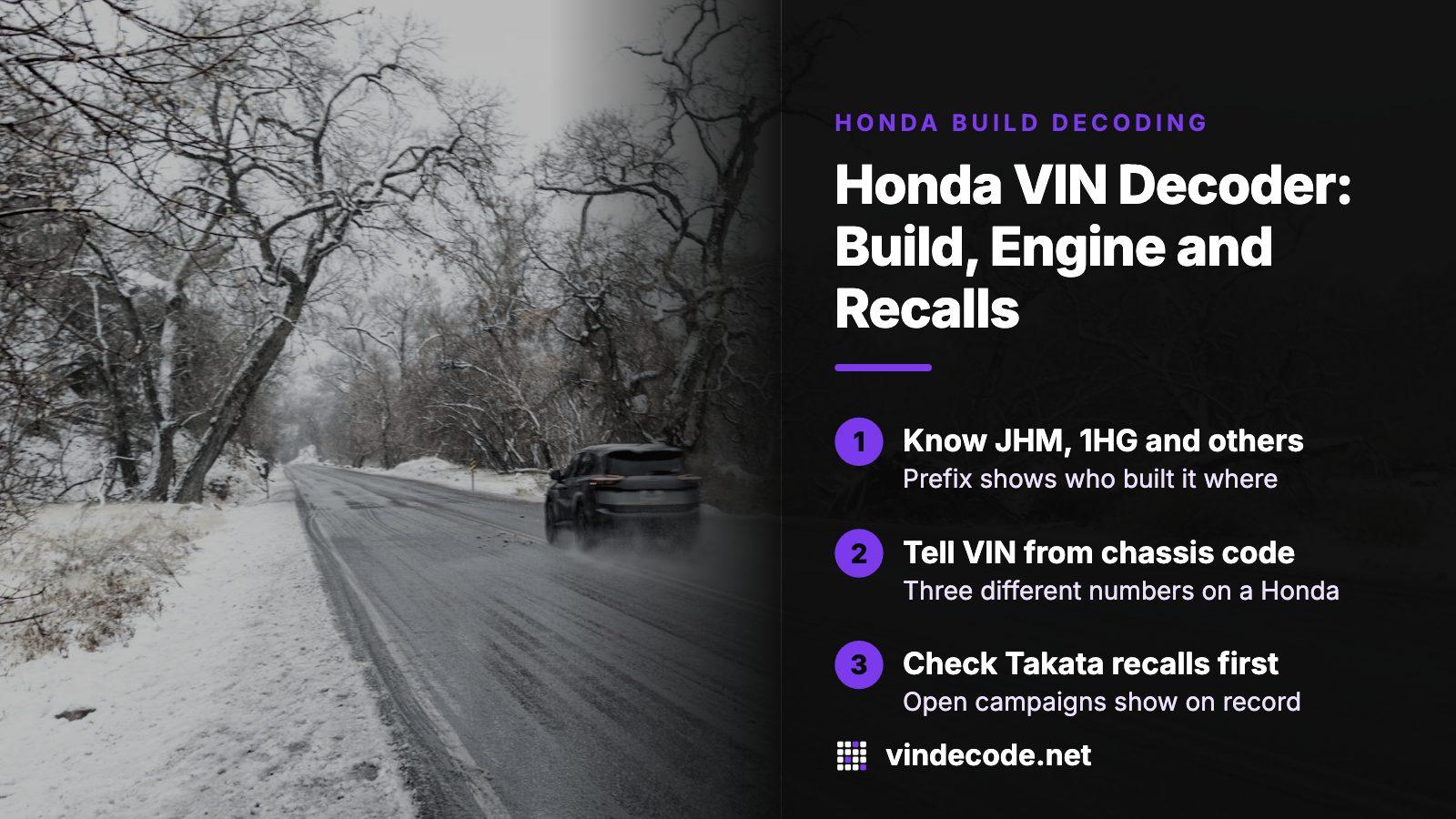
Type all 17 characters of the VIN into the decoder. You get the model year, model, engine, drivetrain and assembly plant, plus any recall still open on record. A JHM prefix means Honda Japan, 1HG is American Honda and 2HG is Honda of Canada. The decode cannot show crashes, title brands or mileage, and chassis codes like FK8 are not in the VIN at all. For those, start with the free preview of the history report.
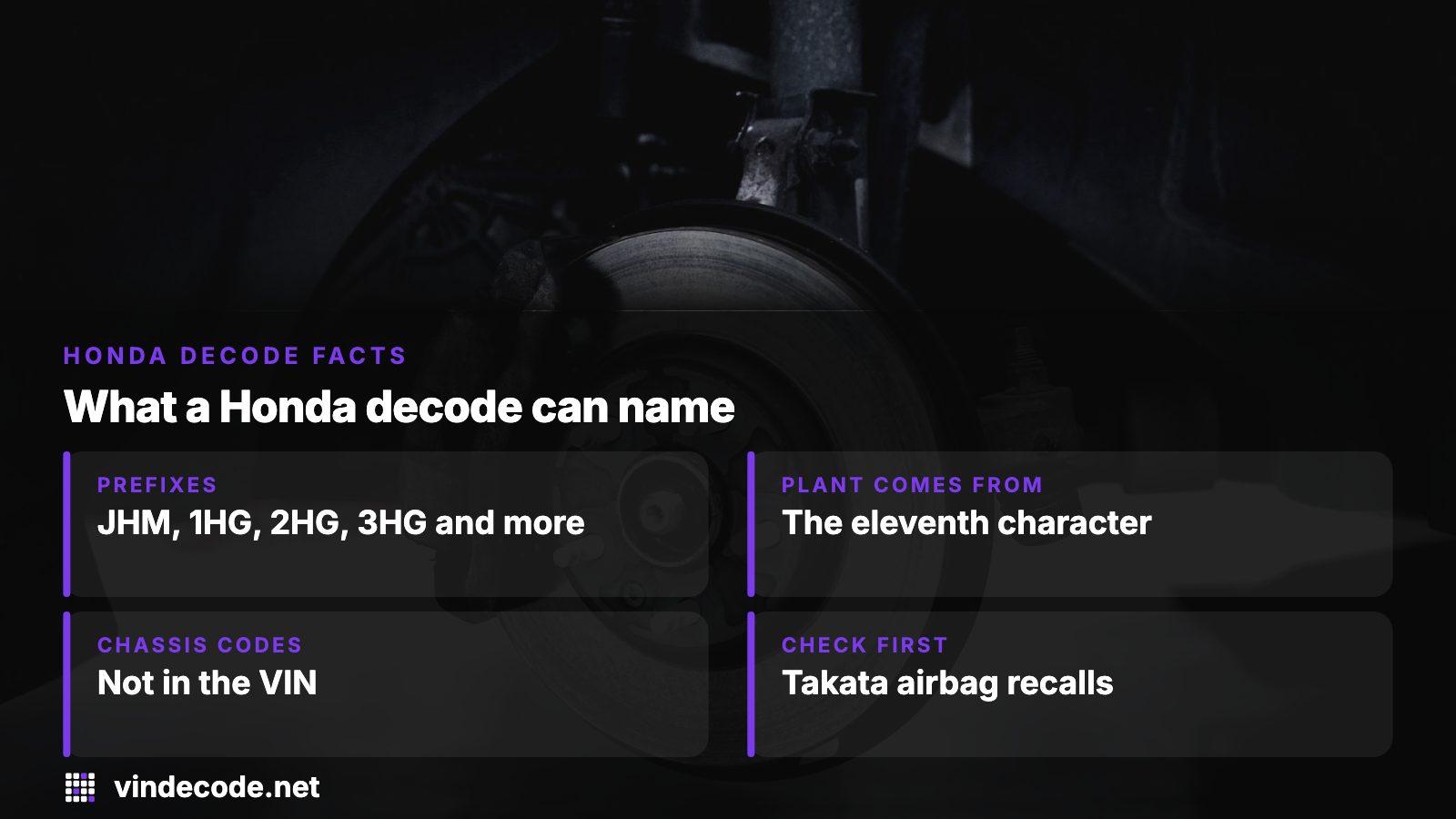
- Prefixes
- JHM, 1HG, 2HG, 3HG and more
- Plant comes from
- The eleventh character
- Chassis codes
- Not in the VIN
- Check first
- Takata airbag recalls
What the decode tells you about a Honda
The decoder matches your VIN to the layout Honda filed with NHTSA's public vPIC database. What comes back is the car as the factory specified it, which is the one part of a listing a seller cannot rewrite.
- Model year, model and body class, such as sedan, coupe or SUV
- Engine displacement, cylinder count and fuel type
- Transmission and drivetrain, where Honda filed them
- The assembly plant and its country
- On many Hondas, an engine code and a trim label too
- Open recalls recorded against that exact VIN
Sample Hondas run through NHTSA's decoder for this page all carried an engine code and a trim label, though a few older ones left the drivetrain empty. A blank means the record has no entry, not that the car has a problem.
Read the VIN off the car, then type it in
Copy the number from the metal, not from the advert. A listing can carry a typo, and one wrong character decodes as a different car or returns an error.
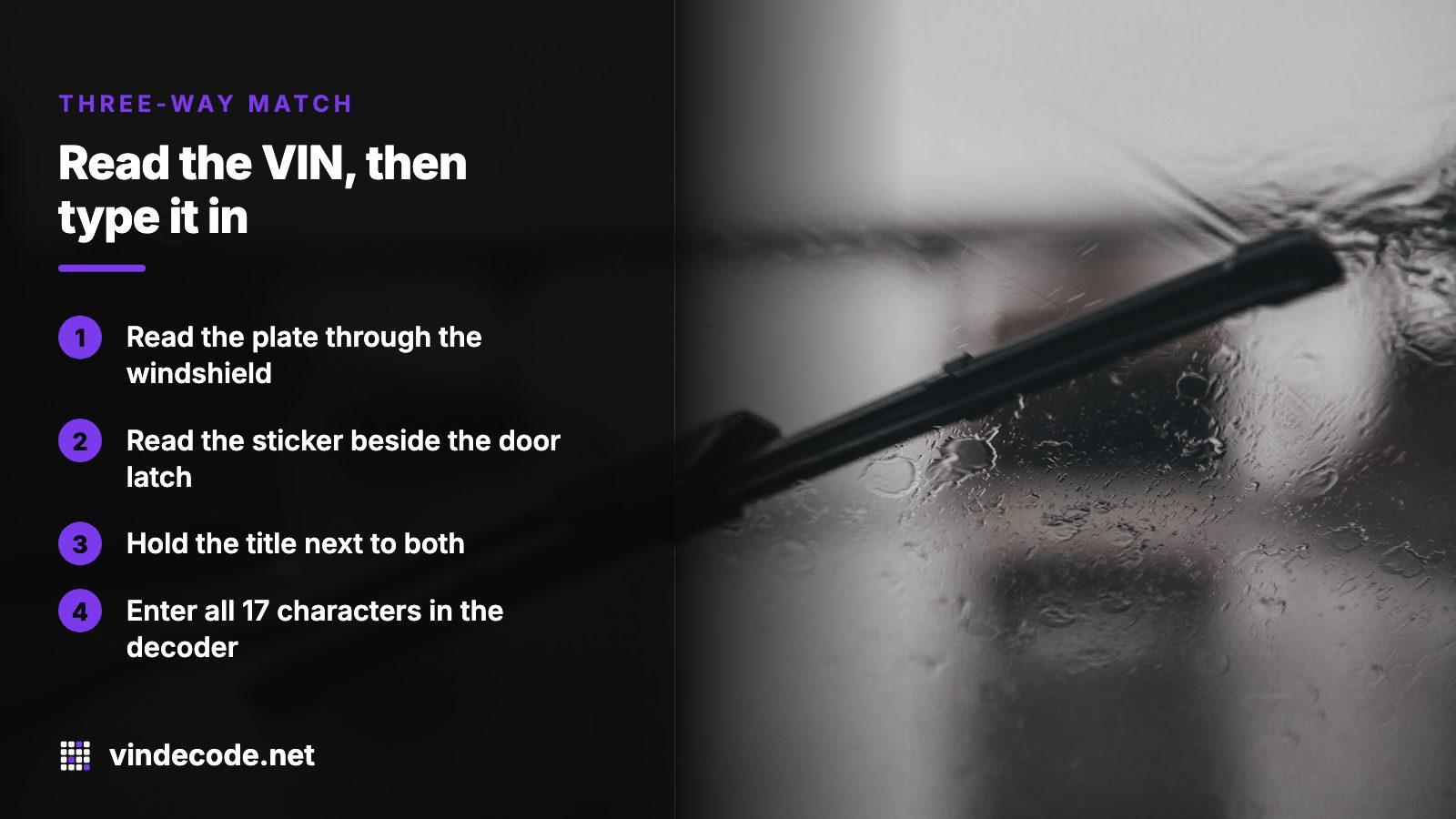
- Crouch beside the windshield on the driver's side and read the plate through the glass.
- Swing the door open and read the sticker on the frame beside the latch. It must match the plate character for character.
- Hold the title or insurance card next to both and compare a third time.
- Enter all 17 characters in the decoder on this page. Letters I, O and Q are skipped in VINs, so a round character is a zero.
The first three characters: who built it, and where
Honda builds in Japan, the United States, Canada and Mexico, so it holds several manufacturer codes. NHTSA's records tie each of these prefixes to a Honda entity:
| Prefix | What NHTSA lists |
|---|---|
| JHM | Honda Motor Co. in Japan, passenger cars |
| 1HG | American Honda, passenger cars |
| 2HG | Honda of Canada, passenger cars |
| 3HG | Honda de Mexico, passenger cars |
| 5FN and 5J6 | American Honda, SUVs and minivans |
| 2HK | Honda of Canada, SUVs and minivans |
A prefix names the maker, not the factory. Alter only the eleventh character of a sample VIN in NHTSA's decoder and the plant changes with it. An American prefix on a Civic or Accord is ordinary. Acura has codes of its own, so a Honda prefix on an Acura-badged car is the mismatch to question.
VIN, chassis code and engine code are three different things
Honda forums talk in chassis codes and engine families. Neither is a VIN field, so a decode that never says FK8 or K20 is not missing anything.
| Name | What it identifies | Where it lives |
|---|---|---|
| VIN | One specific car | Plate, door frame and title |
| Chassis code, such as FK8, EK9, DC2, CL7 or FL5 | A model line and generation, common to many cars | Marque references and parts catalogs |
| Engine code, such as K20, K24, J35 or D16 | An engine family and variant | Stamped on the block |
To find a chassis code, take the decoded model and year to a marque reference and match them yourself. A family name covers an architecture rather than one size, so K20 and K24 belong together.
Where a Honda can differ from its decode
Character eight reflects the engine as Honda built it. The stamping on the block reflects whatever is bolted in now. Honda tuners swap engines more readily than owners of most makes, so the two can part ways.
- Compare the engine code on the block with the one the decode names.
- A swap is not a defect in itself, but it should be disclosed, with receipts naming who did the work.
- Ask whether the swap meets your state's emissions rules and whether an insurer will write a policy at the value you expect.
- On a sporty trim, inspect the brakes, gearbox and engine rather than the badges. Badges and body kits are cheap, and the genuine car carries a premium.
NHTSA's trim label is fair to trust on ordinary trims. On a performance variant, let the hardware settle it.
Check Takata and other open recalls by VIN
The Takata inflator campaign was the largest recall the industry has seen, and a sizable slice of the cars involved wore a Honda or Acura badge. An inflator could rupture when the airbag fired, and some vehicles were put under do-not-drive warnings. Recalls follow VIN ranges, so search with the VIN rather than the model name.
From an NHTSA owner complaint
A 2008 Honda Civic owner told NHTSA the car had just come from a local used car dealer. The owner typed the VIN into the recall lookup and found a Takata airbag campaign still unrepaired on that car. Aware that a Honda dealer could fix it, the owner asked what the selling dealer is responsible for.
Run the lookup before you pay, not after. NHTSA's tool costs nothing, and Honda pays for an open recall repair however many owners the car has had. Follow any driving instructions in a notice exactly as written.
What a decode cannot see, and what the report adds
A decode is a snapshot of the specification at the factory gate, and a recall lookup lists only campaigns open today. Neither says what the road did in between.
From an NHTSA owner complaint
A 2006 Honda Civic owner, who bought the car at a used lot in July 2016, saw coolant leaking and smoke on a drive home. A Honda dealer said a recall for a cracked engine block had expired, and quoted a repair the owner said exceeded the car's value. As they tell it, a VIN check had shown no open recalls.
A clean recall result is not a clean bill of health. Search NHTSA's complaints for the exact model year, ask for the service file, then add the records a decode cannot hold:
- Odometer readings across the car's life, to test the number on the dash
- Accident and damage records
- Salvage and auction records with photos, and any title brand
- Liens, impounds and theft records
- Ownership and use type, and the market value
Which check answers which question
| Your question | Where the answer is |
|---|---|
| Is this the engine Honda installed? | The decode, then the stamping on the block |
| Is an inflator or other campaign open? | NHTSA's recall lookup, run on the VIN |
| Was it in a crash or branded? | Damage and title records in the history report |
| Does the mileage hold together? | Odometer readings across the records |
| Was a swap done properly? | The seller's receipts and a mechanic who knows Hondas |
No single lookup answers all five, so work down the list in that order.
Preview first, then one payment if the car holds up
Enter the VIN and a preview comes first. It is free and asks for no card. Paying is one-off: buy one report, or take 3, 5 or 10 at once, and no subscription is left to cancel. The pricing page lists current amounts.
A sensible order: decode, compare with the ad, run the recall lookup, read the block, and buy the report once the build matches and the seller still sounds straight. Taking several suits you if you are weighing a few Hondas.
Where this information comes from
- NHTSA: recalls lookup — Where to run a VIN against open recalls, Takata inflator campaigns included.
- NHTSA: vPIC VIN decoder — The public decoder and the manufacturer-filed data behind it, including Honda's manufacturer codes and plants.
- NHTSA owner complaint 10979955 — owner experience, paraphrased
- NHTSA owner complaint 10956940 — owner experience, paraphrased
Sources and photos: Facts checked against the sources above in November 2026. Photos by Zoshua Colah, Thibault Valjevac and ün LIU on Unsplash; diagrams by VINDecode.
Keep reading
- Acura VIN Decoder: Check the Build, Trim and HistoryHonda's luxury marque, with manufacturer codes of its own.
- Toyota VIN Decoder: Check the Build, Then the Car's RecordThe same decode for a Honda rival, including Lexus codes.
- VIN Decoder: Decode a VIN Number Online, Then Check Its HistoryEvery VIN position explained, including the check digit.
- Sample reportA finished report, to see what the history adds after the decode.
Frequently asked questions
How do I decode a Honda VIN?
Enter all 17 characters into the decoder. It checks them against the structure Honda filed with NHTSA's vPIC database and returns the year, model, body class, engine and plant. One wrong character gives an error or a different car, so recheck the number against the plate on the car.
What does a JHM prefix on a Honda VIN mean?
JHM is a manufacturer code for Honda Motor Co. in Japan, so the car was built there. Hondas made in North America open differently, most often 1HG for American passenger cars and 2HG for Canadian ones. For the factory, read the eleventh character.
Will a Honda's chassis code appear in the VIN?
No. Codes such as FK8, EK9, DC2, CL7 and FL5 are Honda's internal platform names, and they sit outside the 17 characters. Decode the VIN for model and year, then match those to a chassis code in a marque reference or a parts catalog.
Does a Honda VIN decoder show accidents or mileage?
No. A decode records the specification the car left the factory with, not its use. Accidents, title brands and odometer readings sit in title, damage and mileage records, which the history report gathers.
Should an older Honda get a Takata check before I buy?
Yes. Enter the VIN at NHTSA's recall site, which takes seconds and costs nothing. If an inflator recall is open, ask the seller to have a dealer repair it before you pay, and obey any do-not-drive notice as written.
Now check the car itself
The guide explains what to look for. The report shows what this VIN has on record.