THE SHORT ANSWER
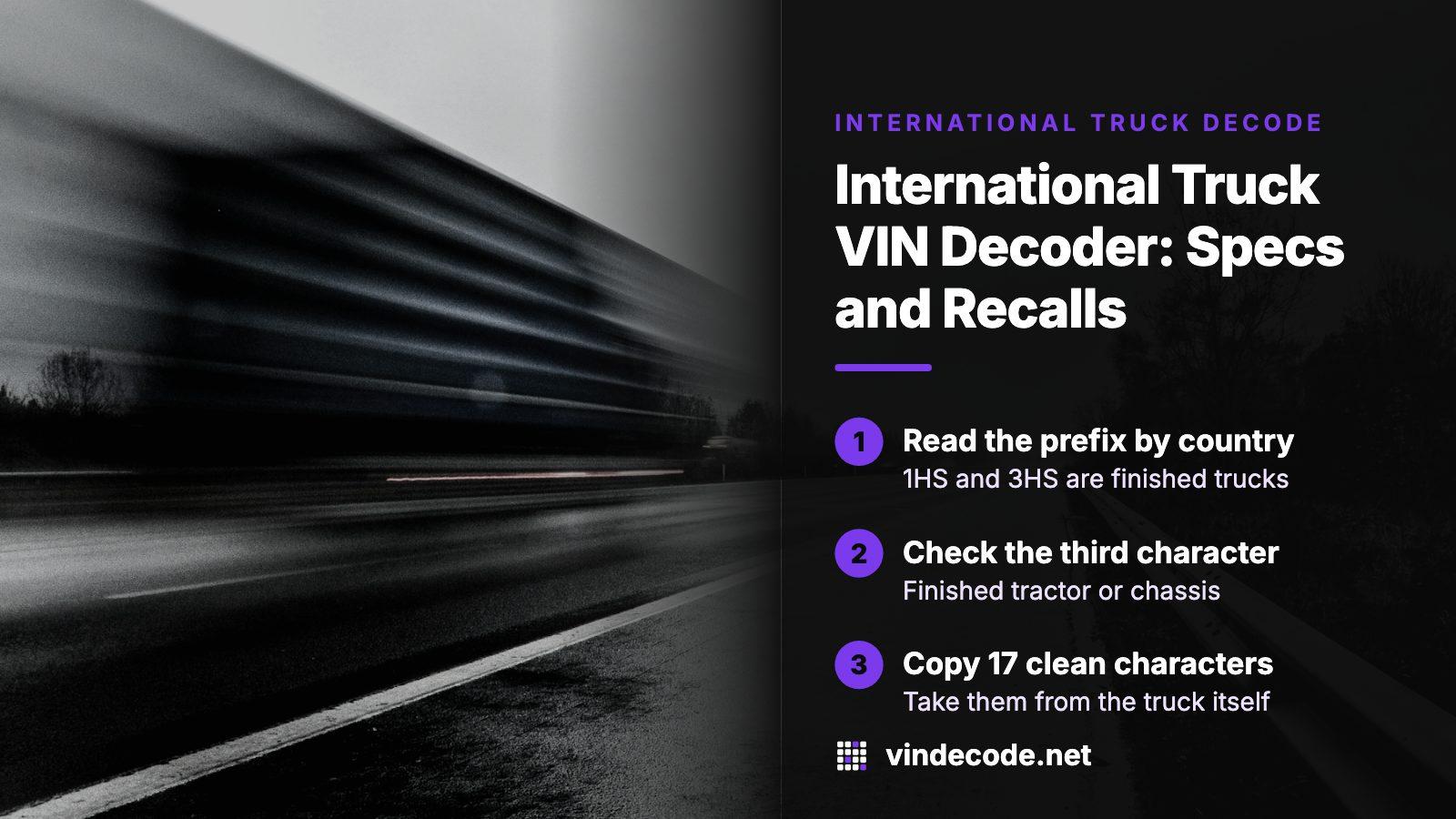
To decode an International truck VIN, enter all 17 characters in the decoder above. It returns model, model year, body class, weight class, engine and country of assembly. A 1H, 2H or 3H start means a U.S., Canadian or Mexican build, and the third character separates finished trucks from chassis. Accident, title, lien and mileage records are not in a decode, so open the history preview next.
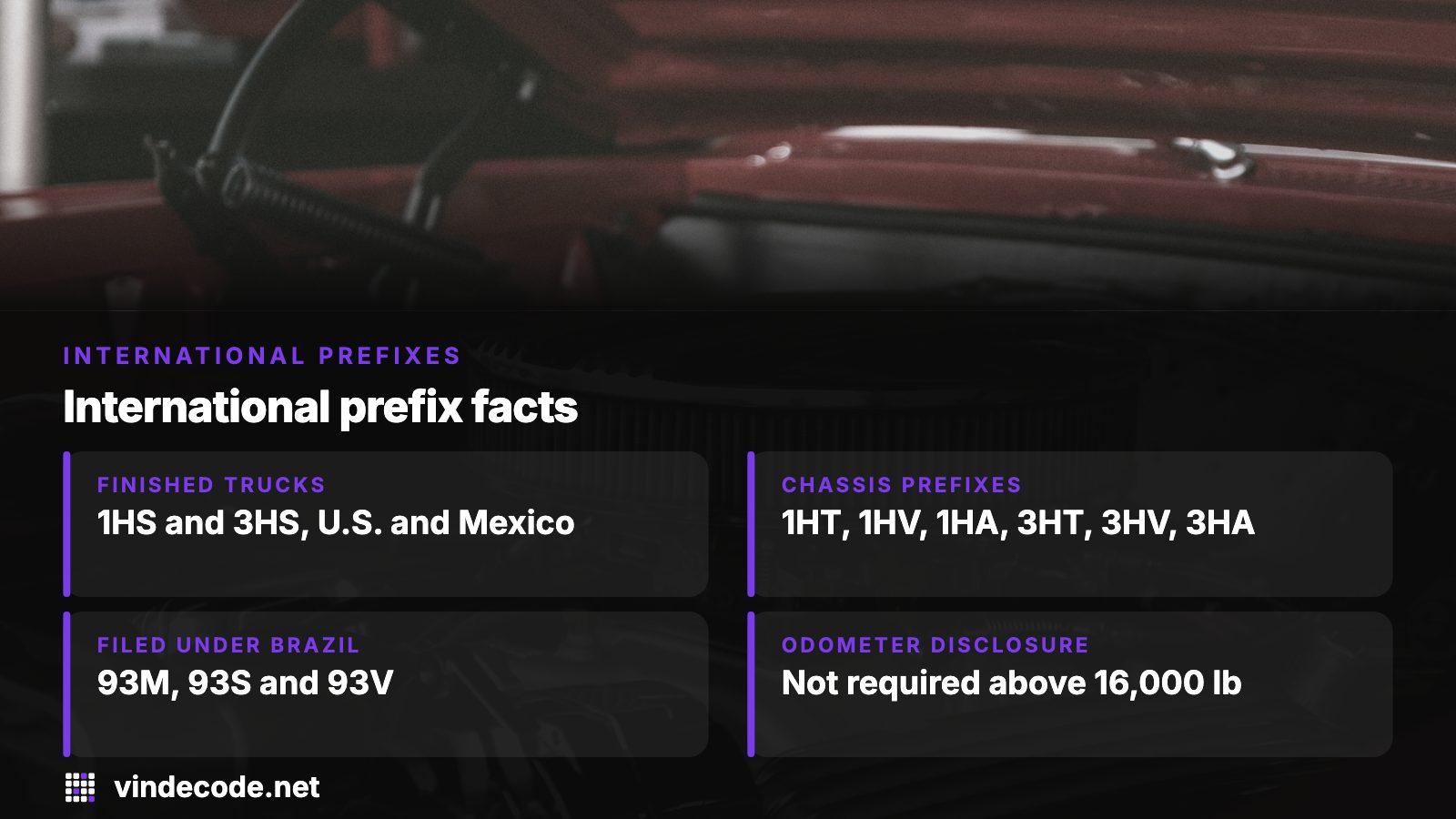
- Finished trucks, U.S. and Mexico
- 1HS and 3HS
- Chassis prefixes
- 1HT, 1HV, 1HA, 3HT, 3HV, 3HA
- 93M, 93S, 93V
- Filed under Brazil
- Odometer disclosure
- Not required above 16,000 lb
What the decoder reports on four real International VINs
We ran partial VINs from public NHTSA complaint records through NHTSA's vPIC decoder, with asterisks where the record hides characters. Each returned a full build profile.
| VIN starts | Model and year | Type | Weight class | Built |
|---|---|---|---|---|
| 3HSDZAPR*LN | LT625, 2020 | Truck-tractor, Cummins X15 | Class 8 | Mexico |
| 3HCDZTZR*KL | LT625, 2019 | Truck-tractor, International A26 | Class 8 | Mexico |
| 1HTKSSWK*KH | CV515, 2019 | Incomplete vehicle, 4x2 | Class 5 | Springfield, U.S. |
| 1HTEUMML*KH | MV607, 2019 | Incomplete vehicle, Cummins B 6.7 | Class 6 | Springfield, U.S. |
Every reply carried a check-digit warning, expected with an asterisk in the ninth position. On a full VIN, the same warning points to a copying slip, since that position exists to catch one.
International's prefixes, by country and by finish
NHTSA lists this make under several company names, so the prefix list runs longer than most owners expect. The register ties the first character to the country of build, with the United States, Canada and Mexico taking 1, 2 and 3 in that order.
| Prefix | Country | Type |
|---|---|---|
| 1HS, 1HP | United States | Truck |
| 1HT, 1HV, 1HA | United States | Incomplete vehicle |
| 3HS, 3HR, 3HC | Mexico | Truck |
| 3HT, 3HV, 3HA | Mexico | Incomplete vehicle |
| 2HS, 2HP | Canada | Truck |
| 2HT, 2HV | Canada | Incomplete vehicle |
| 93M, 93S | Brazil | Truck |
| 93V | Brazil | Bus |
The 93 entries are the odd ones. Because NHTSA files them under Brazil, a U.S. listing carrying one deserves a question about where the truck came from.
One LT625, two manufacturer names
Decode two 2019 LT625 tractors and the make reads International on both, yet the manufacturer field can differ. A 3HS number returned International Motors, LLC. A 3HC number returned Blue Diamond Truck, whose parent field points back to International Motors. Neither is a warning on its own.
- International Motors, LLC: most 1H and 3H prefixes, and the legal name on the maker's website and its 2025 recall filings
- Navistar, Inc.: the filer on recall campaigns in the data through 2023
- Navistar Canada, Inc.: the 2H prefixes
- Blue Diamond Truck: the 3HA and 3HC prefixes
- IC Bus, LLC: its own prefixes for buses, such as 4DR
Search by VIN rather than company name, since a name search can miss what the other filer holds.
Finished tractor or chassis: the third character
Under 1HS or 3HS the truck left the plant complete. Under 1HT, 1HV, 1HA, 3HT, 3HV or 3HA it left as a chassis that a second company finishes. The CV515 and MV607 above are chassis, and vPIC warns that such a truck may have been altered since the factory.
Federal rules require a label at each stage. The chassis maker records its name, build date, weight ratings and the VIN, and stays responsible for the parts it fitted. The last company to work on the truck adds its own certification label.
From an NHTSA owner complaint
An owner of a 2019 International CV515, VIN starting 1HT, reported the front end bouncing hard and patchy front tire wear at roughly 17,000 miles. A shop blamed a failed suspension. The owner also found the door label listing 245/70R19.5 tires while 225/70R19.5 were fitted. This is the owner's account, not an NHTSA finding.
Take from it that a label and a truck can disagree. Read the door label against what is bolted on, and ask who completed the vehicle.
Getting 17 clean characters off the truck
The maker's label belongs at the driver's door, on the hinge pillar, latch post or door edge, or failing that on the left of the dash panel. It is meant to be permanent, so one that peels, looks swapped or is missing needs an explanation.
- Photograph every label first, including the one naming the company that completed the truck.
- Copy the VIN, then match it to the title and the ad, digit by digit.
- Enter all 17 characters. A check-digit warning usually means a copying slip, though the number may also not be a real VIN.
- Hold the result against the label: model, year, weight class and engine should agree.

Weight class and mileage on a working truck
Weight class is the firmest field in a decode, since it comes from the rating the maker filed. Class 5 runs 16,001 to 19,500 pounds, Class 6 runs 19,501 to 26,000 and Class 8 starts at 33,001. An LT625 listed in a lighter class is misdescribed, and the decode shows it in seconds.
Mileage is the weak spot. The federal odometer rule excuses a seller from stating mileage when the vehicle's rating tops 16,000 pounds, which covers every truck in the first table, so the title may carry no figure.
From an NHTSA owner complaint
An owner of a 2019 International LT625, VIN starting 3HS, reported a loud engine knock, warning lights and lost power in December 2023. The dealer suspected a cracked block and head, but only a teardown would confirm it. The owner put the mileage near 625,000 and said the manufacturer had been told but gave no help. This is the owner's account, not an NHTSA finding.
A decode would say LT625, 2019, Class 8, and nothing about those miles. Ask for service records and pay for an engine inspection before paying for the truck.
Recalls on an International: one lookup, several filers
A VIN lookup at NHTSA shows which campaigns apply to the one truck in front of you. A model-year list is longer: NHTSA's data for 2019 LT trucks holds 18 campaigns, and each names only 'certain' vehicles.
Some repairs have a history. Wrist-pin trouble on 2018 to 2021 LT trucks appears in three campaigns, filed in 2020, 2021 and 2022 (20V255000, 21V281000 and 22V691000), each naming a different spread of models. Ask the seller which numbers were completed.
Companies that modify a truck can file separately. The 2019 CV list includes a 2020 campaign filed by Maintainer Corporation of Iowa, not the chassis maker, about a power take-off installed incorrectly on modified CV 515 tow trucks.
After the decode: what a history report adds
A decode stops at the factory gate. A history report searches records filed under the same VIN afterward, and a few of them move the price of a used International.
| Record | What it tells you |
|---|---|
| Title brands | Salvage, rebuilt or any other brand on the title |
| Accident and damage records | Where the truck took a hit, if it did |
| Salvage and auction history | Auction sales, with photos |
| Odometer readings | Whether recorded miles climb the way real use would |
| Liens and theft records | A lender's claim, or a stolen-vehicle report |
Entering a VIN gives a free preview. After that you pay once. Buy a single report, or buy 3, 5 or 10 in one go; nothing renews. The pricing page has current rates. A quiet report means nothing was filed under that VIN, not that nothing happened, so read it beside an inspection.
A sensible order before money moves
- Photograph the door label and any second label on the truck.
- Decode the VIN above and compare model, year, weight class and engine with the advert.
- On a 1HT, 3HT, 3HA or other chassis prefix, ask who completed the truck and request their paperwork.
- Check the chassis VIN in NHTSA's recall search, then ask the body builder about its own campaigns.
- Open the history preview. If the truck still looks right, buy the full report.
- Pay a mechanic you chose to inspect the engine, frame and body, and ask to see service records.
Where this information comes from
- NHTSA: vPIC VIN decoder — The public register where International's prefixes, filers and countries are listed, and where the partial-VIN decodes were run.
- NHTSA: recalls lookup — The federal check for open campaigns by VIN. Campaign details on this page came from NHTSA's recall data.
- eCFR: 49 CFR 565.15, VIN content — What the characters must identify, the check digit and the weight class ranges.
- eCFR: 49 CFR 567.5, vehicles built in stages — The labels and responsibilities of the chassis maker and the final-stage builder.
- eCFR: 49 CFR 580.17, odometer exemptions — Why a seller need not state mileage on a vehicle rated above 16,000 pounds.
- NHTSA owner complaint 11563701 — owner experience, paraphrased
- NHTSA owner complaint 11567014 — owner experience, paraphrased
Sources and photos: Facts checked against the sources above in November 2026. Photos by Ümit Yıldırım, Carrie Allen www.carrieallen.com and Victor Hughes on Unsplash; diagrams by VINDecode.
Keep reading
- Semi Truck VIN Decoder: Decode the Tractor, Then Check Its HistoryThe Class 8 basics that apply to any heavy tractor, whatever the brand.
- Freightliner VIN Decoder: Tractor, Chassis or Coach UnderneathAnother chassis maker whose numbers end up under other companies' bodies.
- NHTSA VIN Decoder: What It Returns, Where It Stops, What Comes NextWhat the federal decoder behind these results covers, and where it stops.
- Sample reportA finished report, to see what the history adds after the decode.
Frequently asked questions
What do the first three characters of an International VIN mean?
They name the filing company, the country and the finish. 1HS and 3HS are finished trucks built in the United States and Mexico, 2HS is Canadian, and 1HT, 3HT and 3HA are chassis that another company completes.
Why does my decode name Blue Diamond Truck?
The 3HA and 3HC prefixes are filed under Blue Diamond Truck, a Mexican company whose parent field points to International Motors, LLC. The make still reads International. Check the model and year against the door label.
Are 93M, 93S and 93V International codes?
They are filed to International Truck and Engine Corporation, but under Brazil, with 93V listed as a bus. If a U.S. listing shows a 93 number, ask the seller where the truck came from.
Does the decode show wrecks or mileage?
No. It reads the factory coding only. Accident, salvage, lien and odometer records are filed later, and a seller need not state mileage above 16,000 pounds, so ask for service records too.
Does a recall lookup cover the body and equipment fitted afterward?
Not reliably. A company that modifies or equips a truck can file under its own name, as with the 2020 power take-off campaign on modified CV 515 tow trucks. Search the chassis VIN, then call whoever built the body.
Now check the car itself
The guide explains what to look for. The report shows what this VIN has on record.