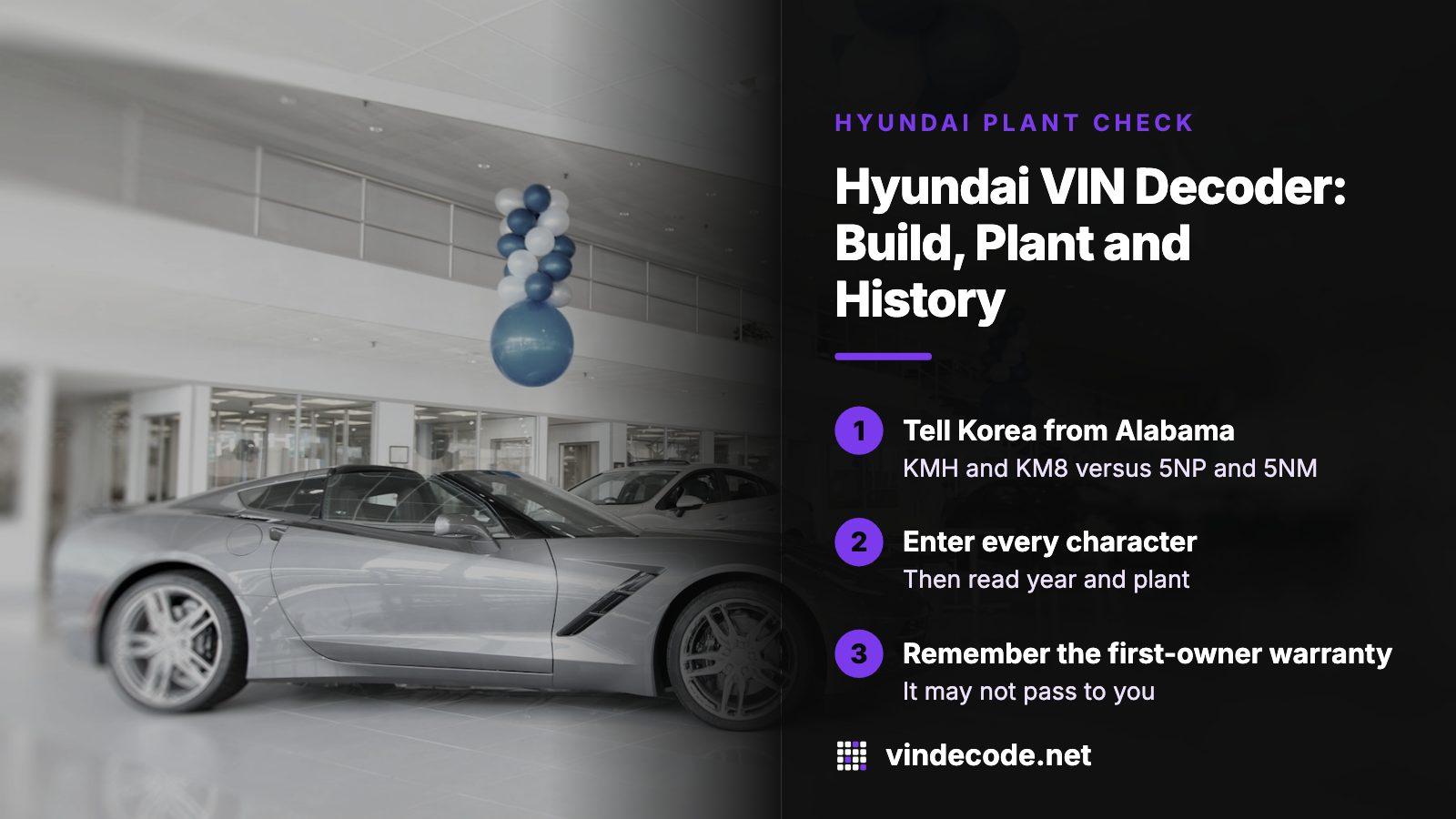
THE SHORT ANSWER
To decode a Hyundai VIN, enter all 17 characters. The prefix tells you whether Korea or Alabama built the car, and later positions give the model year and plant. The result confirms what the car is, not what has happened to it. Crashes, title brands and odometer history sit in a separate record, so run the free preview first and spend on the full report only for a car that survives it.
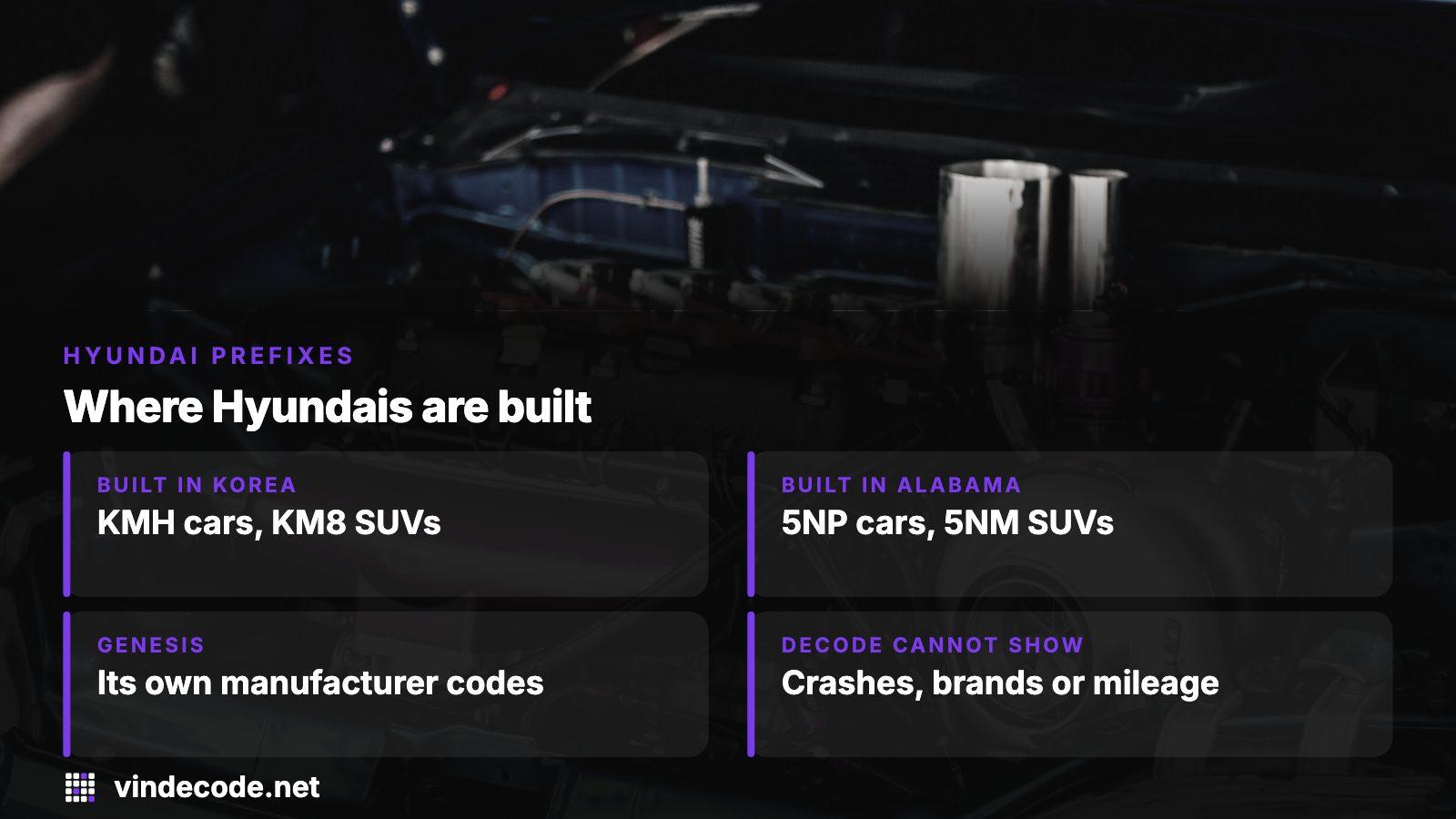
- Built in Korea
- KMH cars, KM8 SUVs
- Built in Alabama
- 5NP cars, 5NM SUVs
- Genesis
- Its own manufacturer codes
- A decode cannot show
- Crashes, brands or mileage
What the decode returns for a Hyundai
A decode checks your VIN against the structure Hyundai filed with NHTSA, so the answer is the factory's description of the car, not the seller's. Most of it is routine, which is the point: it exposes an ad naming the wrong engine, drivetrain or year.
| Decoded field | What to hold it against |
|---|---|
| Model year, model and body class | The year on the title and the body style in the ad |
| Engine size, cylinders and fuel type | The engine the listing names, since one model can carry more than one |
| Drivetrain | Front-wheel or all-wheel drive, as advertised |
| Country and assembly plant | Korea or Alabama, which can matter for recall scope |
Raise any mismatch before you talk price.
Reading the number off the car, and typing it right
Trust the metal, not the listing. Copy the number from the car itself and read it twice.
- Peer through the windshield toward the dash on the driver's side. A small plate there carries the number.
- Swing the driver's door open and read the label fixed to the frame. It has to match the plate.
- Compare both with the title and the insurance card, then type all 17 into the box. The alphabet used for VINs skips I, O and Q, so anything that looks like an O is the digit zero.

Korea or Alabama: what the first three characters say
Hyundai assembles cars in Korea and at a plant in Alabama, so both kinds of prefix turn up on lots across the USA. Neither is a warning sign, and the specification is the same wherever the car was put together.
| Prefix | What it says |
|---|---|
| KMH | Built in Korea, a passenger car |
| KM8 | Built in Korea, an SUV or multipurpose model |
| 5NP | Built in Alabama, a passenger car |
| 5NM | Built in Alabama, an SUV |
Character 10 is the model-year code and 11 marks the plant. Where and when a car was built matters mainly for recalls, which are often keyed to the plant and the build date. Two Hyundais that look identical can sit on opposite sides of one campaign. The prefix cannot say whether yours is affected. A lookup on your VIN can.
The warranty that stops at the first owner
Hyundai built its name on a long powertrain warranty, and many used buyers shop the brand with that figure in their heads. The catch is who holds it. The long term generally belongs to the original purchaser, and a later owner usually gets a shorter powertrain term.
| Owner | Coverage that applies |
|---|---|
| Original purchaser | The full advertised term |
| Second and later owners | A shorter powertrain term |
| Basic coverage | Runs out its own term whoever owns the car |
| Emissions coverage | Federally mandated, so it passes to the next owner |
From an NHTSA owner complaint
The owner of a 2018 Tucson, bought used at 26,000 miles, told NHTSA the engine now burns oil at about four quarts for every thousand miles. Hyundai refused to replace the engine because the owner was not the first, and the owner says nobody had explained that the 100,000-mile coverage falls to 60,000 miles for later owners.
That owner learned the terms after the engine failed. A buyer can learn them first, with one call to a dealer.
Genesis and Kia: related brands, separate codes
Genesis is now a standalone luxury brand with manufacturer codes of its own, the arrangement Lexus has with Toyota. Before the separate brand existed, Hyundai sold a model named Genesis. Those cars are Hyundais, and the model year in the VIN separates them from the later range better than the badge.
Kia belongs to Hyundai's parent group, and the two share platforms and engines but not manufacturer codes. That helps research, since a documented fault on a Kia carrying the same engine often points at your car as well. Your own recall and campaign status still comes only from your own VIN.
Open recalls, and the fixes that never show up as recalls
Recalls follow ranges of VINs, not a model name, so only a lookup by VIN gives a reliable answer. NHTSA's lookup costs nothing and the dealer repairs a recalled car without charge. It lists federal safety recalls only. Hyundai has run service programs that sit outside the recall system too, an anti-theft software update for certain model years among them, and a clean federal result is silent on those.
From an NHTSA owner complaint
The owner of a used 2018 Tucson told NHTSA the engine failed on the highway at about 71,000 miles. Hyundai declined a replacement, citing an unfinished knock-sensor software campaign. The owner says no notice of that campaign, or of an ABS-module fire recall still open on the car, ever arrived.
A buyer who runs the VIN does not have to wait for a letter. Check the federal lookup, then ask a dealer which campaigns were completed and request the paperwork.
Red flags when the decode and the car disagree
Some mismatches are paperwork slips; others signal a car that is not what it claims. Put each to the seller, in writing if possible.
| What you find | What to do |
|---|---|
| Decoded engine or drivetrain differs from the ad | Ask which is right, then price from the decode |
| Plate and door label show different numbers | Stop and get a written explanation before any deposit |
| The model-year character disagrees with the title | Ask the seller to explain and check the title record |
| A Genesis badge on a Hyundai VIN, or the reverse | Believe the VIN over the badge |
| The seller quotes the full advertised warranty on a used car | Ask a dealer what remains for a later owner |
After the decode: the history report as the next step
A decode describes the car at the point of manufacture and is blind to everything since. A salvage brand, a collision, a lien or a wound-back odometer is not written into the 17 characters. Those facts sit in title, damage and odometer databases, which the history report gathers under the same VIN.
- Title brands and accident or damage records
- Odometer readings across the car's life, to test the dash
- Salvage and auction history with photos
- Theft and insurance records, relevant to model years in the anti-theft program
- Liens, impounds and the number of owners
If the decode matches the ad and the preview raises nothing, buying the full report is the sensible next step.
What it costs, and a sensible order for a used Hyundai
Start with the preview, which is free and asks for no card. The full report is bought once, alone or as a bundle of three, five or ten for shoppers comparing cars. Nothing is billed monthly, and amounts are listed on the pricing page.
- Decode the VIN and set every field against the listing before you travel.
- Run NHTSA's free recall lookup, then ask a dealer about manufacturer programs such as the anti-theft update.
- Ask a Hyundai dealer which powertrain term remains for a second owner.
- Open the history preview, and buy the report once the build and the story agree.
- Match both VIN locations to the title at handover.
Where this information comes from
- NHTSA: vPIC VIN decoder — The public federal database where manufacturers file how their VINs are structured.
- NHTSA: recalls lookup — Free open-recall check by VIN, with repairs made at no cost by the manufacturer.
- EPA: fueleconomy.gov — Official fuel economy figures by engine and drivetrain, useful once the decode names the configuration.
- NHTSA owner complaint 11681222 — owner experience, paraphrased
- NHTSA owner complaint 11736491 — owner experience, paraphrased
Sources and photos: Facts checked against the sources above in November 2026. Photos by Richard R, Cole Keister and Willian Cittadin on Unsplash; diagrams by VINDecode.
Keep reading
- Kia VIN Decoder: Decode the Build, Then Check the HistoryThe sister brand in the same group, with its own manufacturer codes.
- VIN Decoder: Decode a VIN Number Online, Then Check Its HistoryEvery VIN position explained, including the check digit.
- NHTSA VIN Decoder: What It Returns, Where It Stops, What Comes NextHow the federal decoder behind these results works.
- Sample reportA finished report, to see what the history adds after the decode.
Frequently asked questions
How do I decode a Hyundai VIN?
Type all 17 characters into the VIN box. The decode matches them against the structure Hyundai filed with NHTSA and reports the engine, drivetrain, body class, year and plant. One wrong character gives an error or the wrong car, so recheck what you typed.
Does a Hyundai VIN decoder work for USA cars built in Korea?
Yes. A Hyundai sold new in the USA decodes the same way whether it came from Korea or the Alabama plant, and the first three characters say which. A Korean prefix on a US-market car is normal.
What does a KMH prefix tell you about a Hyundai?
It marks a passenger car built in Korea, where K is the country letter. KM8 marks Korea-built SUVs and multipurpose models. Alabama-built cars start with 5NP for passenger cars and 5NM for SUVs, so the prefix alone reveals the factory.
Do second owners get Hyundai's long powertrain warranty?
Usually not in full. The headline term generally goes to the original purchaser and later owners typically get a shorter one, while basic and emissions coverage pass on. Skip the seller's figure and give a Hyundai dealer the VIN to see what remains.
Can a Hyundai decoder show accidents or odometer problems?
No. A decode describes the car as built. Accidents, title brands and odometer readings are recorded elsewhere, so you need a history report for them. Open the free preview first. The full report is optional and bought once, with bundles for comparing several cars.
Now check the car itself
The guide explains what to look for. The report shows what this VIN has on record.