THE SHORT ANSWER
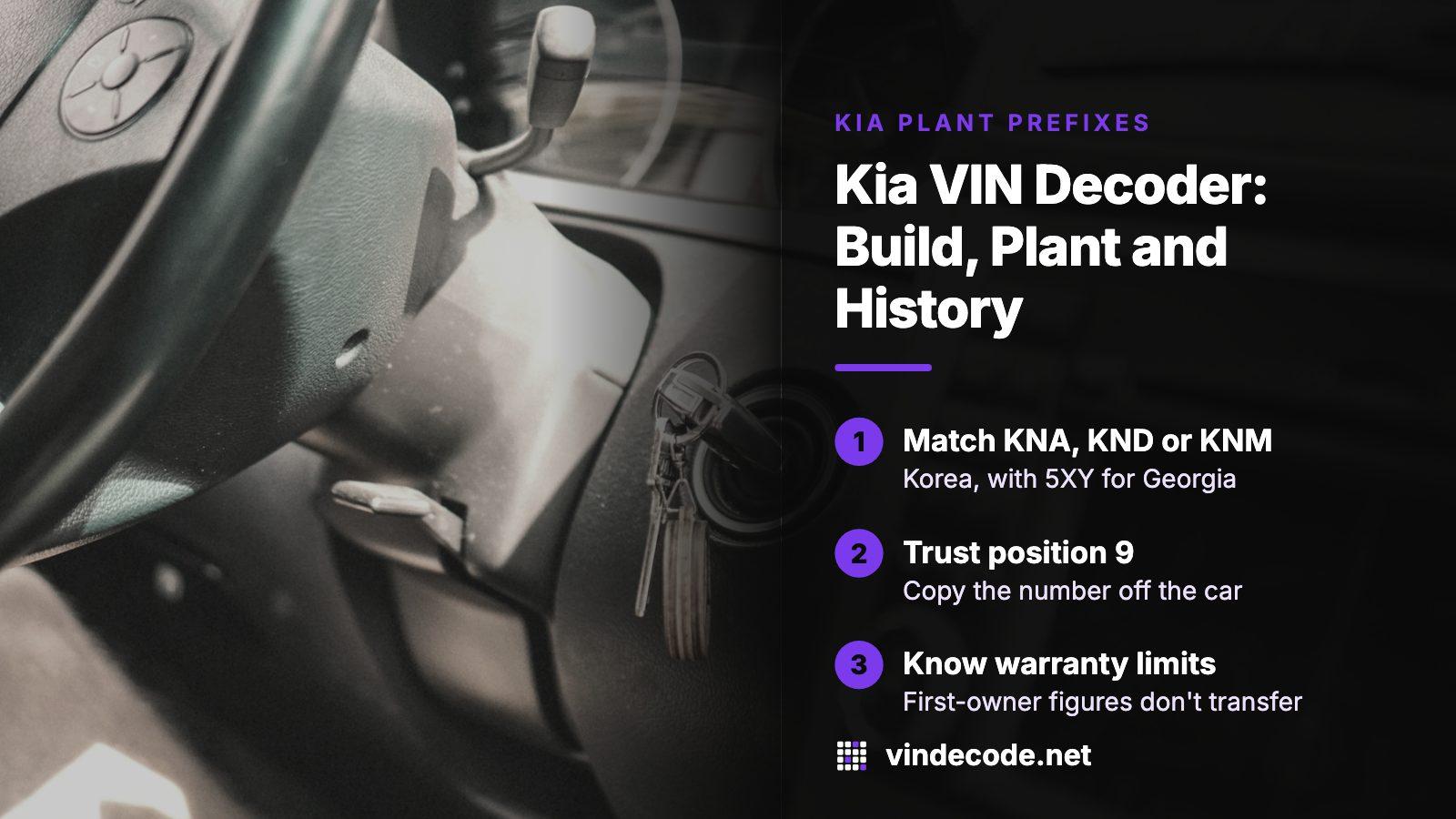
To decode a Kia VIN, type all 17 characters. A KNA, KND or KNM start means Korea, 5XY means the Georgia plant and 3KP means Mexico. Character 10 is the model year and 11 the plant. The result confirms the specification and open recalls, but not title brands, crashes, mileage or remaining warranty, so use the free preview and call a dealer before you settle on a price.
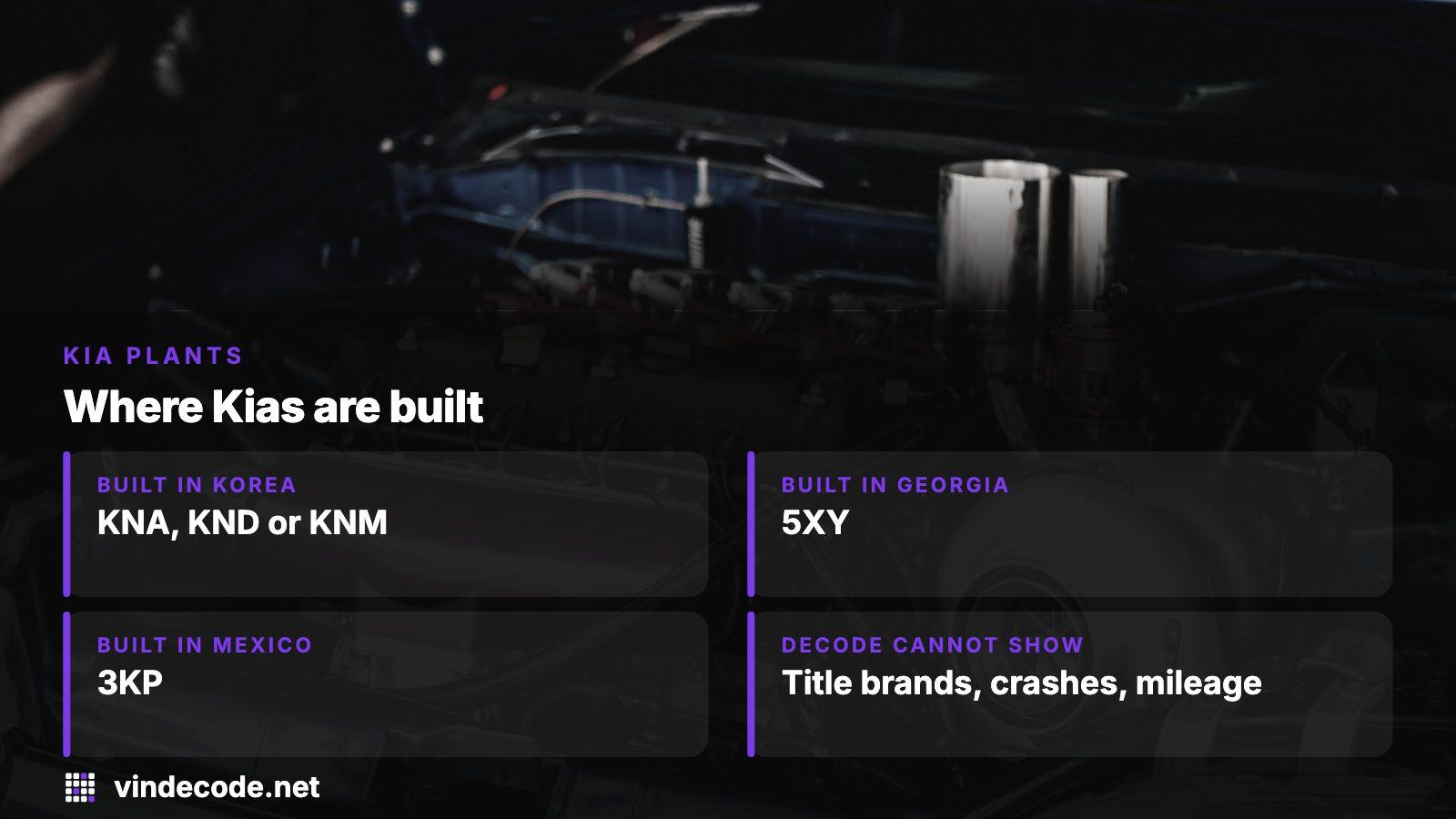
- Built in Korea
- KNA, KND or KNM
- Built in Georgia
- 5XY
- Built in Mexico
- 3KP
- A decode cannot show
- Title brands, crashes, mileage
What the decoder returns for a Kia
A Kia decode checks your number against the layout Kia filed with NHTSA. The answer is the factory's description of the car, so it exposes a listing that names the wrong engine, drive or year.
| Decoded detail | Check it against |
|---|---|
| Model year, model and body class | The title and the body style in the ad |
| Engine size, cylinders and fuel | The engine the seller quotes, since one model can offer several |
| Front- or all-wheel drive | The ad and the photos |
| Country and assembly plant | The prefix stamped on the car |
| Open safety recalls | Whatever the seller says is outstanding |
Kia and Hyundai share engines and platforms, so a fault documented on the Hyundai twin of your engine is worth reading about. It is a lead, not proof.
Copy the number off the car, then trust position 9
Typos creep into listings. Take the number from the car, read it twice, and only then type it.
- Stand beside the driver's door and crouch until you can read the plate stamped at the base of the windshield, up on the dashboard top.
- Swing the driver's door open and read the sticker on the door frame. It has to match the plate.
- Check both against the title, then enter all 17 characters. The alphabet has no I, O or Q, so what looks like an O is a zero.
Position 9 is a computed check character. A single wrong digit normally trips it and returns an error instead of some other car.

What the prefix and the middle characters say
Kias sold in the USA come from Korea, Georgia and Mexico, so a used lot shows several prefixes.
| Prefix | Assembled in |
|---|---|
| KNA, KND or KNM | Korea |
| 5XY | Georgia, United States |
| 3KP | Mexico |
Characters 4 to 8 carry the model, body style and engine code, and 12 to 17 are that car's own serial number. A Georgia prefix is ordinary, since Kia builds several popular models there. What no prefix can tell you is whether your car sits inside a recall or program. Only the full number can.
Warranty: the first owner's figure is not yours
The long powertrain term that draws buyers to Kia was written for the original purchaser. After a sale, a later owner generally gets a notably shorter term, so a car advertised with years of cover remaining may offer you only a slice of it.
- Ignore the brochure figure when you price the car.
- Call a Kia dealer, read out the VIN, and request the date the car entered service and the term a later owner receives.
- Ask about every cover separately, including corrosion, emissions and any hybrid battery, since each follows its own timeline.
- Get the answer before negotiating. If the seller's price rests on remaining warranty, the true figure is your argument.
Why the theft program never shows in a recall lookup
Certain Kia model years left the factory with no engine immobilizer, and thefts of them made headlines. Kia responded with a software update and hardware measures. That fix is run by the manufacturer outside the federal recall system, so NHTSA's lookup can show nothing open on a car that never got the update. Read an empty result as silence, not an all-clear.
- Ask a dealer whether the VIN qualifies for the software update and whether it was done.
- Ask about the steering wheel lock supplied with the program.
- Request an insurance quote on the real VIN, since carriers have rated affected years differently.
- On a used car, settle the update before the price.
- Run NICB's VINCheck, a free theft lookup, on these years.
Recall letters follow the first owner
A recall is tied to a range of VINs, not a model name, and when a part is shared the Hyundai version often gets a parallel campaign. NHTSA's lookup answers for your exact VIN and the dealer repairs the car at no cost. The gap is the post: notices go to addresses on file, and a car that has been sold can drop off the list.
From an NHTSA owner complaint
One 2013 Optima owner told NHTSA the car quit running on the road and ended up at a dealership. The owner says a recall applies, but because they were not the first owner they "never got a recall letter". According to the complaint, the dealer is now refusing the repair.
Do not wait for the mail. Look the VIN up yourself, and keep in mind that manufacturer programs, the anti-theft update included, are absent from the federal list.
Where the decode stops and the history report starts
A decode shows the Kia as it left the factory. Nothing after that is encoded in the 17 characters. Title, damage and odometer entries live in separate records filed under the same VIN, and a history report is where they are collected. Hybrid and electric models add a gap of their own: the decode names the powertrain but says nothing about battery health, so ask what battery cover remains and whether a second owner inherits it.
From an NHTSA owner complaint
Another 2013 Optima owner told NHTSA the engine seized at about 136,000 miles. An insurer had totaled the car after a hit-and-run in October 2024, and it was later registered with a rebuilt title. The dealer agreed the engine had failed but said the branded title ruled out a repair, and Kia customer care turned the request down.
A decode of that car returns a clean 2013 Optima. The total-loss record sits in title history, and as this owner learned, it can decide what the maker will repair.
- Title brands such as salvage and rebuilt
- Crash and damage entries, showing where to look underneath
- Earlier odometer readings, to test the dash
- Auction history with photos after a loss
Red flags when the decode and the listing disagree
A mismatch can be a harmless slip or a sign the car is not what it claims. Raise each one before any money moves.
| What you see | What to do |
|---|---|
| Decoded engine or drive differs from the ad | Ask which is right, then price from the decode |
| Windshield plate and door sticker disagree | Hold the deposit until the seller explains in writing |
| Character 10 conflicts with the year on the title | Ask to see the title record |
| The seller quotes the full headline warranty | Get the later-owner term from a dealer |
| Nobody can say if the anti-theft update was done | Ask a dealer by VIN and get an insurance quote |
What it costs, and a sensible order for a used Kia
Opening the preview costs you nothing. A Kia report is paid for once, either alone or as a set of 3, 5 or 10 should you be comparing a few cars. No plan renews, and you can read the amounts on the pricing page.
- Run the Kia VIN through the decoder first and check every field against the listing before any trip.
- Run NHTSA's recall lookup, then ask a dealer about the anti-theft update and the later-owner warranty.
- Look at the history preview next, and pay for the report only on cars that still seem sound.
- At handover, read both VIN locations on the car against the title.
Where this information comes from
- NHTSA: vPIC VIN decoder — The public federal database where Kia files how its VINs are laid out.
- NHTSA: recalls lookup — Open-recall check by VIN, with repairs at no cost. Manufacturer programs sit outside it.
- NICB: VINCheck — A theft lookup by VIN, relevant to the model years in the anti-theft program.
- NHTSA owner complaint 11690064 — owner experience, paraphrased
- NHTSA owner complaint 11710781 — owner experience, paraphrased
Sources and photos: Facts checked against the sources above in November 2026. Photos by tim, Tigran Shishmanyan and Willian Cittadin on Unsplash; diagrams by VINDecode.
Keep reading
- Hyundai VIN Decoder: Read the Build, Then Check the HistoryThe sister brand in the group, with its own manufacturer codes and Alabama plant.
- VIN Decoder: Decode a VIN Number Online, Then Check Its HistoryAll 17 positions of a VIN, including how the check digit works.
- Sample reportA finished report, to see what the history adds once the decode is done.
- PricingSingle reports and bundles, and how the one-time payment works.
Frequently asked questions
How do I decode a VIN for a Kia?
Type the 17 characters into the decoder box with no spaces. The result lists model year, body class, engine, drive type and assembly plant from Kia's filing with NHTSA. An error usually means a mistyped character, because position 9 acts as a checksum.
What does KNA mean at the start of a Kia VIN?
It marks a Kia assembled in Korea, where the letter K stands for the country. KND and KNM are other Korean prefixes. Georgia-built cars start with 5XY and Mexican ones with 3KP, so three characters tell you the factory region.
Does the Kia warranty transfer to a second owner?
Only in part. The long powertrain term quoted in ads is the original purchaser's, and a later owner generally gets a much shorter one, while other cover runs on its own schedule. Give a Kia dealer the VIN and ask what applies to you from the in-service date.
Can a Kia VIN decoder show accidents or a salvage title?
No. A decode describes the car as built, so crashes, title brands and mileage history never appear in it. They live in separate records. Run the free preview to see whether any exist, and buy the report only if you want the detail. It is one payment.
Which Kias were hit by the theft problem?
The program covers certain model years that left the factory without an engine immobilizer, and a decode alone will not say whether yours is one. A dealer can check eligibility from the VIN and tell you if the update was applied. NHTSA will not list it.
Now check the car itself
The guide explains what to look for. The report shows what this VIN has on record.