THE SHORT ANSWER
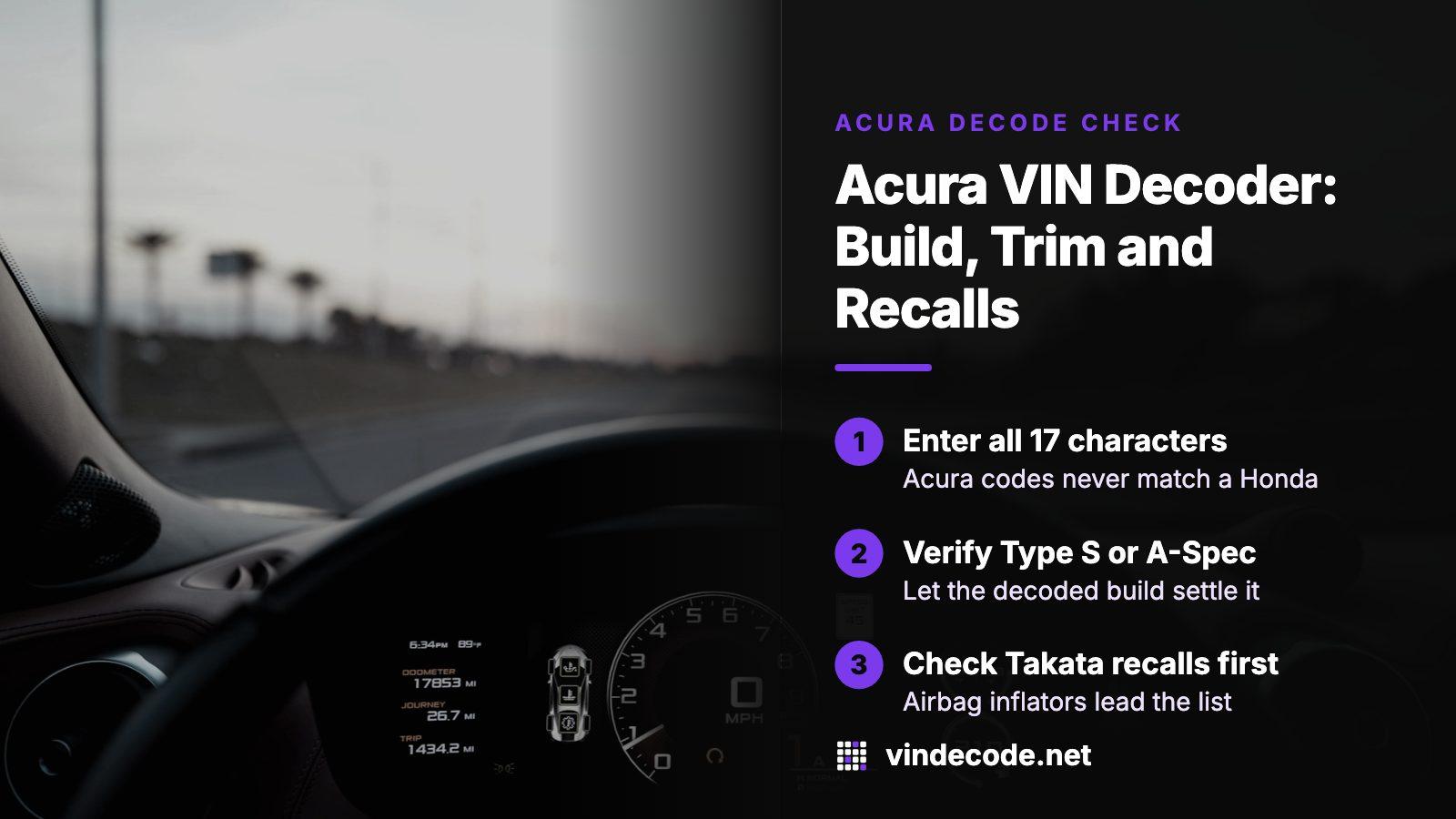
To decode an Acura VIN, enter all 17 characters. Acura has its own manufacturer codes, so the first three never match a Honda. The decode returns the model year, engine, drivetrain and plant, but it cannot show crashes, brands or mileage. For those, open the free preview of a history report, then buy the full report only when the car still holds up.
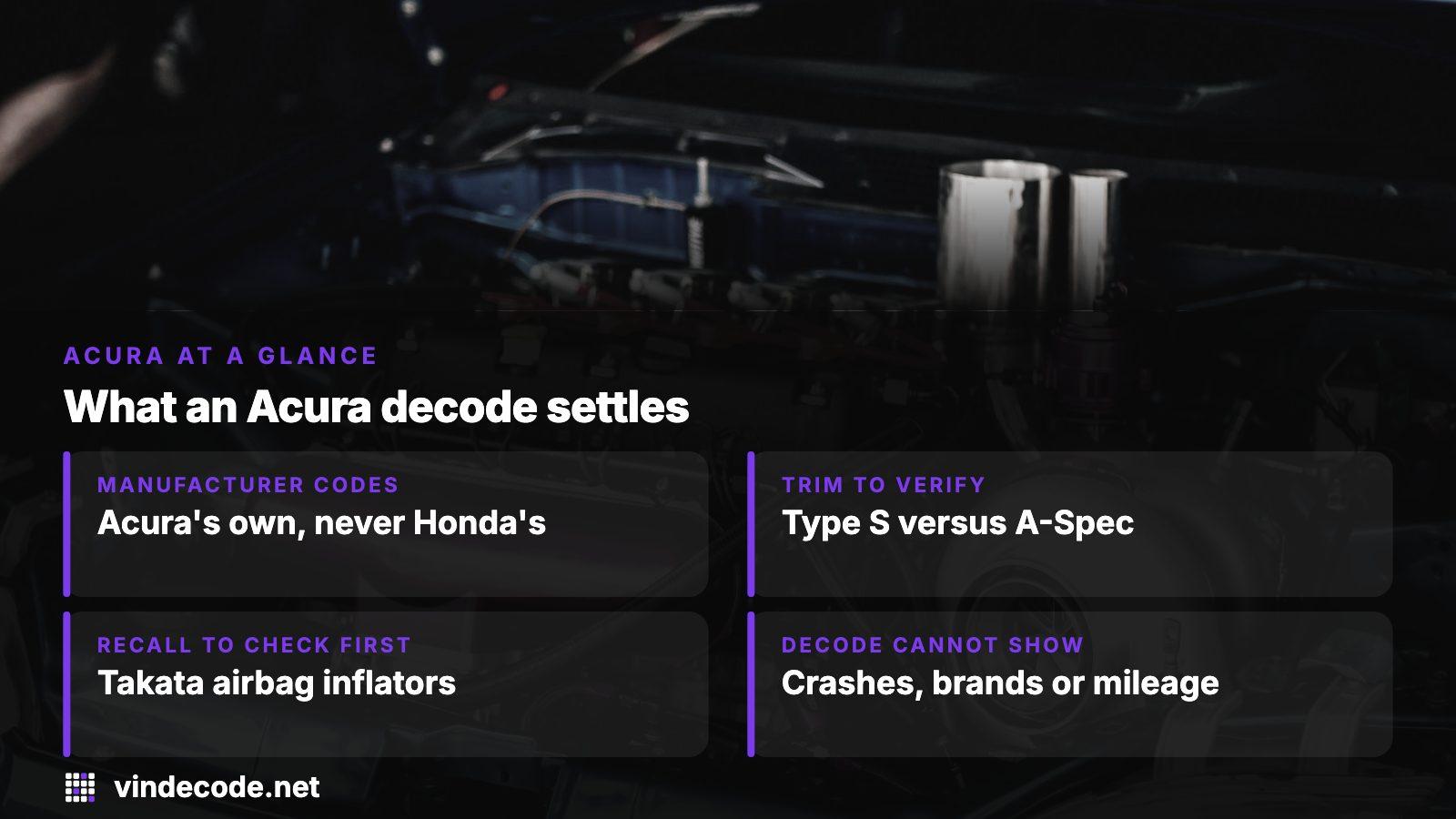
- Manufacturer codes
- Acura has its own, never Honda's
- Trim to verify
- Type S versus A-Spec
- Recall to check first
- Takata airbag inflators
- Decode cannot show
- Crashes, brands or mileage
What an Acura decode actually returns
A decode reads the VIN against the structure Acura filed with NHTSA, so what comes back is the car as the factory specified it, whatever the ad says today. A listing can claim anything, while the number was assigned at the factory and has to match the car.
- Model year, model name and body style
- Engine size, cylinder count and fuel type
- Front-wheel drive or all-wheel drive
- Which restraint system the factory fitted
- Country of assembly and the plant that built it
- Open safety recalls for that exact car, looked up in NHTSA records
Hold each line up against the listing. An engine or drivetrain that differs from the seller's claim is the first thing to raise with them.
Find the VIN and enter it correctly
The most reliable copy is the one on the car itself. The two numbers you find there must be identical, and both must match the paperwork.
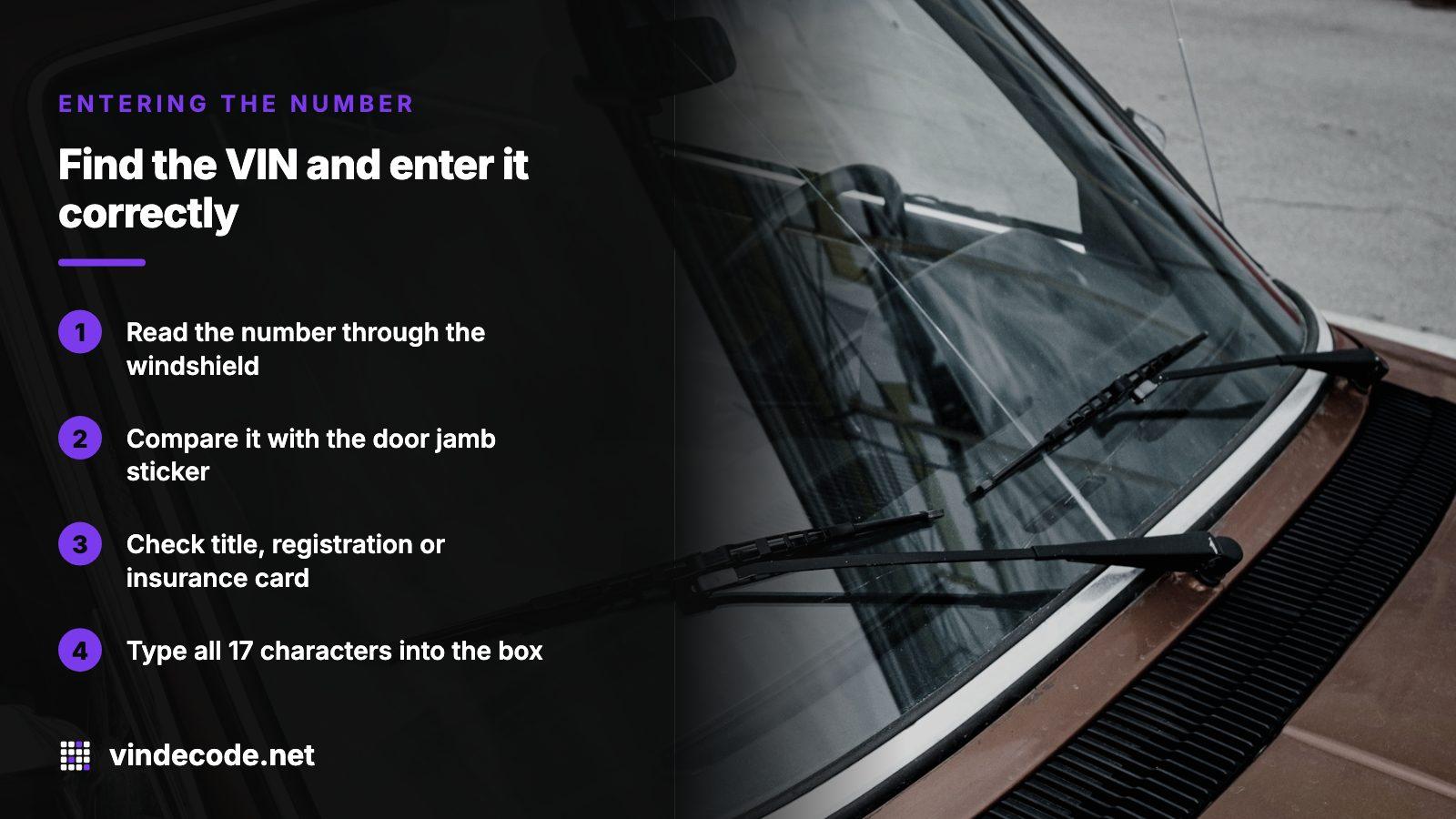
- Stand at the driver's side of the dash and read the number through the glass where the windshield meets it.
- Open the driver's door and compare it with the sticker on the jamb.
- Check the title, registration or insurance card for the same characters.
- Type all 17 characters into the box on this page. A VIN never contains I, O or Q, so a character shaped like an O is really a zero.
| What it identifies | Where it sits |
|---|---|
| Maker and country | Characters 1 to 3 |
| Model, body style and engine | Characters 4 to 8 |
| Check digit that validates the rest | Character 9 |
| Model year | Character 10 |
| Assembly plant | Character 11 |
| Production serial number | Characters 12 to 17 |
Acura's own codes, and why they are not Honda's
Acura is Honda's luxury marque and the two share plenty of engineering, yet manufacturer identifiers are issued per marque. An Acura VIN therefore never opens with a Honda code. Lexus and Toyota follow the same pattern.
| Prefix | Where it was built |
|---|---|
| JH4 | Japan, passenger car |
| 19U | United States, passenger car |
| 5J8 | United States, multipurpose vehicle and SUV |
| 2HN | Canada, Honda's Canadian operations |
A US or Canadian prefix is normal, since several models are assembled in North America. Acura holds other codes beyond these four, so decode an unfamiliar prefix instead of guessing from it. The warning sign is a mismatch: an Acura badge on a VIN that decodes to Honda, or the other way round, needs a full explanation before any money moves. Badges bolt on. The VIN does not.
Type S or A-Spec: let the build settle it
Listings blur these two. Type S means different mechanicals: its own powertrain and chassis tuning. A-Spec dresses an ordinary model with styling and extra equipment. It can be a good car, but it is a different car to own and to price, and the body kits look close enough that a seller can be sincere and still wrong.
What the VIN decodes to is the model and engine that left the plant. Price the car from that, not from the badge on the trunk lid.
- Confirm the engine through the decode before price comes up.
- Match the engine stamping to the decode, because swaps turn up in this family more than in most.
- Check that the brakes and suspension suit the variant being advertised.
- Have a dealer check the VIN against how the car was originally built.
Confirming the all-wheel-drive system
Torque-vectoring all-wheel drive adds value on the cars that have it, but only some models and trims do, and lettering on the body proves nothing. The decode names the drivetrain before you travel anywhere, and a look under the car confirms it.
- Get under the car and find the rear differential and propeller shaft. A car without them is front-wheel drive, whatever its lettering says.
- Ask whether the rear drive unit has its own service record.
- Drive slowly on full steering lock and notice any binding or driveline noise.
- Confirm the four tires are the same make and model and wear evenly.
What carries over from Honda and what does not
A used Acura often costs less to run than the badge implies, because much of the mechanical hardware has a Honda counterpart, sometimes the same part under a different number and at a different price. An independent shop that knows Honda hardware can usually service one.
| Area | How much is shared |
|---|---|
| Engine and drivetrain | Often the same hardware, so parts and know-how transfer |
| Suspension and brakes | Commonly built on a shared platform, with specifications that can vary |
| All-wheel-drive hardware | Acura-only parts, on the models that carry torque vectoring |
| Electronics and infotainment | Mostly Acura-only, with Acura pricing |
| Interior trim and badges | Acura-only |
Check recalls first, especially Takata
On an older Acura, the open-recall lookup matters more than any trim question. The Takata airbag inflator campaign ranks as the biggest recall the industry has seen, and a large part of the affected cars were Hondas and Acuras. The fault was an inflator that could rupture when the airbag fired, and some vehicles were put under do-not-drive warnings.
Look it up before you drive it home
On a private sale, put the VIN into NHTSA's recall lookup before you take delivery. A notice can carry instructions for driving the car in the meantime, and those instructions mean exactly what they say. The lookup costs nothing, and the owner pays nothing for the repair, however many people have owned the car.
A recall follows ranges of VINs, not a model name, and a campaign can span both Acura and Honda cars when they share a component. Search with the exact number.
Where the decode stops and the history report starts
A decode cannot see what happened to the car. A salvage brand, a crash, a rolled-back odometer or a lien is not in the number. Those come from title, damage and odometer records, and the history report gathers them.
- Accident and damage records alongside any title brands
- Salvage and auction history, photos included
- Odometer readings across the life of the car
- Liens, impounds and theft records
- Insurance records
- Who has owned it and how it was used
- Open recalls, market value and factory specs
| What you see | What to do |
|---|---|
| Decoded engine differs from the ad | Ask which is right and price from the decode |
| Decode says front-wheel drive on an all-wheel-drive listing | Treat the listing as wrong until the car proves otherwise |
| A title brand the seller never mentioned | Ask for a written explanation before any deposit |
| Odometer readings that drop between records | Treat as a red flag and walk away unless it is explained |
Cost, and where to go once the decode checks out
Enter the VIN and the preview comes first. It is free and needs no card. The full report is paid once: buy one report on its own, or a bundle of 3, 5 or 10, and nothing renews. Current prices sit on the pricing page.
A sensible order is to decode, compare the result with the ad, look up recalls, and buy the report once the build matches and the seller still looks straight. Then put the car on a lift and confirm the engine and drivetrain in person. A bundle suits you if you are weighing several cars.
Where this information comes from
- NHTSA: recalls lookup — Where to look up open recalls by VIN, including the Takata inflator campaigns.
- NHTSA: vPIC VIN decoder — The federal database where manufacturers file how their VINs are structured.
- EPA: fueleconomy.gov — Official fuel economy figures by engine and drivetrain, handy once the decode names the configuration.
Sources and photos: Facts checked against the sources above in November 2026. Photos by Dennis Eusebio, Max Tokarev and Willian Cittadin on Unsplash; diagrams by VINDecode.
Keep reading
- Honda VIN Decoder: Decode the Build, Then Check the HistoryThe parent brand, with its own codes and engine families.
- Lexus VIN Decoder: Confirm the Build, Then Check the HistoryAnother luxury marque with the same trim trap.
- VIN Decoder: Decode a VIN Number Online, Then Check Its HistoryEvery VIN position explained, including the check digit.
- Sample reportA finished report, to see what the history adds after the decode.
Frequently asked questions
How do I decode an Acura VIN?
Type all 17 characters into the VIN box. The decoder matches them against the structure Acura filed with NHTSA's public vPIC database and returns the year, model, body style, engine, drivetrain and plant. One mistyped digit usually gives an error or the wrong car, so recheck the characters.
Does an Acura VIN decoder show accidents?
No. A decode describes how the car was built. Accidents, title brands and odometer readings sit in history records, so you need a vehicle history report for them. The decode confirms the right car; the report shows its past.
Why does my Acura VIN not start with Honda's code?
Each marque gets its own world manufacturer identifier, even when it shares a platform and engine with a sister brand. Acura's start with codes such as JH4, 19U, 5J8 or 2HN. If an Acura-badged car decodes as a Honda, ask the seller to explain the difference.
Do Honda parts fit an Acura?
Many mechanical parts do, since the brands share engineering. Interior trim, badges and most electronics are Acura-specific. Ask a parts counter to check a part number against your VIN before you buy, because the same hardware can carry a different number and a different price.
Does an older Acura need a Takata recall check?
Yes, before you buy. Look up the VIN on the NHTSA recall page, which takes seconds and costs nothing. If the inflator campaign is open, have the seller get the dealer repair done before you hand over money, and follow any do-not-drive notice exactly as written.
Now check the car itself
The guide explains what to look for. The report shows what this VIN has on record.