
THE SHORT ANSWER
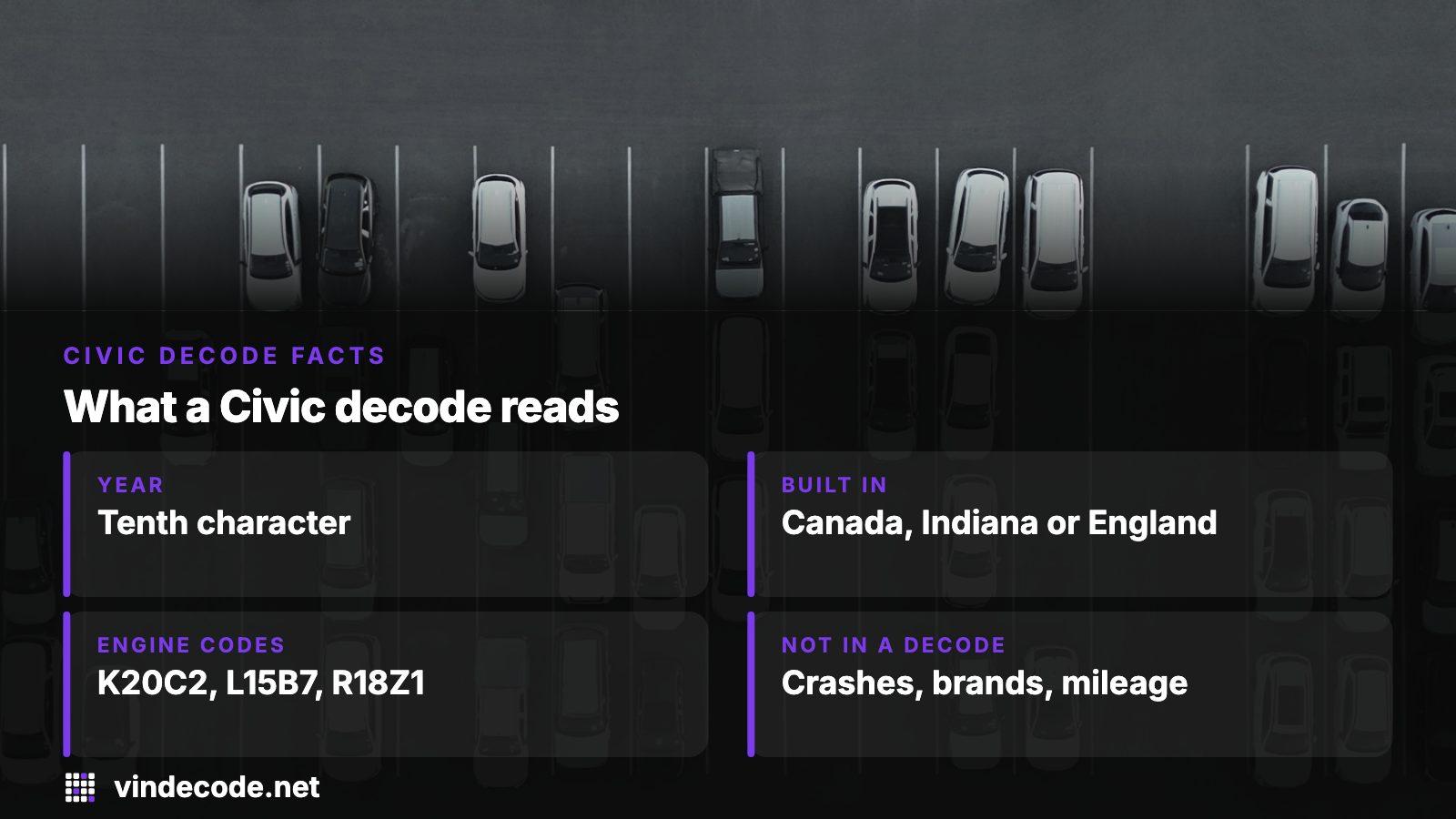
Enter all 17 characters and the decoder returns the Civic's model year, body style, trim, engine code and assembly plant, drawn from what Honda filed with NHTSA. The tenth character gives the year and a later letter gives the plant, so a Canadian prefix on a Civic is normal. A decode shows nothing about crashes, title brands or mileage. The free preview of the history report covers those.
- Year
- Tenth character
- Built in
- Canada, Indiana or England
- Engine codes
- K20C2, L15B7, R18Z1 and others
- Not in a decode
- Crashes, brands, mileage
What a Civic decode returns
The decoder compares your number with the patterns Honda submitted to NHTSA's vPIC catalog, a public database built from manufacturer-reported data. Run a few sample Civic numbers through it and the answer is specific.
| Sample VIN, made up | Decoded as |
|---|---|
| 2HGFC2F51HH500001 | 2017 sedan, LX, 2.0 liter, engine K20C2, built in Alliston, Ontario |
| 19XFC2F74LE000001 | 2020 sedan, EX, 2.0 liter, built in Greensburg, Indiana |
| SHHFK7H44KU200001 | 2019 hatchback, Sport, 1.5 liter, engine L15BA, built in Swindon, England |
| 19XFL1H78PE000001 | 2023 hatchback, EX-L, 1.5 liter, engine L15B7, built in Greensburg, Indiana |
These numbers are invented with a valid check digit, so they match no real Civic. Your own car should return the same kinds of fields.
Year, plant and prefix on a Civic
Civics reach American buyers from three countries, so the opening letters vary. In the samples above, 2HG pointed to Honda of Canada, 19X to American Honda and SHH to Honda in England. None of that is a warning sign.
- Across the samples, the tenth position read H on the 2017 car, K on 2019, L on 2020, then N and P on the 2022 and 2023 models.
- The factory came from the plant position, not the prefix alone, so read the decoded city rather than guessing from the first three letters.
- Sport variants are listed by NHTSA only for later years: its Honda model list shows a Type R from the 2018 model year and an Si in 2023, so an older car carrying those badges deserves a hard look.
If the ad says 2017 and the tenth character decodes to a different year, the listing or the number is wrong. Settle that before anything else.
Take the VIN from the steel, then type it
An advert can carry a typo, and a single wrong character brings back another car or an error message. Read the number off the vehicle yourself.
- Squat beside the driver's headlight and sight down onto the dash corner, where the stamped plate shows.
- Check the label on the door pillar, which should spell the same 17 characters.
- Lay the title or an insurance card beside them and compare once more.
- Key in all of it. Zero is the only round character a VIN holds, because the alphabet skips I, O and Q.
In testing, NHTSA's tool still answered when the final character was missing, but it flagged the result as an incomplete VIN. Treat such a reply as a draft.

Why Civic recalls follow build dates and engines
NHTSA's recall records describe affected Civics by year, production window and engine, which is why a decode is a useful first step. One 2016 campaign reached only 2.0 liter cars finished in a stretch that began in September 2015 and ended in February 2016, where a missing piston pin clip could seize the motor. Another, in 2012, covered only cars finished over five days in late October, which had the wrong steering column.
A 2017 recall named the right halfshaft on sedans and coupes, and a later one covered a steering magnet on 2017 and 2018 Civics that could reverse the steering assist on full lock. A 2023 fuel pump recall ran across Civics from 2013 through 2023, and older cars sit inside several airbag inflator campaigns.
Search by VIN, not by model
One model year can hold cars that fall inside a campaign and cars that fall outside it. Put the complete VIN into NHTSA's recall lookup, then search again when you collect the car.
When the VIN record does not behave
Decoding assumes the number sits in a database someone will answer from. NHTSA's owner complaint files show that is not always so.
From an NHTSA owner complaint
The owner of a 2001 Civic LX bought it overseas from a US Army civilian employee, then saw smoke and an electrical smell from the steering column. A Texas garage matched the symptoms to a 2004 recall, yet the dealer and the manufacturer's phone line each answered that the VIN did not exist. The owner later learned the record had been dropped when the car shipped abroad under a military sales program.
From an NHTSA owner complaint
A different 2001 Civic owner described a mailed airbag inflator recall notice that listed the car's VIN. At first a Honda dealer called the car unaffected, then confirmed on a second call, after a second notice, that it needed replacement parts. The complaint was about driving the car in the meantime on the dealer's first answer.
Take from this that an empty result from a decode or a lookup should prompt more questions rather than relax you, and that a recall notice with your VIN on it deserves a second opinion.
What a decode leaves out
Even a full decode is an old photograph. An engine code from 2012 or 2003 may appear with an empty drive type, and a 2000 sample returned a model year and plant with no model at all, so blanks are common on older Civics. The check digit can be fine while the answer is thin.
NHTSA counts owner complaints by year too: 1,404 for the 2006 Civic and 1,128 for the 2001, against 456 for the 2012. Those are owner reports, not proven faults, but they show which years deserve a closer look before you commit.
A decode also says nothing about a title brand, an insurance total loss, an auction sale, or a rolled-back dash. Those records live in the history, and the federal NMVTIS system exists largely to expose brands and stolen cars.
Add the history once the build checks out
Begin with the free preview on this site. It confirms the number is on record and shows what the full report holds, and no card is needed. After that comes one payment for a single VIN, with packs of 3, 5 or 10 for anyone weighing several Civics. Nothing renews, and current amounts sit on the pricing page.
- Title brands, and any salvage or flood record
- Accident and damage entries, plus auction photos when a sale was recorded
- Odometer readings dated over the years, to test the dash
- Liens, impounds and theft entries
- Open recalls, market value and factory specs
Walk away if the decoded year, engine or plant disagrees with the seller's story, or if the mileage cannot be reconciled.
Where this information comes from
- NHTSA vPIC: VIN decoder — Public decoder built on manufacturer-submitted patterns, which is the data behind the sample Civic decodes.
- NHTSA recalls API: 2016 Honda Civic — Campaign details for the engine, parking brake and lighting recalls, including build windows.
- NHTSA recalls lookup — Where to run a full VIN against open recalls.
- NHTSA owner complaint 10281648 — owner experience, paraphrased
- NHTSA owner complaint 11233246 — owner experience, paraphrased
- VehicleHistory.gov: NMVTIS for consumers — The federal title information system and its consumer guidance.
Sources and photos: Facts checked against the sources above in November 2026. Photos by Mustafa Sheikhmouss, JavyGo and Iain on Unsplash; diagrams by VINDecode.
Keep reading
- Honda VIN Decoder: Decode the Build, Then Check the HistoryThe same decode across the whole Honda range, with prefixes and chassis codes.
- VIN Decoder Explained: What Decoding a VIN Means and How It WorksWhat each of the 17 positions means.
- NHTSA VIN Decoder: What It Returns, Where It Stops, What Comes NextHow NHTSA's own tool works and where it stops.
- Sample reportA finished report, to see what the history adds after the decode.
Frequently asked questions
How do I decode a Honda Civic VIN?
Copy all 17 characters from the windshield plate or the door pillar label and enter them in the decoder. It returns the year, body, trim, engine and plant Honda filed with NHTSA. If the answer is an error, recheck each character against the car.
Which character of a Civic VIN gives the model year?
The tenth position. The samples tested for this page showed H for 2017, K for 2019 and L for 2020, then N and P for 2022 and 2023. When it contradicts the listing, either the advert or the number has an error.
Is a Civic built in Canada or England a problem?
No. Honda assembles Civics for North America at several plants, and NHTSA's decoder named Alliston in Ontario, Greensburg in Indiana and Swindon in England for sample numbers. The plant is a fact about the build, not a quality verdict.
Does the Civic decoder reveal a past crash?
It does not. A decode reports how the car left the factory. Crashes, salvage records, title brands and odometer readings sit in separate records that the history report gathers, and the free preview shows whether the VIN has any.
Why does my older Civic decode with blanks?
Older manufacturer submissions are thinner. A 2000 sample returned a year and plant but no model, and 2003 and 2012 samples left drive type empty. A blank means no entry was filed, so use the title and an inspection to fill the gap.
Now check the car itself
The guide explains what to look for. The report shows what this VIN has on record.