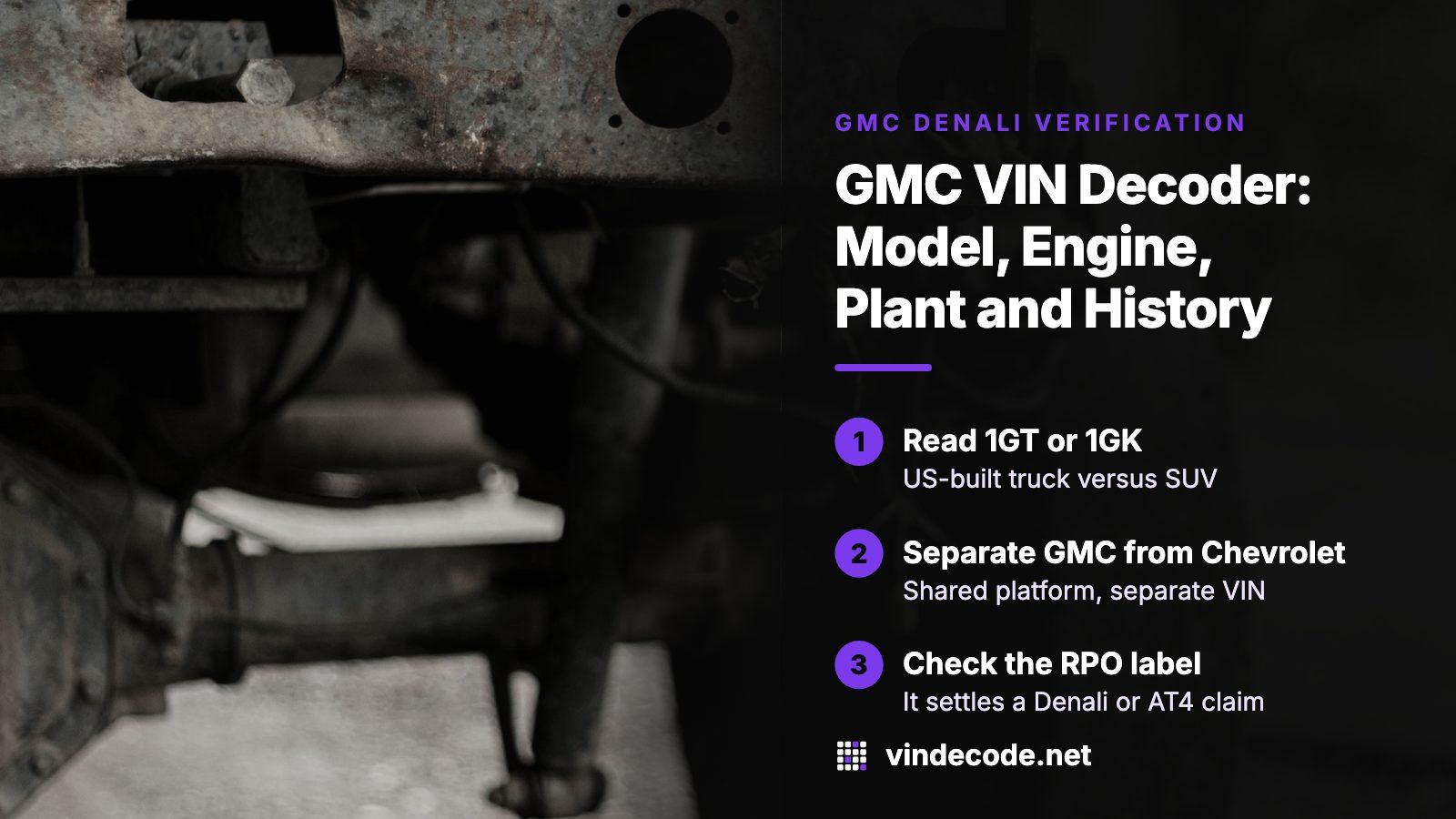
THE SHORT ANSWER
To decode a GMC VIN, type all 17 characters into the box above. The first three name the builder: 1GT is a US-built GMC truck and 1GK a US-built GMC SUV, while a leading 2 or 3 points to a plant in Canada or Mexico. Character 8 is the engine, 10 the model year and 11 the plant. Trim and option content are not in the VIN; the RPO label carries them, and a history report covers accidents, brands and mileage.
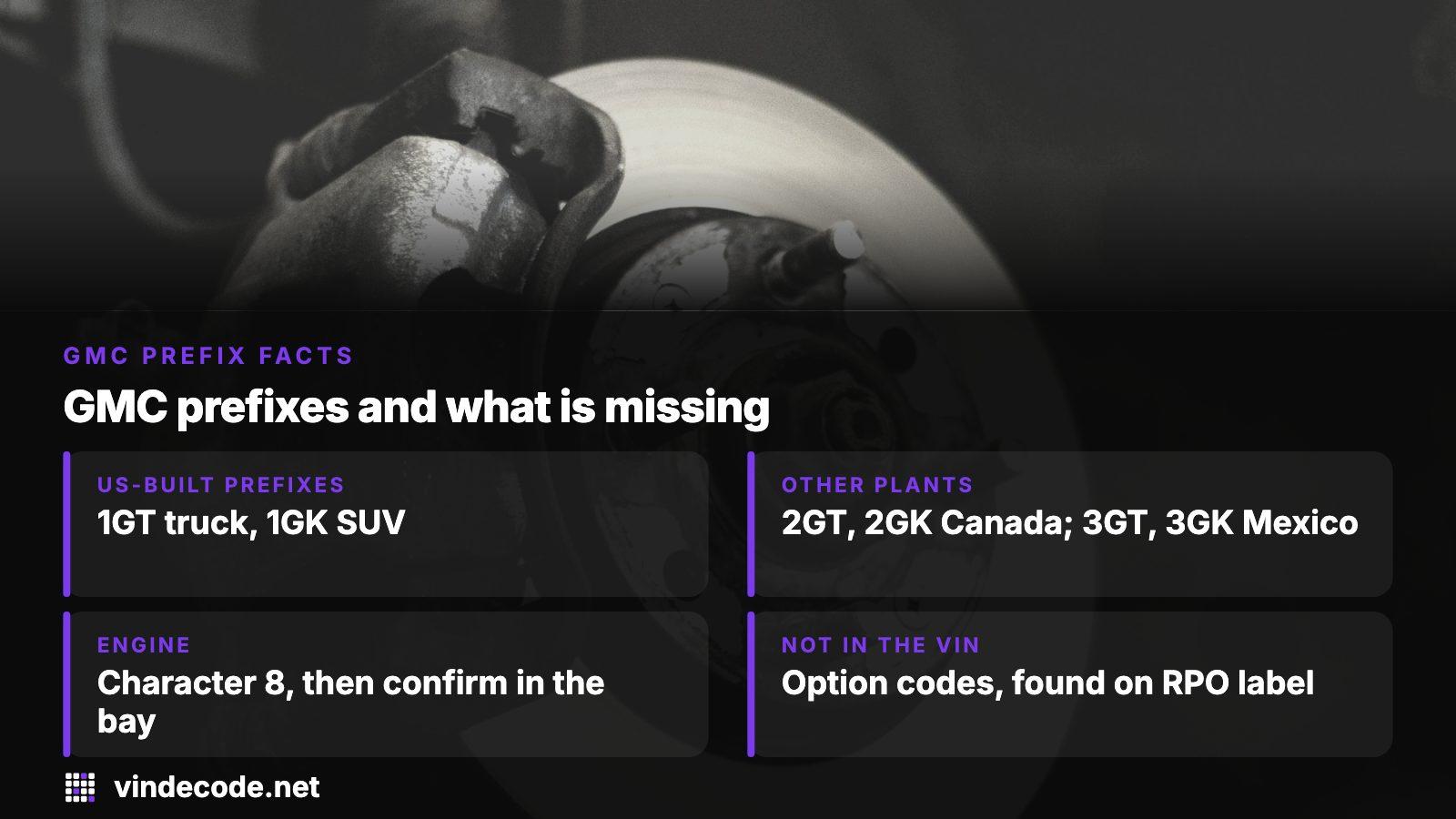
- US-built prefixes
- 1GT truck, 1GK SUV
- Other plants
- 2GT and 2GK Canada, 3GT and 3GK Mexico
- Engine
- Character 8, then confirm in the bay
- Not in the VIN
- Option codes, found on the RPO label
Running the decoder on a GMC: where to read the VIN
A decode is only as good as the number typed into it. One wrong character returns an error or a different vehicle, so take the VIN from the truck itself, not from the advert.
- Stand outside at the driver's corner and read the plate at the base of the dash through the glass. Photograph it in daylight.
- At the driver's door, shoot the label on the frame, which repeats the number.
- Check each of the two photos against the title and go character by character.
- Type all 17 characters into the decoder above.
NHTSA's filing supplies year, model and body style, engine and fuel, drive type, weight-rating class, factory restraints, and the country and plant of assembly. If plate, label and title disagree, stop until the seller explains.
The GMC prefixes: 1GT, 1GK, 2GT and 3GT
Every GMC VIN opens with a three-character code for builder and origin. The first character is the country of assembly, G is General Motors, and the third marks the division and vehicle type.
| Prefix | Vehicle | Built in |
|---|---|---|
| 1GT | GMC truck, including the Sierra and other pickups | United States |
| 1GK | GMC SUVs such as the Yukon, Acadia and Terrain | United States |
| 2GT, 2GK | The same two types | Canada |
| 3GT, 3GK | The same two types | Mexico |
Characters 4 to 8 hold the descriptor GM chooses, with the engine at position 8. Position 9 is a check digit calculated from the rest of the number, so a mistyped VIN is often rejected. Then come the model year at 10, the plant at 11 and the serial number at 12 to 17.
GMC and Chevrolet: shared platform, separate VIN
Sierra and Silverado are engineered side by side, so engines, platforms and often plants are common to both. Styling, trim ladder, equipment and price are where they part.
- Shopping: a Chevrolet with the same engine and equipment may cost less, so compare content, not names.
- Repairs: engine and chassis parts usually fit both, while badges, trim pieces and some interior parts do not.
- Faults: a problem documented on the Chevrolet twin deserves a look on a GMC with the same engine.
- Recalls: one campaign can name both divisions, so only the VIN says whether yours is included.
The division sits in the VIN
Badges, grilles and wheels can be bolted on. The VIN's third character names the division that built the truck, and no parts-counter swap changes it. A GMC grille over a VIN naming another division means a rebadge, and the seller should be able to say when and why.
Is it really a Denali? The RPO label settles it
Denali is GMC's premium trim and it commands a real premium used. It is also a name, and a previous owner can fit the grille and wheels to a lesser truck. Factory equipment is recorded as option codes on a label printed during assembly, and nothing can be added to a label that already exists.
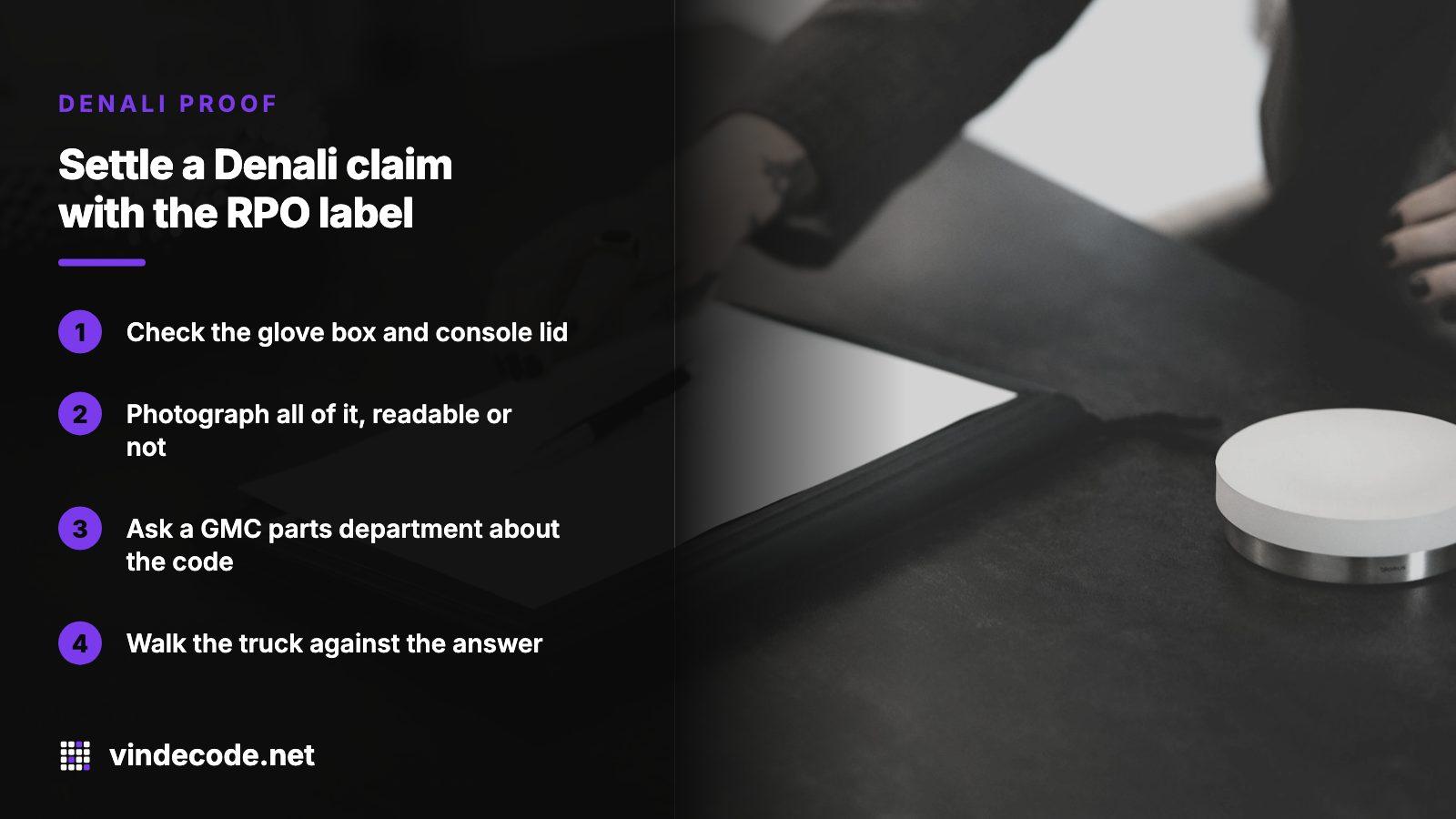
- Check the glove box, then the center console lid, the load floor and the space under the spare cover.
- Photograph all of it, including lines you cannot read yet.
- Ask a GMC parts department what that code set means for the model year.
- Walk the truck against the answer: seats, wheels and equipment should match.
From an NHTSA owner complaint
An owner of a 2015 Sierra 1500 who calls the truck a Denali described the brake pedal as hard to press at low speeds, with a "choppy" response, several times. The owner suspected a recall on brake pedal effort fit the problem, but noted the Denali apparently was not covered. The complaint is silent on any dealer or GM reply.
Owners describe a truck by its trim name, while recall lists are built on VIN ranges. When the two seem to disagree, trust the number.
Sierra and AT4 trims: what to confirm before you drive
Price on a Sierra comes down to a short list of build choices, each of which you can verify before the trip.
- Cab: regular, extended and crew cabs are priced differently, and the bed length has to suit the cab.
- Engine: read character 8, then look in the engine bay.
- Drive: the decode names it and the transfer-case control in the cab proves it.
- Axle ratio: printed on the RPO label, and it matters if you tow.
- Weight rating: the label on the door jamb carries it.
AT4 and other off-road trims add hardware that changes what the truck can do. Search the codes for a locking rear differential, since sellers claim it often. Confirm the suspension package instead of judging by ride height, and look under the truck to see the skid plates yourself.
Recalls are matched by VIN, so check the number
A recall covers a range of VINs, and GM campaigns often reach several divisions because the faulty part is common to them. NHTSA's lookup answers for one VIN and costs nothing, and a recall still open gets fixed by the manufacturer without charge. Run it on the exact number before you buy.
From an NHTSA owner complaint
An owner of a 2015 Sierra 1500 told NHTSA the truck lost power steering and shut off while driving. It restarted after several tries, and the failure came back later, at about 130,379 miles. Two dealers each said the truck's VIN was not part of steering campaign 18V586000, and nothing was diagnosed or repaired.
A dealer's answer comes from the VIN, not the badge or the model year. Run the lookup yourself and keep the result.
What the decode cannot see: the history report
A VIN describes the truck on the day it was built, and everything afterward is recorded elsewhere. A GMC with the right engine, a matching RPO label and a clean decode can still carry a salvage brand or a wound-back odometer. Pickups tow and haul, so mileage and damage records matter more than usual. The report searches those records under the same VIN.
| You want to know | Where the answer sits |
|---|---|
| Was the title ever branded? | Title brand records |
| Was it hit, and where? | Accident and damage records |
| Does the odometer tell a believable story? | Odometer readings |
| Did it sell at auction, with photos? | Salvage and auction history |
| Is money owed on it, or was it stolen? | Lien, impound and theft records |
Cost, and a sensible order of checks
A preview appears as soon as the VIN is submitted, and it is free. Unlocking the whole GMC report costs a one-time fee, either for one report or for a pack of 3, 5 or 10, and no recurring billing applies. The pricing page shows what each option costs.
- Decode the VIN read off the truck and compare year, engine and drive with the listing.
- Request a photo of the whole RPO label from the seller.
- Put the VIN through NHTSA's recall lookup.
- Look at the preview, then buy the report once the build adds up.
- Have a mechanic of your choosing inspect the truck before any money changes hands.
Where this information comes from
- NHTSA: vPIC VIN decoder — The federal database where manufacturers file VIN structures, behind the model, engine and plant fields.
- NHTSA: recalls lookup — Checks one VIN for open recalls, which the manufacturer repairs at no cost to the owner.
- EPA: fueleconomy.gov — Official mileage figures by engine and drivetrain, useful once the decode names the configuration.
- NHTSA owner complaint 11702269 — owner experience, paraphrased
- NHTSA owner complaint 11651825 — owner experience, paraphrased
Sources and photos: Facts checked against the sources above in November 2026. Photos by Zoshua Colah, Annika Wischnewsky and Benjamin Brunner on Unsplash; diagrams by VINDecode.
Keep reading
- Chevrolet VIN Decoder: Decode a Chevy, Then Check Its HistoryThe Chevrolet side of the shared platform, with the RPO label explained in full.
- GM VIN Decoder: Decode Any GM VIN, Then Check Its HistoryPrefix codes across every General Motors division, not only GMC.
- VIN Decoder: Decode a VIN Number Online, Then Check Its HistoryThe general decoder, for a vehicle from any other maker.
- Sample reportA finished report, to see what the history adds after the decode.
Frequently asked questions
How do I decode a GMC VIN?
Enter the 17 characters printed on the windshield plate or the door-frame label. NHTSA's vPIC database holds the VIN structure GMC filed, which the decoder reads back as year, body, engine, drivetrain and plant. History is a separate step.
What is the difference between 1GT and 1GK on a GMC VIN?
Both are GMCs built in the United States. The third character gives the type: T for a truck such as the Sierra, K for an SUV such as the Yukon, Acadia or Terrain. A leading 2 means Canada and a leading 3 means Mexico.
Can a VIN tell me whether a GMC is a Denali or an AT4?
Not on its own. A trim is a bundle of equipment, written as option codes on the RPO label rather than in a name typed into a listing. Match the label to the truck, then ask a dealer what the codes mean for that model year.
Does decoding a GMC VIN show accidents or title problems?
No. The decode reports how the truck was built. Brands, accident damage, odometer readings, auction photos, liens and theft records live in the history report under the same VIN. Use the decode to test the listing and the report to test the past.
Is it free to check a GMC for open recalls?
Yes. NHTSA's lookup is free and answers for one VIN at a time. Check the VIN, not the model name, because a campaign covers a range of numbers rather than every truck wearing that badge.
Now check the car itself
The guide explains what to look for. The report shows what this VIN has on record.