THE SHORT ANSWER
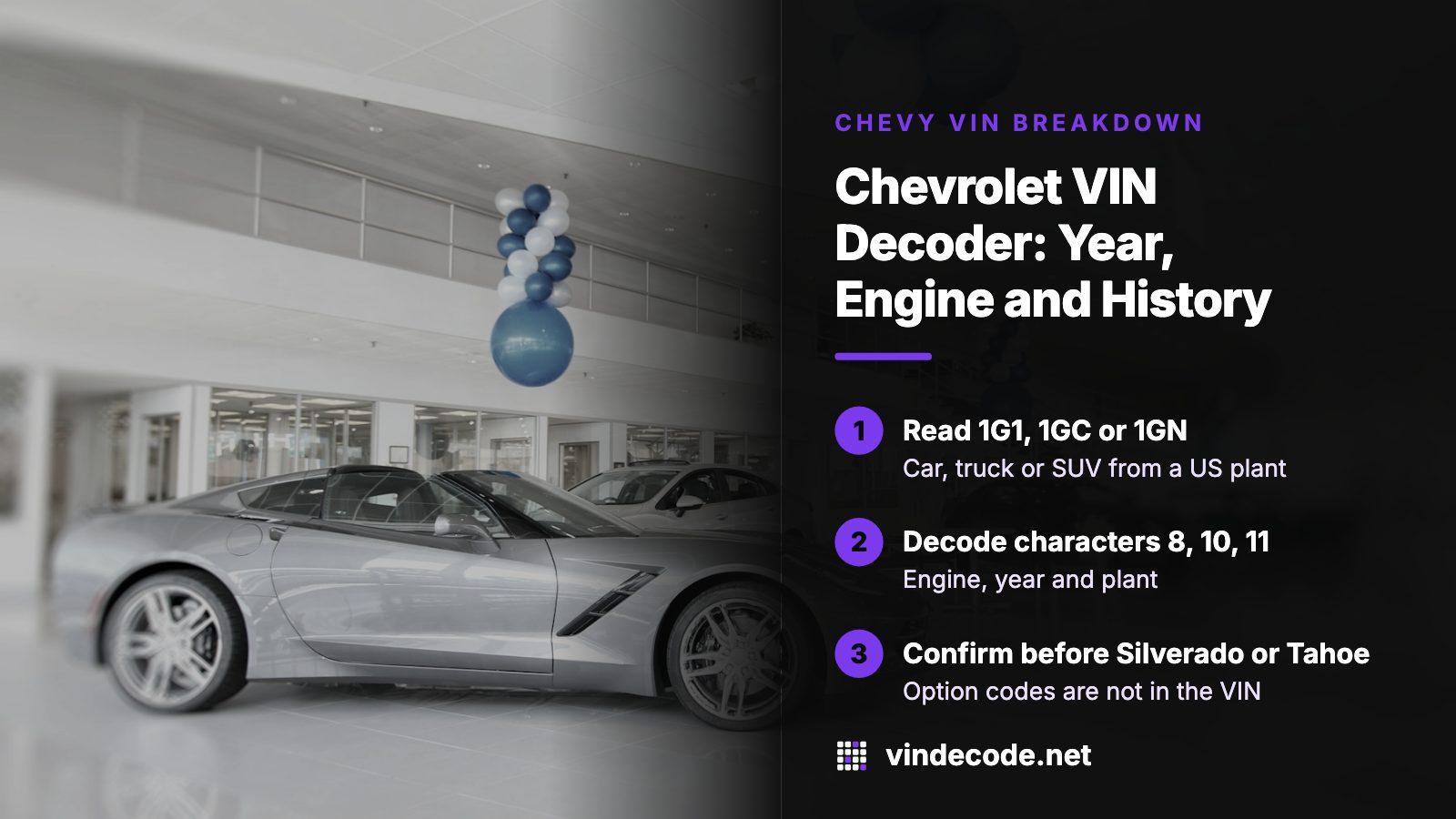
To decode a Chevy VIN, type all 17 characters into the box above. The first three name the maker: 1G1 is a US-built Chevrolet car, 1GC a truck and 1GN an SUV. Character 8 is the engine, 10 the model year and 11 the assembly plant. The decode shows how the vehicle was built. Accidents, title brands and mileage come from a history report, and paint and option codes from the label on the car.
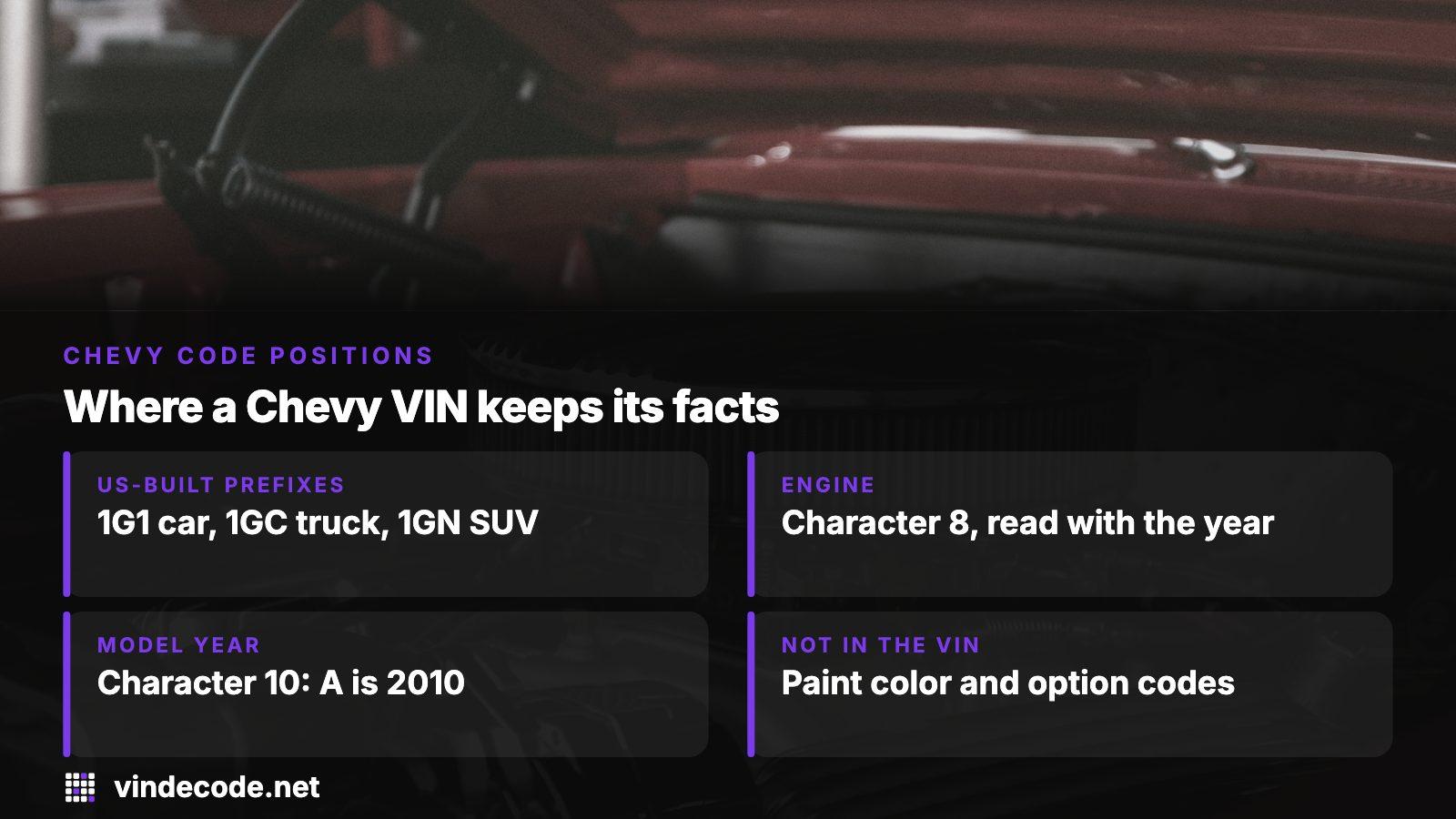
- US-built prefixes
- 1G1 car, 1GC truck, 1GN SUV
- Engine
- Character 8, read against the model year
- Model year
- Character 10: A is 2010, T is 2026
- Not in the VIN
- Paint color and option codes
What the Chevy decoder returns
Chevrolet sells most models in many builds, so the badge on the tailgate tells you little. Two Silverados from one model year can differ in engine, drive system, cab, bed and axle ratio, and they are priced to match. The decoder reads the factory record filed under the VIN and says which build is in front of you.
| Field | What it settles on a Chevy |
|---|---|
| Model year and body | Whether the generation and body match the advert |
| Engine and cylinders | Which powertrain to read up on before a drive |
| Fuel and drive | The fuel type, and whether it is two- or four-wheel drive |
| Restraints | Airbags and belts as installed in the factory |
| Plant and country | Where it was assembled, which can decide if a recall applies |
EPA's fuel economy site then gives official mileage for that engine and drive.
Typing the VIN in: where Chevrolet puts it
Typing a number from an advert invites a wrong character, and one wrong character returns an error or a different vehicle. Read it off the Chevy.
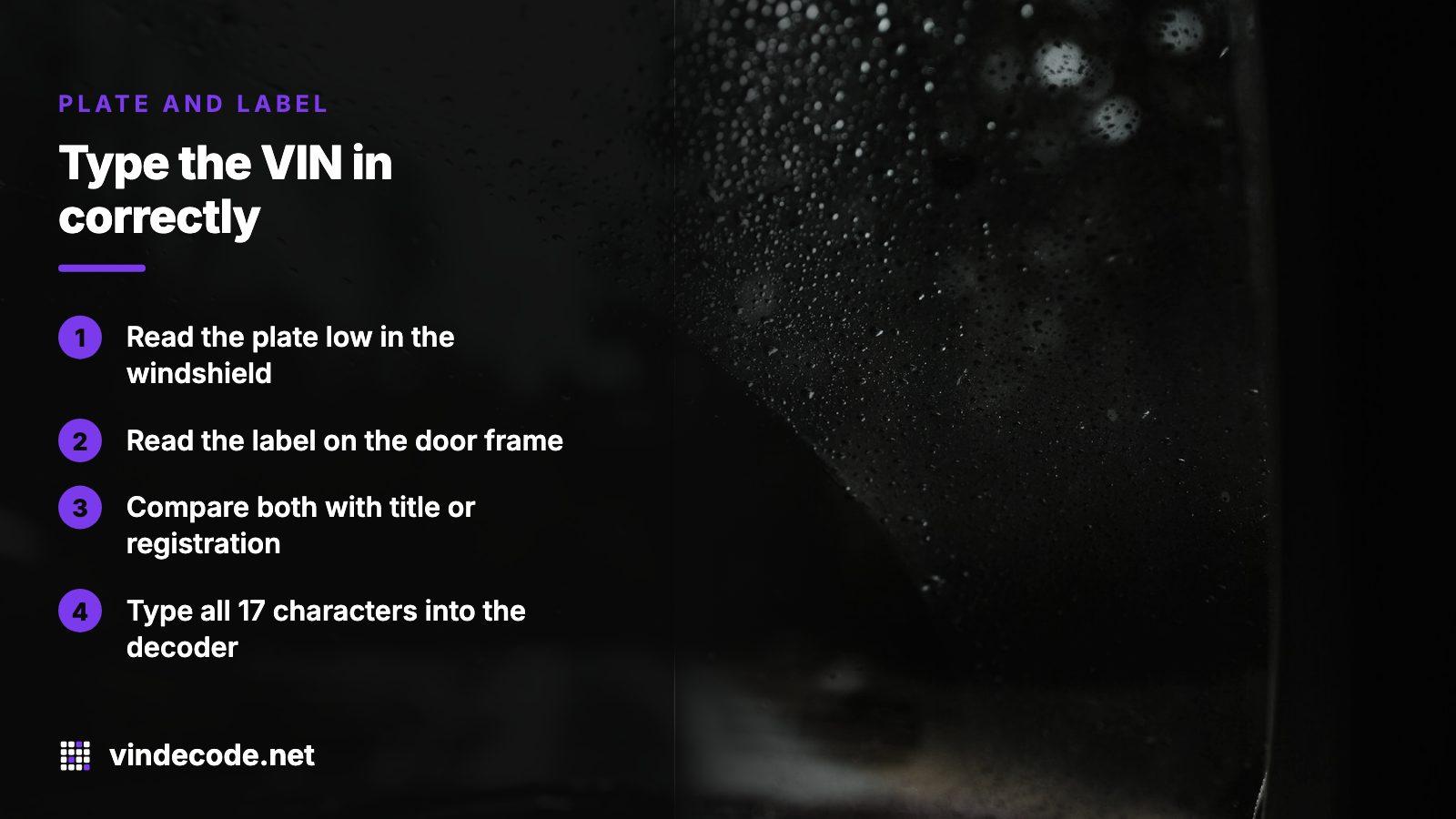
- Stand at the driver's side and read the plate low in the windshield, visible from outside.
- Open the driver's door. The label on the door frame repeats the number.
- Compare both against the title or registration.
- Type all 17 characters into the decoder above.
A plate, label and title that disagree should stop the sale until the seller explains. One reading is easier to fake than two that match.
Reading the result: 17 characters on a sample string
Every Chevrolet VIN follows one layout. The sample below is split by position and shows the structure only.
| Characters | Sample | What they carry |
|---|---|---|
| 1 to 3 | 1G1 | Country, maker and division: a Chevrolet car from a US plant |
| 4 to 8 | ZD5ST | Descriptor chosen by GM, with the engine in the eighth place |
| 9 | 4 | Check digit, a checksum worked out from the rest of the number |
| 10 | P | Model year, here 2023 |
| 11 | F | Assembly plant |
| 12 to 17 | 233170 | Serial number of that one vehicle |
The prefix: 1G1, 1GC, 1GN and the others
The prefix gives the maker and the origin before you read anything else. A leading 1 or 5 means a US plant, 2 Canada, 3 Mexico and K Korea. The letter G always means General Motors, and the third character narrows it to a division and vehicle type.
| Prefix | Vehicle | Plant country |
|---|---|---|
| 1G1 | Chevrolet car | United States |
| 1GC | Chevrolet truck | United States |
| 1GN | Multipurpose vehicle such as the Tahoe, Suburban or Traverse | United States |
| 2G1 | Chevrolet car | Canada |
| 3G1 | Chevrolet car | Mexico |
| KL1 | Smaller Chevrolet models from GM Korea | South Korea |
Cousins, not twins
Silverado and Sierra are built on one platform, yet GMC and Chevrolet hold separate manufacturer codes. If the grille says Chevrolet and the VIN names another division, something was changed, and the seller needs a documented reason. A prefix missing from the table is no red flag, since GM holds many identifiers.
Engine, model year and plant: characters 8, 10 and 11
Character 8 names the engine, and Chevy buyers lean on it most because one model line often offered several engines in a single year. GM has redefined these codes between generations, so a chart for the wrong era names the wrong engine. Decode against the model year, then check the engine bay. An unmentioned swap affects insurance, emissions compliance and what the vehicle is worth.
Character 10 is the model year, and the sequence repeats every thirty years. Five letters never appear: I, O, Q, U and Z. The earlier cycle ran A for 1980 to Y for 2000, and 2001 to 2009 used the digits 1 through 9, which means the letter by itself settles nothing until you know the generation.
| Letter | Model year |
|---|---|
| A | 2010 |
| F | 2015 |
| L | 2020 |
| P | 2023 |
| T | 2026 |
Character 11 is the plant. Recall campaigns are often limited to one plant and a window of build dates, so two Chevys that look the same can differ in exposure.
Silverado and Tahoe buyers: confirm these first
Chevy trucks carry a truck prefix, and their descriptor characters encode the cab and the weight-rating class. Price hangs on engine, drivetrain and cab, and listings misstate all three often enough to check before you travel.
- Cab: regular, extended and crew versions are valued differently.
- Bed length, which has to suit the cab.
- Engine: character 8, then the engine bay.
- Drive: work the four-wheel-drive selector inside the cab.
- Axle ratio: printed on the RPO label, and decisive for towing.
- Weight rating: the gross vehicle weight rating, printed on the door jamb label.
What the VIN leaves out: option codes and paint
No VIN holds the paint color or the option list. Both are printed on the Service Parts Identification label, where General Motors writes every factory option as a short code of three characters, a Regular Production Option or RPO. The decoder does not read that label, you do, so photograph all of it. Where to look:
- The glove box, which is the usual spot.
- Lift the cargo floor, check the underside of the trunk lid, and look beneath the spare tire cover.
- The center console lid on some trucks and SUVs.
Two claims appear in listings constantly: Z71 for the off-road package and G80 for a locking rear differential. A label printed when the vehicle was built settles whether a package was fitted at the factory. GM has reused codes across eras, so read each against the model year. For touch-up paint, quote the code, not the marketing name, because one name sometimes covers two formulas.
Where the history report picks up
A VIN describes the vehicle at the factory gate. Later events sit in other records, which a decode never reaches. The report searches them under the same number.
| Record | Question it answers |
|---|---|
| Title brands | Has the title ever been branded? |
| Accidents and damage | Was it hit, and where? |
| Odometer readings | Does mileage rise in a believable line? |
| Salvage and auction | Did it pass through an auction, with photos? |
| Liens and impounds | Does a lender or an impound lot have a claim? |
| Theft and insurance | Was it reported stolen or claimed on? |
| Recalls, ownership and value | What is open, how was it used, and what is it worth? |
A Chevy with the right engine and a clean decode can still carry a salvage brand. The decode proves it matches the advert, and the report shows what has happened to it since.
Cost and a sensible order for a used Chevy
The preview that appears after you enter the VIN costs nothing and asks for no card. Buying the report is a single payment covering one report or a bundle of 3, 5 or 10, and nothing renews afterward. The pricing page lists the amounts.
- Decode the number you read on the vehicle and compare year, engine and drive with the listing.
- Request a photo of the whole RPO label and match it to the car.
- Run NHTSA's recall lookup. The manufacturer fixes open recalls at no cost to the owner.
- Open the preview, then buy the report if the build adds up.
- Have a mechanic you pick inspect it before any money moves.
Where this information comes from
- NHTSA: vPIC VIN decoder — The federal database where manufacturers file their VIN structure, behind the model, engine and plant fields.
- NHTSA: recalls lookup — Checks one VIN for open recalls, which the manufacturer repairs without charge.
- EPA: fueleconomy.gov — Official mileage figures by engine and drivetrain, useful once the decode names the configuration.
Sources and photos: Facts checked against the sources above in November 2026. Photos by Richard R, Justin Cron and Victor Hughes on Unsplash; diagrams by VINDecode.
Keep reading
- Chevy Truck VIN Decoder: Read the Build, Then Check the HistoryThe truck-focused version, including older generations and their stickers.
- GM VIN Decoder: Decode Any GM VIN, Then Check Its HistoryPrefix codes across every General Motors division, not only Chevrolet.
- GMC VIN Decoder: Read a Sierra or Yukon VIN, Then Check Its HistoryThe Sierra's side of the platform it shares with the Silverado.
- Sample reportA finished report, to see what the history adds after the decode.
Frequently asked questions
How do I decode a VIN for a Chevy?
Read the 17 characters from the windshield plate or the driver's door frame label and enter them in the decoder above. Chevrolet files its VIN structure with NHTSA's vPIC database, so make, model year, body, engine, drivetrain and plant come back. A history report adds the title and accident records.
What does 1G1 mean at the start of a Chevy VIN?
A Chevrolet car from a US plant. The 1 marks the country, G means General Motors, and the third character gives the division and vehicle type. Trucks begin 1GC, while SUVs such as the Tahoe and Suburban begin 1GN.
Which VIN character is the engine on a Chevrolet?
The eighth. It is one of the characters owners use most, since engine choice drives parts, capability and resale value. Read it against the model year because GM has reassigned codes between generations, then confirm the engine in the bay.
Is the paint color in a Chevrolet VIN?
No. No manufacturer encodes color in the VIN. The paint code sits on the RPO label, normally in the glove box, as a base coat code plus a clear coat code. Give a paint supplier those codes instead of the marketing name.
Does decoding a Chevy VIN show accidents or recalls?
It shows how the vehicle was built, not what happened to it. Accidents, title brands and mileage live in the history report. Recalls attach to VIN ranges rather than models, so check the exact VIN with NHTSA's lookup, which costs nothing. Open recalls are repaired at no charge.
Now check the car itself
The guide explains what to look for. The report shows what this VIN has on record.