THE SHORT ANSWER
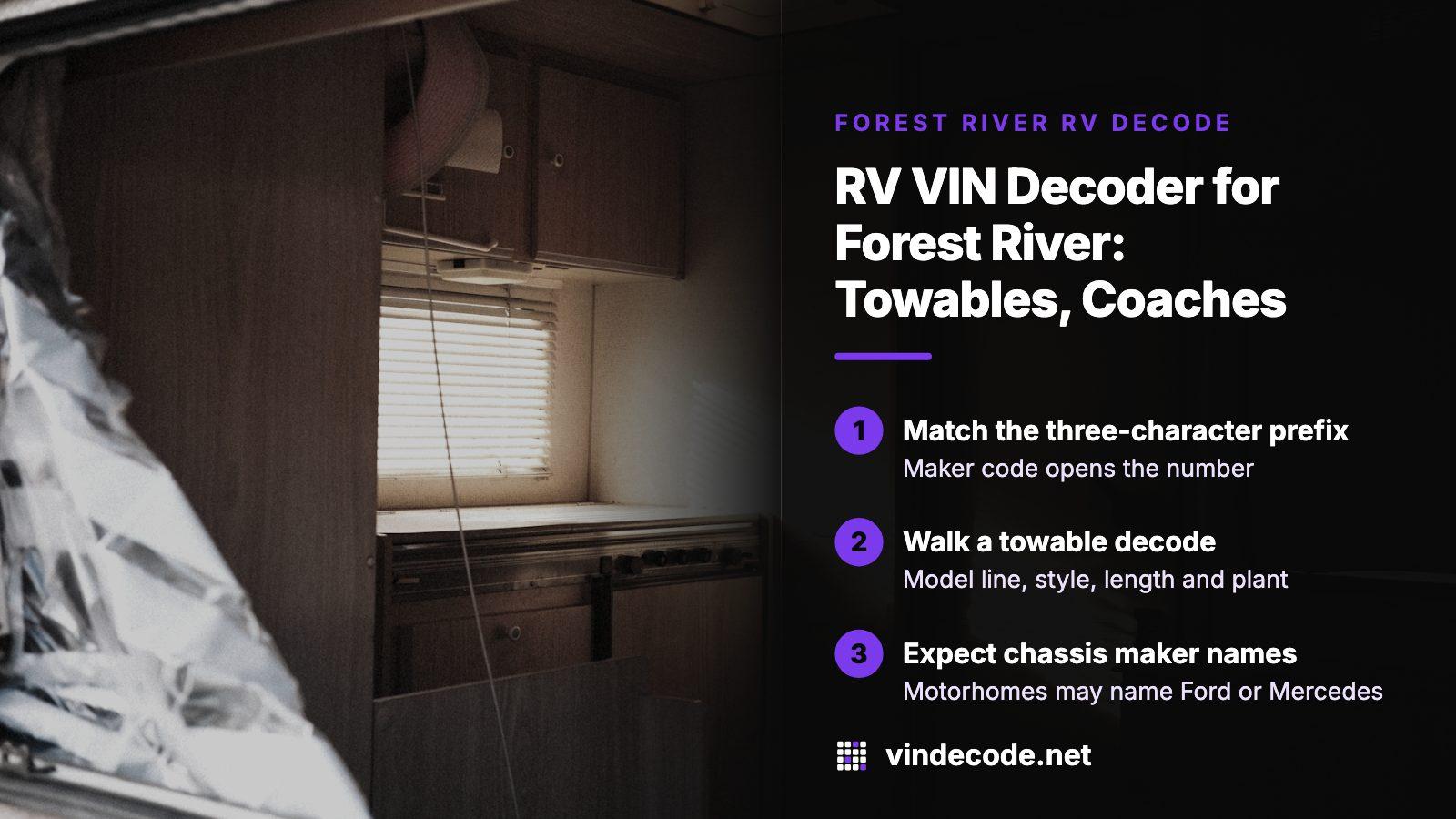
Type all 17 characters into the decoder above. On a Forest River travel trailer or fifth wheel, the first three characters name Forest River, and the rest gives the model line, trailer style, length and plant. A Georgetown or Forester motorhome may open with Ford or Mercedes-Benz codes instead, because the VIN follows the chassis. Either way, the decode describes the unit as built, not its history, so follow it with a report before paying.
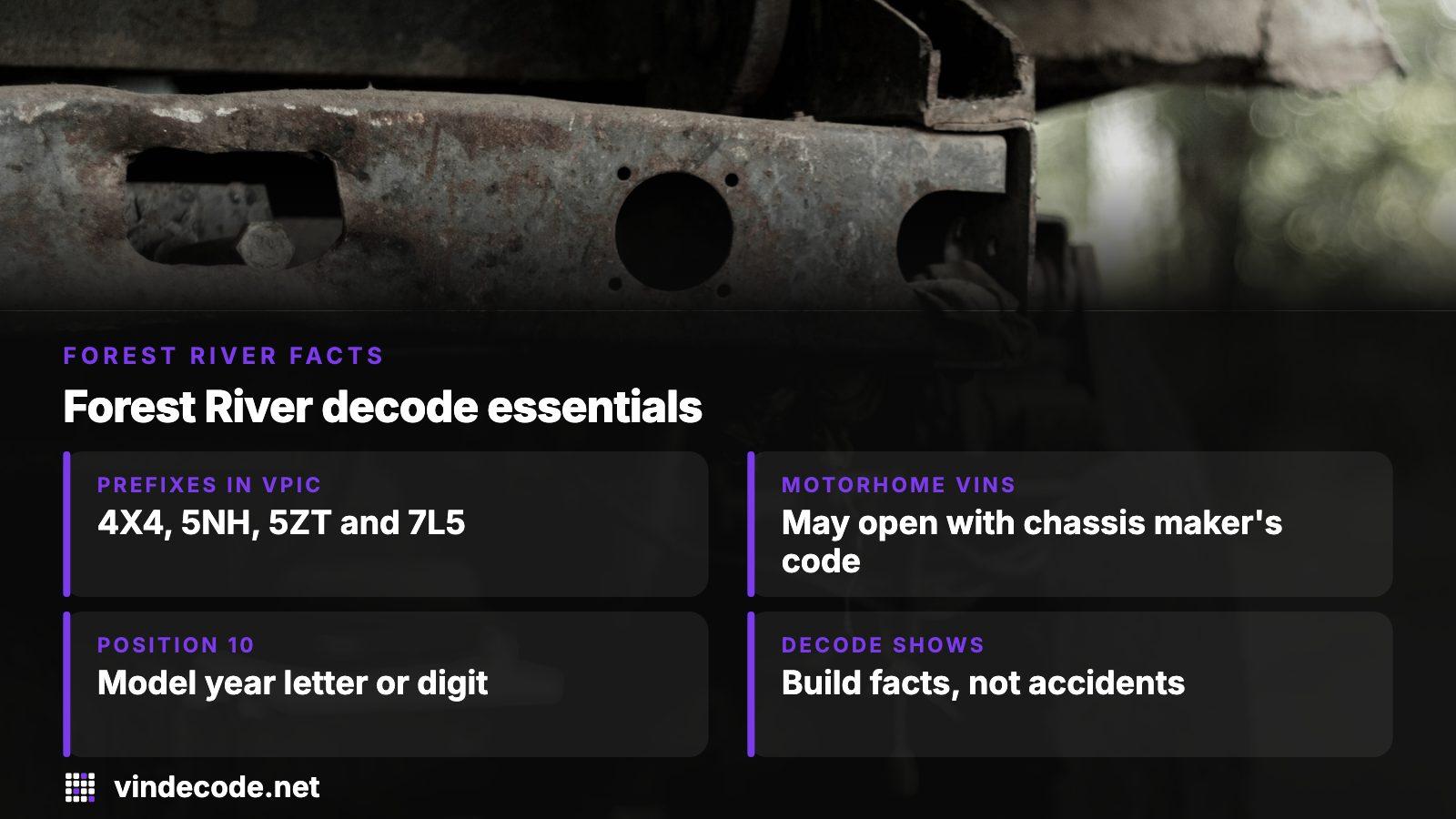
- Forest River prefixes in vPIC
- 4X4, 5NH, 5ZT and 7L5
- Motorhome VINs
- May open with the chassis maker's code
- Position 10
- Model year letter or digit
- Decode shows
- Build facts, not accidents or liens
What the decoder returns for a Forest River unit
Forest River sells under a long list of brand names, among them Cherokee, Salem, Wildwood, Rockwood, Flagstaff and Georgetown. NHTSA's database files them under one manufacturer, so a decode usually names the brand line plus a few build details rather than a floor plan or option list. Think of it as the maker's entry on file for that number.
| Unit type | What the decode tends to show | Who the prefix names |
|---|---|---|
| Travel trailer | Brand line, ball-hitch style, length, build plant | Forest River |
| Fifth wheel and toy hauler | Brand line, fifth-wheel style, length, build plant | Forest River |
| Class A or Class C motorhome | Chassis facts, sometimes the coach brand as well | Often the truck chassis builder |
Run the decode first because it is quick, and a mismatch with the listing is a cheap early warning. If the seller says a 2022 Cherokee and the decode shows another brand line or a very different length, ask questions before anyone drives out to see it.
Where to get the number you type in
Copy it from the unit, not the advertisement. Start with the federal placard on the exterior, the sticker that also lists the weight rating. Then compare it with the title and registration; all three should agree character for character. A listing that shows only a partial number deserves a polite request for the full one.
- Towable: the number sits on the maker's own paperwork and the unit's placard, so one string covers the whole trailer.
- Motorhome: the title carries the chassis number, so use that string, then ask the seller for any separate coach identifiers.
- Photographed numbers: zoom in and read 0 against O carefully, since the federal check-digit table has no values for I, O or Q.
What each part of the 17 characters tells you
Federal rules split the number into sections. Characters one to three point to the manufacturer and vehicle type. Four through eight describe the unit itself; for a trailer, that is the make, its type, body style, length and how many axles it has. The ninth is a check digit that flags transcription mistakes. Position ten gives the model year, position eleven names the plant that built it, and the last six count the units off the line.
- Prefix: NHTSA's list shows Forest River under 4X4, 5NH, 5ZT and 7L5, all typed as trailers.
- Tenth character: N is 2022, P is 2023, R is 2024, S is 2025 and T is 2026.
- Check digit: a wrong value means a misread character or an altered number, so retype before drawing conclusions.
Some of what a seller calls the model year is really the chassis year. A 2020 Georgetown in one NHTSA owner complaint sits on a 2019 Ford chassis, and the tenth character of that VIN is the 2019 code. Neither number is wrong. They answer different questions.
A towable decode, step by step
NHTSA's own test of partial VINs shows how this plays out. A number beginning 4X4TCKY25NK, entered with model year 2022, came back as a Forest River Cherokee, a ball-hitch trailer, 23 in length, built in Topeka, Indiana. A different Cherokee prefix, 5ZT2CKFC8NY, returned a shorter unit from the same town. A number starting 5NHFCTM20NC decoded as a Cherokee toy hauler in fifth-wheel style, built in LaGrange.
Those test entries were only 11 characters long, so the decoder flagged them as incomplete. A short or mistyped number still returns something, but do not trust it until all 17 characters are in.
Why a motorhome decode can name Ford or Mercedes-Benz
A coach is built on a chassis that another company made. NHTSA complaint records for Georgetown units show VINs opening with Ford codes, and one 2022 Forester owner says the unit rides on a Ford E-450. A second Forester record opens with a Mercedes-Benz van code and mentions a Sprinter front axle recall. In each case the number follows the chassis, which is the part that was titled first.
From an NHTSA owner complaint
A 2022 Forester buyer told NHTSA the new coach arrived with an open chassis recall on the Sprinter front torsion bar. The dealer pointed at Mercedes-Benz, Mercedes-Benz said parts were unavailable, and the owner said the dealer never mentioned the recall at the sale. The family felt unable to drive it until the repair was done.
Check recalls against the chassis number and the coach brand alike, before the deposit rather than after the first trip.
Recalls: one campaign, many brand names
Forest River files recalls for the company as a whole, so a single campaign can name a dozen brands and several model years. The 2022 Cherokee lookup alone lists six campaigns, covering things like tires, wiring, labels and propane fittings. Campaign 22V243000 names Coachmen, Freedom Express and Spirit lines in the same notice as the Cherokee. If you search only by the brand on the sidewall, you can miss a campaign filed under a sibling name.
From an NHTSA owner complaint
The owner of a 2020 Georgetown told NHTSA in 2024 that a notice had arrived for the propane tank bracket campaign, 24V103000, yet the dealer could not get the repair part and the wait felt unreasonable. Nothing had failed. The owner also wrote that a VIN tool showed no open recall, which clashed with the letter in the mailbox.
Recall data lags real notices, and a clean lookup is a snapshot rather than a guarantee. Ask the seller for any recall letters on paper, and check again on signing day.
What the decode cannot tell you, and the report that can
A decode reports how the unit was built. It cannot say whether it was flooded, written off, sold at auction, carrying a lien or rolled back on the odometer, and for an RV that is where the money is lost. Water damage in particular hides behind fresh paneling. Federal title records exist to keep stolen and unsafe vehicles from being resold, which is why a title check belongs in every RV purchase.
That is the gap our history report fills. Enter the same VIN and the free preview shows whether records exist. The full report then covers title brands, damage and salvage entries with their photos where available, liens, theft and insurance entries, plus open recalls. Coach-only matters such as slide-out wear or roof leaks still need someone to look at the unit in person.
What it costs and the order to run the checks
The decoder and the preview cost nothing. Beyond the preview, a report is a single payment without any repeat billing, and the pricing page shows what is available today. Spending on one report for a unit you have already narrowed down beats a surprise at the title office.
- Decode the full number from the placard and compare it with the listing.
- Confirm the same string appears on the title and registration.
- Look up open recalls under both the chassis and the coach brand.
- Open the free preview, then order the full report if the unit is still a contender.
- Inspect the unit in person, with the report in hand, before you pay.

Where this information comes from
- NHTSA: vPIC VIN decoder — The federal decoder behind partial-VIN tests and plant results, built on maker-reported data.
- eCFR: 49 CFR 565.15 VIN content — The rule that sets what each VIN section means, the check digit and the year codes.
- NHTSA vPIC: Forest River manufacturer identifiers — Lists the prefixes registered to Forest River and their vehicle type.
- NHTSA recalls API: Forest River Cherokee 2022 — Shows how one campaign spans several brand names.
- VehicleHistory.gov: consumer NMVTIS information — The Justice Department's explanation of why title records protect buyers.
- NHTSA owner complaint 11582989 — owner experience, paraphrased
- NHTSA owner complaint 11471599 — owner experience, paraphrased
Sources and photos: Facts checked against the sources above in November 2026. Photos by Alexander Lunyov, Carrie Allen www.carrieallen.com and Zoshua Colah on Unsplash; diagrams by VINDecode.
Keep reading
- RV VIN Decoder: Decode a Motorhome, Trailer or Fifth WheelThe general version for any RV brand, including how coach and chassis numbers split.
- Keystone RV VIN Decoder: Read the Trailer, Then Check Its PastAnother big towable maker, useful when you are comparing two listings.
- Trailer VIN Decoder: Year, Length and Axles From the NumberHow trailer numbers differ from car numbers, from length to axle layout.
- NHTSA VIN Decoder: What It Returns, Where It Stops, What Comes NextWhat the federal database behind this decode covers, and where it thins out.
Frequently asked questions
How do I decode a Forest River RV VIN?
Enter all 17 characters from the federal placard into the decoder above. For a towable, the result names the brand line, trailer style, length and build plant. For a motorhome, expect chassis details first. Confirm the same string on the title, because a typo in even one character changes the answer.
Why does my Forest River motorhome decode as a Ford?
The VIN on a coach follows the chassis, and Georgetown and Forester records show Ford chassis under the body. The truck builder numbered the chassis first, so its codes lead the number. Look for a separate coach plate or paperwork from the seller to identify the Forest River side of the unit.
Does the decoder show recalls on a Forest River trailer?
It can point you to them, but treat it as a starting point. Forest River files one campaign across many brand names and years, so search under sibling brands too. Owners have also reported letters arriving while online tools showed nothing open, so keep paper notices and recheck on signing day.
Can a VIN decode tell me if an RV was flooded or totaled?
No. The decode reports build facts supplied by the maker. Water damage, written-off status, auction sales and liens live in title, insurance and salvage records. Run a history report on the same number, then inspect the unit for soft floors, stains and musty smells.
Is the Forest River VIN report free?
Only the decoder and the preview are free. The full report is bought one time rather than on a plan, and current options are listed on the pricing page. Decide after the preview shows that records exist for the number.
Now check the car itself
The guide explains what to look for. The report shows what this VIN has on record.