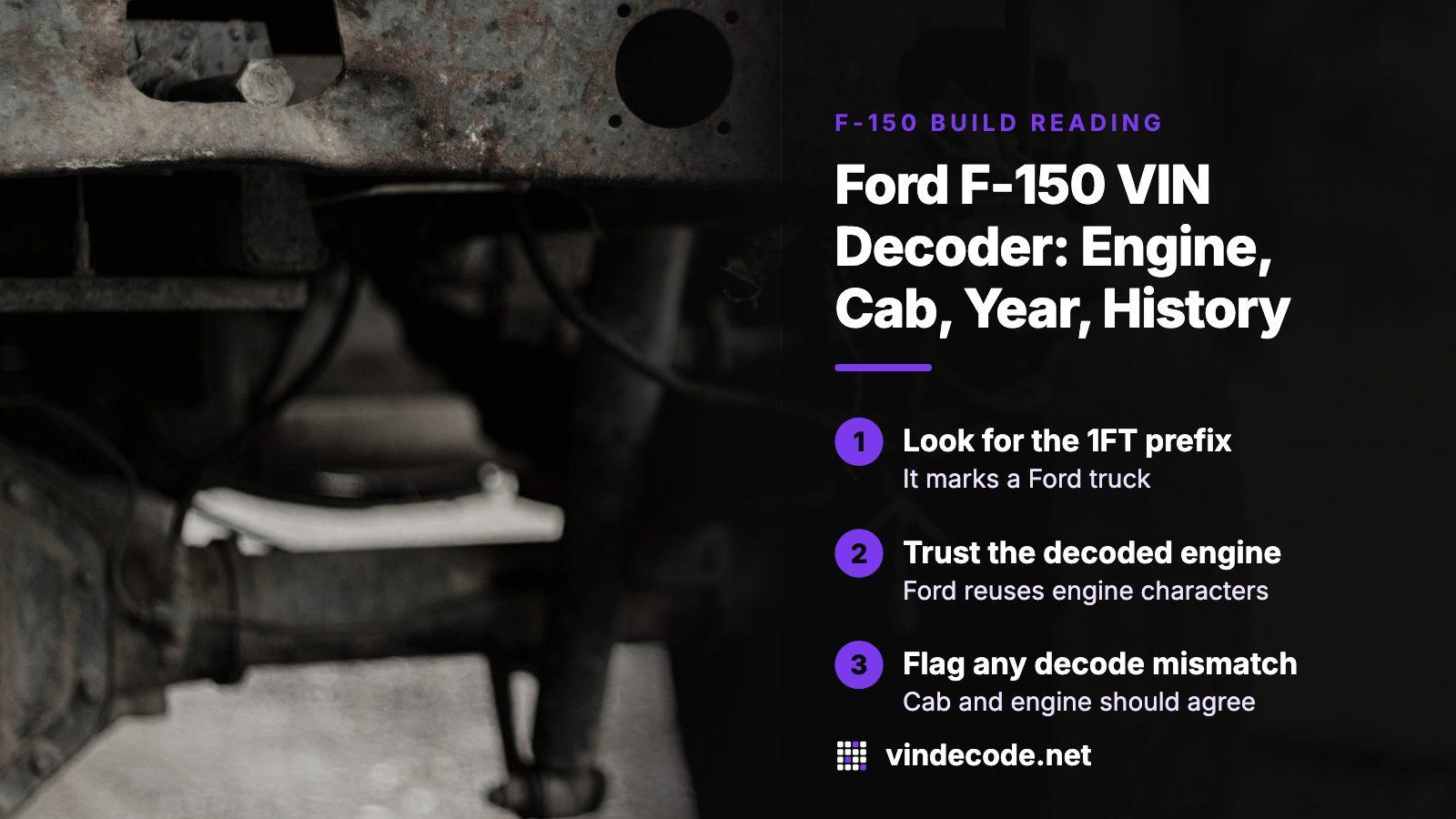
THE SHORT ANSWER
Enter all 17 characters above. A 1FT prefix marks a Ford truck. Position ten holds the year letter and position eleven the plant. The engine sits at position eight, but Ford reuses engine characters between years, so trust what the decoder returns over a chart. The decode stops at the factory door; odometer, title and damage records come from a history report.
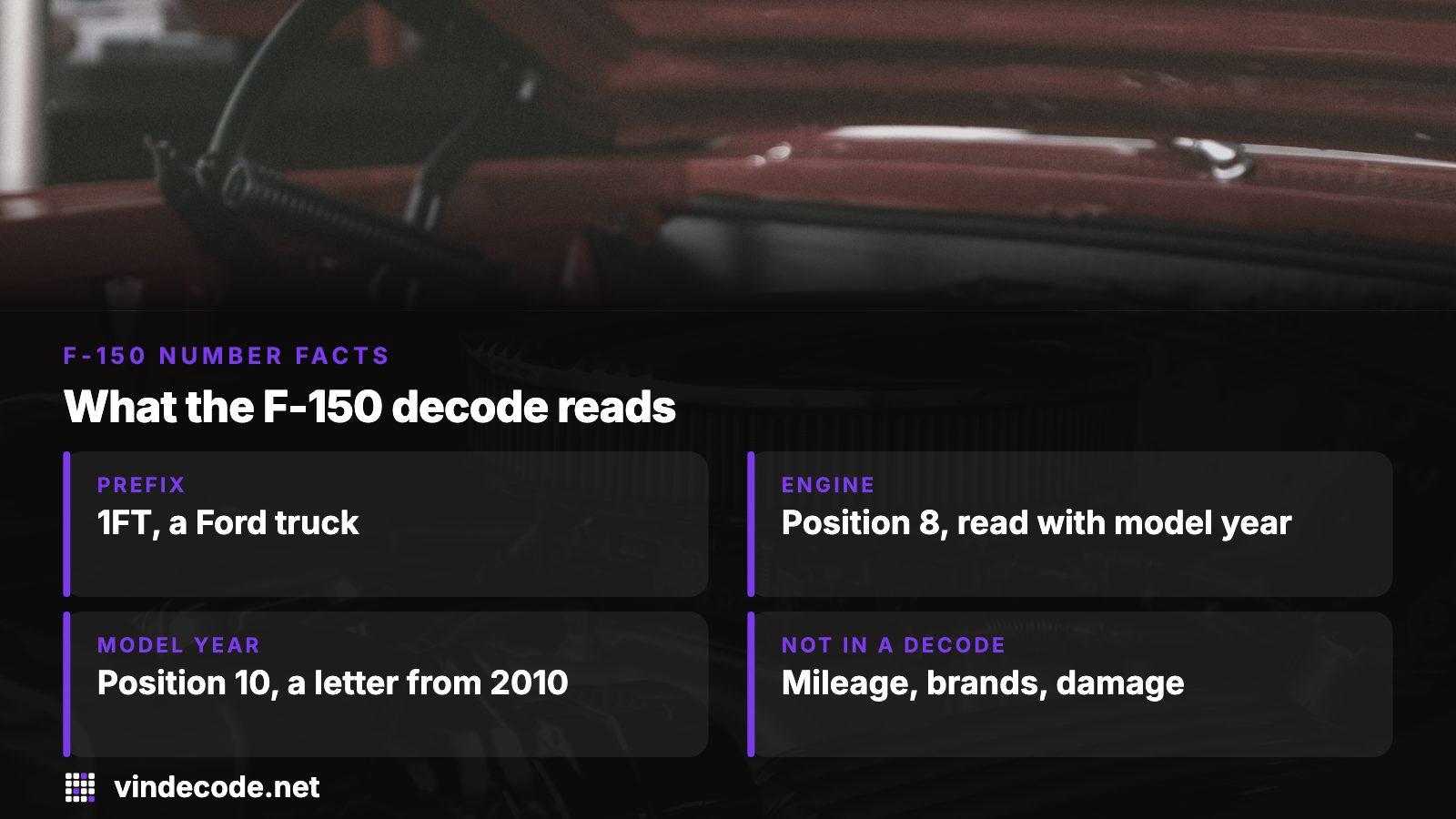
- Prefix
- 1FT, a Ford truck
- Engine
- Position 8, read against the model year
- Model year
- Position 10, a letter from 2010 on
- Not in a decode
- Mileage, title brands, damage
What a decoder returns for an F-150
A 2021 F-150 comes in many builds. The federal fueleconomy.gov site lists that year in two- and four-wheel drive with six engines: a 3.3-liter V6, a 5.0-liter V8, turbo V6s of 2.7 and 3.5 liters, a 3.0-liter turbo diesel and a 3.5-liter turbo hybrid. NHTSA's public decoder separates them, as these test strings show.
| Test string (2021) | Cab and drive | Engine and fuel | Plant |
|---|---|---|---|
| 1FTEW1CB3MKD10001 | Crew cab, 4x2 | 3.3-liter V6, gasoline | Kansas City (Claycomo), Missouri |
| 1FTEX1EP6MKD10001 | Extended cab, 4WD | 2.7-liter V6, gasoline | Kansas City (Claycomo), Missouri |
| 1FTFW1E86MKD10001 | Crew cab, 4WD | 3.5-liter V6, gasoline | Kansas City (Claycomo), Missouri |
| 1FTFW1E59MKD10001 | Crew cab, 4WD | 5.0-liter V8, gasoline | Kansas City (Claycomo), Missouri |
| 1FTFW1ED2MFC10001 | Crew cab, 4WD | 3.5-liter V6, gasoline and electric | Dearborn, Michigan |
| 1FTFW1E15MFC10001 | Crew cab, 4WD | 3.0-liter V6, diesel | Dearborn, Michigan |
Each string is made up for the test, carries a correct check digit and decoded clean. None came back with a trim level such as XLT or Lariat. An electric Lightning also starts 1FT: a 2022 test string returned battery-electric, built in Dearborn, in a heavier weight class than the gasoline trucks.
Where to read the VIN on the truck
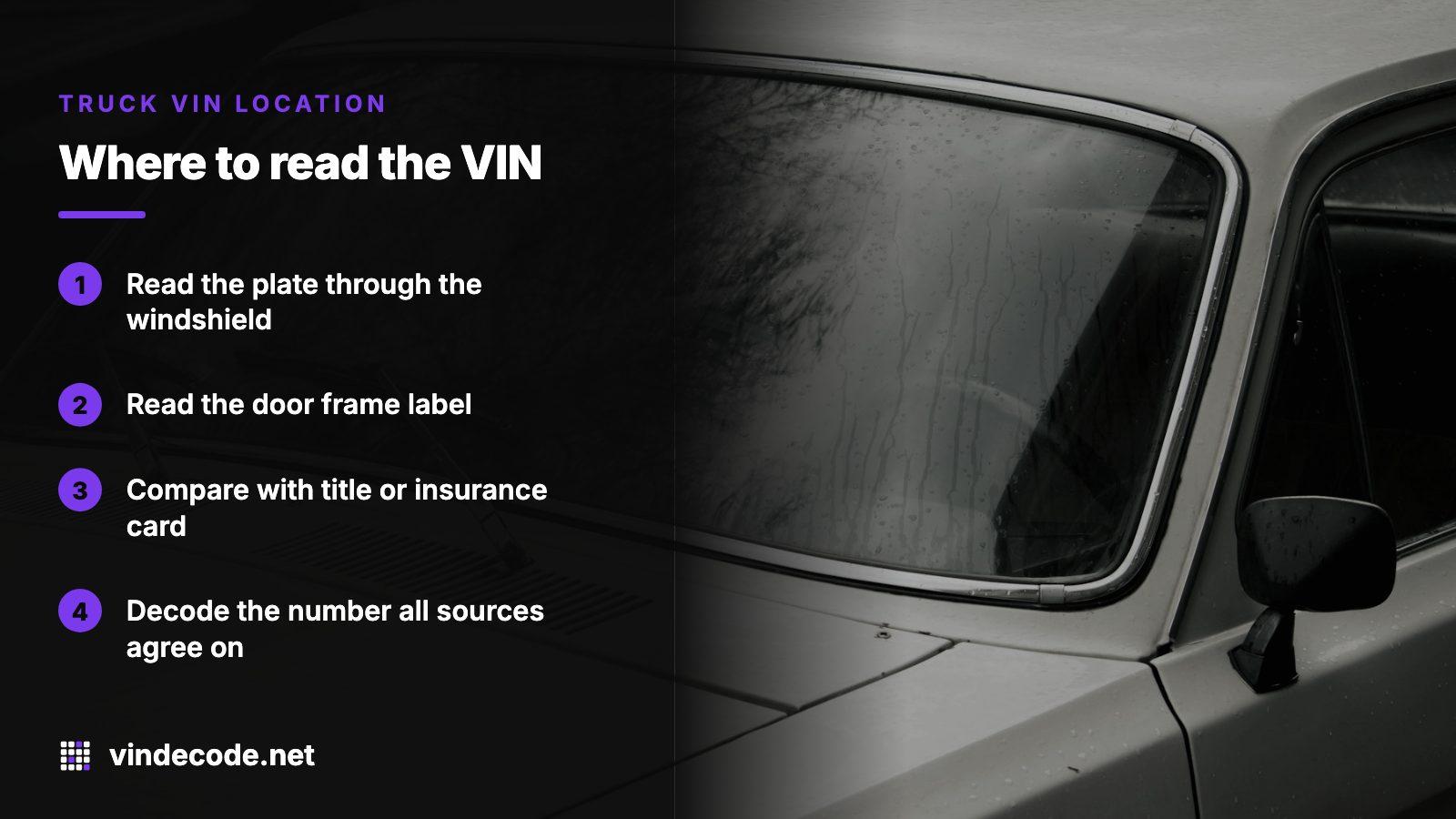
Read the number off the truck, not the ad. Federal law places a light truck's VIN where a person outside can read it through the windshield, close to the left pillar.
- From the driver's front corner, read the plate through the windshield and photograph it.
- Open the driver's door. The label on the frame repeats the number and adds the build date and weight ratings.
- Hold the title, registration or insurance card against both photos and compare each character.
- Decode the number that every source agrees on. Federal rules leave the letters I, O and Q out of a VIN entirely, so spotting one means you misread a character.
Reading one F-150 VIN, character by character
Here is the test string 1FTFW1E86MKD10001 set against the decoder's answer.
| Positions | In this string | What the decoder said |
|---|---|---|
| 1 to 3 | 1FT | Ford, truck (2FT and 3FT are Ford's Canadian and Mexican companies) |
| 4 to 8 | FW1E8 | Crew cab, 4WD, 3.5-liter V6, weight class 2F |
| 9 | 6 | Check digit, reported correct |
| 10 | M | Model year 2021 |
| 11 | K | Kansas City (Claycomo), Missouri |
| 12 to 17 | D10001 | Sequence number, invented for the test |
The seventh character settles what M means. For a truck rated at 10,000 pounds or under, a letter there pushes the year character into the 2010 to 2039 range, so M is 2021 rather than a year from the earlier cycle.
The eighth character is Ford's own code
Positions 4 to 8 are chosen by the maker, so no single chart works across years. The same eight characters decode differently in two model years.
| Test string | Year letter | Engine returned |
|---|---|---|
| 1FTFW1ET3DFC10001 | D, 2013 | 3.5-liter V6, gasoline |
| 1FTFW1ET0MKD10001 | M, 2021 | None; position 8 reported unused |
| 1FTFW1E86MKD10001 | M, 2021 | 3.5-liter V6, gasoline |
A T that named a 3.5-liter V6 in 2013 comes back blank in 2021, where that size sits under an 8 and the hybrid under a D. Treat an empty engine field as unresolved and read the engine bay. A swap the seller never mentioned affects insurance, emissions and value.
Red flags when the decode and the truck disagree
A decoder fills in a build even from a mistyped number. With the ninth character altered on a test string, NHTSA's decoder said the check digit failed, yet still listed a 2021 F-150, the 3.5-liter engine and the Kansas City plant. Read the status line before the fields.
- A check-digit warning, an invalid-character note (a letter O drew one) or an incomplete VIN: retype from the plate.
- A tenth character that gives a different model year than the listing.
- A cab, drive or engine the truck does not show, such as a four-wheel-drive decode on a truck with no transfer-case control.
- A plate, door label and title that disagree character for character.
What a decode cannot see, and what the report adds
The decode describes the truck on the day it was built. Everything after sits in other records, and a work truck lives in them.
| Record in a history report | What it settles on an F-150 |
|---|---|
| Odometer readings | Whether mileage climbs in step with the years |
| Title brands | Whether any state called it salvage, flood or rebuilt |
| Accident and damage | Where it was struck, with auction photos if any |
| Ownership and use | Fleet or rental work against one private owner |
| Liens and impounds | Whether a lender or tow yard still has a claim |
From an NHTSA owner complaint
An owner of a 2018 F-150 told NHTSA the mileage did not add up after a dealer sale. The odometer read 48,201 at purchase, and a report the owner pulled later listed the last recorded reading as 112,129.
A decode cannot see mileage, so a gap like that shows up only in the history. On a 2015 or newer truck, which has aluminum body panels, also ask who repaired any damage.
Recalls follow the VIN, not the model year
NHTSA's file lists 29 recall campaigns for the 2021 F-150 and 14 for 2015, but each names only certain trucks. One 2021 campaign, on seat-belt webbing, covers certain SuperCab trucks. One 2015 campaign reached trucks built across two days in January.
From an NHTSA owner complaint
An owner of a 2017 F-150 with 60,000 to 70,000 miles reported a torque converter that shuddered above 45 mph. The owner said a recall exists for that very problem yet the truck's VIN falls outside it. The record states no outcome.
A recall is written against specific VINs, so only the full number shows where a given truck stands. NHTSA's lookup takes a VIN at no charge, and the repairs carry no cost to the owner.
What it costs and what to run first
A free preview opens as soon as you enter the VIN. The report itself is a one-off purchase, for this one truck or in a set sized three, five or ten, and there is no plan to cancel. Prices live on the pricing page.
- Photograph the plate and door label, then decode the number they share.
- Compare year, cab, drive and engine with the listing; walk away if they differ.
- Put that VIN into NHTSA's recall lookup as well.
- Open the preview first, and spend on the full report only when the build holds up.
- Pay a shop you choose to inspect it. Even a clean federal title record is no promise of a sound truck, and the NMVTIS site itself urges an independent inspection.
Where this information comes from
- NHTSA: vPIC VIN decoder — Federal decoder built from manufacturer filings, the source of every build field in the test strings, and meant for 1981 and newer vehicles.
- eCFR: 49 CFR Part 565, VIN requirements — The federal rule behind the 17-character format, the check digit, the year letters, the seventh-character rule and where the VIN must be readable.
- Fuel Economy: fueleconomy.gov — Federal listing of the drive and engine combinations offered on the 2021 F-150.
- NHTSA: recall data for the Ford F-150 — Campaign counts by model year and the cab and build-date limits written into individual recalls.
- NMVTIS: Understanding an NMVTIS Vehicle History Report — The federal description of the title, brand, odometer, total-loss and salvage data, and its advice to add an independent inspection.
- NHTSA owner complaint 11775269 — owner experience, paraphrased
- NHTSA owner complaint 11763384 — owner experience, paraphrased
Sources and photos: Facts checked against the sources above in November 2026. Photos by Zoshua Colah, Tigran Shishmanyan and Victor Hughes on Unsplash; diagrams by VINDecode.
Keep reading
- Ford VIN Decoder: Decode a Ford VIN, Then Check Its HistoryEvery Ford prefix, with what 1FA, 1FM and 1FT cover across cars, SUVs and trucks.
- VIN Decoder Year Chart: Position 10 Codes for 1980 to 2039The tenth-character letters laid out by model year, with the seventh-character rule.
- Sample reportA finished report, so you can see the odometer and title sections before you pay.
- NHTSA VIN Decoder: What It Returns, Where It Stops, What Comes NextWhat the federal decoder behind these results returns, and where it stops.
Frequently asked questions
How do I decode a Ford F-150 VIN?
Take all 17 characters from the dash plate, confirm them on the door label and the title, then type them into the decoder above. Compare the year, cab, drive and engine it returns with the truck. Read the status line first: a check-digit warning usually means a typo.
What does the eighth character of an F-150 VIN mean?
It is Ford's engine code, and the same character can name one engine in one model year and nothing in another. For a 2021 truck NHTSA's decoder separated the 3.3, 2.7, 3.5, 5.0, diesel and hybrid builds. Treat a blank result as unresolved, not as an error.
Can a VIN decoder tell an F-150 XLT from a Lariat?
Not reliably. NHTSA's decoder returned a series, cab, engine and drive for every test string but no trim level. Badges are cheap to buy and fit, so judge trim by the equipment on the truck itself.
Does an F-150 VIN decode show accidents or mileage?
No. A decode describes how the truck was built. Odometer readings, title brands, damage and liens sit in other records, which a history report on the same VIN searches. Run both, then have a mechanic you choose look over the frame and body.
Will the decoder read the VIN on an older F-150?
NHTSA describes its decoder as meant for 1981 and later model years. A truck older than that falls outside it, so lean on an era-specific reference and on the truck's own stampings and paperwork.
Now check the car itself
The guide explains what to look for. The report shows what this VIN has on record.