THE SHORT ANSWER
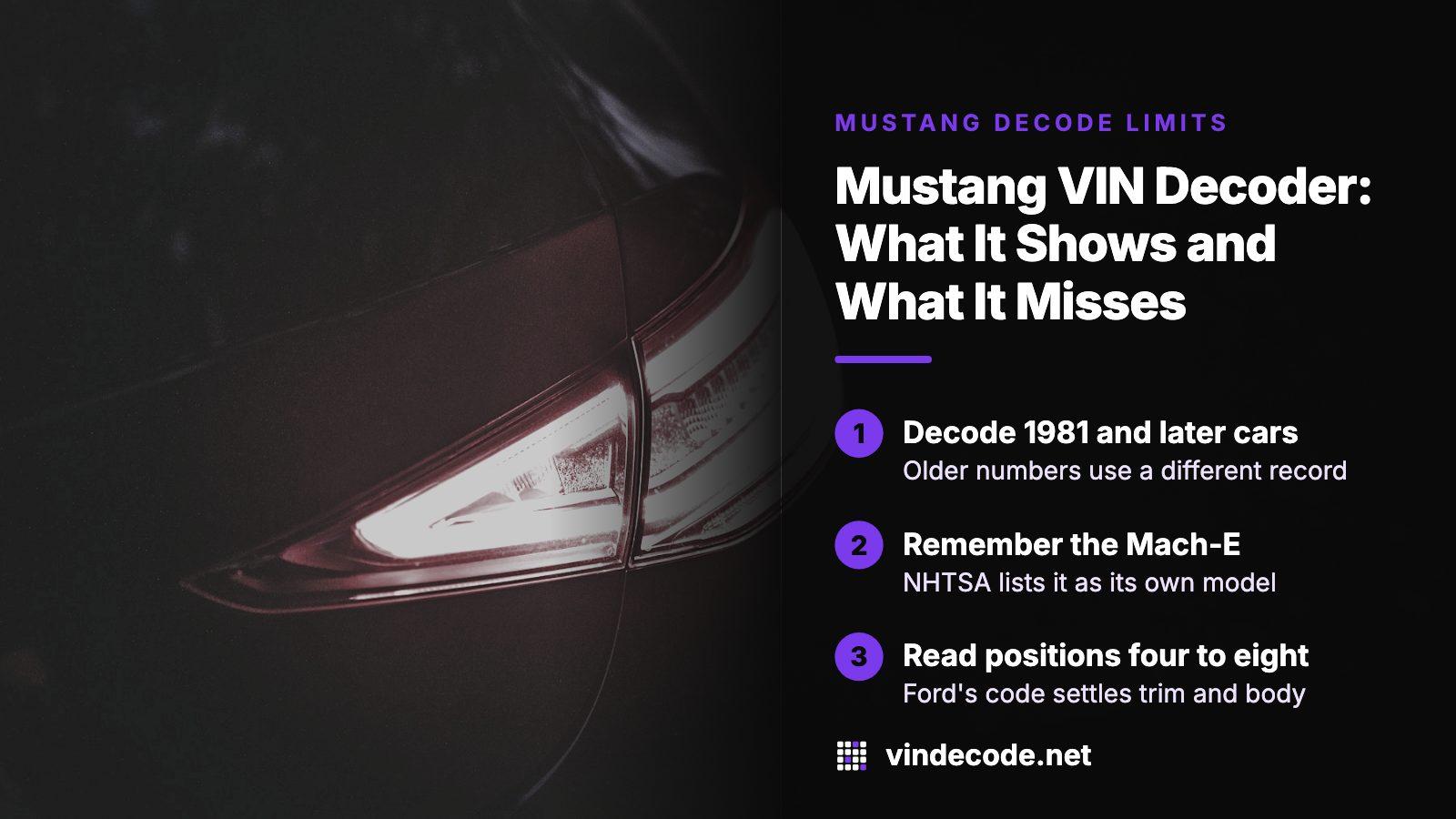
Type all 17 characters into the decoder above. The tenth character encodes the model year, the eleventh names where the car was built, and Ford's own code in positions four to eight settles trim, body and engine. The Mustang Mach-E is filed as a separate model and built in Mexico. Numbers on 1960s cars are shorter and fall outside NHTSA's tool. A decode describes the build only; damage, brands and odometer history sit in a history report.
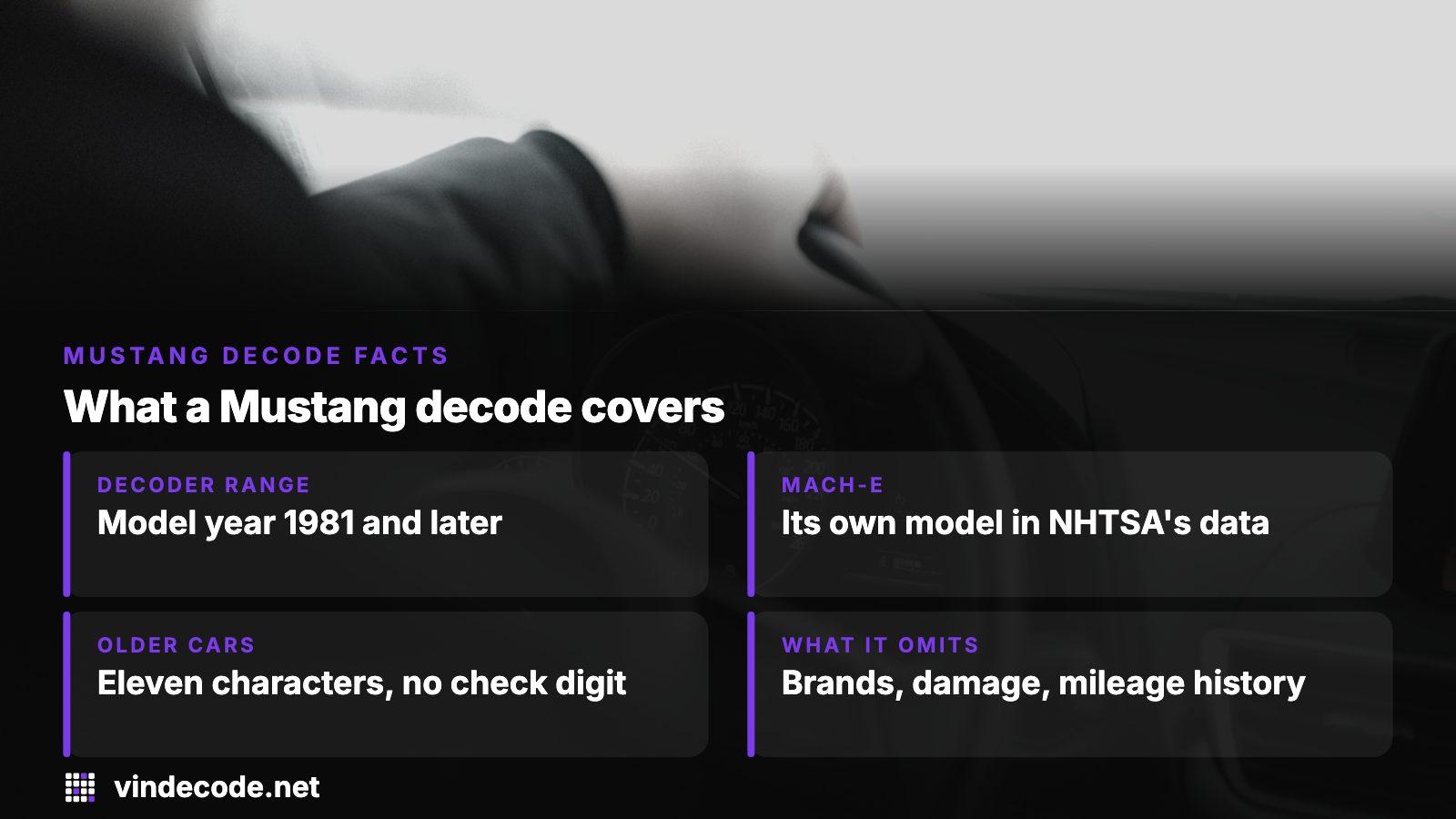
- Decoder range
- Model year 1981 and later
- Mach-E
- Its own model in NHTSA's data
- Older cars
- Eleven-character numbers, no ninth-place check digit
- What it omits
- Title brands, damage and mileage history
What the decoder returns for a Mustang
The tool looks up the pattern Ford filed with NHTSA and prints the fields that filing holds. Six Mustang test strings went through the public database; each has a valid check digit but belongs to no real car.
| Test string | Year | Trim and engine | Plant |
|---|---|---|---|
| 1FACP41E9JF100001 | 1988 | LX hatchback, 5.0 L V8 | Dearborn, Michigan |
| 1ZVHT82H355100001 | 2005 | GT coupe, 4.6 L V8 | Flat Rock, Michigan |
| 1FATP8UH6F5100001 | 2015 | I4 convertible, 2.3 L | Flat Rock, Michigan |
| 1FA6P8TH7J5100001 | 2018 | I4 coupe, 2.3 L | Flat Rock, Michigan |
| 1FA6P8CF9J5100001 | 2018 | GT coupe, 5.0 L V8 | Flat Rock, Michigan |
| 1FA6P8JZ4L5500001 | 2020 | Shelby coupe, 5.2 L V8 | Flat Rock, Michigan |
Gaps appear. On the 2018 GT string the drive type and gearbox came back empty, which NHTSA reads as no data on file, not proof the feature is missing.
Read the VIN off the Mustang itself
One misread character produces an error or points the decoder at another car.
- Federal rules make the number legible through the glass from outside, standing at the left windshield pillar, in daylight. Start at that spot.
- Take a close photo of the plate and match it, character by character, to the title and the registration.
- Type it into the decoder above. The VIN alphabet omits I, O and Q, so an error on one of those letters is a misread.
Character nine is a checksum derived from the sixteen around it. A clean result shows the number agrees with itself, not that the plate belongs on this car. A plate fixed to a replaced part deserves questions.
What the characters say on a late-model Mustang
From 1981 the federal layout applies. The test strings show how each block reads.
| Characters | What they hold | Seen in the tests |
|---|---|---|
| 1 to 3 | Maker and type of vehicle | 1FA on five strings, 1ZV on the 2005 one |
| 4 to 8 | Line, series, body and engine, in Ford's own code | On the 2015 to 2024 strings, place eight was F for the 5.0 L V8s and H for the 2.3 L fours |
| 9 | Check digit | Derived from the rest |
| 10 | Model year | J for 1988 and 2018, F for 2015, L for 2020 |
| 11 | Assembly plant | 5 for Flat Rock, F for Dearborn |
| 12 to 17 | This car's own serial | Differs on every car |
The 1988 and 2018 strings share a J because year letters return after 30 years, so read the letter against the body style and generation.
Mach-E, Shelby and loose use of the name
A 2021 test string starting 3FM came back as Mustang Mach-E, a battery-electric SUV with all-wheel drive, assembled in Cuautitlan, Mexico. Recalls and owner complaints are filed by model, so look them up under the name the decoder returns rather than the one in the advert.
- A Mach-E sold under a plain Mustang headline.
- A GT badge on a car whose decode says I4 and 2.3 L.
- A Shelby claim where the decode names a plain GT.
- A model year in the advert that disagrees with the tenth character.
Each of those is a question for the seller, and an unsatisfying answer is a reason to walk.
Older Mustangs: a different number, a different record
NHTSA says its decoder targets 1981 and later, and earlier vehicles sit outside it. The 1965-style string 5F07C100001, forced through anyway, returned an incomplete-VIN error, invalid characters and a wrong match from a maker of motorcycle sidecars. A late-1960s string, 9F02F100001, returned no vehicle at all.
Ford's early scheme used eleven characters: the model year as a single digit, the plant as a letter, two digits of body series, an engine letter, then a six-digit consecutive number. No slot is left for a check digit, so a swapped pair still looks plausible.
For 1967 through 2020 model years, Marti Autoworks says it licenses Ford's production database and sells a report per serial number. It lists factory options only, may omit standard items and disclaims any view on authenticity or condition. It describes the build, not the life.
Recalls follow the VIN, not the nameplate
NHTSA lists four campaigns for the 2018 Mustang, and they reach different cars: a missing roll pin in the 10-speed automatic that can disable Park, a cluster software fault on automatics, and an aftermarket supercharger kit. Dealers do recall work free of charge, per the remedy text. A stock manual car falls outside those three.
From an NHTSA owner complaint
The owner of a 2018 Mustang told NHTSA in June 2026 that the engine sputtered and smoked at about 56,000 miles, then lost coolant and stalled. A dealer traced coolant into two cylinders and called the engine finished. Ford, the owner says, replied that the VIN was not under recall and carried no warranty, and the dealer repaired the car out of pocket.
Take from it that an empty recall lookup closes only the recall question. Run NHTSA's lookup on the full VIN and save a dated copy, but do not read silence as a sound engine.
What a history report adds after the decode
The decode is the car as built. Later events sit in other records, which a report searches under the same VIN.
| Question after the decode | Where the answer sits |
|---|---|
| Was it ever branded salvage, junk or flood? | Title brands |
| Has it been in a crash, and how bad? | Damage and accident records |
| Did it pass through a salvage auction? | Auction history, with photos |
| Do the miles climb believably? | Odometer readings over time |
| Does a lender, pound or police report have a claim? | Lien, impound and theft records |
The federal title database warns that its reports are concise, that brand rules differ by state and that a clean result is no guarantee. Read a clean report as permission to keep checking.
What no record shows: how the car was driven
From an NHTSA owner complaint
An owner of a 2018 Mustang told NHTSA in July 2026 that the automatic hesitated, jerked when cold and finally dropped into limp mode at about 82,256 miles. The dealer updated software and relearned shift settings, then diagnosed internal failure and quoted a full replacement. Asked for help, Ford answered that no recall, service program or extended warranty applied.
Odometer and title records can reveal a rolled-back or branded car. Wear is something else. A mechanic you choose should lift the car, scan for codes and drive it cold before any money moves.
Cost, and a sensible order of work
The preview that opens after you enter the VIN is free and needs no card. Buying the report is one charge and nothing renews afterwards. Pay once for a single report, or take three, five or ten together; the pricing page lists what each option costs today.
- Decode the number from the car and hold year, trim and engine up against the advert.
- Put the whole VIN through NHTSA's recall lookup and screenshot the result.
- Open the preview and order the report once the build matches the listing.
- Book an independent inspection before any deposit.

Where this information comes from
- NHTSA: vPIC VIN decoder — States the 1981 starting point for decoding and supplied the test-string results, including the Mach-E and the failed 1960s patterns.
- eCFR: 49 CFR Part 565, VIN requirements — The federal rule for 17 characters, the ninth-place check digit, excluded letters and where the number must be readable.
- NHTSA: recalls by vehicle, 2018 Ford Mustang — The four campaigns on file for that model year and their free-of-charge remedies.
- NMVTIS: information for consumers — What the federal title database holds and the limits it states for its reports.
- Marti Autoworks — Coverage years and stated limits of the licensed Ford production reports for older cars.
- NHTSA owner complaint 11746432 — owner experience, paraphrased
- NHTSA owner complaint 11752476 — owner experience, paraphrased
Sources and photos: Facts checked against the sources above in November 2026. Photos by Maurice Sahl, Scott Graham and Miles Loewen on Unsplash; diagrams by VINDecode.
Keep reading
- Ford VIN Decoder: Decode a Ford VIN, Then Check Its HistoryFord's prefixes and the same decode applied across the brand.
- Classic Car VIN Decoder: Which Years It Reads and What Comes AfterGround rules for cars whose numbers pre-date the 17-character format.
- VIN Decoder Year Chart: Position 10 Codes for 1980 to 2039The tenth-character letters laid out so you can match them to a year.
- Sample reportA finished report, to see what the history adds after the decode.
Frequently asked questions
Can the VIN tell me whether a Mustang is a GT or a four-cylinder?
On 1981 and later cars, usually. The test strings returned GT with a 5.0 L V8 for one pattern and I4 with 2.3 L for another, and the eighth character differed. Trim names are Ford's coding and fields can come back blank, so confirm against the engine, the badges and the paperwork.
How do I decode a 1960s Mustang VIN?
Not with NHTSA's tool, which is built for 1981 and later cars. Read the eleven-character Ford number against a marque reference, and for cars from 1967 on ask the seller whether a Marti report exists. A history report suits 17-character numbers only.
Is the Mustang Mach-E decoded the same way?
The layout is the same 17 characters, but NHTSA files it as its own model. The 2021 test string beginning 3FM decoded as an electric, all-wheel-drive SUV built in Mexico, while the gasoline strings began 1FA or 1ZV and came from Michigan plants. Prefix and plant separate them quickly.
Why does the decoder say my Mustang's check digit is wrong?
Character nine is a checksum of the other sixteen, so a failure usually means a typo or a misread letter. Retype the number from the car. A short classic number will error out regardless, because the check digit belongs to the 17-character format.
If the decode matches the advert, is the car safe to buy?
No. A match means year, trim and engine agree with Ford's filing. It says nothing about crashes, branded titles, rolled-back odometers or liens. Run the history report on the same VIN, keep the recall lookup with the paperwork, and have the car inspected before paying.
Now check the car itself
The guide explains what to look for. The report shows what this VIN has on record.