THE SHORT ANSWER
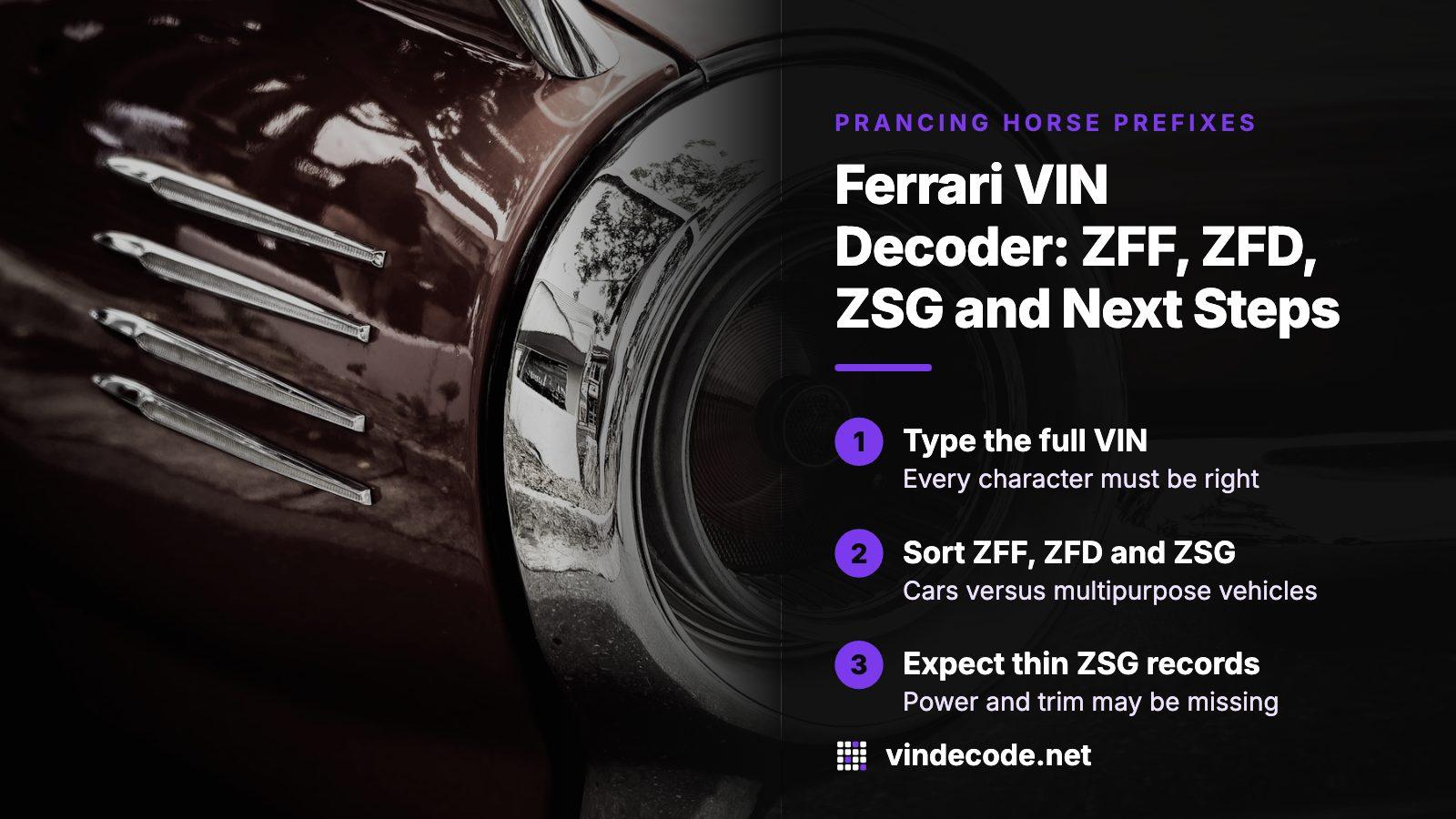
A Ferrari VIN decodes through NHTSA's public database once you type all 17 characters. Prefixes ZFF and ZFD mark passenger cars, and ZSG covers the Purosangue-type multipurpose vehicles. You get model, year, body style, engine size and plant. Accident records, title brands and mileage are not part of a decode, so run the free history preview as the second step.
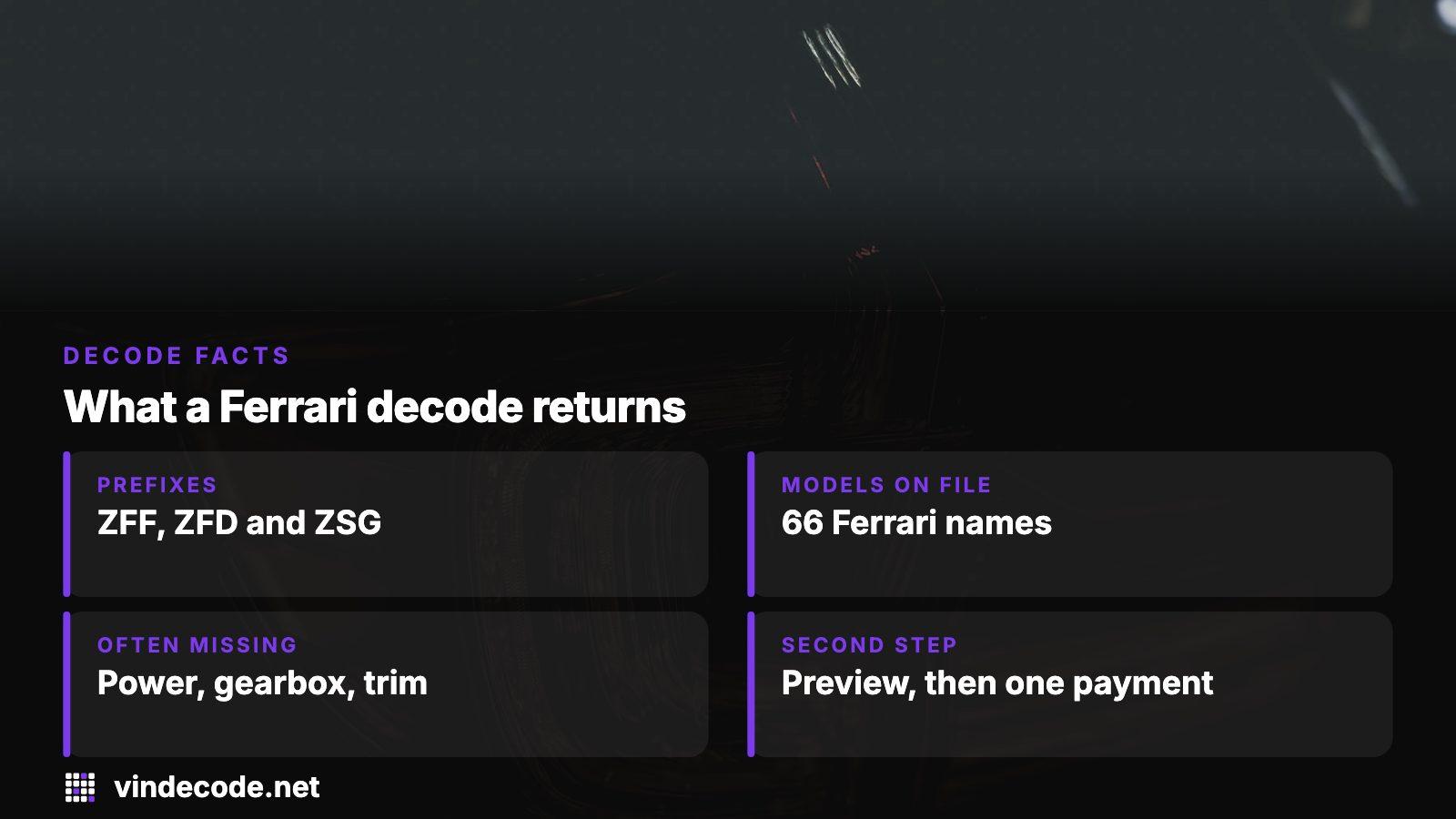
- Prefixes in NHTSA's list
- ZFF, ZFD and ZSG
- Models on file
- 66 Ferrari names in the database
- Often missing
- Horsepower, transmission, trim
- Second step
- Free preview, then one payment for the report
What a Ferrari decode tells you about the car
The decoder reads your VIN against the pattern Ferrari filed with the federal government, so what you read back is a snapshot of the car on the assembly line. That makes it a quick lie detector for a listing. If the advert says 488 and the record says 458, you have learned something before spending a cent.
- Model name and model year
- Body style, such as coupe or convertible
- Cylinder count and engine size in liters
- Fuel type and, sometimes, a transmission style
- Plant city and country
The vehicle database carries 66 Ferrari model names, so older and newer cars are both covered. Pre-1981 cars are a weaker fit, since the decoder was built for model years from 1981 on.
Three prefixes, five real decodes
NHTSA lists three manufacturer identifiers. ZFF belongs to the Italian maker and is typed as a passenger car. ZFD is registered to the North American arm, also as a passenger car. ZSG was added in April 2023 for multipurpose passenger vehicles. The table shows what the public decoder returned for partial VINs, entering the first eleven characters plus the model year.
| Car decoded | Body | Engine returned | Power returned |
|---|---|---|---|
| 2018 812 Superfast | Coupe | V12, 6.5 L | 788 hp, rear-wheel drive |
| 2017 488 GTB | Coupe | Eight-cylinder, 3.9 L | 660 hp |
| 2011 458 Italia | Coupe | Eight-cylinder, 4.499 L | Blank |
| 2010 California | Convertible | Eight-cylinder, 4.3 L | Blank |
| 2013 FF | Hatchback | 6.262 L, cylinders blank | 651 hp |
Every one of them named Maranello as the plant. A car sold as a genuine Italian-built Ferrari whose record points elsewhere, or fails to decode at all, needs a direct question to the seller.
Blank cells and the thin ZSG record
Look at the table again. The 458 and the California show no power figure, and the FF shows no cylinder count at all. NHTSA's own note says a missing value means the agency lacks data on that item, and nobody should conclude the car lacks the feature.
The ZSG prefix is thinner still. When only that prefix was entered with 2023 as the year, the answer gave the make and the vehicle type, plus a message that no detailed data was available yet and a warning about the model year. Treat a ZSG result as a starting point and ask for the build paperwork on anything the advert claims.
Rule of thumb
A blank neither confirms nor contradicts a seller's claim. Specific options, trim and output figures belong in documents from the factory side, so ask for them in writing.
Getting a clean copy of the VIN
Federal rules put a passenger car's VIN inside the cabin, where someone standing outside can read it through the windshield next to the driver-side pillar, printed at least 4 mm high. Take a photo of it in place. Then compare the photo with the title, the registration and the advert, because the listing may have a typo and the paperwork may have something worse.
A valid VIN has exactly 17 characters, spelled with numerals and capital letters other than I, O and Q. Position nine is a check digit, so a single wrong character usually produces an error instead of a different car. For a passenger car, position seven must be a letter. Positions four to eight carry make, line, series, body, engine and restraint details, in a key the maker supplies.
When the VIN and the car disagree
Decoding earns its keep in the unlucky cases. The record NHTSA holds is the reference, and a car that contradicts it is a problem before any money moves.
From an NHTSA owner complaint
The owner of a 2007 F430, a retired soldier, told NHTSA he paid a Ferrari dealer in Germany for the car in late 2013 and sent it home by ship. When it reached a Georgia port in February 2014, customs officers found the number on the car disagreed with the title and with how the car was built. They confiscated it, and he says it cannot be modified to suit American rules. He also says the dealer has gone silent and puts his loss at $167,000. These are his claims, not findings.
Whatever the details, the lesson for a buyer is plain: decode the VIN, match it to the title, and settle any mismatch before the wire goes out, not at the border.
Recalls that attach to a Ferrari VIN
A decode gives the model, and the model decides which campaigns might apply. NHTSA's recall record for a 2017 488 GTB lists three, shown below. Each covers certain model years, so check by VIN rather than by the badge.
| Campaign | Problem | Remedy |
|---|---|---|
| 19V006000 | Passenger air bag inflator may explode in a crash | Dealer replaces the air bag assembly, no charge |
| 21V833000 | Brake fluid may leak, risking loss of braking | New reservoir cap and a software update, no charge |
| 19V411000 | Air bag control unit may fail to fire air bags or belt pretensioners | Dealer replaces the unit, no charge |
Owners have also told NHTSA that parts for the air bag repair were slow to arrive. One 2017 488 GTB owner wrote that the dealer had none, and that repeated calls to the maker's customer service produced no date. An open recall is something to settle with the seller, in writing, before purchase.
What a decode cannot see
The 17 characters describe how the car was built and stop there. A repaired crash, a rebuilt title or a rolled-back odometer leaves no mark in them. Those facts live in title, damage, salvage and mileage records, which a history report gathers under the same VIN.
From an NHTSA owner complaint
In February 2026 someone told NHTSA that a rental company was renting out a rebuilt 488 whose air bags did not work. The car presumably decoded as a normal 488, since the decode describes only the build. A rebuild shows up in damage and title records, which is why the history step matters.
The federal title database, NMVTIS, counts 87 percent of the nation's vehicle fleet among its records and puts its salvage or total-loss entries near 20 million. It also warns that a search can give a false negative, because not every state reports, so a quiet record is not proof of a clean car.
Cost, and the order to run the checks in
No card is needed for the history preview. The full report that follows is bought once, as a lone copy or in a set of 3, 5 or 10, and no subscription starts. The pricing page has the amounts. A sensible order looks like this:
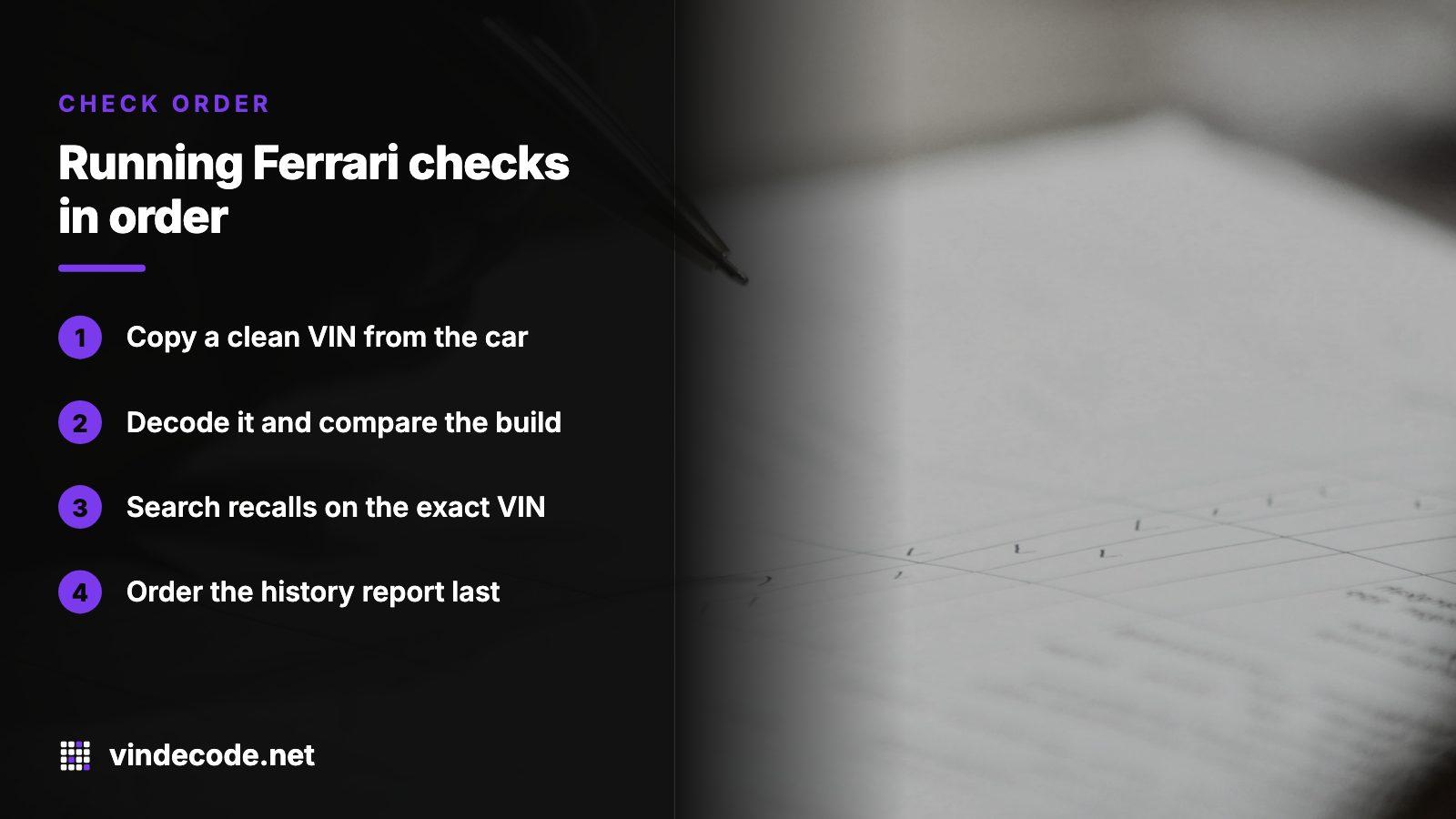
- Photo the VIN where it sits on the car and read it against the title.
- Run the decode, then hold model, year, engine and plant up to the listing.
- Check open recalls on the federal lookup for the same VIN.
- Run the history preview for title brands, damage and mileage.
- Buy the full report if the preview raises questions, then arrange a specialist inspection.
The inspection comes after these steps, not in place of them.
Where this information comes from
- NHTSA: vPIC VIN decoder — The public tool where the Ferrari decodes above were run.
- NHTSA vPIC API: Ferrari manufacturer identifiers — Lists the three prefixes and the vehicle type of each.
- eCFR: 49 CFR 565.15, VIN content requirements — Source for the rules on what positions four to eight describe and the letter in position seven.
- NHTSA recalls API: 2017 Ferrari 488 GTB — The three campaigns summarized in the recall table.
- NMVTIS: information for consumers — Coverage figures and the warning about false negatives.
- NHTSA owner complaint 10583521 — owner experience, paraphrased
- NHTSA owner complaint 11736642 — owner experience, paraphrased
Sources and photos: Facts checked against the sources above in November 2026. Photos by Warren Griffiths, Masjid MABA and A n v e s h on Unsplash; diagrams by VINDecode.
Keep reading
- Maserati VIN Decoder: ZAM and ZN6 Prefixes, Model, Engine, PlantAnother Italian marque where the decode is only the first check.
- Lamborghini VIN Decoder: ZHW, ZPB, Model, Engine and PlantPrefixes and plant details for the other Italian supercar maker.
- NHTSA VIN Decoder: What It Returns, Where It Stops, What Comes NextHow the federal database behind these decodes works.
- Sample reportA finished report, to judge what history adds to a decode.
Frequently asked questions
How do I decode a Ferrari VIN?
Type all 17 characters into the decoder on this page and read back the model, year, body, engine and plant. Take the number off the car itself, since one wrong character causes an error. Then compare each line with the advert and put every mismatch to the seller before you travel or pay.
What do ZFF, ZFD and ZSG mean on a Ferrari?
They are manufacturer identifiers in NHTSA's list. ZFF is the Italian maker's passenger car code, ZFD is registered to the North American company, and ZSG covers multipurpose passenger vehicles. The prefix tells you the maker and vehicle type, and the characters after it narrow down the specific model.
Why does my Ferrari decode show no horsepower?
Blank cells mean NHTSA holds no data for that item, as the agency says itself. Several of the cars above returned no power figure or transmission. It does not suggest anything is missing from the car. Ask the seller for the build documents when a specific figure matters.
Does a Ferrari VIN decoder show accidents or a salvage title?
No. A decode describes how the car was made, and crash damage, title brands and odometer readings are recorded elsewhere. The history preview on this site is the next step for those records, and it costs nothing to run before you decide on the full report.
Can I check Ferrari recalls with the VIN?
Yes. NHTSA runs a recall lookup that accepts a VIN and lists open campaigns, and the repair itself is done by a dealer without cost to you. Campaigns cover certain model years only, so rely on a VIN search, and get the status of any open item confirmed in writing by the seller.
Now check the car itself
The guide explains what to look for. The report shows what this VIN has on record.