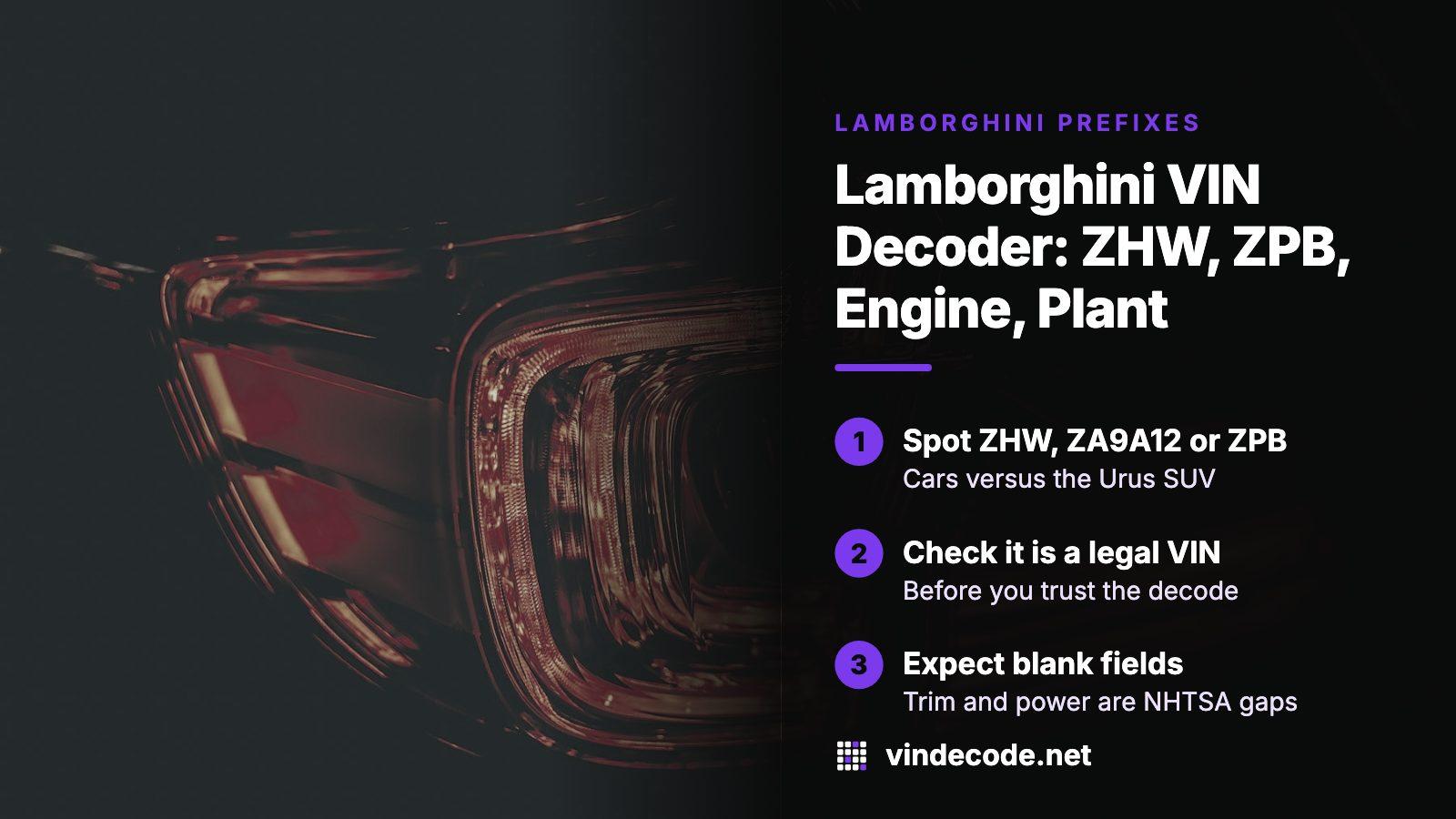
THE SHORT ANSWER
To decode a Lamborghini VIN, enter the full 17 characters in the decoder on this page. A VIN starting ZHW is a passenger car such as a Gallardo or Huracan, and ZPB is the Urus SUV. The result gives model, year, body, engine and the Italian plant. Crashes, title brands and mileage are absent, and the history preview covers those.
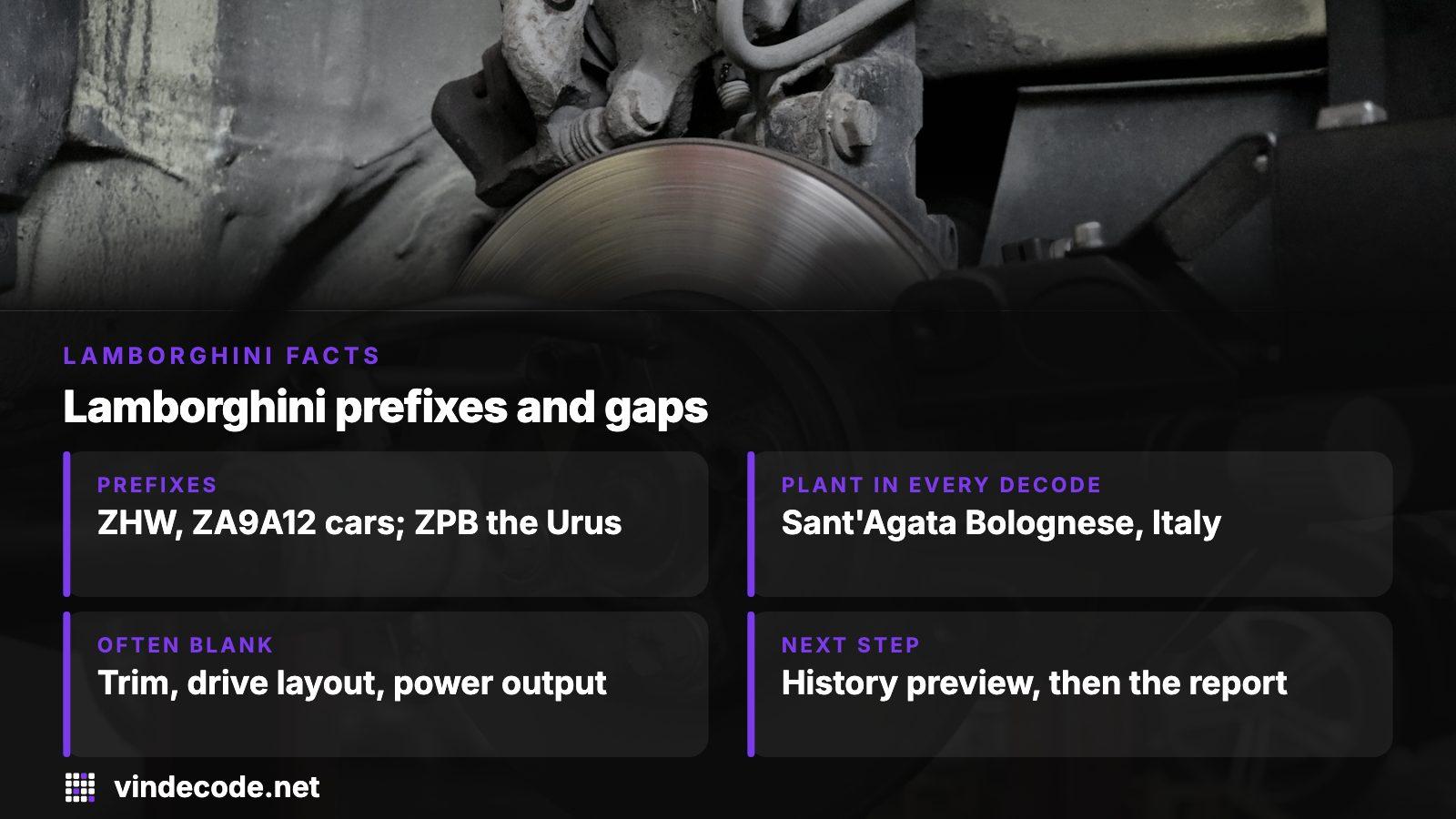
- Prefixes
- ZHW and ZA9A12 for cars, ZPB for the Urus
- Plant in every decode checked
- Sant'Agata Bolognese, Italy
- Often blank
- Trim, drive layout, power output
- Next step
- Free history preview, then one payment for the report
What a Lamborghini decode puts on screen
The decoder looks your VIN up in NHTSA's vPIC database, which holds the pattern Automobili Lamborghini filed for its cars. The answer describes the car at assembly, which makes it a clean test of any listing against the metal.
- Model name, model year and body style
- Engine layout, cylinder count and displacement
- Fuel type
- Vehicle class and weight class
- City and country of assembly
The database lists ten Lamborghini model names, from Diablo and Murcielago through Aventador, Huracan and Urus to the newer Revuelto and Temerario. A decode that returns a model name different from the badge on the car is the first red flag, and it costs nothing to find.
ZHW, ZA9A12 and ZPB, shown on real Lamborghini VINs
NHTSA lists three maker identifiers for Lamborghini. ZHW and ZA9A12 are classed as passenger cars, and ZPB is classed as a multipurpose passenger vehicle, which is where the Urus sits. The nine in the third place of ZA9A12 is no accident: federal rules reserve that digit for makers whose identifier runs to six characters. The rows below decode VINs taken from owner complaints, using the first eleven characters and the model year.
| Decoded car | Prefix | Body | Engine as NHTSA lists it |
|---|---|---|---|
| 2004 Gallardo | ZHW | Coupe | V10, 5.2 L |
| 2008 Gallardo | ZHW | Roadster | V10, 5 L |
| 2020 Huracan | ZHW | Coupe, EVO Coupe series | V10, 5.204 L, 631 hp |
| 2023 Huracan | ZHW | Coupe, Tecnica trim | V10, 5.204 L, 630 hp, 4x2 |
| 2022 Urus | ZPB | SUV | V8, 3.996 L, 641 hp |
| 2023 Urus | ZPB | SUV, S series | V8, 3.996 L, 657 hp |
Every one of them names Sant'Agata Bolognese as the plant. A decode that points somewhere else, or fails outright on a car sold as a modern Lamborghini, deserves a phone call to the seller before anything else.
Copy the VIN from the car, then check it is a legal one
Under federal rules a passenger car carries its VIN inside the cabin, where it can be read through the windshield from outside, by the driver's side pillar. Photograph it there, and read the paperwork against the photo. Listings contain typos and occasionally something worse.
A valid VIN has exactly 17 characters, built from the digits plus all letters but I, O and Q. Position nine is a check digit, so one wrong character usually triggers an error from NHTSA instead of a different car. Position seven must be a letter on a car this size. The same rules bar two vehicles from sharing a VIN anywhere in a 60-year window that opens with model year 1980, so a duplicate is a warning sign, not a coincidence.
NHTSA describes its decoder as meant for model years from 1981 forward. On an older car, expect the decoder to be the weakest tool in the box and lean on a specialist and the paperwork.
Blank fields are NHTSA's gaps, not the car's
Look again at the table. The Gallardos show no trim and no power figure, and neither Urus shows a drive layout. NHTSA's own note says an empty value only means the agency has no data on that point, and nobody should infer the car lacks the feature.
Treat a blank as a question
If the advert claims an option, a trim or a power output the decode leaves empty, ask the seller to prove it from the build paperwork. A blank neither confirms nor contradicts the claim.
The maker's own records are the place for finer build detail. Use the decode for the broad facts, quickly, and ask the factory side for the rest.
Recalls that follow a Lamborghini VIN
Several Lamborghini campaigns touch fuel, fire or wheels, and each covers certain model years only. The same recall can apply to one car and miss its neighbour on the lot, so check by VIN, not by model name.
| Model and years | Campaign | Fault in the record |
|---|---|---|
| Aventador 2012 to 2017 | 17V073 | Fuel may touch the exhaust with a full tank, fire risk |
| Aventador SV 2015 and 2016 | 18V461 | Bolts that center the brake discs can loosen, wheel could detach |
| Gallardo 2004 to 2006 | 12V430 | Pressurized steering lines by the pump may leak, fire risk |
| Urus 2019 and 2020 | 20V713 | Fuel line connector heat damage, leak and fire risk |
NHTSA's tool shows what is open on your VIN, and the maker's own recall page searches campaigns from the last 15 years. Dealers carry out the repairs without charge.
What owners tell NHTSA, and what a decode misses
Complaints about these cars are rare in NHTSA's files, which fits a low-volume maker. The few that exist show problems a decode cannot predict.
From an NHTSA owner complaint
A 2004 Gallardo owner reported a fire in the engine bay while driving. The account says transmission control fluid met the hot exhaust after a pressure line failed. That is a different part from the steering pipes in the recall above, so one open campaign never covers everything.
From an NHTSA owner complaint
A 2023 Huracan owner described the whole instrument cluster going dark on a highway. The car was towed, and the dealer said it was out of warranty and quoted $8,000. The owner called it a "massive safety issue". Ask any seller what warranty is left and whether it transfers.
Both cars decoded cleanly. The decode told the buyer what was built, and told them nothing about what would fail.
Where each answer lives
A VIN records how a car was made and stops there. A repaired crash, a salvage title or an odometer that was altered leaves no mark in the 17 characters. Those facts sit in title, damage and mileage records, and the history report pulls them together for one VIN.
| Question | Where the answer is |
|---|---|
| Model, year, engine, plant | The decode |
| Fine build detail and options | The maker's records |
| Salvage, flood or other title brand | History report: title records |
| Crash damage, with photos | History report: damage and auction records |
| Mileage that adds up | History report: odometer readings |
| Loan still owed, theft | History report: lien and theft records |
| Open safety recalls | NHTSA's recall lookup, no charge |
The federal title database behind many reports says 87 percent of the country's vehicles appear in it, and it holds close to 20 million salvage or total loss entries. Not every state feeds it, since the page puts reporting at more than half, so a quiet record is not proof, and a specialist inspection still belongs on the list.
Cost, and the order to run the checks in
The preview is free and needs no card. You pay once for the full report, buying a single copy or a bundle of 3, 5 or 10; no plan renews behind your back. The pricing page lists the amounts.
- Photograph the VIN on the car and decode it.
- Hold the result against the advert, starting with model, then body and engine.
- Run the VIN through NHTSA's recall tool and the maker's own page.
- Open the history preview and look for brands, damage and odometer gaps.
- Order the full report only for a car that passed the first four steps.
An inspection by a Lamborghini specialist comes after all of this, not instead of it.

Where this information comes from
- NHTSA: vPIC VIN decoder — The public database where the maker's VIN pattern is held, and where the decodes above were run.
- NHTSA: vPIC API — Explains partial decodes and why the model year should be sent.
- eCFR: 49 CFR 565.15, VIN content requirements — Source for the rules on identifier length and the letter in position seven.
- NHTSA: recalls lookup — Open-recall check by VIN.
- NHTSA owner complaint 10215906 — owner experience, paraphrased
- NHTSA owner complaint 11677967 — owner experience, paraphrased
- Lamborghini: recall campaign search — The maker's VIN search for recent campaigns.
Sources and photos: Facts checked against the sources above in November 2026. Photos by A n v e s h, Carrie Allen www.carrieallen.com and Media Digital on Unsplash; diagrams by VINDecode.
Keep reading
- Bentley VIN Decoder: Read the Build, Then Check the Car's PastAnother low-volume luxury marque where the decode is only the first step.
- Porsche VIN Decoder: WP0, WP1, Plant, Engine and 911 GenerationPrefixes, plants and what the factory build record adds on a Porsche.
- NHTSA VIN Decoder: What It Returns, Where It Stops, What Comes NextHow the federal database behind these decodes works.
- Sample reportA finished report, to judge what history adds to a decode.
Frequently asked questions
How do I decode a Lamborghini VIN?
Enter all 17 characters in the decoder on this page and read back the model, year, body, engine and plant. Take the number from the car itself, since one wrong character causes an error. Compare the result with the advert line by line and put every mismatch to the seller.
What do ZHW and ZPB mean at the start of a Lamborghini VIN?
NHTSA lists ZHW for Lamborghini passenger cars, such as the Gallardo and Huracan, and ZPB for the Urus SUV. A third identifier, ZA9A12, is also listed for cars. The prefix names the maker and vehicle type, and the plant comes from a later position.
Will a Lamborghini VIN decode show trim or options?
Sometimes. The Huracan decodes above showed a trim, while the Gallardos showed none. NHTSA treats a blank as missing data, not as proof an option is absent. For option lists and fine detail, ask the maker or a dealer, and have the answer written down before you agree a price.
Does the decoder show accidents, salvage titles or mileage?
No. A decode covers the build only. Crashes, title brands, odometer readings and loans sit in other records, which a history report gathers. Decode first to confirm the car, then open the free preview to see what the full report would add for this VIN.
Can I decode a classic Lamborghini made before 1981?
NHTSA describes its decoder as meant for model years from 1981 forward, so an older car may not decode at all. For one, lean on a specialist's inspection and the paperwork, and read every document carefully before you pay.
Now check the car itself
The guide explains what to look for. The report shows what this VIN has on record.