THE SHORT ANSWER
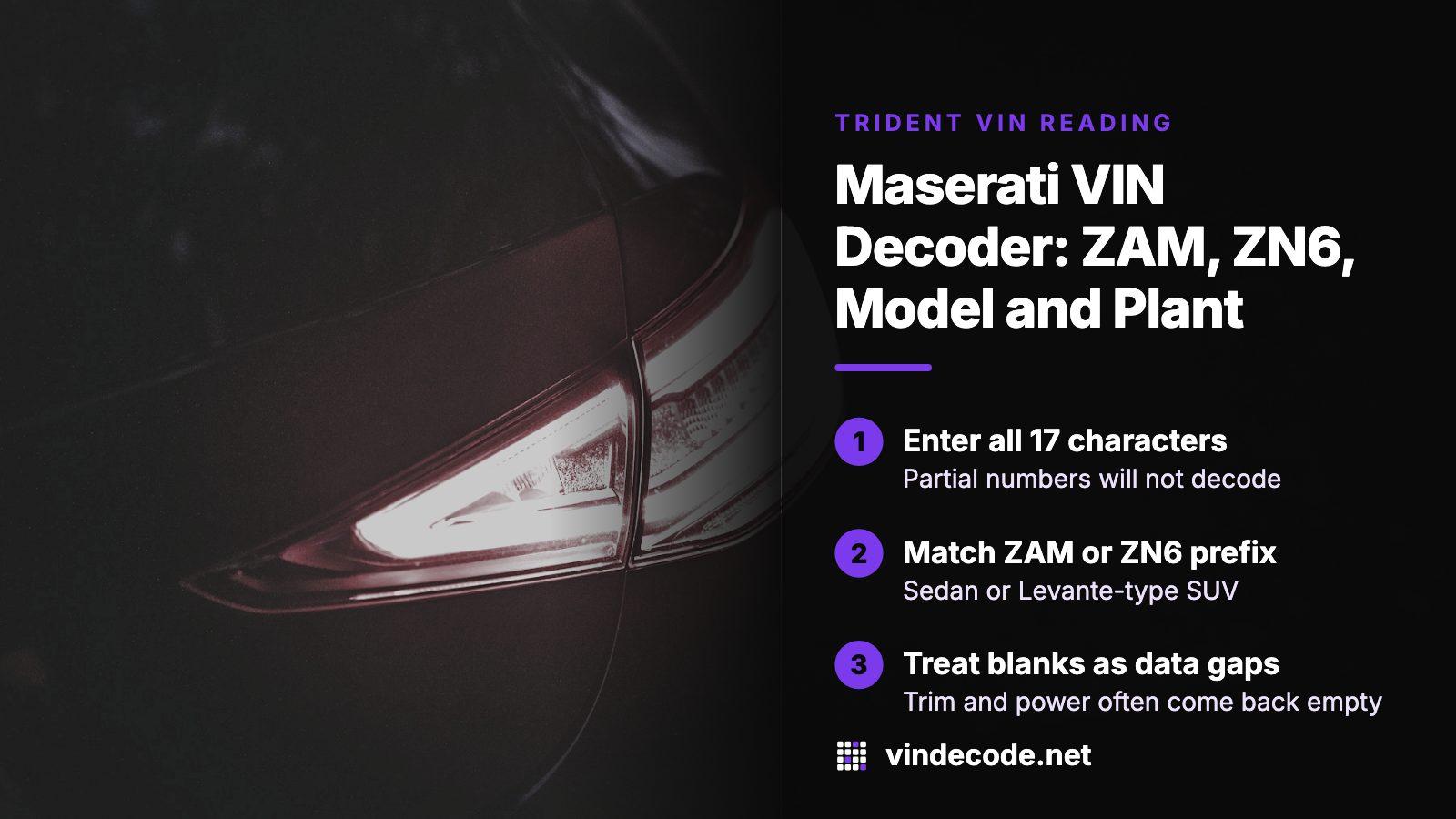
A Maserati VIN decodes in seconds once every one of its 17 characters is entered. A VIN beginning ZAM is a Maserati passenger car such as a Ghibli or Quattroporte, and ZN6 marks an SUV such as the Levante or Grecale. The result names model, year, body, engine and plant. It leaves out crashes, title brands and mileage history, which the free history preview covers.
- Prefixes
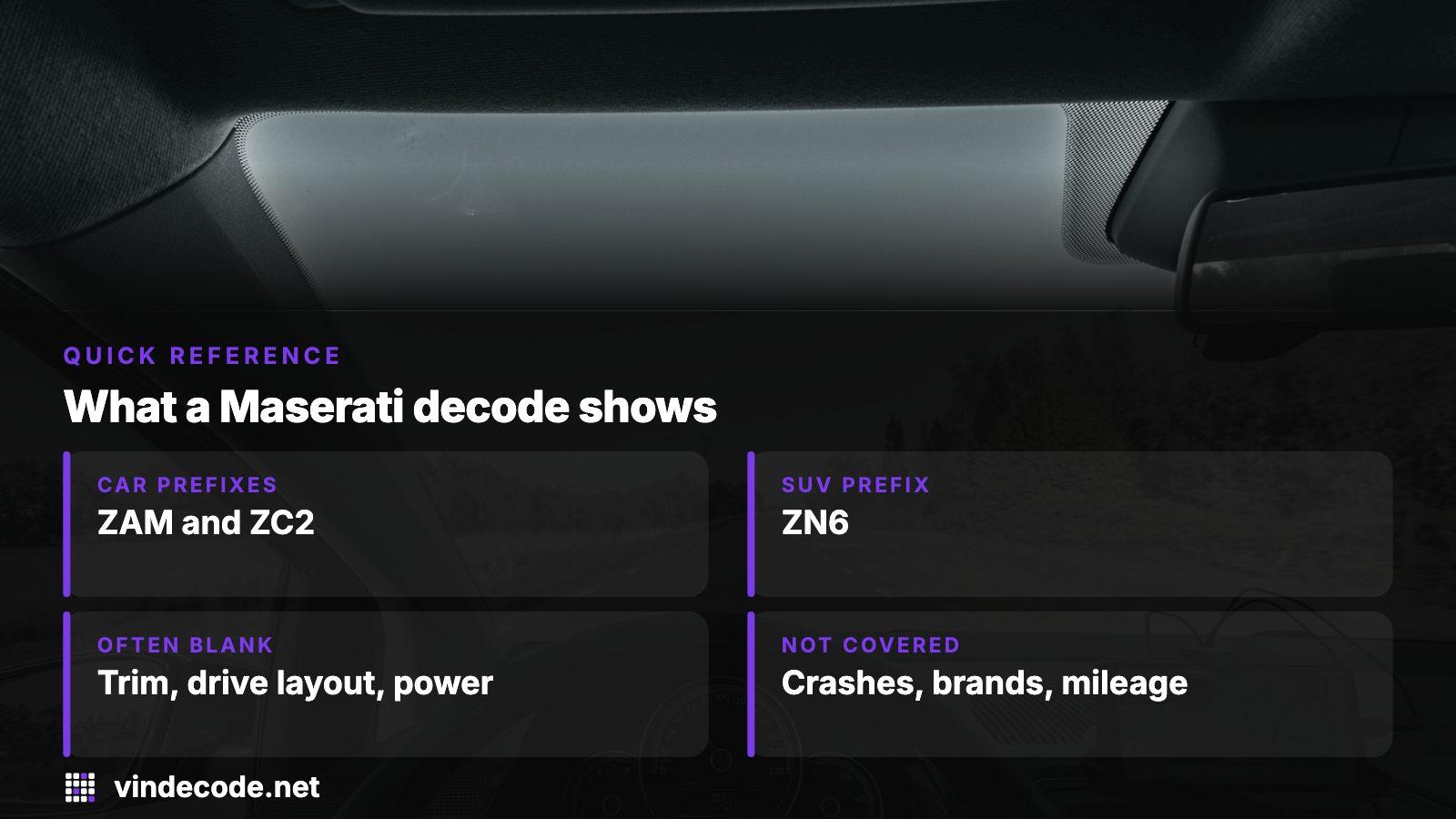
- ZAM and ZC2 for cars, ZN6 for SUVs
- Plants seen in our decodes
- Modena, Grugliasco, Mirafiori, Cassino
- Often blank
- Trim, drive layout, power figure
- Next step
- Preview first at no charge, report as a one-off purchase
What a Maserati decode puts on screen
Behind the decoder sits the pattern Maserati S.p.A. filed with NHTSA. Your VIN is matched to it, and the answer shows the car in its original factory form, which makes it a fast test of any advert.
- Model name, series code and model year
- Body style and number of doors
- Cylinder count, displacement and whether the engine is turbocharged
- Drive layout, when NHTSA has it
- City and country of assembly
The federal database knows fifteen Maserati names, from the old Biturbo, Merak and 228 through Quattroporte, Ghibli, Levante and GranTurismo to the newer MC20, Grecale and MCPura. If the decoded model differs from the badge on the trunk lid, you have found your first question for the seller.
ZAM, ZC2 and ZN6, shown on real Maserati VINs
The agency files three maker identifiers under Maserati, all of them Italian. ZAM and ZC2 are filed as passenger cars. ZN6 is filed as a multipurpose passenger vehicle, the class the SUVs fall into. The rows below use VINs quoted by owners in NHTSA complaints. Each was decoded from its opening eleven characters plus the model year.
| Car | Prefix | Body and engine as listed | Plant |
|---|---|---|---|
| 2005 Quattroporte | ZAM | Sedan, V8, 4.2 L | Modena |
| 2010 GranTurismo S | ZAM | Coupe, V8, 4.2 L | Modena |
| 2014 Ghibli | ZAM | Sedan, 6 cylinders, 3 L, 404 hp, AWD | Grugliasco |
| 2014 Quattroporte Essence | ZAM | Sedan, 6 cylinders, 3 L, 404 hp, AWD | Grugliasco |
| 2017 Levante Sport | ZN6 | SUV, turbo 6 cylinders, 3 L, 345 hp, AWD | Mirafiori |
| 2023 Grecale GT | ZN6 | SUV, turbo 4 cylinders, 2.0 L, AWD | Cassino |
The plant column is worth a second look. Four different Italian cities appear, so a plant that differs from a friend's Maserati proves nothing. What matters is whether the plant fits the model and year you are being sold.
Typing the number so the decoder accepts it
Before typing anything, copy the number off the Maserati itself and check it against the registration. Most failed decodes come from slips of the finger, though a few come from listings that carry the slip.
Position nine holds a check digit. We tested it by taking the real Ghibli prefix ZAM57RTA4E1 and adding six zeros to make 17 characters. NHTSA refused it with a message that the ninth position does not calculate properly. One wrong character inside a genuine VIN fails identically, so a seller's number that gets rejected is itself a red flag.
NHTSA also accepts partial numbers, with an asterisk standing in for each missing character, and it suggests always sending the model year. A partial decode carries the warning 'Incomplete VIN', so treat it as a rough read and not as proof.
Older than 1981
The federal tool was built for 1981 and later cars. A classic Maserati from the Merak era may not decode at all, and the paperwork and a marque specialist have to carry the identification.

A blank field is a gap in NHTSA's data, not in the car
Look back at the table. The 2005 Quattroporte shows no trim, no drive type and no power output. The Grecale shows no horsepower. Blanks mirror what the maker reported to the agency, and they do not mean the equipment is absent.
- If an advert claims a trim or package the decode leaves empty, ask the seller for build paperwork that proves it.
- If the decode names a trim that the advert does not, trust the decode and ask why.
- If the engine size or cylinder count disagrees with the listing, stop and get a written explanation.
Recalls attach to the VIN, not to the model name
Maserati's recall record for a 2014 Ghibli runs to six campaigns, and the 2014 Quattroporte carries the same six. A 2017 Levante has three. Each covers a build window, which means neighbors on a dealer lot can differ.
| Campaign | Cars covered | Fault in the record |
|---|---|---|
| 16V122 | 2014 to 2016 Quattroporte and Ghibli | Driver floor mat can slip under the accelerator pedal |
| 16V264 | 2014 to 2016 Quattroporte and Ghibli | Rear tie-rod bolt may be under-tightened, risking loss of control |
| 16V424 | 2014 Quattroporte and Ghibli | Gear selector can mislead the driver about Park |
| 18V831 | 2014 and 2015 Quattroporte and Ghibli | Damaged fuel lines may leak, fire risk |
| 17V161 | 2017 Levante | Software fault can drop the car into neutral or stall it at low speed |
Dealers do these repairs at no charge. The catch is proof. Ask for the service invoice that shows the work, since a car can be sold with a recall still open. NHTSA's recall data is searchable by make, model and year, and the history report lists any open recall found for the VIN.
What the factory record cannot tell you about a used Maserati
A VIN records the build and goes quiet after that. Used-car money is lost in the years that follow. NHTSA's complaint files hold first-hand accounts that show it.
From an NHTSA owner complaint
An owner of a 2015 Ghibli reported buying it from a dealer in December 2020 with 51,675 miles showing. A history report from the earlier trade-in had listed 41,135 miles, and the owner filed the complaint under the heading of odometer fraud.
A gap of over ten thousand miles is the sort of thing a mileage timeline exposes. The decode of that Ghibli would have looked perfect.
Hidden frame damage, and where it shows up first
From an NHTSA owner complaint
One 2014 Quattroporte owner had financed the car second-hand. A small crash in spring 2019 sent it to a body shop, which held it for roughly six weeks before declaring it totaled. Digging afterward, the owner found an older deer collision and an estimate showing the frame had been pulled. The payout was 14K, set against more than 35K spent on the car.
From an NHTSA owner complaint
Another 2014 Quattroporte buyer wrote that structural damage was not disclosed when the car was bought pre-owned, and surfaced a year and a half later, after a small fender bender. The insurer then wanted to total it.
Both stories end the same way: a small new claim exposed an old repair. Salvage records, auction photos and damage entries are where such a history tends to show. The government's title database, NMVTIS, says it includes 87 percent of US vehicles and roughly 20 million salvage or total loss records, though only a bit over half the states feed it. An empty result therefore lowers the odds without ending them, and a specialist's inspection of the frame is still the final test.
What it costs and the sequence that saves money
Opening the preview costs you nothing. The full report is bought one time, either for a single car or several at once, and no subscription follows. See the pricing page for today's amounts.
- Photograph the VIN where it is stamped, then decode it here.
- Compare model, body and engine against the advert.
- Search NHTSA's recall data and ask for repair paperwork.
- Run the VIN through the history preview and watch for title brands, damage entries and mileage jumps.
- Pay for the report once the car has passed steps one to four, then book a mechanic.
Where this information comes from
- NHTSA: vPIC VIN decoder — The public database holding Maserati's filed VIN patterns, and the model-year limit of 1981.
- NHTSA: vPIC API — Explains partial decodes with an asterisk and why to send the model year.
- NHTSA: recalls data for the Maserati Ghibli, 2014 — Source for the campaign numbers, covered cars and remedies in the recall table.
- NHTSA owner complaint 11766107 — owner experience, paraphrased
- NHTSA owner complaint 11324292 — owner experience, paraphrased
- NHTSA owner complaint 11218712 — owner experience, paraphrased
- NMVTIS: consumer access — Coverage figures for the federal title database and the warning about false negatives.
Sources and photos: Facts checked against the sources above in November 2026. Photos by Maurice Sahl, Alejandro Escamilla and Sander Jeurissen on Unsplash; diagrams by VINDecode.
Keep reading
- Lamborghini VIN Decoder: ZHW, ZPB, Model, Engine and PlantAnother low-volume Italian marque where the decode is only the first step.
- Alfa Romeo VIN Decoder: Giulia and Stelvio Decoded, Then CheckedPrefixes and plants for the Italian brand that shared a recall with some Maseratis.
- VIN Decoder Explained: What Decoding a VIN Means and How It WorksHow each of the 17 positions is built, for any make.
- Sample reportA finished report, to judge what history adds to a decode.
Frequently asked questions
How do I decode a Maserati VIN?
Enter the whole VIN in the decoder above, then read the model, year, body, engine and plant it returns. Take the number straight off the vehicle, because a single wrong character triggers an error. Hold each line up to the advert and put any mismatch to the seller before price comes up.
What do ZAM and ZN6 mean at the start of a Maserati VIN?
NHTSA lists ZAM and ZC2 as Maserati passenger car identifiers and ZN6 as the one for SUVs and similar vehicles. In our decodes the Levante and Grecale both began ZN6, while the Ghibli, Quattroporte and GranTurismo began ZAM. The plant is identified by a later position, not the prefix.
Does a Maserati VIN decode show the trim and options?
Sometimes. The 2017 Levante came back as a Sport and the 2010 GranTurismo as an S, while the 2005 Quattroporte had no trim at all. An empty field means NHTSA lacks the data, so request build paperwork when a claimed package affects the price.
Can a decode reveal a Maserati's crash history?
No, because a decode describes only the build. Accidents, salvage titles, odometer readings and liens live in separate records that a history report pulls together per VIN. Decode first, then try the free preview to learn what the report holds for that number.
Can I decode an older Maserati such as a Biturbo?
The Biturbo name does appear in NHTSA's model list, but the agency built the tool for 1981 and newer cars. Early results may be thin or missing, so lean on paperwork and a marque specialist, and read every document before paying.
Now check the car itself
The guide explains what to look for. The report shows what this VIN has on record.