THE SHORT ANSWER
A classic truck VIN decoder works on 17-character numbers, so it reads a truck from the 1981 model year forward and returns the model line, cab, drive, engine, weight class and build plant. Older trucks have shorter numbers set by each manufacturer, and the federal data behind public decoders has nothing filed for them. An empty result on a 1975 truck is normal. For anything newer, decode first and run a history report second.
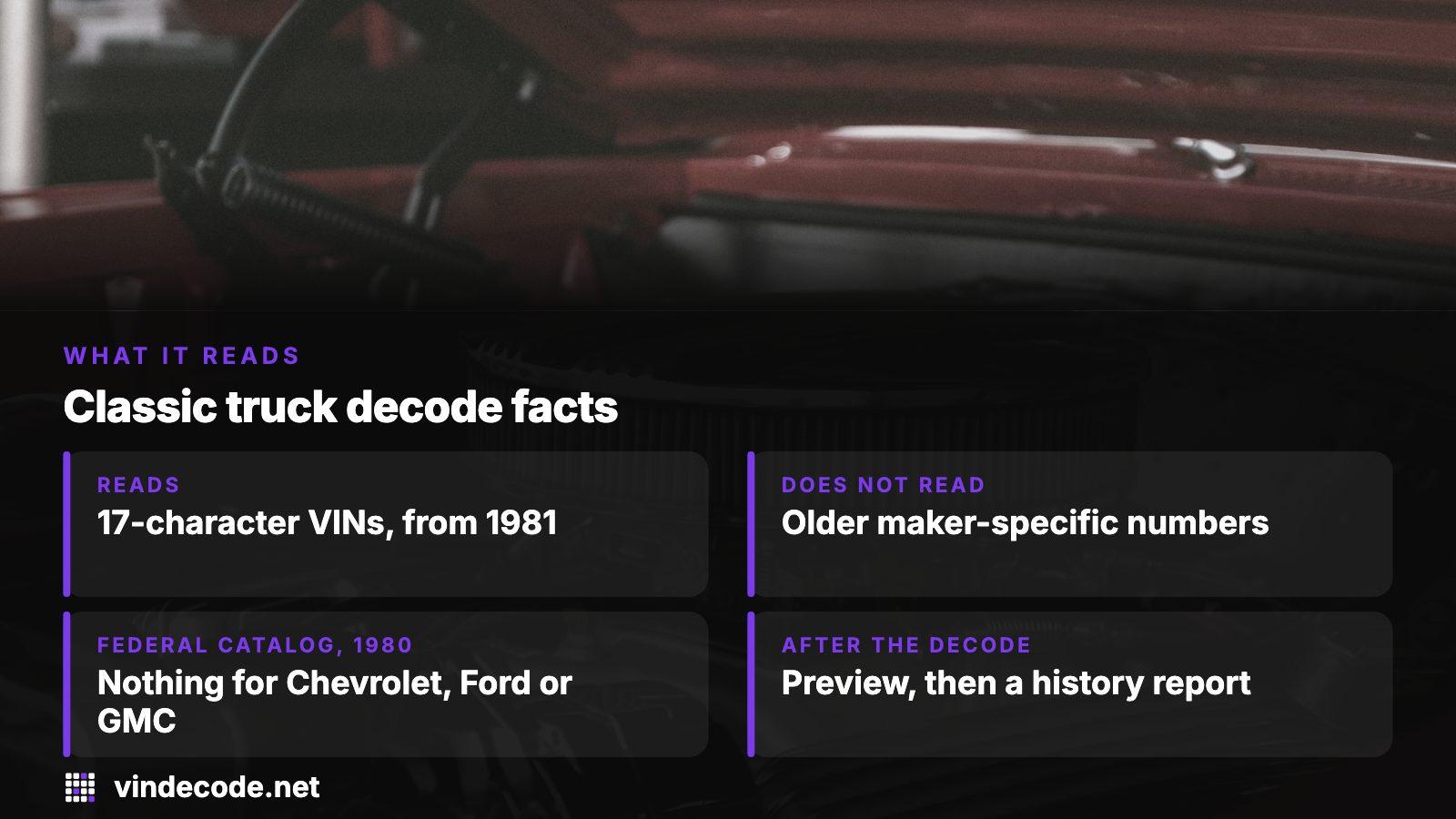
- Reads
- Trucks with a 17-character VIN, from 1981
- Does not read
- Shorter maker-specific numbers on older trucks
- Federal catalog, 1980
- Nothing for Chevrolet, Ford or GMC
- After the decode
- Free preview, then a history report on the same VIN
What a decode tells you about a classic truck
From the 1981 model year on, every pickup and work truck carries the same 17-character layout a new one does, so the decoder reads a vintage F-series with the logic it uses on a new one. It converts the number into the build the factory recorded. For a truck, these fields do the most work.
| Field | What it states | What to compare it with |
|---|---|---|
| Model and series | The truck line and its nominal load rating, such as half ton | The seller's claim of half ton, three-quarter ton or one ton |
| Body and cab | Pickup, chassis cab, van or wagon, plus the cab style | The truck as it sits in the driveway |
| Drive type | Two-wheel or four-wheel drive | A 4x4 badge on a number that decodes as 4x2 |
| Engine | Displacement, cylinders and fuel as built | The block under the hood, which may be a later swap |
| Weight class | The gross weight band the factory assigned | Any payload talk in the listing |
| Plant | The assembly city and state | The data plate on the door post |
That is the factory's version of the truck. It is a starting description, and it stops on the day the truck left the line.
Why a 1975 pickup decodes as nothing
Public decoders query NHTSA's vehicle product information catalog, and its records begin with the 1981 model year. Ask it which Chevrolet models exist for 1975 and it replies successfully with an empty list. That reply is not a failed lookup, and typing the number again will not change it.
| Maker | Models filed for 1980 | Models filed for 1981 |
|---|---|---|
| Chevrolet | 0 | 49 |
| Ford | 0 | 310 |
| GMC | 0 | 25 |
| Dodge | 3 | 32 |
Dodge is the exception. Its three entries for 1980 are chassis cab, van and wagon bodies, and none is a pickup. A 1980 truck deserves one try at the decoder; anything earlier does not.
A blank result is a statement about the catalog. Nobody should read it as a verdict on the truck, whether they are selling it or buying it.
What to do when the truck has a short number
Before the 17-character rule, each manufacturer numbered its own trucks, with its own lengths and its own meaning for each position. No single decoder can cover that, so a pre-1981 pickup calls for a reference to its maker and year, or an owner registry.
- Tally the characters before anything else. Seventeen goes to the decoder above; fewer goes to a reference for that maker.
- Match the stamped or plated number to the title, character for character, standing at the truck rather than looking at photos.
- Treat stampings on the engine, axle housing or transmission case as serial numbers for those parts. They follow the part and can legitimately differ from the truck's own number.
- Take build-plate codes to a reference for that exact maker and year, never to a general decoder.
Older trucks change hands informally, and a missing owner in the title chain can cause trouble when you register it. Ask to see the paperwork before you ask for a test drive.
Finding the number and typing it without errors
Start at the door pillar, then look along the cowl and down the frame rail. A restored truck, or one with a replacement cab, may show a different stamping in each spot, so photograph all of them and read them again at home.
Type slowly. The federal table behind the check digit assigns no value to I, O or Q, so any lookalike on the truck is really a one or a zero. If the decode flags the check digit, a character is wrong somewhere. The decoder can still return a build with that flag attached, so treat the result as a lead until the characters match the title.
When a decode guesses the wrong decade
Position 10 holds the model year as a letter or digit, and those codes repeat on a thirty-year cycle. A half-ton from 1985 and one from 2015 share a character there. On lighter trucks, position 7 breaks the tie: a digit points to the earlier cycle and a letter to the later one. Heavier trucks have no such tell, so the decoder may note that the year could be wrong and let you enter it yourself. Do that when the truck's age is not in doubt.
Brand decoders for the trucks buyers hunt
The federal catalog lists the popular pickup and work lines by name for 1981, and each maker still lays out positions 4 to 8 in its own way. A brand decoder explains that layout, so use one after the general decode.
| Truck | Listed for 1981 under | Brand decoder to use |
|---|---|---|
| C/K pickup, Blazer, Suburban | Chevrolet and GMC | Chevy truck decoder, GMC decoder |
| F-100 to F-350, Bronco | Ford | Ford F-150 decoder |
| D-Series, W-Series, Ramcharger | Dodge | Dodge decoder |
| Medium and heavy work trucks | International | International truck decoder |
What a history report finds that a decode cannot
A decode describes the build. A history report searches what was written after the truck left the factory: odometer readings, title brands, liens and theft records, plus crash and damage entries and any salvage or auction past, photos included. Outstanding recalls and use type round out the file, and use type shows whether a truck worked for a fleet or a business. A repaint or a restored cab can hide a hard past, but these records sit where paint cannot reach.
Read a blank recall result for what it is
On a 1981 or newer truck, a clean recall result means the agency searched its campaign records and found none still open. On an older truck the search finds no records at all, so the blank tells you nothing about the truck. NHTSA's own lookup is free.
What the preview costs and the order to work in
Enter the VIN and you get a no-charge preview of which records exist for that truck, ahead of any payment. After that you can order one report or buy a larger set of 3, 5 or 10 if you are weighing several trucks. Nothing renews, and the amounts are on the pricing page.
- First count characters: 17 means run the decoder, fewer means title and maker reference.
- Decode the number, and enter the model year yourself if the result looks a decade or three off.
- Compare model, cab, drive and engine with the listing.
- Run the preview, then order the report for that VIN if the truck is still on your list.
- Match the VIN on the truck, the title and the report before you pay the seller.
- Ask a marque specialist to authenticate any truck whose price rests on rarity.

Where this information comes from
- NHTSA: vPIC VIN decoder — The federal decoder behind public tools, including its check-digit flag and its note about a doubtful model year.
- NHTSA: vPIC API, models by make and year — Source for the model counts for 1980 and 1981 and the empty reply for earlier years.
- eCFR: 49 CFR Part 565, VIN requirements — The rule behind the 17-character layout, the check digit, the model year position and the position 7 tie-breaker.
- NHTSA: recalls lookup — The recall search by VIN, which returns nothing for trucks older than its records.
Sources and photos: Facts checked against the sources above in November 2026. Photos by Zoshua Colah, Annika Wischnewsky and Victor Hughes on Unsplash; diagrams by VINDecode.
Keep reading
- Chevy Truck VIN Decoder: Read the Build, Then Check the HistoryHow Chevrolet lays out a truck number, for the C/K pickups on most wish lists.
- Ford F-150 VIN Decoder: Read the Truck's Build, Then Check Its HistoryFord's positions 4 to 8 on F-series trucks, with the model year cycle explained.
- Classic Car VIN Decoder: Which Years It Reads and What Comes AfterThe same 1981 divide on cars, plus factory tags and cloned identities.
- Sample reportA finished report, to see what the records add once the decode is done.
Frequently asked questions
Can a VIN decoder read a truck built before 1981?
Not through the federal catalog, which holds nothing before the 1981 model year. A 1975 query returns an empty list, and the decoder's error says the manufacturer code is not registered with NHTSA. That wording describes the database. Use a maker reference and the title to establish what the truck is.
How many characters should an old truck's VIN have?
Fewer than 17 on a truck built before the 1981 model year. The exact length depends on the maker and the year. A short number is normal for that age and is not a sign of tampering. The test that counts is whether the stamping on the truck and the title agree exactly.
Does the decoder tell me if the engine is original?
It names the engine the factory fitted. Whether that engine is in the truck now is a separate question, answered by stampings on the block and a specialist's eye. Engine swaps are common on old trucks, so a different engine is a point to raise with the seller, not proof of a problem.
Can I order a history report on a pre-1981 truck?
The report searches records by a standard VIN. A shorter number gives it little to search, so settle identity through the title and a maker reference first. For a 1981 or later truck with a standard number, the free preview shows what records exist before you buy.
What does a check digit error mean on a truck decode?
Position 9 is calculated from the other 16 characters, and the result did not match. Usually one character was misread or mistyped, and typing the letter O for a zero is the classic slip. Treat the output as a lead and confirm the number against the title.
Now check the car itself
The guide explains what to look for. The report shows what this VIN has on record.