THE SHORT ANSWER
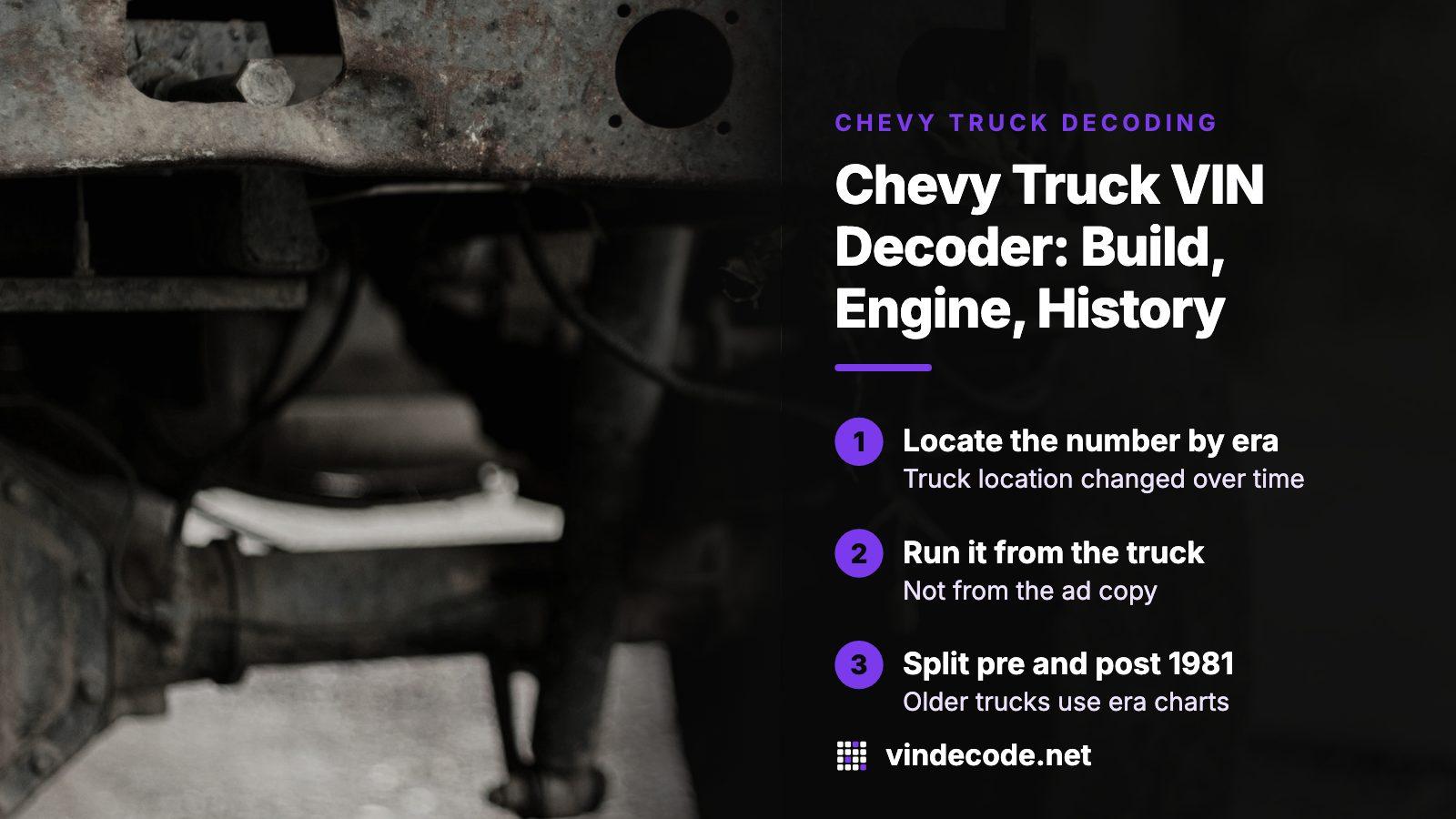
To decode a Chevy truck VIN, enter all 17 characters in the box above. A Chevrolet truck from a US plant starts 1GC, from Canada 2GC and from Mexico 3GC. Character 8 is the engine, 10 the model year and 11 the plant. Trucks built before 1981 carry shorter numbers that a decoder cannot read. The decode shows how the truck was built. Brands, accidents and mileage come from a history report on the same VIN.
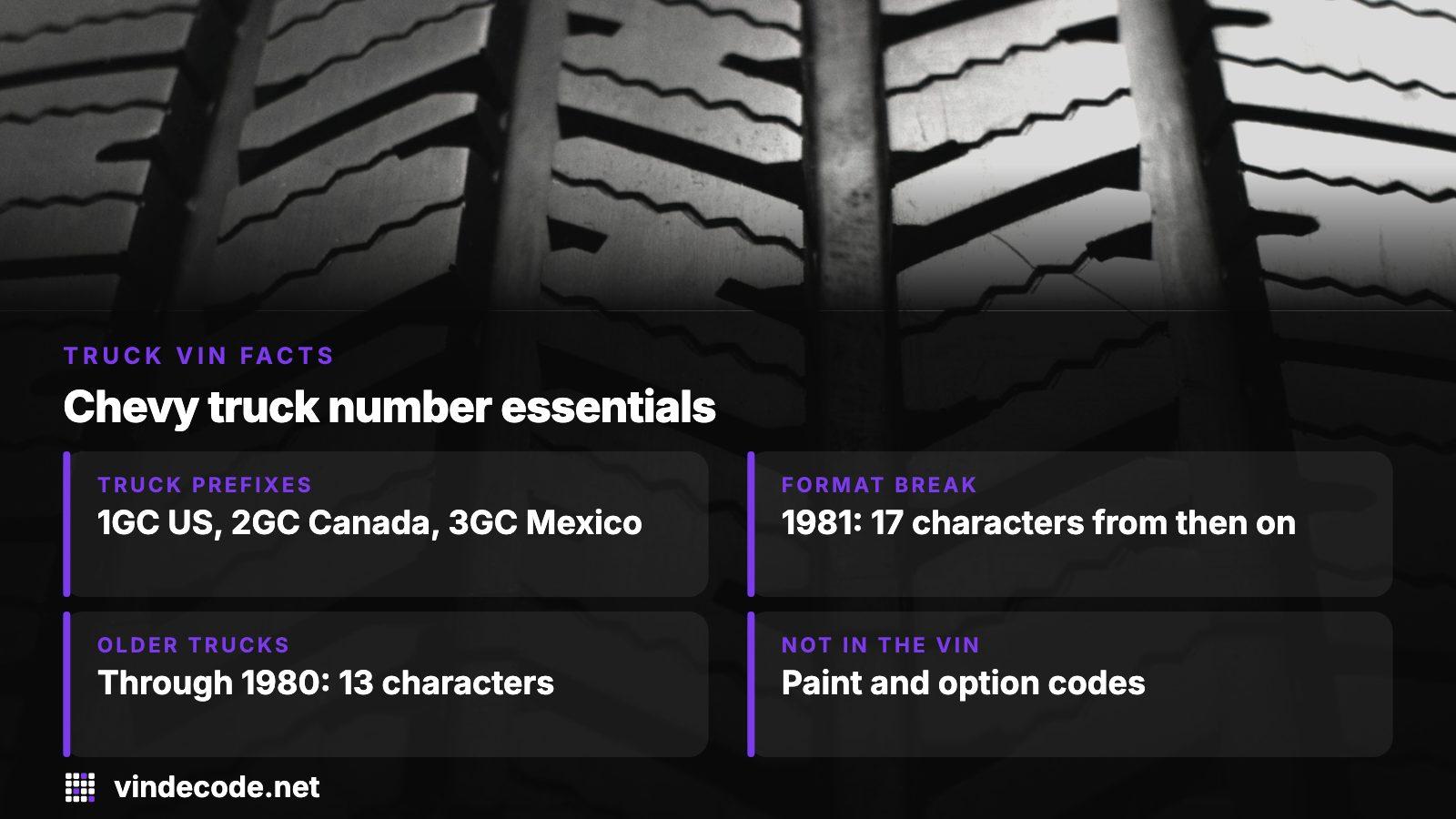
- Truck prefixes
- 1GC US, 2GC Canada, 3GC Mexico
- Format break
- 1981: 17 characters from then on
- Older trucks
- Through 1980: 13 characters, era charts
- Not in the VIN
- Paint and option codes
What the decoder reads off a Chevy truck
A Silverado badge says little by itself. Trucks of one model year differ in engine, drive, cab and weight rating, and each combination sells at its own price. The decoder matches your VIN to the factory's filing and names the build in front of you.
| Decoded field | Why it matters on a truck |
|---|---|
| Model year and series | Does the generation match the listing |
| Cab and body | Regular, extended and crew cabs carry different values |
| Engine and fuel | The powertrain to research before a drive |
| Drive and weight class | Two- or four-wheel drive, and what the axles were built to carry |
| Plant and country | Where it was assembled, which can narrow a recall |
Fields vary by model line, so one that comes back empty reflects what the maker filed, not a fault with the truck.
Finding the number on the truck, by era
Read the number off the truck itself. Recent trucks show a plate low on the dash, readable from outside, with a second label on the driver-side door pillar. Early C/K trucks use a tag on the hinge pillar or the jamb beside it, and squarebody-era trucks carry another copy on a glove-box sticker. Underneath, the top of the frame rail holds a partial stamping, and a V8 block has a partial on its pad near the passenger-side cylinder head.
- Read the dash plate from outside, then the label on the door pillar.
- Photograph both and hold them up against the title or registration.
- On a truck built before 1981, add the glove-box sticker and the frame rail.
- Type the number they all agree on into the decoder above.

Run the number from the truck, not from the ad
Listings are typed by hand, and a number lifted from a different truck is an old trick. Decode that number and you get a tidy build for a truck you are not buying, which feels reassuring and settles nothing.
From an NHTSA owner complaint
A 2019 Silverado 1500 buyer described a private sale where the VIN quoted before the sale differed from the one on the title and the truck. The mismatch surfaced in the DMV parking lot on registration day. A mechanic's history report on the title's number showed 182,041 miles, against 72,409 when it was bought, and the seller stopped answering.
Photograph the plate, door label and title yourself, and decode only a number that appears on all three.
Reading the 17 characters on a truck
| Characters | What they carry | Truck-specific note |
|---|---|---|
| 1 to 3 | Origin, builder, vehicle class | 1GC, 2GC and 3GC are Chevrolet trucks; 1GB is a chassis sold incomplete |
| 4 to 8 | Manufacturer's descriptor | Series and weight class; the engine sits in the eighth place |
| 9 | Check digit | A computed value, so a bad one means a typo or a made-up number |
| 10 | Model year | One character on a 30-year loop |
| 11 | Plant | Matters when a recall covers a single plant |
| 12 to 17 | Serial | Light trucks end in five digits, heavier ones in four |
On a light truck, the seventh character sorts the year letter into an older or newer cycle: a digit means older, a letter newer. Silverados also cross borders. Two 2020 trucks in NHTSA's complaint files begin 1GC and 3GC, so a 3 up front is no warning sign by itself.
Trucks built before 1981 decode differently
Federal rules fixed the 17-character VIN from the 1981 model year, and decoders are written for it. Through 1980, a Chevy truck wore a 13-character number: a letter for drive, a digit for the series class, a letter for the engine group, a digit for the model year, then the plant letter and a running sequence. That year digit repeats every decade, so only the format dates the truck.
- Through 1980: 13 characters, read against an era chart.
- From 1981: 17 characters with a check digit, which a decoder can attempt.
- Squarebodies, 1973 to 1987, straddle the break: a 1979 truck and a 1983 truck follow different rules.
A 1979 truck that will not decode is behaving normally. A 1983 truck that fails deserves a closer look. GM's heritage archive holds searchable factory documents by model, a better reference than a decoder for the older trucks.
Plate, paperwork and frame: when they disagree
Dash plates unbolt and door labels peel. Frame stampings and engine-pad partials are much harder to move, so the number should match wherever it shows up.
- A dash plate that differs from the door label or the title.
- A plate that is missing, or freshly riveted, without a story.
- A frame stamping ground off or painted over on a truck sold as original.
- A mismatched engine pad: routine on a work truck, costly on a collector truck.
From an NHTSA owner complaint
One 2020 Silverado owner, who bought from a dealer, told NHTSA that the VIN plate was gone from its usual place and only a small one inside the door could be found. A later history report showed 137,164 miles against 88,000 at purchase, and the buyer called the Texas Department of Motor Vehicles.
The complaint does not tie the missing plate to the mileage gap. The lesson is narrower: a missing or replaced plate needs an explanation, and the history on the surviving number tells you the rest.
What the history report adds once the build checks out
The decode describes the truck as it left the assembly line. Later events sit in other records, which the report searches under the same VIN.
| Record | Question it answers about a truck |
|---|---|
| Odometer readings | Do the entries climb steadily, or step backwards? |
| Title brands | Has it ever been branded salvage or flood? |
| Accident and damage | Where was it hit, and are there auction photos? |
| Ownership and use | Fleet, rental or commercial work, or a private truck? |
| Liens and impounds | Does a lender or tow lot still have a claim? |
| Theft and recalls | Was it reported stolen, and which safety repairs are open? |
Trucks are bought to work, so how one was used matters more than its trim level. The decode confirms the listing; the report tests the story.
What it costs, and what to run first
The preview after you enter the VIN is free and needs no card. Paying for the full report happens once: a single report, or a bundle of 3, 5 or 10, with no renewal. Amounts are on the pricing page.
- Decode the number from the truck and compare year, cab, engine and drive with the ad.
- Run that VIN through NHTSA's free recall lookup and NICB's VINCheck theft screen.
- Open the preview, then buy the report if the build adds up.
- Have a mechanic you choose check the frame rails and cab corners for rust or repair before you pay.
Where this information comes from
- NHTSA: vPIC VIN decoder — Federal database holding the manufacturer VIN filings behind the build fields and the 1GC, 2GC and 3GC truck codes.
- NHTSA: recalls lookup — Checks one VIN for open recalls, which a dealer repairs without charge to the owner.
- eCFR: 49 CFR Part 565, VIN requirements — The federal rule behind the 17-character format, the position 9 check digit, the year codes and the digit-only serial characters.
- GM Heritage: Vehicle Information Kits — GM's archive of factory documents by model, useful for trucks older than the 17-character format.
- NICB: VINCheck — Insurance-industry theft and total-loss screen, worth running on any truck whose numbers look disturbed.
- NHTSA owner complaint 11721917 — owner experience, paraphrased
- NHTSA owner complaint 11735782 — owner experience, paraphrased
Sources and photos: Facts checked against the sources above in November 2026. Photos by Zoshua Colah, Owen Michael Grech and fr0ggy5 on Unsplash; diagrams by VINDecode.
Keep reading
- Chevrolet VIN Decoder: Decode a Chevy, Then Check Its HistoryThe brand-wide decode, covering the car and SUV prefixes this truck page leaves out.
- Classic Truck VIN Decoder: What It Reads, Where It Stops, What Comes NextOlder trucks of any make, where the format of the number decides how you read it.
- GMC VIN Decoder: Read a Sierra or Yukon VIN, Then Check Its HistoryThe GMC counterpart: a Sierra shares a platform with the Silverado but not its VIN prefix.
- Sample reportA finished report, to see the odometer and title sections before you pay.
Frequently asked questions
How do I decode a Chevy truck VIN?
Copy all 17 characters off the dash plate, check them against the door pillar label, enter them in the decoder above, and compare year, engine, cab and drive with the truck. A truck built before 1981 has a shorter number, which you read against an era reference instead.
What does 1GC mean at the start of a Chevy VIN?
A Chevrolet truck built at a US plant: 1 is the country, G is General Motors and C marks a Chevrolet truck. Tahoe and Suburban SUVs begin 1GN. A leading 2 or 3 means Canada or Mexico, and Silverados appear under both 1GC and 3GC.
Will a decoder read the VIN on a pre-1981 Chevy truck?
Usually not. Decoders expect 17 characters, and trucks through 1980 use a shorter layout with different positions. Compare the plate with the glove-box sticker and the frame stamping, read it against an era chart, and save history reports for trucks with a standard number.
Is the trim or option package in a Chevy truck VIN?
Not directly. The descriptor identifies series, cab, engine and drive, while packages and paint appear as short codes on the label in the glove box. Photograph the entire label and read each code against the model year before relying on it.
Can a VIN decoder show whether a Chevy truck was wrecked?
No. A decode describes the build only. Wrecks, title brands and mileage sit in other records that a history report searches by VIN. Recalls attach to VIN ranges, so run the exact number through NHTSA's lookup; dealers repair open ones free of charge.
Now check the car itself
The guide explains what to look for. The report shows what this VIN has on record.